The Power of the Ascended Lord

Human_headed_winged_bull_facingAscension Day is a feel-good celebration of Jesus seated at God’s “right hand in the heavenly places, far above all rule and authority and power and dominion, and above every name that is named, not only in this age but also in the age to come.” If Christ is reigning like that and we are reigning with Him and sharing in Christ’s power, then we too are over everybody else just as Jesus is over everybody else. Sounds like a good deal. Or is it? Let’s take a closer look at what this power of Christ is all about.

Getting a sense of how power and especially omnipotence applies to God is tricky. After all, we dream of being omnipotent and invulnerable so we assume that the Master of the Universe wishes the same thing. Not a good assumption.

René Girard noted that power is attributed to the primordial victims of collective violence. (See Violence and the Kingdom of God) That is, the victim was powerful enough to be the cause of the social meltdown and also powerful enough to be the solution to the violence. (The reality, of course, is that such victims were normal humans with no supernatural powers.) The Gospels reveal Jesus as a vulnerable human being who clearly did not cause the social crises of first-century Jerusalem and whose death brought about no solution to it. Whatever power Jesus has, it isn’t this power. The illusion of the power of the victim should make us suspicious about how we attribute power to God.

A second and more common image of power is the imperial structure. In the days of Isaiah and other prophets, Assyria was such an image. The statues and friezes of winged bulls are symbols of this kind of power. This is the kind of power the apostles seem to have been thinking of when they asked Jesus: “Lord, is this the time when you will restore the kingdom to Israel?” (Acts 1:6) Jesus’ ascension right after hearing this question was a firm No.

When Paul says that Jesus is far above all rule and authority and power and dominion, and above every name that is named, not only in this age but also in the age to come,” he is saying that Jesus is far above and beyond all cultures that rely on sacrificial violence and the Assyrian-Roman impositions of power. That is, the power of Christ is to bring us out from these cultural practices. But are we being brought out of the world to escape these cultural entanglements? Sorry if you were hoping for that.

crosswButterfliesPaul concludes this section of Ephesians with powerful irony: “God has put all things under [Jesus’] feet and has made him the head over all things for the church, which is his body, the fullness of him who fills all in all.” Paul is using the common image of military victim where the victor lays his foot on the head of the vanquished, making the loser his footstool. But under Jesus’ foot is not the head of the vanquished but Jesus’ own Body, the Church. This is the Body of the crucified one who was raised from the dead and returned as the forgiving victim. Jesus’ reigning in Heaven at the right hand of the Father is coterminous with Jesus living with us here on earth, sharing our vulnerability to the imperial structures of power who continue to act like the Assyrians and the Romans.

If we are the Body of the forgiving victim, then forgiveness, not rulership, is what reigning with Christ is all about. This power to forgive was the gift the risen Christ breathed into the disciples (Jn. 20:23)  In John, Jesus says that it is this “Spirit of truth” who abides in us. When we keep Jesus’ words, he and the Father and the Spirit will come and dwell within us to empower us with their love for one another and for us and for all those whose sins (including our own!) need forgiving.

 

Freud’s Illusion and the Paschal Mystery

Cemetary2In December 1927, the New York Times announced that Freud had doomed religion with his book The Future of an Illusion. In The Authenticity of Faith: the Varieties and Illusions of Religious Experience, psychologist and professing Christian Richard Beck evaluates this claim. Beck points out that Freud did not debunk religion by refuting the classical proofs of God’s existence but by arguing that religion was ego-centric wishful thinking that we must outgrow. We could respond by suggesting that atheism is wishful thinking; a wish not to be accountable to God. There is that but there is much value in taking Freud’s critique seriously to see if it holds up to Christianity as it is actually lived which is what Beck does.

Beck turns to Ernest Becker to evaluate Freud’s thesis. Becker (the focus of Beck’s book Slavery to Death) argued that denial of death was a prime motivation in human behavior, leading us to seek “heroic” acts levels to stave off the reality of death, an example of what Freud called sublimation. (See Escape from the Denial of Death)  It happens that there have been many scientific studies of Becker’s thesis by his followers and they tend to show that the more one is reminded of mortality, the more rigidly one defends one’s worldview and denigrates others. This applies to any worldview, not just Christianity.

Beck then brings in the Psalms of lamentation (a large chunk of the Psalter) and the spiritual darkness that Mother Teresa admitted to as counter-indications that wishful thinking is the only dynamic in Christianity. Beck could just as easily have brought in St. John of the Cross who wrote about “the dark night of the soul.” Beck then turns to William James who pre-dated Freud in his scientific study of religious experience that was published in The Varieties of Religious Experience. James distinguished between “healthy-minded” believers and “sick souls.” The terms are misleading in that “healthy-mindedness” is superficial and leads to denial of life’s difficulties and so is not really that healthy. Meanwhile, “sick souls” wrestle with cognitive dissonance and inner darkness in a way that makes them more resilient and authentic in the long run. The Psalmist of lament, Mother Teresa and St. John of the Cross would be “sick souls.” Beck notes that the charges Freud and Becker make about wishful believers applies well to what James called the “healthy-minded” but not at all to the “sick souls.” Dietrich Bonhoeffer’s famous distinction between “cheap grace” and “costly grace” seems to fit James’ distinction quite well.

Since there had been no scientific investigations of James’ categories, Beck has filled this gap with his own field work. First, participants were given a questionnaire to give ratings as to how “healthy-minded” or “sick-souled” they were and then they were given a task such as to evaluate an essay by a Christian and one by a Buddhist. Not surprisingly, the “healthy-minded” respondents denigrated the Buddhist while the “sick souls” were much more tolerant in their attitudes. The same result came with tests on comfort with the Incarnation (such as whether one admits Jesus might have had diarrhea) or evaluating two works of art, one imaging healthy-mindedness, the other more focused on life’s pain. In each case, there was strong confirmation of James’ distinction of different believers.

It is worth mentioning René Girard’s theory of the origin of religion in collective violence in this context. Girard does not think that early humans wished for pie in the sky and then made up a religion to get it. Rather, they responded to social crises by killing or expelling a victim. The camaraderie that resulted from this act and the institutionalization of sacrifice was the payoff. (See Two Ways of Gathering) In fact, belief in a heavenly afterlife is quite a latecomer in world religion. The social solidarity of collective violence can easily be achieved these days without a deity. Freud himself made a dogma of his ideas and expelled all dissenters. In Girard’s thinking, it is the Gospel accounts of Jesus’ suffering and death that expose sacred violence for what it is. Girard’s thought adds weight to the correlation between being “healthy-minded” and prone to expelling those who differ. Beck does not say anything about the Paschal Mystery, but the cross at the center of Christianity should be enough to suggest that Christianity has its own built-in critique of wish-fulfillment in Freud’s sense or “healthy-minded” religion in James’ sense. One need only read the Epistles of Paul to see this self-critique at the origins of Christianity. I think Beck would agree since he sees a much deeper love among the “sick souls” than among the “healthy-minded” and he notes that in 1 Corinthians Paul says that love is the greatest virtue of all.

Beck’s exploration of Freud and James is of great importance for coming to grips with a theological anthropology and pointing in the direction of authentic faith and genuine spirituality.

Respect (3)

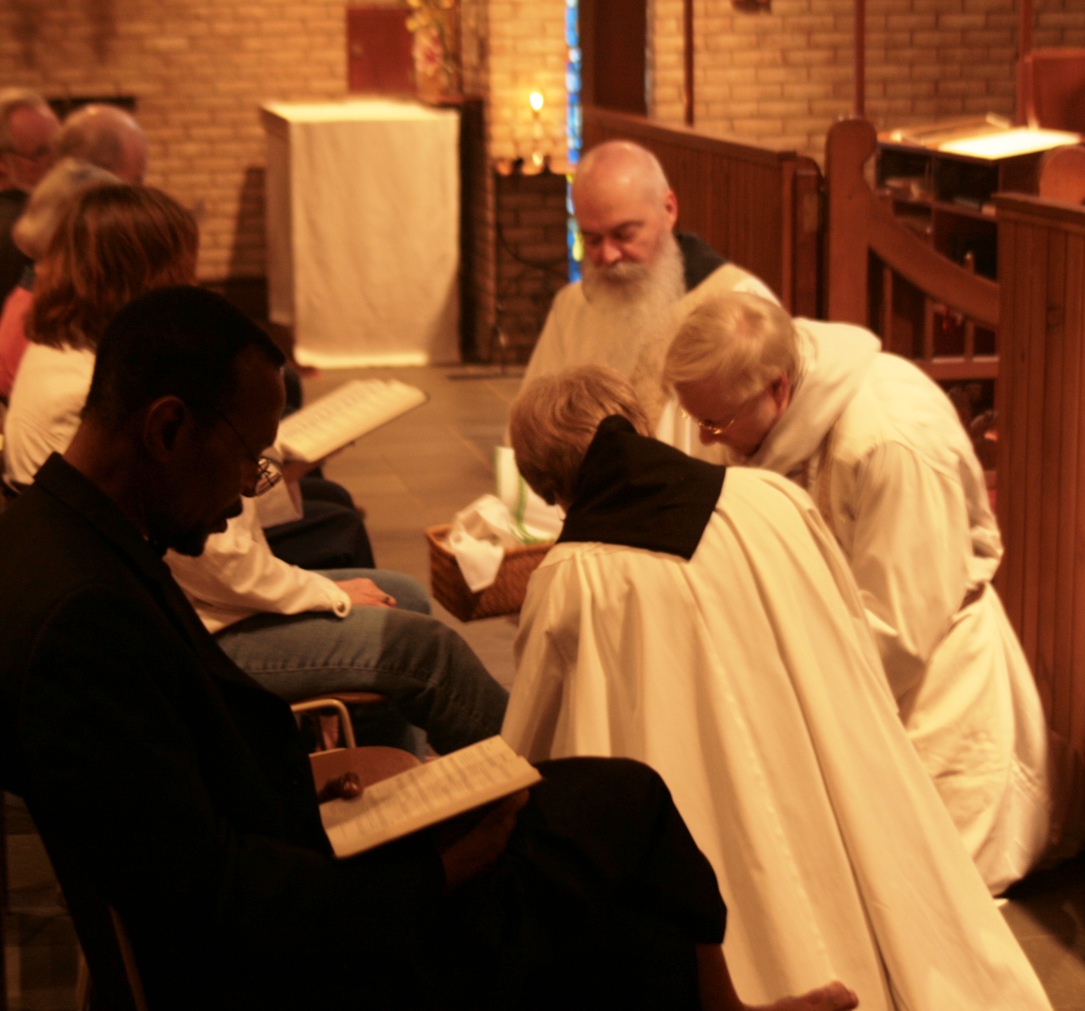
AndrewWashingFeet - CopyThe situation of the cellarer of the monastery providing for people who depend on his solicitude is quite the opposite of the person who approaches God in prayer “humbly and respectfully.” The cellarer himself would be on the other end of the stick on this one. Here is the danger of projecting worldly power on God when God is approached humbly and respectfully. If we picture God as a whimsical potentate who grants favors or withholds them in plays of power the way we do if and when we get a chance, then we slip into playing these power games with people who depend on us. This is precisely what Benedict forbids the cellarer to do. Benedict forbids such behavior because it goes against the Gospel.

St, Benedict famously insists that “all guests who present themselves are to be welcomed as Christ.” Benedict goes on to quote Matthew 25 to emphasize the point. Likewise, the cellarer, in attended to fellow monastics and guests should do the same. Benedict also says that “care of the sick must rank above and before all else, so that they may truly be served as Christ.” Once again, Benedict quotes Matthew 25. “The Lord of all things” whom we approach in prayer with our needs, who is greater than “a powerful man” from whom we might ask a favor, identifies with the humans who approach us in need.

We all have a hard time respecting people in positions subordinate to us, especially if they are needy. We instinctively look down on them because we think we are the ones with something to give or withhold. In other words, were are in the winning position and we like it that way. However, if Christ assumes the “losing” position, and Christ is the King whom we should obey, then we should be obedient to the needs of others in a respectful way. We might say that Christ makes other people respectable even if they have no respectability within themselves. The implication of this, of course, is that we also lack respectability within ourselves and it is Christ who gives us respectability.

The theological principal for saying that a person is entitled to respect just for being a human being is that we are each made in the image of God. That is true, but Christ’s identification with each person in need, and we all are in need in some ways at some times, is superadded to our creation in God’s image. This super-addition is based on Christ’s redemption of us, Christ’s having died for us. Since Christ died for everybody, Christ identifies with everybody. By identifying with each of us, Christ takes the rivalry out of the relationship. The way we relate to one another has nothing to do with winning, with having the upper hand in some way. Christ has leveled the playing field. Christ is focused on the needs of each one of us. That means Christ is focused on our own needs and also the needs of the people we encounter. It is doing what we can with another’s needs and having a kind word when we can’t. (And we often can’t fill another’s needs.) In all this, we participate in Christ’s respect for us, which makes us more respectable than we were.

Respect (2)

WilliamGuestsChurch1

[A continuation of Respect (1)]

The importance of respect can be easily seen when we think of routine encounters. Love is too freighted a term for the way we interact with, say, the person at the checkout counter of a store. It is obvious that courtesy and respect are called for but not love as it rests (and twists and turns) in the popular imagination. We all know how much we appreciate doing business with people who are respectful and how much we avoid doing business with those who aren’t. In such cases, respect isn’t much of a feeling but it is a set of actions and a manner of speaking. Although receiving respectful treatment gives us a low grade sense of well-being, disrespectful treatment tends to make us instantly angry and all sense of respect flies out the window or through the wall. Disrespect makes the smallest exchanges seem big and highly significant while we don’t think of much of respectful encounters. The thing is, both respect and disrespect are highly contagious but the latter is especially so. We tend to think we are owed respect just for being people and feel violated if we are not treated respectfully. Yet we are apt to think other people should earn our respect. This looks like a double standard but I can sympathize. This sort of attitude comes naturally to me. However, if God’s unconditional love for us is taken as a model for human relationships, it follows that we should give unconditional respect, which is harder. We can fool ourselves into thinking we only hate the sin but love the sinner, but how about respecting the sinner while hating the sin?

The chapter on the Cellarer of the monastery in the Rule of St. Benedict (Chapter 31) is the most concise and articulate view of respect and courtesy that I know. The cellarer is the monk responsible for providing for the community and guests. To do that, he needs to respect the tools and all other material goods to the extent of treating them as if they were “sacred vessels of the altar.” Here is an indication of the continuum from respect to God in prayer to respect for material reality in one’s work. The cellarer should provide “the allotted amount of food without any pride or delay lest they be led astray.” That is, the cellarer should be respectful of the needs of others and should not take advantage of his position to play petty power games with people the way some bureaucrats will with their tiny turfs. The Latin for “leading them astray” is scandalizaverit which means scandalize, place a stumbling block before the other. “Scandal” is a word imported from the Greek New Testament and is the word Jesus used when he warned against causing his “little ones” to stumble, a verse Benedict goes on to quote. Jesus and Benedict are alerting us to a human tendency that René Girard has more recently pointed to: the human tendency to make oneself a stumbling block for another by making a simple encounter a contest of wills. This is precisely what Benedict wants the cellarer to avoid. (I discuss scandal in Girard and Benedict in my book Tools for Peace.)

On the contrary, if the cellarer does not have a requested item, he should “offer a king word in reply.” When I was guestmaster for the monastery, there were times when I did not have room to accept any more guests and I kept this admonition in mind and tried to speak kindly and give encouragement for coming at another time. If the cellarer should be the one who suffers discourtesy, he should “reasonably and humbly deny the improper request.” The onus is on the cellarer to stem an escalation of disrespect by treating even a disrespectful person with respect.

Continued in Respect (3)

The Earthquake that Saves

abyssIn Matthew’s Gospel, the Resurrection of Jesus causes an earthquake. Just as an earthquake shakes up the earth, the Resurrection shakes us up, fatally undermines the way we have lived our lives, and gives us a radical reorientation. But did the Resurrection have to be an earthquake? Could it possibly have been a smooth transition from a good quality of life to a better one?

According to seismology, an earthquake is caused by one or more faults under the surface of the earth. A fault can hold its position for some time but it is inherently unstable and it will slide sometime or other and cause the earth to shake. The Resurrection could not help but cause an earthquake because there were faults in human culture just waiting to shift when the event occurred. A look at the Old Testament readings we read during the Vigil can point out where the faults were and still are.

The story of the Flood shows us what Cain’s murder of Abel led to: a society overwhelmed with violence. They did not need God to create a flood to carry them away; their own violence had overwhelmed them like a flood. The near-sacrifice of Isaac by Abraham refers to the institutionalization of sacrifice to stave off the meltdown of the Flood. The people were convinced that somebody must die in order that the people might be saved. That is what Caiaphas said to justify the execution of Jesus. Abraham thought somebody must die until an angel (messenger) of God told him otherwise. In Jesus Risen in our Midst Sandra Schneiders points out that God wanted neither Isaac nor Jesus to die, but while Abraham obeyed God, Caiaphas and Pontius Pilate decided otherwise. Pharaoh’s Egypt was a society held together through institutionalized sacrifice: the enslavement of the Hebrews. When plagues struck, Pharaoh blamed the Hebrews and drove them out. God transformed the event into a deliverance from slavery. Like the people in Noah’s time, the Egyptians were overwhelmed by their own violence. (When Jesus welcomed the children that his disciples tried to keep away, he showed for all time that God is not a child killer.) These are the fault lines that could only slip and shake the earth when the angel of the Lord “descending from heaven, came and rolled back the stone and sat on it.” The guards, representatives of the sacrificial culture, became “like dead men.” Death is what sacrificial cultures lead to.

The angel’s words “Do not be afraid” are at least as earthshaking as the earthquake. These words of peace turn us upside down and around in circles. What is the man we killed to stabilize society going to do to us now that he is out and about again? Why would he tell us not to be afraid? What is this world coming to? Two women both named Mary who live on the margin of the society of their time, a society that would not let them testify in court as witnesses, are asked to be witnesses to this momentous news, to the momentous presence of life. They run off with “fear and great joy.” Mary and Mary don’t get far before they meet up with Jesus who greets them and repeats the angel’s words: “Do not be afraid.” Jesus de-centers us once again by taking us from the center of religious and political power to that backwater Galilee where he will start a new life for us. St. Paul says of the Hebrews who were delivered from Egypt that we all “passed through the sea and all were baptized into Moses in the cloud and the sea.” (1 Cor. 10:2) When we renew our baptismal vows, we renewed our commitment to being overwhelmed by God’s deliverance from a sacrificial culture that creates fault lines to a new culture based on the forgiving victim. These words are spoken not just to the two women but to the two guards and to each one of us. Sandra Schneiders says: “In the Resurrection God gave back to us the Gift we had rejected. Can we accept the gift of peace this time around? Can we spread the news to others and, most important, to ourselves that we have been delivered from the flood waters of our violence to a new land, a new way of living where we do not need to be afraid?

Mimetic Blessing through Abraham (1): Cain and Abel

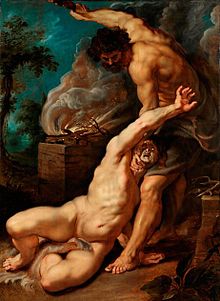
Cain_slaying_Abel,_1608-1609Fratricide is a running thread throughout Genesis. The rivalry portrayed in its stories do not involve romantic triangles as in novels and plays, but rather, the disputes are over blessings, the other running thread throughout Genesis.

In Creation God blesses humanity with all that God has created, but humanity rejects that blessing for the sake of one tree that then shrank to a barren landscape. To begin the process of re-gathering a scattered humanity after the Tower of Babel, God calls Abraham to leave his father’s house, i.e. the scattered, rivalrous civilization he was born in, and move to a land God will show him. When Abraham leaves the entanglements of mimetic rivalry behind, whole new vistas of possibilities suddenly present themselves.

God then tells Abraham:  “I will make of you a great nation, and I will bless you, and make your name great, so that you will be a blessing” and by him “all the families of the earth shall be blessed.” (Gen. 12: 1-3) We are so habituated to getting (or taking) blessings that we often fail to notice that God said Abraham would be a blessing and a blessing not just for him and his household but for all households. The intervening verse that God will curse those who curse Abraham is discordant. If God really is in the business of blessings, then God is not in the business of cursing. After all, Jesus did not curse those who cursed him and worse. However, we could say that when we curse someone who is a blessing, and through Abraham everybody is a blessing, then we are consumed by our own cursing.

We see all this already at play in the story of Cain and Abel who fight over a blessing and the supposed lack thereof. Genesis does not tell us why God accepted Abel’s sacrifice and not Cain’s. Girard’s theory of collective violence founding culture leads me to suggest that tilling the ground was a factor. There could have been mimetic rivalry among nomadic herders of sheep but tilling the ground like Cain was all the more conducive to rivalry over particular plots of land, such as Ahab’s coveting Naboth’s vineyard. The proliferation of vegetative dying and rising deities in mythology suggests that landed economy lead to mimetic crises and their resolution through collective violence. On the other hand, when we note the alleged zero sum blessings in the fratricidal strife that follows, maybe Cain jumped to the conclusion that when Abel was blessed, there could be no blessing for him.

What is decisive is that when Cain’s offering was rejected, or he thought it was, he embroiled himself with Abel, which was also to exile God. God called out to Cain, something God continues to do with violent humans to the end of time, but Cain would not let go of his preoccupation with his brother until he had killed him.

Afterwards, Abel’s blood cried from the ground. This is a marked contrast with the fratricidal myth of the founding of Rome where the blood of Remus was silent. Like Romulus, though, Cain was a founder of culture while Abel was the first prophet as defined by Jesus in Mt. 23:35, that is, a prophet is a victim. Abel’s blood seems to have cried for vengeance. The author of Hebrews, however, says that the blood of Jesus “speaks a better word than the blood of Abel.” More proof that God is in the business of blessing and not cursing.

Ignatiusly Reading

Ignatius_of_Loyola_(militant)[This is a companion post to Quixotic Reading]

Reading in a life-giving way is not primarily a matter of reading but of living; of how we read our lives. Don Quixote idolized Amadis of Gaul, Emma Bovary idolized her lovers and Werther idolized Lotte. The primary reason for the Werther effect is that readers of Goethe’s novel committed the same idolatry through mimetic desire as did Werther. If we are too embroiled in our mimetic desires to have eyes to see what Cervantes and Flaubert see, then we will only see what Goethe seems to have been able to see when he wrote Werther: the despair of desiring a woman desired by another who has made that woman unattainable. That is, the way the readers of Werther were living their lives affected their reading and their reading reinforced the way they were living their lives.

In his incisive study of Don Quixote (The Humble Story of Don Quixote; Reflections on the Birth of the Modern Novel) Cesario Bandera leads us to the heart of the Don’s problem and ours: “God-like Amadis is not God. God transcends empirical reality but does not ignore it or make it irrelevant.” The more we look at the world around us and interact respectfully with it, the less apt we are to be swept away by the fantasies of mimetic desire. God “demands an absolute act of faith beyond empirical reality, but such an act of faith does not obliterate the inherent rationality of the world ‘out there.’ The act of faith is essential only to prevent empirical reality from becoming a god unto itself, an idol.” (p.155) Bandera is alerting us to the problem of allowing our models to distort the world around us, making models like Amadis or Albert (Lotte’s husband) the lens through which we interact with the world instead of God.

Ignatius of Loyola provides an instructive contrast to Don Quixote. According to his Autobiography, Ignatius liked to read the same sorts of chivalrous romances the Don Quixote did and, while he was recovering from his battle injuries, he asked for this sort of literature, but only a life of Christ and a book of the lives of the saints was available, so he read those instead. These books changed not only what Ignatius read, but how he read. Not only did he stop to think about the things he was reading, he also stopped to think “about the things of the world that he used to think of before.” That is, Ignatius was using what he read to connect him to real life, the life God had created rather than what life looks like through the lens of an idol like Amadis. During this time of struggle and repentance, Ignatius then confesses his infatuation with the idea (not reality) of going into the service of a “certain lady,” oblivious to “how impossible it would be.”

But then Ignatius started to think about what it would be like to imitate Saint Francis or Saint Dominic who had imitated Christ? Such thoughts gave him consolation that thoughts of soldiering and chivalry did not give him. Here were models that were challenging but not impossible. Ignatius was spurred on to develop a spirituality based on the imitation of Christ, not an imitation of external actions only but, more important, of cultivating the inner disposition of Christ’s charity for others that was to become the backbone of his Spiritual Exercises. Bandera draws the contrast for us when he says that “unlike Christ, Amadis cannot give his follower what he wants without ceasing to be Amadis.” (P.157) That is, Amadis, if real, would be what Girard calls a model-obstacle whom Quixote would need to best in combat, which would change Amadis for the worse if Amadis was vanquished. Christ, on the other hand is a model without rivalry, who wishes to be imitated without rivalry. Ignatius discovered that Christ creates an abundance of charity that can only become more abundant through imitating him. The idea of imitating Jesus led to a real pilgrimage to Jerusalem and then to a real spiritual pilgrimage of imitating Christ for the rest of his life.

Quixotic Reading

Don_Quijote_and_Sancho_PanzaIt is both interesting and significant that the mimetic desire revealed in two of the novels discussed by René Girard in Deceit, Desire & the Novel are derived, not from other people, but from characters in literature.

Don Quixote famously went mad with a desire to imitate Amadis of Gaul in the medieval romances of this knight errant, while Madame Bovary’s desires were fueled by the sentimental novels she read. The literature consumed by both characters gives them distorted visions of reality. Don Quixote mistakes windmills for evil giants and a barber’s basin for a knight’s helmet. Madame Bovary sees the lovers of her life through the lens of the romance novels and fails to see them as they really are until it is too late.

Of the two, Don Quixote is much more removed from “reality” than Madame Bovary. Yet, although the novels Madame Bovary has read seem to mirror “real life” and are thus “realistic,” it is she who seems to be even more confused about “reality” than Don Quixote, to the point of being smothered by fantasy so that what self she has disappears. C.S. Lewis offers us a key insight here when he says : “Children are not deceived by fairy tales; they are often and gravely confused by school stories. Adults are not deceived by science fiction; they can be deceived by the stories in the women’s magazines.” Lewis seems a bit sexist here but the underlying point is clear enough. “Realistic” stories present models and stir up desires that seem realistic but are traps that catch the unwary reader.

Curiously, Don Quixote’s fantasies have a contagion of their own. An unnamed man accuses Don Quixote of having a “talent for making anyone who has anything to do with you mad and senseless.” It is curious that Don Quixote is blamed for the insanity of others, as the other people are arguably making themselves insane by staying on Quixote’s case to the point of obsession. In the second part of the novel, a duke and duchess spend huge amounts of time and expense to mirror Don Quixote’s desires in theatrical fakery. They themselves seem to be caught up in Quixote’s madness as much as their victim.

In both cases, there is something of a collective violence around a victim. In the case of Don Quixote, his singularity provokes a spontaneous, improvised conspiracy to bring him to his senses. In the case of Madame Bovary, the social system of mimetic desire is fully developed to the extent that both Madame Bovary and her irresponsible husband and lovers all act like puppets of the ambient fantasy fueled by the novels and the culture industry.

Novelists such as Cervantes and Flaubert are faced with the enormous challenge of revealing the truth of mimetic desire in a medium that is normally used to reflect and fuel mimetic desire. After all, it is the latter tendency that makes huge profits for the producers of this and other media. In the second part of Don Quixote Cervantes does not disguise his indignation over copycat offshoots of his work and other ersatz imitators. Perhaps the main thrust of the second part was to mirror the misunderstandings of his readers in the Duke and the Duchess.

It isn’t enough to write novels revealing mimetic desire. Also needed are readers who can truly see what these novels reveal. If Cervantes was exasperated by the readers of his time, imagine his apoplexy over a musical featuring an inspirational song about following impossible dreams. For Cervantes was showing us in his novels that successfully imitating fictional characters is truly impossible. Don Quixote could not live Amadis of Gaul’s life any more than Emma Bovary could live the lives of heroines in the novels she read. They could only live their own lives, which they failed to do.

Werther is another fictional person who was widely imitated for a time. Heartsick and overwhelmed by his mimetic desire for a woman already promised to another man, Werther kills himself. The publication of Goethe’s novella was followed by an epidemic of suicides throughout Europe. This phenomenon is still called the Werther effect. Drowning in the mimetic desire of fictional characters can be deadly.

So how do we read in a way that is life giving? The short answer is to seek life where it can be found, where Don Quixote found it at the end, in repentance. I will give a slightly longer answer in my next blog post.

Respecting All Things that God has Made

buddingTree1The Book of Common Prayer gives us an important focus for Lent by starting the collect for the Ash Wednesday Eucharist with “Almighty and everlasting God, you hate nothing you have made and forgive the sins of those who are penitent.” So often, we blame the material world for our sins and then hate what God has made which God also loves. In a sense, the material world becomes a scapegoat for our own disordered desires. If we eat too much, it isn’t really the fault of the food, though we quickly blame it for our own lack of self-control. Women, of course, have been blamed for being “tempting” as if it is their responsibility to control the desires of men while men need take no responsibility for themselves.

To complicate the picture, René Girard has demonstrated many times in his books that our desires are intertwined with the desires of others in a dense network of mutual imitation. If we become ensnared in desires for certain things or certain people because others desire them, we are in a frustrating situation and, again, it becomes convenient to blame the other people and other things for the pickle we are in.

We need to remember that God is our model for perfect love for all that God has made. That means that, unlike Zeus and many other mythological deities, God does not lust after humans but loves all humans with perfect respect. The more we respect other people and all things in the world, the more restraint we have in relation to them. So it is that when we repent and turn to God, we also turn to all things and to all people that God has made with new respect and love.

Sacrificing the Aztecs

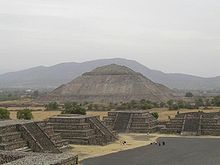
Teotihuacan9The sacrificial rites of the Aztecs at the time of their conquest give a rich example of the institutionalizing of sacrifice. The horrific quantity of children sacrificed to bring on rain with their tears, and the men whose hearts were cut out to keep the sun alive leads us to dismiss them as civilized human beings. But they were highly civilized. In the book Sacrifice and Modern thought, two stimulating articles help us understand Aztec sacrifice. Both Laura Rival and David Brown help us sympathize with the Aztecs as human beings. Rival points out that human sacrifice was modeled on the deities who threw themselves into the primordial fire to create the fifth sun and set it in motion. This myth points to a noble disposition behind the sacrifice. It is not hard, however, to see this as a typical myth that hides the collective violence that laid the foundations of their culture.

David Brown summarizes clearly the “flower wars” that were part of the sacrificial system. These wars had become as highly ritualized as the sacrifices performed on the top of the pyramids. The whole purpose of these wars was to capture sacrificial victims in fair fights. The initial chaos leading to the myths and sacrificial rites had led to a complex, highly restrained structure of warfare.

Brown quotes a moving statement by an Aztec leader who says that the Spaniards did not understand “how vital it is for us to give blood to the gods.” As selfless as the sacrifices were, and the Aztecs believed they were rewarded in the afterlife, they were convinced that if they failed to continue these sacrifices, the gods would become angry and turn away from them. Here we have it: as with so many other early cultures, the Aztecs were caught in a sacrificial system that allowed no escape. If the gods are subject to anger and capriciousness, one does not dare turn away from the only rites that had a chance of deflecting the divine wrath.

The structure and restraint of the Aztecs is a dramatic contrast to the chaotic overrunning of their country on the part of the Spanish Conquistadors. Cortes justified these measures out of repulsion at the sacrifices carried out by the conquered people, but in a cruel irony, the Spanish made a cruel holocaust of the sacrificers. A comparison with the lynching of blacks in the United States shows us the same chaotic mob violence. (See Selling Postcards of the Cross.) In The One by Whom Scandal Comes, René Girard contrasts the fundamental way Satan works in archaic cultures and in modern cultures where some awareness of the Gospel has occurred. Among the Aztecs, as with so many other peoples, Satan was the transcendent principal of order. But with Satan cast out of the sky during the ministry of the Hebrew prophet Jesus, Satan acts imminently within human cultures as a disrupter.

In my last post, I noted how killing twins became part of a package of maintaining a satanic social order. (See Twin Killings.) All twins can be thankful that this order has been dismantled. Likewise, we can be grateful that we don’t have pyramids where people’s hearts are torn out. We are free of the satanic order, but we are not free of the chaotic violence that has been unleashed on to the world unless we actively seek the freedom we gain from being grounded in the God of Love who has gathered all Aztec victims into the divine fire that fills us all with eternal life.