Principalities and Powers

WilliamGuestsChurch1Jesus was not crucified by just one person; he was crucified by a social system. The Gospels and the apostolic preaching in Acts show clearly how hostile social systems in Jerusalem came together to create a larger social system that was united solely by the agreement to put Jesus to death. By quoting from the persecution psalms, these sources suggest that persecutory social systems have always been a part of humanity. René Girard has demonstrated how mythology covers up and yet still points to this same persecutory mechanism. It is such social systems that Paul calls the “principalities and powers” of the world. These principalities get their power from the collective cohesiveness of persecution. This collective power is overwhelming to the individual within this system. Hence the transcendent power they have for Paul. However, Paul also says that the principalities and powers have been dismantled and nailed to the cross by Jesus. The forgiving victim is gathering a radically different social system that not only does not require the sacrifice of the victim but totally precludes such a thing. Paul says that if the principalities and powers had known, they would not have crucified the Lord of Glory. Because they did, we have some ability, by the grace of God, for seeing the fundamental signs of a society that is still run, at least in part, by the principalities and powers and for seeing what are the signs of the Kingdom that the Risen and Forgiving Victim has opened up for us.

A society run by the principalities and powers is punitive. Some people may think that is a good thing, but in  a punitive society, somebody must be to blame whenever anything goes wrong or even seems to go wrong. That is, somebody must be punished. When a society needs to have somebody punished, then this need takes precedence over justice. It is better for an innocent person to suffer than for the corporate rage of the society to suffer for lack of an object of that rage.  It follows that the Law of Tit for Tat reigns. There is no room for mercy. Every offense must be met in equal measure. As long as this Law reigns, there is no end in sight to the spiral of retaliation. In Jesus’ Kingdom, restoration of relationships is the corporate desire when things go wrong. The pain of this restoration might feel like punishment for some, but the pain is remedial, moving toward reconciliation.

In the society of the Principalities and Powers, somebody is always expendable. Caiaphas’ dictum that it is better that one person die than that the whole nation should perish is “gospel.” Collateral damage is an acceptable price to pay for objectives deemed good to those who are running the show. Jesus’ parable of the lost sheep that the shepherd seeks until he finds it and brings it back to the fold shows that in Jesus’ Kingdom, nobody is expendable.

The society of the Principalities and Powers is dualistic.  There has to be an “in” group and an “out” group. The society’s identity is based on what is wrong with those people, the enemy.  If we are to love our enemies, as Jesus teaches, then enemies do not define us in any way.

Most devastating of all, the society of the Principalities and Powers is mendacious. The need to cover up the truth of collective violence in primitive societies carries over to the most sophisticated of modern societies. Part of this mendacity is to blame the victim. The blame that many US politicians cast on women who are raped is a particularly grisly example. Victims of lynching, too, were blamed for what happened to them.

Here is the choice. Where is our treasure? Where is our heart?

Myth Become Fact

crosswButterfliesOne of the more memorable phrases culled from C.S. Lewis is Christ is “myth made fact.” The notion kind of sneaked up on Lewis during the process that lead to his conversion to Christianity.  An offhand remark by his friend T.D. Weldon, a fellow Oxford don and, like Lewis at the time an avowed atheist, made a deep impression on him over the years: “Rum thing, that stuff of Frazer’s about the Dying God. It almost looks as if it really happened once.” Of course, that is precisely the claim of the Gospels.

Lewis’ insight is worth comparing with René Girard’s view of Jesus in relation to mythology. Girard, of course, also studied Frazer’s writings about deities, mainly vegetative deities, dying and rising. Frazer, seems to have absorbed Jesus into the other myths, blurring the distinction between them. Girard, on the other hand, believes that both the myths and the Gospel accounts refer to real events. Here, he also differs from Lewis who seems to have thought of myths as something like cosmic poetry, dealing with timeless truths, such as the vegetative cycle in temperate climates where nature, like Persephone, dies and then rises again. For Girard, all myths, in their origins, are made fact.

Girard’s thesis of sacred violence asserts that social tensions in early societies were resolved, if they were resolved at all, by collective violence that was very real. Mythology then became something of a cover up of this event while still alluding to it. The rising from the dead in such mythology would be the deification of the victim who, in retrospect, was seen as the solution for the problem for which the victim was earlier blamed. Tying such mythology into the vegetative cycle raises suspicions for me that this development, if it did not originate in agricultural societies, was greatly furthered within them. After all, the claiming of land by a tribe would easily inspire other people to desire that land. In such a setting, social tensions leading to the victimage mechanism would happen much quicker than in hunter/gatherer societies. Girard’s thesis also suggests that the real cycle is not in nature but in human activity. That is, an act of collective violence holds a society together for only so long before it needs to happen again. The mythological cycle, then, is a vicious cycle.

For Girard, then, the Gospel narrative of Jesus dying and rising is not the historicization of a timeless truth, but an instantiation of a scenario that had been happening in reality, in time, since the dawn of humanity. What’s new about the Gospels is that the story is told straight out and the victim is claimed to be innocent and was unjustly murdered. For Girard, it isn’t so much a case of myth become fact as the truth behind myth revealed.

As a Christian, Lewis retained sympathy for the myths of dying and rising deities, regarding them as great poetry. Girard, of course, is not so affirming of mythology, as he sees it as obscuring the truth. However, Girard’s point of view does not necessarily mean that myths are bad poetry. Moral goodness and ascetic goodness are not equivalent, after all.

There is a deeper reason though for being open to Lewis’ sympathy. It was the pathos of a deity like Balder who was killed through collective violence that moved Lewis, and it was the same sensitivity that should make the passion of Jesus deeply moving as well. (Interestingly, Lewis went through a period where the dying pagan deities moved him more than the story of Christ; perhaps a residue of his resistance to conversion.) Although a myth such as that of Tiamat, who was blamed for Babylon’s primordial chaos and torn to pieces, does not try to inspire sympathy for a victim the way the Psalms of Lament do, we can see a woman victimized by the people who made a strenuous effort to avoid seeing what they were doing.

There is a deeper reason for sympathy for myth. Deplorable as the countless acts of collective violence were and continue to be, Girard’s thesis also demonstrates how profoundly people were caught up in this mechanism so that they could not escape without intervention from God. It is precisely this intervention from God to free humans in bondage that Paul celebrates time and again in his epistles. If we need this intervention from God in Christ, then we are hardly in a position to be judgmental against the first humans that fell into the same traps we do.

The Class Comedian

sideAltarsIcons1When I was in grade school, we had a class comedian. I took it for granted that there would be a boy in our class who would cut in with funny remarks that more often than not raised our teacher’s ire. It seemed normal to me that this would happen. I was glad to have a class comedian for a couple of reasons. One, he was entertaining. Since classes could be tedious at times, it was nice to have things lightened up from time to time. Two, there was a certain satisfaction in seeing one kid in our class being the one who got in trouble frequently as long as that person wasn’t me.

It so happened that the came when our comedian announced to our teacher and the class that he was moving to another school district and a few days later, he was gone. I remember consciously thinking that we would need a new class comedian and I even knew who it was going to be. I was right on both counts. The very boy I expected to move into the role did that just. (He had acted a bit the part of understudy before this.)

When I think back on all this, it becomes clear that the class comedian, although disruptive at times, was actually a nice kid. He was never mean to anybody as far as I can recall. He didn’t have much in the way of friends although I spent a little time with him. He deserved better in that respect. I knew his family was broken and that sort of thing leads to some children acting out. Much the same could be said for the boy who took over the role of comedian, although he had a bit more of an edge to his personality.

I suppose one might say my insight was a bit precocious; I really don’t know how many other kids in my class had that awareness, if any. On the other hand, any pride over this insight drops down precipitously as I admit that I consciously participated and inwardly affirmed this situation.

Like many children, I was not a stranger to scapegoating activity. I was myself the butt of scapegoating among these same children. That did not happen during class where I was very docile and obedient and rarely in danger of being on object of opprobrium from a teacher. My social adjustment as a child was not particularly smooth and it became harder when my strangeness got connected with my surname so that I was “the man from Mars.” Perhaps it made me feel better that someone else was the class scapegoat in certain respects. Maybe it made it easier for me to be docile because somebody else was acting out on my behalf.

A year or two later, there was a different scapegoat. He wasn’t a comedian or a disruptive presence. He was not as attractive as some kids. Somehow, he rubbed our teacher the wrong way and this boy never had a chance to make it right. I didn’t get the same satisfaction from this boy’s scapegoating; it was not entertaining and at some level it seemed unfair. I suppose I might have been more troubled if I didn’t happen to have a pretty good relationship with this teacher myself. I know see this favoritism as unfair and that I was overrated by this teacher, to detrimental effect in junior high where my limitations showed up. In many ways, he was a good teacher, but the pattern of there being a class scapegoat showed up with other classes he had. One of the most hurtful things that ever happened as a child was at the hands of the music teacher at our school who was also prone to scapegoating behavior. She singled me out for ridicule by showing the class a man on a flying carpet and telling the class that this was me, flying off to dreamland. Another example of a teacher being the scapegoater.

All of these reflections show how easy and insidious for a social group like a class in school, to instinctively gather unity through scapegoating one person or another. It is all the more disturbing to realize that teachers fall into the role of scapegoaters, reinforcing what the children are doing. We all need to get in touch with memories such as these to understand ourselves and to help us overcome the systemic needs that continue to haunt us

Unwrapping the Future

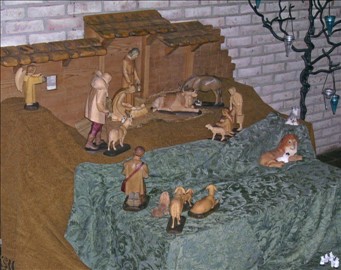
crecheThe yearly cycle of celebrations and commemorations adds solidarity to our experience of time. Christmas, a holiday especially laden with traditions, is a particularly strong anchor, assuring us that everything is as it should be for all eternity. Amen.

One of the traditions of Christmas, however, is the giving of charity. That is a very good thing, considering the needs for generosity, and it helps that once a year, people have a custom of dwelling on such matters. But the need for such charitable giving suggests that not everything is as it should be. If huge efforts by charitable organizations have to be made to assure that no child is deprived of a Christmas, then obviously there are serious social problems that need to be addressed. That is, this cozy traditional holiday poses a challenge for the future.

Manger scenes with the new-born Jesus lying in the straw tug the hearts of many and have been a focus of devotion since St. Francis of Assisi introduced the custom in the twelfth century.  But the whole point of this nativity story is that Jesus was born in the stable because nobody had room for his mother, father, and himself. This is not business as usual. It raises the question: do we really have room for Jesus in our lives? Do we really have room for all the children being born and for their families?

The angel announced to the shepherds proclaimed that this newborn child was the savior, the Lord who was going to usher in a new era of peace. That may sound innocent when we hear this read in church today, but at the time, the Caesar thought he was the savior and he didn’t have room for somebody else to do his job! Of course, he was a savior and keeper of the peace his way, with military and cultural might. The story of the shepherds, then, challenges us to consider who really is our savior and the model of peace for us. Do we keep peace the imperial way though violence to keep everybody in line? We don’t have to have imperial armies to take this approach. All it takes is a drive to control people, by force if necessary. Or do we follow peace Jesus’ way, through vulnerability as a newborn child all the way to the cross and then the Resurrection where Jesus creates peace through forgiveness.

A major cog in the engine of Caesar’s peace in Jesus’ neck of the woods was King Herod. Killing all the baby boys in Bethlehem may not look like a peaceful action, but Herod was keeping the peace, imperial style. Most of us may think Herod a bit extreme, but if we are willing to sacrifice anybody who seems to threaten our control of life, especially the young, we are going the way of Herod, the way of Caesar. Jesus, although he had the power to send legions of angels against Herod, remained vulnerable, dependent on human protection until the time came to suffer the fate the boys of Bethlehem suffered.

All of this may be a downer for a joyful holiday, but the good news is that Christmas is a yearly wakeup call for renewal of life, a renewal fueled by the divine energy of a human child born over two thousand years ago. Everything that was wrong with the world at the time is wrong with the world now and a lot more. We can keep on going in circles if we want, but we have the chance to step off the not-so-merry-go-round and embrace the Christ Child. We will find that the Christ Child has a gift for us. If we dare to open it up, it is a gift for an open future that we can have if we really want it.

See also, Celebrating the Prince of Peace and The Word Became Vulnerable Flesh

Whose Axe? Whose Winnowing Fork?

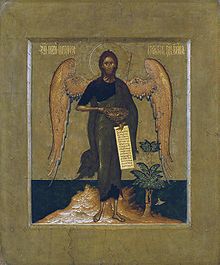
220px-John_the_Baptist_Prokopiy_ChirinAfter centuries without a prophet, a wave of expectation flooded Judea and Galilee. A man dressed the way Elijah was dressed rode this wave and pushed it along with his boisterous preaching. “Repent, for the Kingdom of Heaven is near.” What sort of kingdom did he expect? The call to repent tells us only that we must turn from the direction we are going and move into a different direction. Question the ways we live and look for a different direction.

Two astounding prophecies by Isaiah offer us intriguing, inspiring, but puzzling hints about what the Kingdom might be when he urged us to turn “swords into plowshares” and “spears into pruning hooks” so that we “study war no more” as the spiritual says and that “the wolf shall live with the lamb.” So, now we have all of creation at peace? Not quite. Isaiah tells us that the “shoot from the stump of Jesse” will “smite the earth with the rod of his mouth, and with the breath of his lips he shall slay the wicked.” Apparently taming lions and tigers and bears is easier than taming predatory humans. In calling the Pharisees and Sadducees, “that brood of vipers,” and asking who told them to flee the “wrath to come” while an ax was “laid at the trees” and his successor would have “a winnowing fork in his hand” suggests that they were not as tamable as predatory animals. The predatory lenders of today seem just as untamable. However, surely the kingdom of Heaven was not wrath of this sort, even if John, like the prophets before him, thought such wrath might clear the way for Heaven’s Kingdom.

As soon as he is baptized by John, Jesus cries out precisely the same words: “Repent, for the Kingdom of Heaven is near.” By saying these same words, is he perhaps telling us that John the Baptist, of whom there is none greater born of woman, hasn’t quite set the right direction either. His baptism has taken him on a very different track: the Paschal Mystery. That may seem a bit anachronistic, but from the preaching the Sermon on the Mount on, Jesus takes the direction of absorbing violence rather than inflicting it. Not only does the Kingdom not consist of threshing out the bad guys with a winnowing fork and burning them, but such threshing doesn’t even pave the way to the kingdom. If anything, this violence only blocks the way for everybody as, in our righteous indignation against predatory lenders and their ilk, the axes and fires for burning chaff multiply. One might argue that Jesus himself had some choice words for the Sadducees and Pharisees. However, Jesus called them whitewashed tombs filled with people’s man’s bones. Jesus wasn’t chopping off their heads or burning them up; he was warning them about how dead they were. If Jesus isn’t a thunder deity carrying a battle axe, whose axe is laid to the tree?

In his lectionary commentary, Paul Nuechterlein provocatively suggests that the axe is wielded by us. It isn’t God but we who are chopping down trees all over the world. That is indeed what happened on Mount Calvary. Moreover, according to Isaiah, it is from the stump that new life emerged. So, whose wrath should we flee? Ours. What should we run to? How about the chopped stump from which the new Tree of Life is growing?

Eucharist (3): Discerning the Body

eucharist1St. Paul solemnizes his recounting of Jesus’ breaking bread and passing the cup of wine by saying that he is passing on to the Corinthians what he had received from the Lord. The words Paul uses here are specialized terms for receiving and passing on a sacred tradition. The only other time Paul uses these terms is to testify to Jesus’ Resurrection appearances. Resurrection and eating and drinking to “proclaim the Lord’s death until he comes” go together. After all, does not the Lord come every time we eat the bread and drink the wine?

These solemn words are an island of peace and tranquility in the middle of a storm of human passions amounting to farce. Preceding them is Paul’s denunciation of the insensitive and chaotic eating habits where some people bring opulent meals to church and eat in front of poorer members who have little or nothing to eat. The deterioration of the sharing in the wilderness that began in John’s Gospel has only gotten worse. After holding up Jesus’ shared meal as a model, Paul warns against eating and drinking judgment by “not discerning the body.” Paul may be warning us not to fail to discern Christ’s body in the bread, but he is not thinking in individualistic terms. Christ’s body surely refers to the church and, given the context, Paul is concerned with failure to recognize this corporate body in the way we share, or fail to share what we have with the community. In his fit of tempter, Paul seems to suggest that the Body and Blood of Christ make people sick cause some to die. But considering how strongly Paul insists on God’s freed Gift of grace, Christ Body and Blood can only be more free grace and forgiveness. However, when we fail to see the Body and Blood in Christ in others, sickness, hunger and many more social ills will abound.

With a church in shambles, is the miracle of the Feeding in the Wilderness a distant memory? I noted in the first article in this series that memory is not just recalling something in our heads. Memory is making present. When we eat the death of Jesus, we enter into our own discord that tears the Body apart with cries such as “I am of Cephas!” “I am of Apollos!”  When we eat the Resurrection of Jesus, we eat the forgiveness with which Jesus greeted is disciples to gather them back together. We also eat the feeding in the wilderness and Jesus’ Desire to heal the people brought to him.

We are not left as orphans who have to try to stuff some ideal of human relating into our heads. We are invited to act with others the human drama of entering into God’s Desire for ourselves and all others. Most important, we are fed with the substance of God’s desire to quicken us on the way.

 Eucharist (1): Christ our Passover

Eucharist (2): Feeding in the Desert

Baptism: Overwhelmed by Christ’s Love (2)

lakeGray1Two dramatic events from the Hebrew Bible have been interpreted as prefiguring baptism are the Flood and the deliverance at the Red Sea. Both are deliverances from highly dysfunctional societies.

Genesis 6 portrays human society as consumed with violence. No wonder if everybody was like Lamech and inflicting seventy-seven-fold vengeance on anybody whom he thought had wronged him. In his second epistle, believed by many scholars to be a baptismal homily, Peter says that the deliverance of Noah and his family corresponds to baptism which saves us now through the Resurrection of Jesus Christ. (1 Pet. 3:21) René Girard has suggested that a flood is an apt image for a society overwhelmed with retaliatory violence. In such a scenario, a man who tried not to be a part of this violence would be an obvious choice of a victim to unite the fragmented society. The Christological interpretation in Peter’s epistle suggests by being baptized into Christ’s death, we are brought out of society consumed with violence and given the chance to begin life anew, the chance that Noah and his family had after the flood waters receded. It is worth noting that when referring to Jesus descending into hell (Sheol), Peter does not say Jesus just brought out righteous people like Abraham but that he preached to the very people who had brought humankind to the boiling point while Noah was building his ark.

St. Paul says that we all “passed through the sea and all were baptized into Moses in the cloud and the sea.” (1 Cor. 10:2) Once again we have an overwhelming flood. Moreover, we have a story of a people delivered from a violent and oppressive society. In his book Jesus: the forgiving Victim, James Alison suggests that the Jews were expelled after being blamed for the plagues scourging the country. If the Jews were expelled, why would the Egyptians runs after them to bring them back? Perhaps they realized they would implode without the victims who were deemed responsible for their turmoil. This is what seems to have happened with the Gerasenes when their demoniac was cured by Jesus. One could take the tug-of-war between Moses and Pharaoh as indicating this same tension. (See Dispossessing a Town Possessed) Being overwhelmed by the waters is, again, an apt image of a society succumbing to its own violence once the scapegoats are gone.

Unfortunately, neither new chance at a new life went well. Noah’s drunkenness and rivalry among the brothers that made Ham a scapegoat set humanity on a course where the curse laid on him was used to justify slavery and lynching. The people delivered at the Red Sea suffered from chronic social unrest, leading to Moses raising the bronze serpent in the desert to stop the plague of violence. Likewise, the church continues to fall back into the same rivalry and persecution. Most lynchers, unfortunately, were Christians. A tendency to see baptism as deliverance from personal sin surely reinforces such backsliding. Baptism is not a magical deliverance from personal sin but is a constant invitation to be reborn into the new social life of God’s kingdom centered on the forgiving victim who, like the bronze serpent, was raised up to draw all people to himself.

Baptism: Overwhelmed by Christ’s Love (3)

Baptism: Overwhelmed by Christ’s Love (1)

Baptism: Overwhelmed by Christ’s Love (1)

lakeGray1“We were buried therefore with him [Jesus] by baptism into death, so that as Christ was raised from the dead by the glory of the Father, we too might walk in newness of life.”  Rom. 6:4

If baptism is our initiation into Christ, our entry into the Paschal Mystery, then baptism is the underlying, ongoing dynamic of our lives in Christ. Dying and rising with Christ is something we need to do every day. The Greek word baptismo means to be overwhelmed, inundated. In baptism we are overwhelmed by and inundated with the Paschal Mystery. I will explore this mystery by looking at a few key scripture passages that give us variations on this one theme.

Jesus himself was baptized in the River Jordan by John the Baptist. For John, it was a baptism of repentance from the violent society of his time, to prepare for God’s winnowing fork in “the wrath to come.” But when Jesus comes, he does not bring a winnowing fork; he only brings himself and asks to be baptized. As he is baptized, the heavens open, the Spirit descends, and a voice from heaven says “This is my beloved Son with whom I am well pleased.”

These words refer to two key verses in the Hebrew Bible that tell us what baptism is all about. These words ring out in Psalm 2, addressed to the king, the Messiah, who is being singled out from the nations that are raging together and rising up against the Lord and his anointed. The inundation of baptism draws Jesus out of the inundation of the nations raging with each other. In Jesus, we too are drawn out of this inundation in the sense of being freed from raging against everybody else. We are not freed from being the target of these raging nations when they unite against the one who has been freed from their wrath. These same words also refer to Isaiah 42:1, the first line of the first song of the Servant of Yahweh. Throughout these songs, we find that the servant has been called out of a violent society and becomes the victim of that society’s violence. Unlike the psalmist who threatens the raging nations with a rod of iron, the Servant does not retaliate in any way against the violence inflicted on him. In baptism, we too are overwhelmed by the Servant’s suffering but then we are overwhelmed by the Servant’s vindication by God.

John’s Gospel does not narrate the baptism of Jesus but, as in so many other instances, John shows us the underlying story in a different key. When Nicodemus approaches Jesus by night, Jesus tells him that one cannot see the kingdom of God without being “born anew,” born “from above” by water and the Holy Spirit. Jesus seems only to compound Nicodemus’ puzzlement (and ours!) by suddenly shifting to Moses raising the bronze serpent in the wilderness. However, the bronze serpent was raised during a social crisis in the form of a plague. (Both the disease and the violence against Moses were contagious.) The phrase “lifted up” refers to Jesus being raised on the cross and then being raised from the dead. The bronze serpent, then, becomes an image of Jesus being raised on the cross to draw all people out of the society overwhelmed by violence into a new society as free of the violence as Jesus is himself.

This is the context of the famous words that follow: “For God so loved the world that he gave his only Son, that whoever believes in him should not perish but have eternal life.” If God so loves the world, then God is not bringing a winnowing fork or a rod of iron, but is bringing only himself, wounds from the cross and all, to lift all of us out of the world’s overwhelming violence to overwhelm us with his love.

See Part 2

Jesus Explodes with Life: His Reply to the Sadducees

buddingTree1When the Sadducees approach Jesus in the temple with their question ridiculing resurrection from the dead, they are part of the collective violence surrounding Jesus. This is not a polite debate to entertain viewers on evening TV. The Pharisees have just asked their question to entrap Jesus and triangled in the Roman authorities to boot. Groups of people who normally hate each other but have united against Jesus.

Their question zeroes in on the practice of Levirate marriage, where the younger brother of a man who dies childless marries his brother’s widow. This practice presupposes that one is dead when one dies and that immortality is gained only through one’s offspring. Even this ploy fails in this case as all seven brothers die childless after having married this poor widow. No immortality there. Jesus is trapped. Or is he?

Jesus reply, referring to the words spoken by God through the burning bush, is universally admired for its clever exegesis of a text from Torah that the Sadducees would have to accept as authoritative. But there is much more here than declaring that God is a God of the living. In Raising Abel James Alison explodes this reply by saying that the power of God which the Sadducees do not understand “is that of being completely and entirely alive, living without any reference to death. There is no death in God. God has nothing to do with death, and for that reason facts which are obvious to us, like Abraham, Isaac and Jacob having been long dead at the time of Moses, simply do not exist for God. Let’s put this another way: for us ‘being alive’ means ‘not being dead;’ it’s a reality which is circumscribed by its opposite. For God this is simply not the case. For God being alive has nothing to do with death, and cannot even be contrasted with death.”

These words pack a wallop that throws us through at least seven spheres of being teeming with life. Alison is surely not suggesting that Abraham, Isaac and Jacob are counting the days off their celestial calendar! This is about quality of life, eternal life as Jesus means it in John’s Gospel.

Let us revisit the question with these stirring words in mind. There is a second way that marriage is used as a way to defeat death besides having offspring. Marriage is a means of restraining mimetic rivalry by placing the partner off limits to all others. Otherwise, everybody might kill everybody fighting over sexual partners. In the context of seven brothers, this is especially important and incest laws add extra restraint on the brothers of the bride who might be especially presupposed to rivalry. The premature death of the older brother changes the picture and suddenly the wife goes to the next brother in line. This is not a good way to win a game of mimetic rivalry, however, as the offspring still belongs to the older, the dead brother and not to the younger brother who is still alive. The Sadducees’ hypothetical case adds to the mockery by imagining that the seven brothers meet up with this poor widow in the resurrection and fight over her like dogs fighting over a bone, presumably with no end in sight. (The widow doesn’t matter much in this scheme of things.)

Jesus explodes all this by saying that there is no marrying or giving of marriage in Heaven. There is no bride to fight over after all. There is no longer anything whatever to fight over. Just try to imagine life without having something to fight about! The image of Jesus as the Bridegroom and the Church (that’s all of us) as the bride suggests that the intimacy of marriage is a good shared by all without need of restraints of any kind. Like the Sadducees, we are profoundly mistaken about the power of God as long as we cling to the rivalries of the seven brothers.

Mimetic Laughter

outsideSupper1Laughter is one of the more pleasant things in life, but is it just a frill? In his book The Phantom of the Ego,” Nidesh Lawtoo discusses the importance Georges Bataille attached to laughter for the emerging consciousness of a newborn child. Laughter is one of the first things a baby learns in imitation of a mother, father, or other caregiver. So it is that laughter comprises the first bond a newborn child makes. Interactions with babies may seem silly, something to be transcended with intellectual maturity and so we don’t value laughing with babies.

At its best, laughter is spontaneous and infectious. How many times do we laugh without knowing why, just because other people are laughing? When children are laughing helplessly as part of playing, happiness spreads to everyone around them. We don’t want to be left out of the joke, even if we don’t know what it is. Just think of some of our best times when we laughed with family and friends with no other reason than we were together and we got caught up in laughter.

There is a darker side to laughter, however. Actually it is a darker side of us and our mimetic desires, rather than a darker side of laughter. Often laughter is used to wound others, to score points against others, to put others down to lift ourselves up. Almost as soon as they learn how to speak, small children use laughter in this way. School playgrounds are filled with this sort of thing. Children learn all this from their elders, of course. Just as they imitated the spontaneous laughter of those around them as infants, they imitate the cruel humor that surrounds them as they grow older. Unfortunately, children usually learn this mode of laughter through being shamed by adults who think ridicule is a good way to train children for the hard knocks of life. Laughter continues to be a bond between people, but it is a bonding at the expense of someone, a butt of jokes, a victim.

When he discourages laughter as a sign of pride, St. Benedict certainly had this darker side of laughter in mind, although it is possible that he had a blind spot for the value of spontaneous, bonding laughter. Certainly, when laughter is a put-on act to gain attention, it is the opposite of spontaneous and it is a prideful act, an act seeking to dominate by drawing attention to oneself at the expense of others. I discuss this at length in my book Tools for Peace.

We get so habituated to using laughter as a weapon instead of a bond of love that we hardly know what the latter is. One way back is to use the wit we acquire to learn to laugh at ourselves and help others laugh at themselves. At its best, a comedy does just that. In Mozart’s “The Marriage of Figaro,” discussed in an earlier post, laughter is used as a means to overcome mimetic triangles and tensions and bring reconciliation. Shakespeare does this sort of thing masterly in comedies such as “Twelfth Night” and “As You like It.” In “The Merchant of Venice,” Shakespeare sets a trap for the unwary, leading us into joining the persecution of Shylock before unmasking this derisory laughter for what it is.

Life is too serious and awesome a thing to be left to sourpusses who always want to be on top of somebody else. We all need heavy doses of spontaneous, selfless laughter shared with others.