The Five Kinds of Prayer 1: Petitionary Prayer

FrJudeInChoir - CopySimply put: prayer is the meeting of our desires with God’s Desire.  Although God meets us with an infinitely simple Desire, we are not simple. That is why more than one approach to God is necessary for us.  There are five fundamental ways of prayer which Church tradition teaches, ways that give us a deeper immersion of our desires into God’s Desire. My professor of ascetical theology, Donald Parsons said that just as we need a balanced diet in our eating habits, we need a balanced diet of prayer. The five kinds of prayer give us this balanced diet.

I. Petition.

Petitionary prayer is about asking God to give us something for ourselves.  This is often considered the lowest form of prayer because it is considered selfish. Why should I want anything for me, myself and I? Well, God wants to give gifts to those of us who knock for the door to be opened. For that matter, God wants to give us gifts even when we don’t knock at all.

The thing is, we are filled with what James Alison calls our “smelly” desires whether we like it or not because we are made that way by God. Since we have these desires, we have to do something with them. Renouncing them is one of the things we can do, but we aren’t renouncing anything if we don’t know what we are renouncing.

The importance of petitionary prayer is that we bring our desires to God. In so doing, we increase our awareness of what these desires are, those that are smelly, those that smell like roses, and those that really stink. We may not like having our stinkier desires but we all have them and if we don’t become aware of them, they will rule our lives without our knowing it.  Of course, bringing our desires to God is tricky because we don’t always know what we want. What we think we want does not always turn out to be what we really wanted as all of us have found out many times when we did get what we wanted.

Knowing our desires is further complicated by mimetic desire, our tendency to desire through the desires of others. As we notice how our desires are entwined with those of others, we also become more aware of their rivalrous elements. For example, if we pray for our favorite baseball team to win the championship, we quickly realize that God is not going to play favorites and the best and/or luckiest team is going to win. That is, God’s Desire is not for one team or the other win but for everybody to enjoy the game no matter who wins and who loses. If we can’t enjoy a game when we lose, that’s our problem. The same applies to more serious issues in life such as personal relationships, especially those of a romantic nature. As we bring petitionary prayers of this sort to God, we find at the base of God’s Desire a will toward freedom. This is the freedom for the baseball to bounce the way it chooses and the freedom for people to react to us as they choose. It is often said that God answers a prayer with “No” and that can be the case, but not necessarily. Since God gives the rest of the world the same freedom God gives us, not everything is going to pan out the way God’s Desire might have it. The bombs dropping all over the world in spite of all our prayers that they cease are clear evidence of that.

Avoiding petitionary prayer for fear of being greedy may prove a greater danger than asking for the wrong things.  It could mean we give less import­ance to our­selves than God does.  If we think we are beyond caring about what we get in life, it is all the more important to search our hearts.  Chances are we are hoping for many things, but are denying these very hopes and then congratulating ourselves on our detachment.  More serious, we may be depending on ourselves for getting things in life, and not depending on God.

If we bring our desires to God in prayer, and let God sort them out, we gain some freedom from these desires.  God gives us a handle to make freer choices as to what we really want and how they can more constructively interact with the desires of others.  We might start out asking for a DVD Player and end up asking for help with a deeper need. That is, God educates us in learning to live with our desires when we bring ourselves close to God’s Desire in prayer. Far from being self-centered, petitionary prayer brings us out of the closed world of our natural desires and the even more tightly closed world of our rivalrous desires into the open Desires of God.

Continue to The Five Kinds of Prayer (2): Intercession
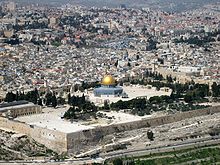
Jerusalem, Jerusalem

Jerusalem“Jerusalem, Jerusalem´ was the outcry of Jeremiah in his Lamentations, and of Jesus when he was rejected by the leadership in in the holy city. James Carroll’s searingly excellent book of this title is an extension of this outcry with historical, theological and spiritual depth.

This book is not so much a history of Jerusalem as a history of the idea of Jerusalem, the Jerusalem of the imagination. The history of the city itself, of course is deeply affected by the ideas and imagination projected on it, almost always to its detriment. Jerusalem is an image of the ideal, the perfect city and yet this great ideal has shed more blood than could fill an ocean and at the present day the ideal threatens the survival of humanity and the planet we live on. How can this be?

Carroll finds the groundwork for an answer to this troubling question in the thought of René Girard. The anthropological insights into mimetic desire and the resulting rivalry often arising from it is most apt a framework for working through the troubled history of the city on the hill. Carroll’s introduction of Girard’s thought is concise, pointed, and highly insightful even for those familiar with Girard’s thought. (See Violence and the Kingdom of God.)

The sacrifice of Isaac, imagined to have been nearly committed on the rock where the temple was later built, is another underlying motif of the book and is a powerful illustration of how God’ revelation of peace and love gets twisted towards violence. A story that almost certainly was intended to reveal the wrongness of human sacrifice got twisted to praising the obedience of Abraham being willing to sacrifice his son which then lead humanity to be willing to sacrifice its children, not just “half the seed of Europe” but at least half the seed of the whole world, “one by one” in the words of Wilfred Owen’s powerful poem on this story. (See Abraham out on Highway 61.)

The Jerusalem of the imagination is narrated through the Jewish establishment of the city as the capital of Judah, a city that became loved when it was lost during the Babylonian exile. It is the city where Jesus ended his preaching ministry and died under the Roman authorities. It is the city the first Moslems wanted because of their share in the tradition of Abraham and the prophets. It is the city that swirled through the Christian imagination, spurring a virulent anti-Semitism that reached its climax in the Shoah. Jerusalem inspired the crusading ideal that lead millions of soldiers and civilians to their deaths. The Battle Hymn of the Republic powerfully sings this violent ideal of the crusade in its purple poetry and Hubert Parry’s noble hymn tune gives force to the ideal of conquering the holy city anew.

It is not possible to do justice to the scope and depth of this book. Anyone interested in religious studies, theology, history, human culture and almost anything else would do well to give the reading of this book a high priority and to read it slowly, carefully and thoughtfully. I do not agree with quite every detail in Carroll’s analysis. Some of his interpretations of the New Testament seem to confuse the content with its reception history, although his analyses of the reception history is fully accurate. The overall thrust is highly compelling and will give every reader, whether Jewish, Christian, Moslem, atheist, or anything else a stiff challenge to one’s thinking, imagination, and relationship to violence, most especially supposedly “noble,” “redemptive” violence.

Jesus the Rejected Cornerstone among the Weeds

field1Jesus’ parable of the wheat and the weeds inflicts on us the discomfort of being told that we have to put up with the people we don’t like but the end of the parable and the explanation of it afterwards give us the comfort of knowing that the people we don’t like will get it in the end. But does Jesus really mean to give us this “comfort?”

When we consider the workings of mimetic desire, the image of a field densely filled with plants intertwined with each other is easily seen as an image of our entanglement with the desires of other people, some of whose desires we covet, others we try to separate ourselves from. Of course, each person who wants something we want and we don’t think it can be shared, is an enemy, a weed who should be pulled out, expelled from the garden. In such a situation, each of us is prone to considering ourselves to be one of the intended, desirable plants while the others are weeds. Of course, when we are preoccupied with how “weedy” everybody else is, we are totally wrapped up with them in our hostility. It is easy, then, to understand this parable as teaching us to mind our own business and not worry about everybody else. The trouble with this interpretation is that we are all in the thick of this garden whether we like it or not and we need to find a constructive way to live with everybody else in it. A deeper interpretation that is often offered, and one I have much sympathy with, is that we should commend everybody else to God and let God deal with them. To make this work, we have to commend ourselves to God as well, or we think we are commending those bad guys to God but we are good guys who can take care of ourselves. Moreover, the word for “letting” the weeds grow is aphete, which also is used in the New Testament to mean “forgive.”

If we give this parable a Christological interpretation, everything looks different. In being the stone rejected by the builders, Jesus was a weed. That’s the way Caiaphas and Pontius Pilate and Herod saw him. Jesus identified himself with a lot of “weeds” on the way to the cross such as the woman with a bad name in town who washed his feet at Simon the Leper’s house and the tax collectors Zacchaeus and Matthew. Every planter knows that it can be difficult to tell an intended plant from a weed. This is why well-intentioned but uninformed “helpers” are the bane of gardeners. If we try to weed out the garden based on our own judgment, we are likely to weed out Jesus himself.

The explanation of the parable seems to be at cross-purposes with the parable itself. Many scholars absolve Jesus of having ever given it, relegating the explanation to a later redactor to the text finalized in Matthew, as Simon Joseph argues with such vengeful texts in The Nonviolent Messiah. Or, we can argue that Jesus was giving us a parody of what an obtuse listener who lacks ears to hear takes away from the parable, as Paul Nuechterlein suggests on his site Girardian Reflections on the Lectionary. The trouble is, self-righteousness takes us to such extremes that it is impossible to parody. Let’s take a look at where the “explanation” takes us. First, we become preoccupied with weeding out the undesirable plants. Second, we identify with the angels who weed the garden. Third we think we shine in righteousness that blinds us to our self-righteousness. That is, we play the role of God, which is idolatry. The end result is weeping and wailing and gnashing of teeth for everybody and no harvest for anybody.

If we look forward to harvesting as opposed to weeding, we get a totally different scenario that fits well with the parable itself. When it comes to harvesting, weeds just don’t matter. The only thing that does matter is picking the fruits and bringing them in so they can offer sustenance to others. When it’s all about harvesting, things start to look a lot like the heavenly banquet that all of us can share without worrying about who is wheat and who is a weed.

Humility (1)

garden1Humility tends to evoke images of groveling before potentates, as when Anna was ordered to bow before the King of Siam. Such popular images project human images on God that have nothing to do with Jesus who was more interested in finding the lost sheep of Israel than having anybody bow down to him.

The first and most fundamental step of humility for St. Benedict is that we keep “the fear of God always before [our] eyes and never forget it.” That is, before humility is anything else, humility is living in the presence of God. This is indeed something very different from groveling in the dust. This step reminds us of our constant need for God and also of God’s sustained presence in our lives. It is precisely in our desires that our need for others shows itself. We often think of needing others to fulfill our desires but it is really more a case of needing others to desire at all as René Girard has demonstrated. (See Human See, human want) We tend to deny our need for the desires of others and to claim these desires for ourselves, which is an act of serious pride. Humility involves, then, accepting the interaction of our desires with the desires of others and accepting our mutual need of each other’s desires. But as this first step of humility teaches us, we most need to be in tune with our need for God’s Desire.

We tend to forget not only God’s presence but, even more seriously, God’s Desire when we are immersed in the desires of other people. Our involvement with the desires of other people tends to become rivalrous, which draws us further from God’s Desire. The more we are grounded in God’s Desire and never forget it, the more constructive we are apt to be in the way we act in terms of the desires of others. For example, we are freer to treat others with respect and courtesy when we don’t need to “win” any human encounters because we are grounded in God’s Desire that has nothing to do with winning but has everything to do with providing for others.

The inner attitude of living in the memory of God’s presence is balanced in the twelfth and final step of humility with the external deportment that corresponds with the former. Humility should be noticeable whether one is “at the Work of God, in the oratory, the monastery or the garden, on a journey or in the field, or anywhere else.” In other words, at all times and all places. Once again we have outer action and inner attitude reinforcing one another just as they should during worship. The last thing Benedict would want would be for someone to put on an act. When we let our actions flow out from right inner attitudes, then these actions are natural with no sense of putting on airs. The more one is mindful of living in God’s presence, the more natural the deportment of humility will be. Moreover, paying attention to this outward deportment does tend to have a humbling effect that strengthens the right inner attitude.

(More about Humility can be read in Andrew Marr’s book Tools for Peace)

The Power of the Ascended Lord

Human_headed_winged_bull_facingAscension Day is a feel-good celebration of Jesus seated at God’s “right hand in the heavenly places, far above all rule and authority and power and dominion, and above every name that is named, not only in this age but also in the age to come.” If Christ is reigning like that and we are reigning with Him and sharing in Christ’s power, then we too are over everybody else just as Jesus is over everybody else. Sounds like a good deal. Or is it? Let’s take a closer look at what this power of Christ is all about.

Getting a sense of how power and especially omnipotence applies to God is tricky. After all, we dream of being omnipotent and invulnerable so we assume that the Master of the Universe wishes the same thing. Not a good assumption.

René Girard noted that power is attributed to the primordial victims of collective violence. (See Violence and the Kingdom of God) That is, the victim was powerful enough to be the cause of the social meltdown and also powerful enough to be the solution to the violence. (The reality, of course, is that such victims were normal humans with no supernatural powers.) The Gospels reveal Jesus as a vulnerable human being who clearly did not cause the social crises of first-century Jerusalem and whose death brought about no solution to it. Whatever power Jesus has, it isn’t this power. The illusion of the power of the victim should make us suspicious about how we attribute power to God.

A second and more common image of power is the imperial structure. In the days of Isaiah and other prophets, Assyria was such an image. The statues and friezes of winged bulls are symbols of this kind of power. This is the kind of power the apostles seem to have been thinking of when they asked Jesus: “Lord, is this the time when you will restore the kingdom to Israel?” (Acts 1:6) Jesus’ ascension right after hearing this question was a firm No.

When Paul says that Jesus is far above all rule and authority and power and dominion, and above every name that is named, not only in this age but also in the age to come,” he is saying that Jesus is far above and beyond all cultures that rely on sacrificial violence and the Assyrian-Roman impositions of power. That is, the power of Christ is to bring us out from these cultural practices. But are we being brought out of the world to escape these cultural entanglements? Sorry if you were hoping for that.

crosswButterfliesPaul concludes this section of Ephesians with powerful irony: “God has put all things under [Jesus’] feet and has made him the head over all things for the church, which is his body, the fullness of him who fills all in all.” Paul is using the common image of military victim where the victor lays his foot on the head of the vanquished, making the loser his footstool. But under Jesus’ foot is not the head of the vanquished but Jesus’ own Body, the Church. This is the Body of the crucified one who was raised from the dead and returned as the forgiving victim. Jesus’ reigning in Heaven at the right hand of the Father is coterminous with Jesus living with us here on earth, sharing our vulnerability to the imperial structures of power who continue to act like the Assyrians and the Romans.

If we are the Body of the forgiving victim, then forgiveness, not rulership, is what reigning with Christ is all about. This power to forgive was the gift the risen Christ breathed into the disciples (Jn. 20:23)  In John, Jesus says that it is this “Spirit of truth” who abides in us. When we keep Jesus’ words, he and the Father and the Spirit will come and dwell within us to empower us with their love for one another and for us and for all those whose sins (including our own!) need forgiving.


Vainglory – Enslavement to the Admiration of Others

garden1Although pride is usually posited as the opposite of humility, the early eastern monastics distinguished vainglory from pride. (Some translations use “boasting” or conceit.”) It is not always easy to see the distinction between the two but vainglory tends to be seeking glory from humans while pride is more directly related to our relationship with God; thinking, or acting as if we don’t need God. In terms of mimetic theory, vainglory is seeking to stir up the desire of other people for our own actions. Vainglory is acting like the hypocrites who make a public display of almsgiving “that they may be praised by others” (Mt. 6:2) or of their fasting for the same reason. Jesus says they have “received their reward,” which presumably is to be praised by other people. John Cassian says that vainglory “has many styles, forms, and “variations” as it can strike at everything we do since every action or even every inaction can be motivated by vainglory. (John Cassian, Monastic Institutes, p. 163)

This is a tough one because it is difficult not to want to be admired. Moreover, although it is vainglorious to want people to acclaim books we write or our other accomplishments, there is no sense and no edification in writing badly or doing bad work. When Benedict says that readers in church or at table should read well enough to edify the hearers, or that the guest quarters should be well prepared for visitors, he makes it clear that we should try to do every task assigned to us well, whether it is writing a book or vacuuming the hallway.

Some of the desert monastics were ruthless with themselves in their attempts to stifle vainglory. This was difficult because they were admired by many people who heard about their lifestyles. When a group of admirers came to see Abba Moses, they asked a monastic where he could be found. The monk told them to go away because Abba Moses was a fool and not worth seeing. They turned away, only to find out from some other monastics that it was Abba Moses himself who had driven them away. Some people take this reverse strategy to the extreme by assuming that if “men revile us and persecute us and utter all kinds of evil against us falsely on Jesus’ account than we are blessed. Maybe, but in a talk I heard Gil Bailie give, he said that we aren’t blessed if people revile us for being a clod. The problem is that we are still preoccupied with the opinions of others.

Jesus gives us a clue when he follows his admonition not to trumpet our almsgiving and other good deeds by adding: “do not let your left hand know what your right hand is doing, so that your alms may be in secret” (Mt. 6:3-4). In his commentary on the Sermon on the Mount in Cost of Discipleship Dietrich Bonhoeffer notes the tension with the admonition: “Let your light so shine before others, that they may see your good works and give glory to your father who is in heaven” (Mt. 5:17) Bonhoeffer suggests that the trick is to hide our good works from ourselves. To do this, we must hide any admiration we get from them as well.

As John Cassian has pointed out, we can be haunted by vainglory when we write a book or vacuum the hallway or do anything else. The best we can do is concentrate not on ourselves or the admiration of others but upon the work itself. As an act of charity, we should try to write a good book that is helpful to others and vacuum the hallway to make the house nicer for those who live there. Benedict has the table reader pray the verse “Lord open my lips” before reading for the week to drive away pride (RB 38:3). Again he wants to reader to concentrate on reading well and not on how well one is reading. Perhaps the best advice Benedict has to offer is: “Do not aspire to be called holy before you really are, but first be holy that you may more truly be called so” (RB 4: 62).

Respect (3)

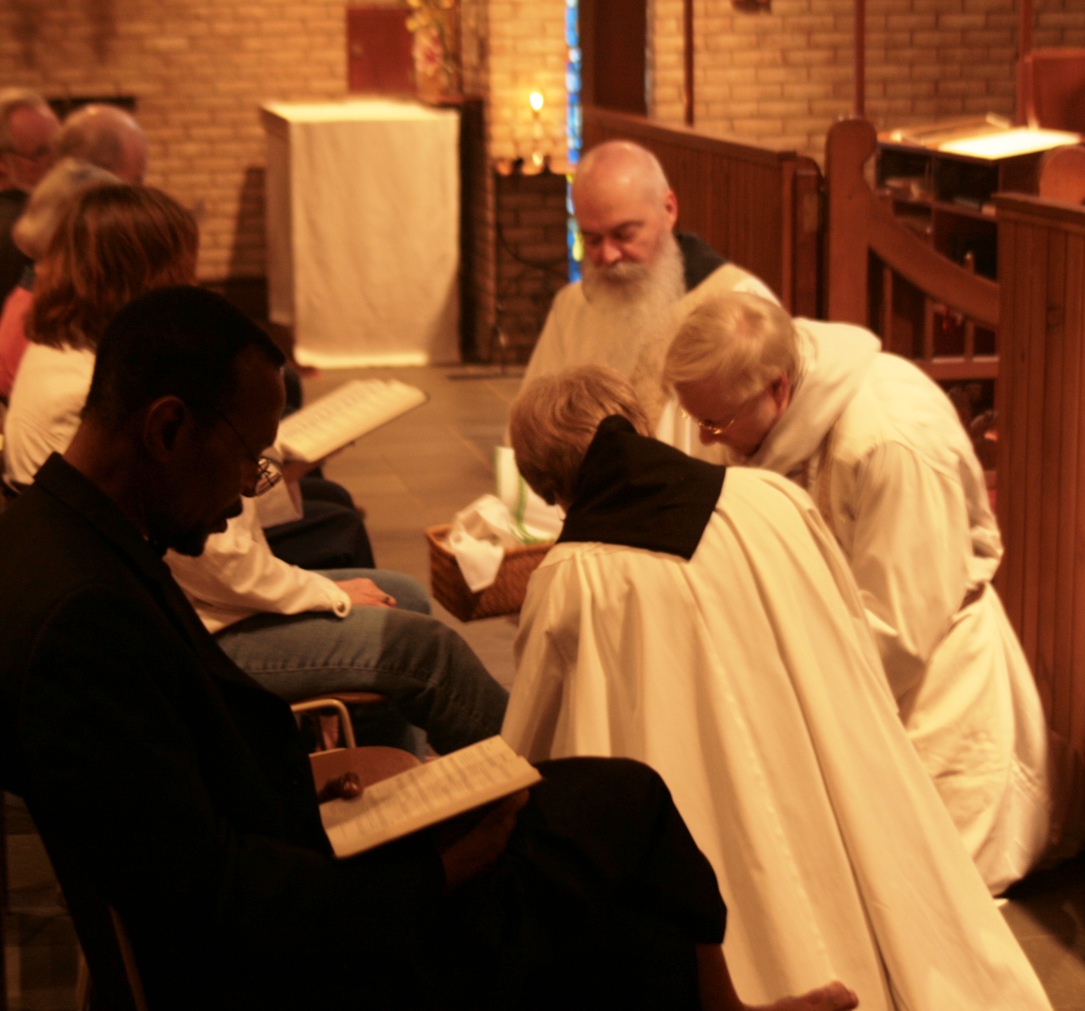
AndrewWashingFeet - CopyThe situation of the cellarer of the monastery providing for people who depend on his solicitude is quite the opposite of the person who approaches God in prayer “humbly and respectfully.” The cellarer himself would be on the other end of the stick on this one. Here is the danger of projecting worldly power on God when God is approached humbly and respectfully. If we picture God as a whimsical potentate who grants favors or withholds them in plays of power the way we do if and when we get a chance, then we slip into playing these power games with people who depend on us. This is precisely what Benedict forbids the cellarer to do. Benedict forbids such behavior because it goes against the Gospel.

St, Benedict famously insists that “all guests who present themselves are to be welcomed as Christ.” Benedict goes on to quote Matthew 25 to emphasize the point. Likewise, the cellarer, in attended to fellow monastics and guests should do the same. Benedict also says that “care of the sick must rank above and before all else, so that they may truly be served as Christ.” Once again, Benedict quotes Matthew 25. “The Lord of all things” whom we approach in prayer with our needs, who is greater than “a powerful man” from whom we might ask a favor, identifies with the humans who approach us in need.

We all have a hard time respecting people in positions subordinate to us, especially if they are needy. We instinctively look down on them because we think we are the ones with something to give or withhold. In other words, were are in the winning position and we like it that way. However, if Christ assumes the “losing” position, and Christ is the King whom we should obey, then we should be obedient to the needs of others in a respectful way. We might say that Christ makes other people respectable even if they have no respectability within themselves. The implication of this, of course, is that we also lack respectability within ourselves and it is Christ who gives us respectability.

The theological principal for saying that a person is entitled to respect just for being a human being is that we are each made in the image of God. That is true, but Christ’s identification with each person in need, and we all are in need in some ways at some times, is superadded to our creation in God’s image. This super-addition is based on Christ’s redemption of us, Christ’s having died for us. Since Christ died for everybody, Christ identifies with everybody. By identifying with each of us, Christ takes the rivalry out of the relationship. The way we relate to one another has nothing to do with winning, with having the upper hand in some way. Christ has leveled the playing field. Christ is focused on the needs of each one of us. That means Christ is focused on our own needs and also the needs of the people we encounter. It is doing what we can with another’s needs and having a kind word when we can’t. (And we often can’t fill another’s needs.) In all this, we participate in Christ’s respect for us, which makes us more respectable than we were.

Respect (1)

churchDistanceBlossoms - CopyHumility and respect are the two fundamental attitudes that are most conducive to living constructively with mimetic desire and avoiding its more destructive potential. Both attitudes need to be habitual dispositions to be effective. Such habitual dispositions are not automatic the way many habits (especially bad habits) tend to be. They need to be renewed every day, every hour, or they will fall away.

Although St. Benedict attaches great importance to outward action, both in manual work and what he calls “the Work of God,” i.e. the Divine Office, Benedict also attaches much importance to the inner disposition supporting these outward observances. In his short chapter 20, “Reverence in Prayer,” Benedict says: “Whenever we want to ask some favor of a powerful man, we do it humbly and respectfully, for fear of presumption. How much more important, then, to lay our petitions before the Lord God of all things with the utmost humility and sincere devotion.” When the Gospel is read at the end of Sunday Matins, the worshippers should “stand with respect and awe.” After each psalm, we should stand in honor of the Trinity.

Humility and respect are so intertwined that it is hard to separate them. They are inseparable in the sense that one cannot have one without the other. However, there is some distinction between them in that respect is directed towards the other, whether God or our neighbor whereas humility is rooted in the self. I want to deal with respect first and then move on to humility.

The first question that comes to mind is: Why respect instead of love? Isn’t Love the primary Christian virtue? Yes, love in the sense of agape is the primary Christian virtue but I think we need to start with respect. It is a case of serving milk before solid food to make sure we are ready for it, trained “to distinguish good from evil” (Heb. 5:14). That is, respect is a prerequisite for love. If we try to leapfrog this prerequisite, there is a real possibility of mistaking lust and other noxious attitudes for love. A tragic example in the Bible is Amnon. He probably thought he loved Absalom’s sister Tamar but his use of force to rape her and his callous rejection of her afterwards makes it clear he had no respect for her and therefore no love. Love is often spoken of as a conquest or an attempt at one. Amnon conquered Tamar through a clever but devilish plot. Don Giovanni made such conquests by the hundreds If Leperello is to be believed. But does Don Giovanni show respect for Donna Anna, Donna Elvira or Zerlina in Mozart’s great opera? Not in your life. What erroneously passes for love sidesteps respect entirely and sidesteps love as well.

One never tries to win respect by conquest. There is no contest with respect, neither is there any mimetic rivalry in respect. Whereas love without respect tries to woo another person into conformity to one’s feelings for that other, respect does no such thing. Respect does not require that another person feel the way I do about anything. Respect is about relating to another, not winning anything. Maybe relating doesn’t seem like much compared to conquering another person. Actually, relating is quite an accomplishment because it involves conquering oneself.

Continued in Respect (2)

Mimetic Blessing through Abraham (2): Abraham’s Offspring

Jacob_Blessing_the_Children_of_Joseph_-_WGA19117[Continuation of Mimetic Blessing through Abraham (1): Cain and Abel

God promised Abraham that he would have as many descendants as the dust of the earth. (Gen. 13:16) I like the later image of the stars in the sky and the grains of sand on the seashore (Gen 22:17) but the earlier image ties in with the creation of humanity out of dust, thus making it clear that descendants of Abraham (like us) are part of God’s ongoing creation. That’s how expansive God’s blessing and being God’s blessing can be.

When Abraham and his nephew Lot found there was tension between their herdsmen, Abraham suggested that they separate and he gave Lot the choice of taking the land to the left or the land to the right. This is quite the opposite from what most of us do which is the first see what the other desires and then desire it for ourselves. Instead, Abraham renounces desiring what his nephew desires and goes in the other direction. (The better-looking land turned out to have its liabilities but that is another story.)

Unfortunately, Abraham does not renounce mimetic desire and rivalry when it comes to his sons Ishmael and Isaac. In spite of being called to be a blessing and promised as many descendants as the dust of the earth, Abraham fails to believe that both of his sons can inherit the blessing he has been given by God. Far from fighting each other, Ishmael and Isaac play well together but they fall victim to the rivalry between their mothers. (Women are equal participants in the mimetic rivalry game in Genesis.) Abraham casts Ishmael out so that his favorite son born of Sarah can inherit the blessing. God, however, makes it clear that there is a blessing for Ishmael, too, even if Abraham did not believe it.

Following his father’s example, Isaac assumes that only one of his two sons can receive his blessing and, like Abraham, he wants to give it to his favorite son. Rebekah’s involvement in this rivalry causes this Isaac’s scheme to misfire. This time, it is the son who receives (takes) the blessing who is exiled where Jacob spends many years in rivalry with his kinsman Laban. When Esau re-enters the story on Jacob’s return, we can see that Esau has done well for himself and has no need to envy his brother’s success. Apparently there was a lot more of a blessing left for Esau than Isaac thought.

Jacob stubbornly upholds the family tradition of disbelief in the scope of God’s blessing and singles out his favorite, Joseph, over/against his ten older brothers. This time the fratricidal strife has enough brothers to create a scenario of collective violence. In contrast to the primitive sacred, however, the unanimity is not complete. Both Reuben and Judah, separately, make plans to save Joseph but they both fail. If they had stood up to their brothers, the mimetic process would likely have been redirected in a peaceful direction. The upshot of the story is that Joseph ends up becoming a blessing to Egypt and to lands far beyond and he saves his own family through his foresight in collecting food during the years of plenty. (Joseph’s making the Egyptians buy back the food that had been taken from them does make Joseph less generous than his God.)

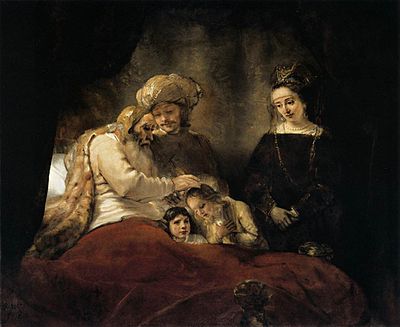
Before he dies, Jacob blesses the two sons of Joseph: Ephraim and Manasseh. He crosses his hands to indicate that Ephraim will be greater than his elder brother, but he gives both boys the same blessing. Finally, through excruciatingly painful experience, Jacob has learned that God has blessings for all of Abraham’s offspring.

Mimetic Blessing through Abraham (1): Cain and Abel

Cain_slaying_Abel,_1608-1609Fratricide is a running thread throughout Genesis. The rivalry portrayed in its stories do not involve romantic triangles as in novels and plays, but rather, the disputes are over blessings, the other running thread throughout Genesis.

In Creation God blesses humanity with all that God has created, but humanity rejects that blessing for the sake of one tree that then shrank to a barren landscape. To begin the process of re-gathering a scattered humanity after the Tower of Babel, God calls Abraham to leave his father’s house, i.e. the scattered, rivalrous civilization he was born in, and move to a land God will show him. When Abraham leaves the entanglements of mimetic rivalry behind, whole new vistas of possibilities suddenly present themselves.

God then tells Abraham:  “I will make of you a great nation, and I will bless you, and make your name great, so that you will be a blessing” and by him “all the families of the earth shall be blessed.” (Gen. 12: 1-3) We are so habituated to getting (or taking) blessings that we often fail to notice that God said Abraham would be a blessing and a blessing not just for him and his household but for all households. The intervening verse that God will curse those who curse Abraham is discordant. If God really is in the business of blessings, then God is not in the business of cursing. After all, Jesus did not curse those who cursed him and worse. However, we could say that when we curse someone who is a blessing, and through Abraham everybody is a blessing, then we are consumed by our own cursing.

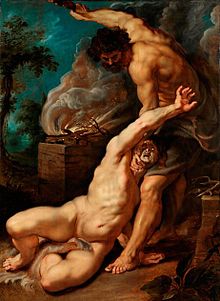
We see all this already at play in the story of Cain and Abel who fight over a blessing and the supposed lack thereof. Genesis does not tell us why God accepted Abel’s sacrifice and not Cain’s. Girard’s theory of collective violence founding culture leads me to suggest that tilling the ground was a factor. There could have been mimetic rivalry among nomadic herders of sheep but tilling the ground like Cain was all the more conducive to rivalry over particular plots of land, such as Ahab’s coveting Naboth’s vineyard. The proliferation of vegetative dying and rising deities in mythology suggests that landed economy lead to mimetic crises and their resolution through collective violence. On the other hand, when we note the alleged zero sum blessings in the fratricidal strife that follows, maybe Cain jumped to the conclusion that when Abel was blessed, there could be no blessing for him.

What is decisive is that when Cain’s offering was rejected, or he thought it was, he embroiled himself with Abel, which was also to exile God. God called out to Cain, something God continues to do with violent humans to the end of time, but Cain would not let go of his preoccupation with his brother until he had killed him.

Afterwards, Abel’s blood cried from the ground. This is a marked contrast with the fratricidal myth of the founding of Rome where the blood of Remus was silent. Like Romulus, though, Cain was a founder of culture while Abel was the first prophet as defined by Jesus in Mt. 23:35, that is, a prophet is a victim. Abel’s blood seems to have cried for vengeance. The author of Hebrews, however, says that the blood of Jesus “speaks a better word than the blood of Abel.” More proof that God is in the business of blessing and not cursing.