Mirror Neurons Revisited

Xenia1Although the title The Myth of Mirror Neurons make cause one to think it, this book does NOT deny the existence of mirror neurons. (See Mirroring Desires.) The myth the author talks about is a serious overrating of what mirror neurons can do in human beings. The discovery that the same neurons in the brains of macaque monkeys fire when they do an action or see the action done, such as grabbing a banana remains intact. It is the extension of the motor simulation to explaining human language and imitation that Hickock contests. Two historical points: 1) Up to the discovery of mirror neurons, the computational system of the brain was somewhat overrated; 2) the discovery of mirror neurons triggered a revival of the highly discredited motor theory of language skills in humans. Hickock explains at length how the same problems that discredited the motor theory of language remain in force, notwithstanding the difficulty of killing zombies. He discusses the evidence for high-level computational processing in the human brain in language use and in imitation. What mirror neurons do is ground the computational work in the brain in the motor areas of the brain. Hickock suggestss that mirror neurons seem to be about the same in macaques and humans but macaques do not talk and they do not imitate very much–certainly not anywhere near on a human skill. Hickock discusses autism and the theory that it is caused by a deprivation of mirror neuron activity. Hickock gives reasons why this does not work as part of a broader questioning of all deprivation theories of autism. In its place, Hickock cites evidence that autism is caused by overload in many areas. It is well-known that autistic persons are hypersensitive to sound and other sensory inputs such as certain colors. There is also growing evidence that autistic persons are hyper-sensitive to the other people; that is, they have an overload of empathy that is overwhelming rather than a lack. Where we seem to end up, for the time being anyway, is a mirror neuron system that grounds a complex computational cognitive set up apps (to use the computer analogy). For those interested in René Girard’s thought who see the discovery of mirror neurons as explaining Girard’s notions of mimetic desire: mirror neurons don’t do as much as the hype has suggested but they are very much in our bodies and they do play a role. The instinctive reaction to stimuli still seems to point to the preconscious element of mimetic desire, or at least part of it. The paradigm that Hickock is moving us toward suggests that it is not mirror neurons but the explosion of cognitive skills in the brain that takes humans out of instinct into learning by experience. Imitation, so fundamental to those exploring Girard’s thought, takes over from what instinct did in animals. Those skilled in neurology and related issues might found it useful to follow up this notion to see if it holds significant explanatory value. In any case, everyone who has been excited about mirror neurons and especially those who have cited the discovery as helpful to understanding humans should read this book to see where at least some scientists are now taking it. Hickock hasn’t just razed the barn; he has also called in the carpenters.

Will and God’s Desire Revisited

AndrewPalmSunday2

Some time in the past I published a post called “Will and God’s Desire.” I have just thoroughly revised this post so as to use it for a brief introduction to a book I am writing that will explore various ways that Girard’s insights into mimetic desire can help us understand and live the Christian life. Several other blog posts will also provide matter for this book. Since a pair of introductory pages are of crucial importance for making the rest of the book work, I am posting it here and asking for any suggestions I might consider to make it clearer and stronger. Here is the introduction as I have it currently:

Spiritual writing often place much emphasis on obeying God’s will. That is good, but I think we can deepen our relationship with God by shifting the emphasis from trying to do God’s will to sharing God’s Desire. The two seem to amount to the same thing: if God desires something, then God wills it. But the differing connotations of these two words have a big effect. The words “obey God’s will” suggest that God’s will is something we should allow God to impose God’s on us. The phrase “share God’s Desire” has a much gentler connotation. It suggests that God has a certain Desire that God wishes to share. Sharing a desire is a very different thing than giving us marching orders. God’s Desire extends an invitation to us to enter into a great mystery. I purposely use the singular form of desire for God because, although God could be said to desire many things, they all converge into one all-encompassing Desire for the well-being of all creation.
Thinking and praying in terms of God’s Desire is attractive in the sense that it opens up a collaborative relationship with God, such as what Abraham and Moses showed when they bargained with God on behalf of God’s people. But our desires are complex, stimulating, and troubling. This problematic aspect of our desires makes us want to exert our own wills against them and then ask God to take the same dictatorial approach on them as well. But if God shares God’s Desire with us instead, then trying to do to ourselves with our own will what God does not do to us is not likely to work. That Desire is something God shares with us rather than imposes on us tells us something important about desire: desire is shared.
Here we come up against the biggest problem we have with our desires. We think they originate within ourselves and so belong to us. This causes us to treat them in a proprietary manner through exerting our wills on them. The French polymath thinker René Girard has suggested that the desires within us are not exclusively our own. They do not originate within ourselves but they originate from the desires of others. That is, our desires are shared. Not only are they shared, they are contagious like an epidemic. We see this when rage flares up throughout a social network like a firestorm. Shared desire can also be as contagious as a gentle smile that floats through people like a soft breeze. Girard calls this shared desire mimetic desire. That is, desire that imitates the desires of others. Actually, as I shall show when I explore this trait in the course of this book, it is important not to think of imitation as an external copying like mimicking the actions of others. Rather, our desires our shared through a deep resonance that connects us with other people and with God. When we think of desires as our own, we are likely to treat them like weapons in battles with other people with the will acting as the general aspiring to be a war god. But the more we try to assert our desires as our own, the more they are governed by the desires of others. The more we rebel against the desires of others, the more subject we are to them. If we try to control the desires of others by trying to make them imitate us, we are still organizing our lives around their desires all the more. Meanwhile, the people who have us trapped into imitating their desires are just as trapped into imitating ours.
This phenomenon of shared desire is like a dizzying labyrinthine worm that boars to the depths of our personhood. This is why trying to control our own desires as if they were strictly our own is beating the air. (1 Cor. 9:26) On a broad social scale, this labyrinth of mimetic desire can lead to meltdowns that lead to collective violence such as the crucifixion of Jesus of Nazareth. For his part, as I will explain at length, Jesus nailed this persecutory meltdown to the cross, to quote Paul creatively (Col. 2:14).
God’s Desire enters into this dizzying matrix of human mimetic desire more deeply than the devouring worm ever could, probing far more deeply than the desires of other people so as to saves us from being overrun by these desires. The amazing thing about God’s Desire is its spaciousness, quite a contrast with the cramped nexus of human mimetic desire. In God’s Desire, there is all the room in the world. That is not surprising since God created all of the room in the world. While human mimetic desire creates scarcity through conflict, God’s Desire provides abundance such as the abundance Jesus that flowed from five barley loaves and two fishes in the wilderness. The gentleness of sharing God’s Desire might make it look like an easy option, but I find it highly challenging. Sharing God’s Desire asks of us nothing short of a total transformation of ourselves as we open our hearts to embrace the expansive Desire of God.
In bringing the shared aspect of desire to our attention, Girard and his many colleagues have opened up a powerful avenue for spiritual and social renewal. This small insight may not look like much but it has the power to help us understand how violence, especially violence connected with religion, occurs. This is especially true with the Paschal Mystery of Christ. More important, this small insight can help us learn how we can become living stones in the temple of God that explode into God’s Kingdom. In the pages that follow, I will explore these ideas as means of hearing God’s Word and making it flesh in our acts of service and prayer.

Longing for God’s Desire

treespath1In one way or another, human desire has always indicated that something is lacking. My stomach is empty so I desire to fill it with food. I don’t have as much money as I would like for the necessities and treats I want so I feel empty until I get enough money to get them. I lack the satisfaction of seeing my favorite baseball team win unless they win. If they do win, I am back to square one with the same emptiness and the same desire by the next day.

René Girard’s theory of mimetic desire pushes the lack that leads to desire a step further. We don’t just lack possessions or a girlfriend; we don’t know what food or what girl to desire until we see what food and what girl somebody else desires. As we learn from scientists’ study of our mirror neurons, we don’t necessarily desire what other people want because they want it or we think they want it. Rather our desires automatically resonate with the desires of others and we need to learn to navigate these resonances as part of human maturation. This prevents us from automatically copying every desire we see in others but the less conscious we are of the impact others’ desires have on us, the more likely we will be driven by others’ desires and the more empty we will be as a result.

Those desires of ours that are drawn from other people easily become conflictual. When that happens, the emptiness opened by mimetic desire deepens into an abyss. When we are wrapped up with a rival, it is never enough to have what the rival wants. As Girard points out, we need to become the other person. We believe (wrongly) that the other person has a certain fullness of being that we don’t have because they have—or seem to have—what we want but don’t have. So it is that we covet not just the ox or wife or car of another but the very being of another person. This is why we never have enough money or possessions or anything else as long as we are in rivalrous relationships. For Girard, this is not an ontological statement but an anthropological one. That is, it is about human relationships. The problem is that we can covet the being of another person until the end of the world and we’ll come up empty. Since the alleged fullness of being on the part of another is illusory, we are only “chasing after wind” (Eccl. 1:14).

Christian thinkers have consistently averred that we are instilled with a longing for God as a gift from God and that this longing means that we cannot be totally satisfied with anything else, no matter how wonderful. As the Psalmist says: our souls “thirst for the living God” (Psa. 42: 2).If we see mimetic desire as fundamental to humanity, it follows that this trait is willed by God and used by God in a fundamental way for our salvation. The certain lack of being caused by mimetic desire gives us an ongoing openness to God, an opening for God to enter into us and dwell within us as Jesus promised us in John’s Gospel. We are created to resonate with the desires of others so that we can resonate with the Desire of the other Other. The phrase “cdeep calls from deep: (Psa. 42: 7) has often been interpreted as the depths of our humanity crying out to the depths of God. This depth is our desire resonating mimetically with God’s Desire. While it is an illusion to think that a human rival has a plenitude of being, God really does have such plenitude. Moreover, God is infinitely generous with God’s plenitude of being. If we open ourselves to God’s Desire, we participate in that Desire is such a way that we can be equally generous with others.

Eating the Being of Jesus

AndrewWashingFeet - CopyThe Holy Eucharist has been accused of being a cannibalistic rite. René Girard would accept the accusation. In a snippet from an unpublished interview, he suggests that the Eucharist recapitulates the entire history of sacrifice and its violence and that history includes cannibalism. When I took a college course on African and Oceanic religions, one of the essay questions I was confronted with on the final exam was to discuss a few anthropological eyewitness accounts of cannibalistic practice. This was the first time I had encountered anything like it. What struck me about the accounts was how these people were intentionally absorbing, through ingestion, the being of the person, sometimes in mockery but more often in respect. (My take on these documents was affirmed by my professor with a top grade.) This is also Girard’s take. He ties this data into his analysis of the dynamics of mimetic rivalry where a rival moves beyond envying the possessions of another to envying the very being of the other. Interestingly, Jesus himself seems to agree with Girard and the anthropologists on this matter. In John 6, he uses strong language when he tells us that we must eat his body and drink his blood, words that suggest cannibalism and seem to have been interpreted as such by his grossed out hearers who, for the most part, went away so as not to hear anything more about it.

Cannibalistic language is often used figuratively in human speech and that is true of Holy Scripture as well. The psalmist affirms God’s deliverance from people who assail and devour his or her flesh (Psalm 27:2). St. Paul warns the Galatians that if they “bite and devour another,” they should take care that they “are not consumed by one another” (Gal. 5: 15). These examples refer to situations of serious mimetic rivalry and even if the psalmist’s enemies and the people of Galatia are “civilized” enough to rescind from literal cannibalism, they are indulging in the essence of that practice.

In what I have called the First Supper, Jesus reverses the cannibalism of devouring another person by freely offering himself, body and blood, in the bread and wine so that we may receive the being of Jesus as a free gift rather than as the spoils of a violent victory. This implies that his death on the cross is a Gift he gives to humanity and is not booty taken away from him against his will as is the booty taken by a conqueror.

What kind of personal being are we receiving when we receive the being of Jesus? In the early human centuries, people were absorbing the bravery and fighting skills of a worthy enemy who was defeated. With Jesus, what we get is something very different. This something very different is demonstrated in Jesus’ act of washing the feet of his disciples as a sign that we should serve one another in all ways. The personal being we receive in the Eucharist is one who, far from wishing to devour another person figuratively, would wish to build up another person in actuality. When we receive the being of Jesus, we receive personal courage beyond imagining, but it is not the courage of one who fights and wins battles against violent foes, but the courage of one brave enough to serve others, even to death on the cross.

Abolishing Sacrifice to Establish Mercy

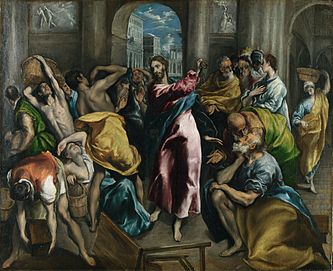
Jesus_cleansing_templeThe story of Jesus knocking over the tables in the temple and driving out the animals shakes us up but then we wonder what we should be all shook up about. Jesus’ act can be seen as the climax of repeated protests of the Hebrew prophets against the sacrificial cult in the temple. Jeremiah mocked his listeners who jabbered: “This is the temple of the Lord! The temple of the Lord! The temple of the Lord!”  (Jer. 7:4). Then there is God’s mocking question from Psalm 50 and repeated elsewhere: “Do you think I eat the meat of bulls and drink the blood of goats?” Amos proclaims God’s hatred of festivals. Most telling are the words of Hosea that Jesus quoted: “I desire steadfast love and not sacrifice, the knowledge of God rather than burnt offerings” (Hosea 6:6.) There is much debate as to whether the prophets wanted the abolition of the sacrificial cult or a reformation that would bring it in line with moral values. In driving out not only the money changers but also the animals about to be sacrificed, I think Jesus is doing a bit of guerrilla theater to prophecy the end of the temple cult, a prophecy fulfilled in 70 A.D. when the combined violence of militant Jew and the imperialistic Romans resulted in its destruction.

When asked to explain his actions, Jesus said: “Destroy this temple and in three days I will raise it up” (John 2:19) This literalist interpretation is promptly debunked by the evangelist when he says that Jesus was “speaking of the temple of his body” (John 2: 21). So much for biblical literalism. The implication that Jesus is replacing the temple with his risen body is a strong indication that he intended to abolish the sacrificial cult. What was wrong with the sacrificial cult? The quote from Psalm 69 “zeal for your house will consume me” shows us the problem if we note the context. Psalm 69 begins with “Save me O God for the waters have risen up to my neck.” The psalmist tells God that he is suffering the same reproach people level against God: “the insults of those who insult you have fallen on me.” This psalm is referred to as one of the “passion psalms” and has been interpreted as a prophecy of Christ. However, I don’t think the psalmist was gazing into a crystal ball and seeing Christ’s Passion; I think the psalmist was complaining about collective violence that was happening to him at the time. The number of persecution psalms and the fate of many prophets, suggests that the Gospels are revealing the human tendency to solve social conflicts by uniting against a victim which is precisely the outcome Jesus predicts when he explains his actions at the temple. T

he prophets consistently denounced the sacrifices made on the “high places,” pagan sacrifices to deities like Moloch who even required the sacrifice of their children. The sacrifice in the temple was more humane in that it was restricted to animals, but the practice derived from the notion that “god” was angry and would be appeased only by sacrifices. The prophets’ denunciations of the temple cult were consistently coupled with denunciations of social violence and injustice where the poor were sold for a pair of sandals as Amos complained. Although it is argued that the prophets thought the temple sacrifices were acceptable, maybe even laudable, if accompanied with righteous actions in the social sphere, but they seem to have a sneaky suspicion that the practice of sacrifice tends to encourage social injustice. The temple setup was, after all, a terrible financial burden on the poor. (I think Jesus was not edified but outraged over the widow who gave the last two coins she had to live on.) The logic of sacrifice was that some living being was always dispensable precisely as the victims of collective violence at the times of social crises were dispensable and their deaths “necessary.” Caiaphas stated the sacrificial logic baldly when he said that it was better “to have one man die for the people than to have the whole nation destroyed” (John 11:50) In modern times this sacrificial logic is expressed by the regretful term “collateral damage.” These considerations suggest that the prophets were convinced that something was fundamentally wrong with sacrificial rites.

Jesus, on the other hand, has a totally different, opposite logic; a logic that Paul says is foolishness to the rest of the world. In John 6, Jesus says that everybody the Father gives him will come to him and nobody who comes to him will be driven away. The parable of the lost sheep makes the same point that it is not the will of our Father in Heaven that even one of his “little ones” should be lost. Jesus believed this so strongly that he would accept death on the cross to make the point and, more important, return as the forgiving victim to gather all who will come to him so that none of us should be lost. The pagan deities wanted sacrifices made to them. The prophets kept trying to get it across to everybody that God pours out sacrificial love to all of us through creation and redemption and that God wants the mercy God gives us in return, not sacrifices .  Caiaphas was willing to sacrifice Jesus and anyone else who put a spoke in the wheel of the sacrificial logic. Jesus was willing to sacrifice himself rather than sacrifice any of us. That is why we do not slaughter bulls on this altar but pass around the bread and wine through which Jesus gives His very self to each one of us.

Liturgical Animals (3): Stories and Ritual

eucharist1Ever since stories started to be told it has been known that we resonate with them and with the actions of the characters at a very deep level. Aristotle famously called it catharsis where our own emotions are purified when we identify with the emotions of a character on stage. Girard’s theory of mimetic desire gives us increased awareness of the phenomenon. It is no accident that Girard discovered that the best novelists and playwrights had discovered it, not least Sophocles who had inspired Aristotle’s concept of catharsis. (See Human See, Human Want.)

The discovery of mirror neurons adds further scientific and anthropological understanding to the way we resonate with stories. (See Mirroring Desires.) Realizing that our mirror neurons are activated by the intentions of others, we now know that the actions of actors on stage or on the screen also activate our mirror neurons. This is why we are so affected by what they do and most particularly what they desire. By identifying with a thief who is the protagonist of a story, we easily find ourselves desiring the thief’s success although in real life we would normally not desire that at all. But then again, perhaps the story has revealed a hidden desire to steal successfully. Or, perhaps a desire that wasn’t there has been created by the thieving action. Or a combination of both.

This is where the debate about whether or not violence or any reprehensible actions should be allowed in movies or on the stage of even in books. Does the violence observed or read about make one more violent or does it cause a catharsis, thus acting as a safety valve that prevents violence in real life? As far as I can tell, the answer goes both ways. After the Columbine school shooting, a video game was blamed for motivating the killers to go on a shooting spree, but this accusation overlooks the huge number of boys in the same age bracket who did no such thing. What we are left with, I think, is the need for us to take some responsibility for what we watch and read and more important, for how we react to them. For some, watching cops and robbers programs are mild entertainment. For others, it is more a thrill of surrogate righteous violence. If it is the latter, is this surrogate thrill enough or does it lead to inflicting violence against the “bad” guys in real life and feeling righteous about it? Or, do we act these feelings of righteous indignation without knowing what we are doing? Which puts us in the position of those who crucified Jesus.

Which brings us back to liturgy. It is worth noting that Greek plays were performed as parts of religious festivals, making the expulsion of Oedipus, for example, a liturgical event. To this day, plays and classical concerts often have a quasi-liturgical atmosphere with dimmed houselights and norms for audience decorum similar to what is usually expected in church. The more raucous and extroverted actions at rock concerts and Pentecostal services are liturgical in their own right with different liturgical norms. The thing is, liturgies and plays and concerts all stimulate the same mirror neurons in similar ways.

In Christian worship, the liturgical action is bound up with stories about Israel and most particularly, the story of Jesus. The stories are drawn out in the readings from scripture and the central story of Jesus, the Paschal Mystery, is compressed in the Eucharist where the story is fed to us literally in the bread and wine. Listening to the Word activates the mirror neurons, hopefully making us identify with the heroes and heroines of faith and most particularly with Jesus. Even from ancient times, certain people have been held up as good examples to imitate. As for Jesus settling a good example, since he compared himself to a burglar at one point, we can feel naughty and subversive in following his example and yet also feel righteous about it (Mt. 24;43). The pitfall is that we might identify with the owner of the house, and so try to keep Jesus out so that our lives aren’t subverted and turned upside down. This is just one example of how a story can twist us around in several directions, leaving us to wonder which end is up.

In general, plays and concerts are not repetitious the way the Eucharist is, which tells the same old story time after time to make it sink more deeply into us each time. It should be noted, though, that many people like to hear the same symphonies time after time and some people have favorite movies they see more times than they can count. Children have a ritual sense with their favorite bedtime stories that they want to hear night after night at the same time each night. In the Paschal Mystery, there is disclosure of the deepest truths about the way we humans live but also how we ought to live and could live by absorbing the character of Jesus. This is a story that never ends.

mimetic scarcity (2)

outsideSupper1The loosening of family and tribal bonds was a second and much longer term strategy for diffusing violence resulting from mimetic rivalry. (See mimetic scarcity 1 for context.) Up to the present day it has been effective enough to be considered a good thing. But it has its disadvantages. It has led to what Norman Geres, a writer cited by Paul Dumouchel, calls “a contract of indifference.” This contract has released from obligations for violence, such as the vendettas that have scarred many social groups. That is good. But this contract as also released us from obligations to care for the misfortunes of other people. That is, we are no longer our brother’s keeper. As an instinctive reaction to violence, the various effects were never planned out and they are still not easily visible. Most seriously, the contract of indifference is deleterious to social conscience. We don’t easily see a connection between our individual actions and their social consequences. To take one example: polluting the environment just doesn’t seem to get on the radar of those who use technology at a level that does just that. It supports an individualist spirituality where saving one’s own soul is the main thing and broader social issues are off the radar.

It is the scarcity created by this “solution” that forms the founding dynamic of capitalism. The basic argument, as I understand it, is that the scarcity gives humans an incentive to try and overcome the scarcity by increasing production so that there will be more material goods than there were. This works in the sense that more material goods are produced that can be consumed by people. But scarcity is not overcome because the increase of production increases desires for goods and when this leads to more increased production, desires increase still more. Material goods never catch up with desire. Mimetic desire, where we desire things because other people desire them, further intensifies this frenzy because whole inventories of perfectly wearable shoes disappear if only a few designs are in fashion. This is how this “peaceful” solution to violence leads directly to the quiet, hidden, sacrifice of many people on the hidden altars of indifference. Indifference is just as contagious as mimetic violence. The ennui of modern humanity analyzed by legions of philosophers and social commentators witnesses to the extent of this contagion.

If Paul Dumouchel is right in suggesting that creating scarcity has roots in early humanity, created scarcity has become much more prominent in modern times. I will make only a brief historical detour to consider the Jewish tradition. The prophets exposed the truth of collective violence much more deeply and clearly than other cultures, thus attenuating the efficacy of sacrificial religion. (“I desire steadfast love, not sacrifice” Hos. 6:6) Did this prophetic exposure increase use of the solution of scarcity to limit violence? The countless oracles against oppression of the poor suggest that scarcity was alive and well in early Jewish society. Perhaps the surrounding cultures, still grounded in sacrificial religion, still had stronger social bonds for caring for each other’s’ needs. Maybe. An historical study of this matter would be welcome.

In pleading for the poor and oppressed, the Jewish prophets were clearly aware of the problems created by scarcity and loosening social bonds and so were trying to increase the scope of “family.” That is, far from loosening ties, we are to strengthen them and extend them. By inviting all of us into being siblings of him, Jesus also encouraged us to be brothers and sisters of one another: the whole church, all of humanity is family. Jesus is most explicit in this teaching in Matthew 25 where “the least of these” are all part of Jesus’ family and therefore ours as well. It is this sense of family that motivated St. Paul to take up a collection in his various churches so as to give famine relief to the brothers and sisters in Jerusalem.

This is a hard saying. First the Jewish prophets and then Jesus, by his death as a result of collective violence, throws a monkey wrench into the first “solution” to violence. But before he died, Jesus, along with the prophets who preceded him, threw another monkey wrench into this second solution. We are given an ascetical double whammy. We have to renounce the solidarity that leads to mimetic strife and then to collective violence, but not only must we retain these same ties, we must strengthen and extend them when it comes to providing for others. That is, the borders that made providing for family tenable have been exploded. Not only that, but if these are “solutions” to violence resulting from intensified mimetic rivalry, and both have been exploded, then we have to discipline ourselves to renounce that rivalry. In analyzing the land enclosures in England, Dumouchel noted the mimetic rivalry of the lairds that caused them to desire better productivity of their lands that brought on scarcity without reducing any material goods in their environments. Make no mistake. I am not suggesting we have to renounce capitalism. We have to exchange goods and services somehow. But renouncing mimetic strife will change the social complexion of capitalism as it changes everything else.

One of the reasons this social demand for social solidarity seems so onerous is because we tend to hear it through the filter of “the contract of indifference.” That is, we think the entire burden falls on each of us individually. We forget even before we hear it that we are invited into a family, a family that is the Body of Christ. We do not have to take responsibility for others, each on our own little lonesome. That would be rugged individualism all over again. Instead, we are encouraged to take responsibility as members of a Body. Jesus reaches out to everyone through each and every one of us. Our personal responsibilities are collective responsibilities.

Liturgical Animals (2)

eucharist1In his first letter to the Corinthians, St. Paul brings us to the heart of Christian worship that Jesus inspired at what we call his Last Supper. His followers were doing what he told them to do: Do this in memory of me. While both the myths and rituals obscured the sacrificial stories on which they were based, the Eucharist clearly tells the story on which it is based:  the betrayal of Jesus, his subsequent crucifixion, and his rising from the dead.  This earliest account of the Eucharist, predating all of the Gospels, enshrines the Words of Institution that are repeated in celebrations of the Eucharist two thousand years later. The Eucharist teaches us through its story but it also teaches us at a deeper, more substantial level through actually feeding us with the Word of God so tangibly that we chew on it and swallow it. Celebrating the Eucharist places our desires into Jesus’ Desire for us to gather with him and the other Persons of the Trinity.

The meal is probably the oldest of rituals performed by liturgical animals. Eating is the first activity that immerses us into mimetic desire as we imitate the desires of our caregivers to desire food and, by the time we are old enough to be conscious of what we are eating, to desire certain foods because those around us desire them. However, as much as meals have to do with providing necessary bodily nourishment, they are always more than that. An intrinsic part of learning to eat is learning how to eat in the company of others. It may be culturally arbitrary whether we use eating utensils and plates or large leaves and fingers, but in every culture I have ever heard of, there is always a way of eating that is learned. The shared desire for food extends to a shared desire for the way of eating it. By rooting liturgy in a meal, the Eucharist roots worship in the sensuous act of eating; of tasting food and drink on our tongues.

In this same letter, Paul brings up the manner of table manners in regards to the Eucharist. He berates the richer members of the congregation for their insensitive treatment of those who are more economically challenged. To flaunt their superior food in front of those who cannot afford it without offering them anything was a serious violation of everything the Eucharist stands for. This desire shared by one group in the congregation to demonstrate their superiority over others, to put them in their places, breaks the unity the feast is supposed to create and strengthen. Paul makes it clear that there is much more to worship than saying or singing words together while celebrating a sacrifice. If people are not treated well, worship is diminished if not rendered nonexistent.

John’s version of the feeding in the wilderness brings all of these themes together. The event is explicitly brought into the context of Yahweh’s feeding the Jews in the wilderness after their escape from Egypt. Raymond Brown pointed out that rabbinic teaching interpreted the manna as symbolizing the Torah, thus uniting food and teaching, something the Eucharist also does. While Matthew and Mark recount two feedings in the wilderness, one for the Jews and one for the Gentiles, John has one story of feeding for all people. Jesus’ blessing of the bread and fishes has ritual overtones although the feeding is taking place in the open air, away from temples, synagogues and churches. The social unity that Paul enjoins is embodied in John’s vision where it gains a deep universality. Unfortunately, the people then unite in trying to make Jesus king, which destroys the social vision as surely as the Corinthians did.

The Eucharist teaches us that we don’t outgrow our earliest lessons: table manners. Without them, we don’t grow up.

Liturgical Animals (1)

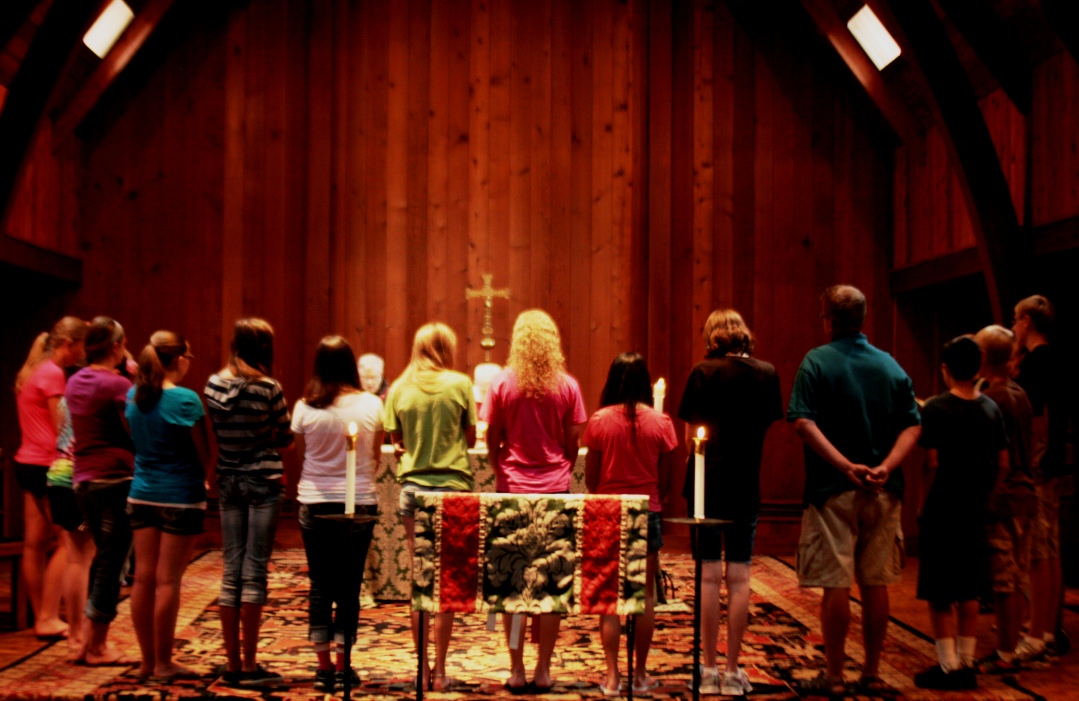
monksinChoir1The reality of mimetic desire guarantees that we will engage in liturgical activity. What kind of liturgical activity and for what end leads to many possibilities. However, since we instinctively react to the desires and intentions of others, we also instinctively move and sing with each other and act together. Since we are mimetic animals, we are also liturgical animals. Much liturgy takes place in churches and temples but liturgy can be done anywhere at any time and it is indeed done all over the place. René Girard’s theory of scapegoating violence places the origins of ritual and liturgy in the spontaneous mob violence against a victim that “solves” a massive social crisis. At first thought, one would think there is nothing liturgical about collective violence; it just happens. But actually collective violence is a very predictable phenomenon that consistently works in a certain way once it gets started. We all know that once the persecutory ball gets rolling it is almost impossible to stop until blood has been spilled. The relatively few instances where the persecutory wave is stopped short of bloodshed also follow a predictable pattern. In essence, the mimetic contagion of a mob has to be redirected into another direction, one less destructive. This is what Jesus did when the Jewish elders were gathered around the woman caught in adultery. This is what Christians do to this day when celebrating the Holy Eucharist. Although I think it likely that sacrificial rituals have their origins in collective violence as Girard suggests, I think that ritual in itself is rooted more deeply in human nature. Since we humans are imitative creatures, we would instinctively coordinate our bodily movements with those of others. This sort of mirroring is instinctive to mothers especially in their interactions with their babies. It is this coordination of movement that would unify a family and then a clan and then a tribe. These coordinated movements would naturally turn into communal dancing and singing. Such coordinated action would naturally move into reenactments of primal collective violence once that occurred, but there is nothing in this instinct for coordinated movement that requires that it move in that direction. This is to say that collective violence and its continuations in sacrifice and institutionalized violence are not of the essence of humanity. There is nothing necessary about it; it’s just something that happens most of the time. What is necessary in the sense of being of the essence of humanity is coordinated movement. Our built-in mimetic desire guarantees that it will happen. There are practical reasons for this trait, among them coordinating movements during hunting expeditions, the way soldiers do military drills to facilitate coordination in battle, and the way football teams synchronize their actions, not to speak of the rituals performed by their fans. Singing together over common work such as gathering fruits and preparing meals might not be as necessary for success as the coordinated movement of hunting parties, but perhaps are as necessary at another level. Maybe nobody dies of boredom but we often feel that we can, and maybe we do in the sense that lack of interest in life isn’t conducive to living a long life. It is singing and dancing together and moving together in other ways that would have given our earliest ancestors an interest in living and it is these activities that spark our interest in life today. Many people today may think they are dismissive of liturgy because they think of stuffy church services or masonic rituals. But the ways we greet people, especially when introducing people to strangers or meeting them, are little rituals that we take so much for granted that we don’t think of them as rituals. When I was young, many people who never darkened the door of a church linked arms in the streets and sang the hymn “We Shall Overcome.” All this is to say that humans are liturgical animals. Gathering with others always has some liturgical overtones in the sense of repeating actions we are used to doing together. Drinking parties tend to follow the same patterns for those groups in the habit of gathering for that purpose. Given this human trait to gather through ritual, it is inevitable that any who wish to gather with others in memory of Jesus would gather liturgically. Liturgy is discussed at length in my book Tools for Peace.

Proceed to Liturgical Animals (2)