
 Easter is an occasion of great rejoicing with bells, boisterous singing, and feasting. But do we really know what we are celebrating? The Gospel reading, doesn’t exactly ring out with Christmas joy of angels filling the skies with songs of God’s glory. Instead, we get “two men in dazzling clothes” who tell the women who came to the grave to anoint Jesus’ body that Jesus was not there but had risen. They had come to the wrong place.
A small group of confused women running off to stammer the news to the disciples isn’t exactly a celebration either. The disciples’s thinking the news is an “idle tale” may reflect a masculine condescending attitude towards women, but their reaction also shows how totally disorienting the news was. The Gospel reading ends with Peter running to the tomb to take a look for himself, seeing the empty linen clothes lying about, and then going home, “amazed at what had happened.” (Lk. 24: 12) Still no celebration; just a lot of unanswered questions. Luke continues his Resurrection narrative with two followers of Jesus walking to Emmaus with no indication of why they should be going there, implying that they are going the wrong way. Their conversation with a stranger on the way confirms their sense of confusion. Should we, too, be too disoriented to celebrate?
I think the key to understanding the problem lies in the words of the angelic beings: “Remember how he told you, while he was still in Galilee, that the Son of Man must be handed over to sinners, and be crucified, and on the third day rise again.” (Lk. 24: 6–7) The stranger who met up with the two disciples asked them rhetorically: “Was it not necessary that the Messiah should suffer these things and then enter into his glory?” (Lk. 24: 26) The word “must” is the key here. The Greek word dei is often translated “it is necessary.” In this case, for whom was it “necessary” that Jesus be handed over to sinners to be crucified and then rise on the third day? There is a tendency to think the death was necessary for God, but that suggests that God needed to have God’s own son die a painful death. Many people have a problem with that notion, I among them.
I find the French thinker René Girard helpful here. He interprets the available anthropological evidence as indicating a tendency of archaic societies to solve social tensions by a process that transforms competitive relationships throughout the society into a shared desire to focus on one person and then kill that person who is deemed responsible for the social tensions. The ensuing peace (for a time) is so strong that the victim is then worshiped as a deity. It is this social mechanism that convinces people that it is necessary for “god” that the victim be killed. Throughout this process, the truth of the victim is precisely what nobody knows, except possibly the victim.
This truth of the victim was gradually being revealed in the prophetic tradition of the Jewish people, most prominently in the verses about the “Suffering Servant” in Isaiah, whom the people accounted “stricken, struck down by God, and afflicted.” (Is. 53: 4) But then the people realized that they, not the victim, were the guilty ones. God had vindicated the “stricken one,” not the persecutors. It was these passages in Isaiah that most helped Jesus’ followers begin to make sense of what had happened to Jesus.
But on the day of Jesus’ Resurrection, the disciples had not thought to connect Jesus with the Suffering Servant. Jesus had told them many times that it was “necessary” that he be handed over to be crucified, but they could not understand. How could it be “necessary” that the man who they thought was going to restore Israel should be handed over to death? They assumed it was “necessary” that the guilty ones be handed over, not the innocent. Then, at Passover time, Jesus was deemed to be the guilty one who was causing the tumult by both religious and civil authorities, and so he was handed over. But the disciples had thought Jesus was innocent. Had they gotten their man wrong? Their fleeing when Jesus was arrested suggests they weren’t so sure.
The empty tomb was the first hint that Jesus’ death wasn’t business as usual. A tomb was supposed to have the corpse of the guilty one, but this one didn’t. The announcement of the angelic beings to the women was a stronger hint that Jesus was innocent after all. The women were told that it, although it was “necessary” that Jesus be handed over and killed, it was even more necessary that Jesus be raised from the dead. By raising Jesus from the dead, God showed Jesus’ followers that the “necessity” that Jesus die was a human necessity, a necessity of human factors, and that it was Jesus’ rising from the dead that was the true divine necessity. Only then could the disciples have their minds opened to understand the scriptures when the Risen Lord met with them himself. (Lk. 24: 45)
It is gloriously great news and a wondrous cause for rejoicing that we are freed from the human “necessity” to blame a victim who is put to death for the crimes of a society. That is, unless we feel too disoriented about not having scapegoats. Maybe that is why rejoicing in Jesus’ Resurrection is a much greater challenge than rejoicing in the birth of a child who is going to accomplish something great—what, we don’t know. Rejoicing in the necessity that Jesus be raised from the dead requires us to change our minds and hearts in radical ways to take in this news. Most challenging of all, we have to accept and then embody the forgiveness of the Risen Victim when storms of accusation remain the status quo even at this present day. Are we up to the challenge? Will we come to the party?
For an introduction to the thought of René Girard see Violence and the Kingdom of God and Living Stones in the House of the Forgiving Victim
 The temptations of Jesus in Matthew and Luke are stylized accounts of three temptations that may not have happened in so neat a fashion in real life, but are clearly meant to be comprehensive of the fundamental temptations that challenge all humans, Jesus included. Jesus’ responses to the three temptations, which would have been particularly strong during his forty days of solitude in the wilderness, are a guide to dealing with the same temptations in our own lives.
 Luke stresses the contrast between John the Baptist and Jesus much more than the three other evangelists. Most strikingly, Luke does not specifically say that John himself baptized Jesus. Luke describes John’s ministry and then says Herod added to all his other crimes by putting John in prison. (Lk. 3: 19–20) Then Luke puts Jesus front and center by saying the he was baptized “when all the people were baptized.” (Lk. 3:21)
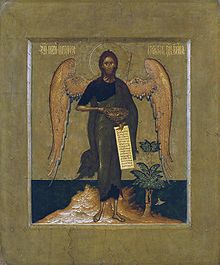 Although John burned with a conviction that God was going to do something new, he had only the models of past prophets to guide him in opening a way to the great new thing. He lived in the desert, wore a camel hair coat and ate wild locusts and honey in imitation of Elijah. Like the prophets of the past, he warned the brood of vipers of the wrath to come if people did not shape up and turn back to God. (Lk. 3: 7) Again like the prophets, he told soldiers not to oppress vulnerable people. Yet again like the prophets, he rebuked his ruler, Herod. And like so many of the prophets, he was put to death.
 The widow who put “two small copper coins” in the temple treasury, all she had to live on, (Mk. 12: 42) has been held up by many preachers as a touching example of heart-warming generosity. Those of us who have come to notice the social and economic issues in the Gospels have seen some concerns that are rather chilling.
 I was introduced to the Transfiguration of Our Lord when Raphael’s great painting of the event hit me between the eyes during my student travels in Rome. With the Feast of the Transfiguration coming during my church’s summer slump (and it wouldn’t have celebrated the feast anyway) I knew nothing about it. In many ways, I didn’t have to. The painting opened up a vision of a transfiguration of humanity beyond what I had thought possible. At the time, what faith I had wasn’t centered around any particular religious viewpoint but I was majoring in religion because I thought the subject dealt with the most important things in life. Seeing the painting was more of a religious awakening than I knew. I was, of course, impressed by the sublimity of the upper half of the canvas where Jesus is floating in the air with Moses and Elijah. But I was even more impressed by the inroads the transfigured light made into the lower half which is often interpreted as indicating sinful and benighted humanity. It has taken me years to see further into the significance of this chiaroscuro effect.
 In the readings from Job and Mark huge storms break out. Storms are chaotic, but they follow the laws of nature, curiously now called “chaos science.” Just before the stormy voyage on the Sea of Galilee, Jesus had pointed out that plants grow from seeds by the laws of nature and that the Kingdom of God is like this natural growth. But what does the storm at sea have to do with the Kingdom of God? Since it is also by the laws of nature that storms destroy crops, are there storms that can blow away the Kingdom of God? The frightened disciples in the boat seem to have thought so and they feared that Jesus didn’t even care about it. Out of the whirlwind God says a lot about throwing oceans around but doesn’t say anything about caring for Job’s excruciating sufferings. Being a puny being in a vast universe doesn’t cheer up a suffering person.
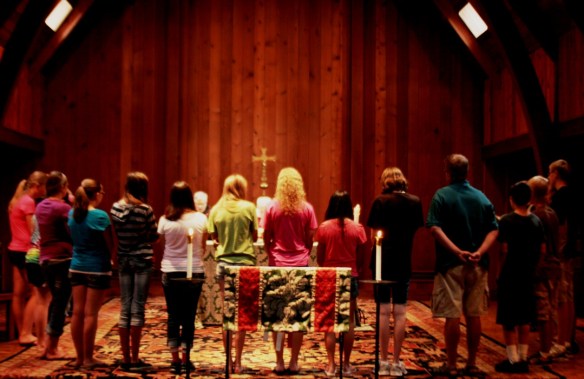 The image of the vine and the branches in John 15 gives us a powerful image of closeness both between ourselves and God and also with each other through our grounding in God.
 When Jesus opened his teaching ministry, Mark says that the people were “astounded” because he taught them“as one having authority, and not as the scribes.” (Mk. 1: 22) Oddly, Mark doesn’t include anything of what Jesus said. The Greek work exousia is much stronger than the English word that translates it. “Powerful authority” would bring us closer to the meaning. That Jesus’ teaching was not like that of the scribes doesn’t give us much more to go on as to the content, but it indicates that this authoritative teaching was distinct from those who were normally considered the teaching authorities.
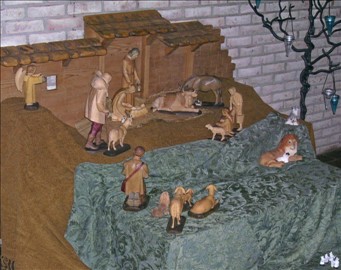 The celebration of the birth of Jesus is a time to put all political differences aside in glad agreement that this child is born. I wish! I have pointed out many times over the years when preaching on Luke’s nativity story that it puts political issues front and center, forcing us to confront our political realities if we are to confront the Gospel.
 Imaginary Visions of True Peace