How to Look Forward to God

From time to time, some of us, probably most of us, are overcome with a feeling that something is about to happen. What it is that is coming is usually vague as in the celebrated song from West Side Story: “Something’s coming, I don’t know what it is/ But it is gonna be great.” Perhaps this longing turns out to be wishful thinking, or maybe something comes but it turns out not to be as great as hoped for. But then there are times when something really does come. John the Baptist proclaimed in the desert a conviction that something momentous was about to happen, even if he didn’t know exactly what it was going to be: “After me comes the one more powerful than I, the straps of whose sandals I am not worthy to stoop down and untie. I baptize you with water, but he will baptize you with the Holy Spirit.” (Mk. 1: 7–8) With Advent being the time of expectation and preparation, John the Baptist is a focus because of his own vocation of prophetic expectation. So how can we deepen our expectations today through his expectations in his time?

Past history can give us some sense of direction about what might be coming, as it did with John. If a parent tells a child that a special treat is coming, the child’s expectations are fueled by the special treats given previously, even if they don’t make the next treat predictable. Mark quotes the opening verses of Isaiah 40 to indicate the history that fueled his expectations. The verses in Isaiah proclaim the miraculous return of the Israelites to Jerusalem at the end of the Babylonian Exile. This remembered act of deliverance raised hope that God would do yet another great new thing in the present time of need under the Roman occupation which had exiled the Jews in their own country.

As for the present time, John did not know specifically what was coming but, from our vantage point, we know that the infant Jesus had been born and we also know what happened when this child grew up. Does that mean that for us there is no suspense? No. When we read a story for a second or third time, we may know how it ends but we find ourselves understanding much more about what the ending means by going through the story again. Surely none of us have exhausted the meanings of Jesus’ birth and death and resurrection! To give a telling example: John himself seems to have been off the mark when he said someone “stronger” than he was going to come as Jesus was born a helpless infant and Mark stresses Jesus’ weakness on the cross. Or is this weakness an unimaginable strength beyond John’s grasp? The Greek word ischyros used here means physical strength, but it can also refer to spiritual and moral strength. What does all this mean to us? We have much insight and inspiration to look forward to!

Like John, we look to the future with trepidation and hope. The author of Second Peter captures our apprehensions today by predicting that “the heavens will disappear with a roar; the elements will be destroyed by fire, and the earth and everything done in it will be laid bare.” (2 Pet. 3: 10) That does not sound reassuring and surely is not what God wants for us; it is obviously a human possibility. But in the midst of such trials, we have a “new heaven and a new earth” to look forward to. Such a new heaven and new earth is beyond imagining; surely they are not like the mediocre visions of heaven that one literary critic referred to as a move from second class to first class accommodations attested to in bad poems..

Is our hope and expectation hopelessly vague? The prophecy in Isaiah can help us now as much as it helped the Israelites at the time of the return from exile. The road may be rough, but God will make the rugged places a plain. (Is 40: 4) Moreover, God will lead us as a shepherd leads the sheep and, again beyond imagining, “the glory of the Lord will be revealed.”

What do we do in the meantime? One thing we can and must do is wait, poised and ready for something to come. Even the impatient adolescent Tony sang in his song: “Yes it will/ Maybe just by holding still, it’ll be there.” If Tony can hold still until he meets Maria, we can hold still until we meet our God who is surely coming to meet us. The other thing we can and must do is repent. We need to straighten out the rough valleys and hills within ourselves that obstruct a highway of God, and we need to turn away from the ways we inflame the earth and turn to ways we can make the earth new. John preached and enacted a baptism of repentance; Jesus’ first admonition after being baptized himself was: Repent. Repent and wait: that is what Advent is all about. Meanwhile, something is coming from God even if we don’t know what it is.

What Kind of Messiah?

After deflecting several questions from the Pharisees, Jesus poses a question of his own:” What about the Messiah? Whose son is he?” (Mt. 22: 42) Predictably they answer: “The Son of David.” That was a standard assumption at the time. Then Jesus quotes the opening verses of Psalm 110 with its Messianic overtones. Since David was believed to be the Psalmist and to be speaking to the Messiah, Jesus asks how David can call his own son “Lord?” The Pharisees can’t answer the question and, typically, Jesus doesn’t answer it either, but lets the question hang. The question has been hanging ever since.

It seems likely that Jesus was questioning the notion of a Davidic messiah who would do what David did—win lots of battles against Israel’s enemies. As Jesus became more and more aware that he was the Messiah, the question became: What kind of a Messiah should he be? If the prevailing notion of a Davidic Messiah was not it his calling, what was his calling?

The question posed to Jesus immediately preceding the dialogue about the Messiah, asking him what the greatest commandment was, and the answer Jesus gave to that question, suggests an alternative understanding of the Messiah that Jesus was beginning to arrive at. It seems that Jesus was beginning to think he was the “Lord” addressed by David. This lead to the question: what kind of Lord should he be? Should he be a Lord whom other people were supposed to love with full heart, soul, and mind? Or was Jesus, as Lord, also to love his Lord, his heavenly Abba, with full heart, soul, and mind? This thought hints at what became known later as a high Christology, that is a Christology that affirms the divinity of Jesus. That Jesus, divine as he himself was, would turn to his heavenly Abba for guidance suggests Jesus was more interested in honoring his heavenly Abba than he was in being an object of adoration. As it turned out, Jesus learned what was at stake in loving his heavenly Abba with full heart, soul, and mind at Gethsemane. Here, Jesus, Lord as he was, was a Messiah who was deeply vulnerable as a human.

The second great commandment that Jesus cited was taken from Leviticus: the love of neighbor as oneself. (Lev. 19: 18) In Leviticus, this commandment, along with several others in the list, is framed by the Lordship of Yahweh. What is most striking about the great commandment in Leviticus is that it is in the context of not seeking revenge or bearing a grudge. The Davidic model, of course, is all about bearing a grudge against Israel’s enemies and seeking revenge against them in battle. In this verse in Leviticus, Jesus was seeing a different model for the Messiah: one who shares his heavenly Abba’s love for all people and in this love, will forswear revenge when he is killed and raised from the dead. Not what the Pharisees seemed to have been looking for.

When Paul came to see that Jesus was the Messiah, did he see a Davidic Messiah? The way he presents himself to the Thessalonians is a resounding No. Far from seeking praise from others, he cared for them as a nursing mother cares for her children. (Thess. 2: 6–8) Moreover, he suffered persecution as they suffered persecution. Sounds like he modeled himself on the way Jesus came to understand his messiahship in terms of following the two great commandments.

Disobedient Brothers

Since I commented on the Parable of the Two Brothers and the Vineyard in my book Moving and Resting in God’s Desire, I will quote my brief comments here:

One brief parable Jesus told are about two brothers, asked by their father to work in the vineyard. One said he would go but he didn’t, the other said he wouldn’t go but then he did. Which did the will of the father? (Mt. 21:28-32) Jesus’ listeners took the bait and took sides, but I don’t think that is the way to respond. Short as this parable is, it suggests that the two brothers are embroiled in mimetic rivalry to the extent that they always say the opposite of what the other says and do the opposite as well. That is, they react to each other and not at all to the father. Both then, have failed to respond to the father and both are in need of forgiveness and mercy. When Jesus responds to his listeners by pointing out that tax collectors and prostitutes believed John the Baptist and they didn’t, he is hinting that the victims of their mimetic rivalry are entering the Kingdom ahead (and maybe instead) of them.

The rivalrous context of the parable increased the likelihood that Jesus’ listeners would hear the parable rivalrously as I suggest they did. The chief priests and elders were trying to stoke tensions, which were already high, by asking Jesus by what authority he did the things he did, most especially his provocative act of cleansing the temple. Jesus deflected the question by asking them if they thought John’s baptism had come from God or was only John’s human initiative. Since the chief priests and the elders were not willing to publically commit themselves, Jesus was not going to commit himself either. He must have realized that they were not going to admit that Jesus’s authority came from heaven any more than they would admit the same of John.

It is worth noting that fraternal strife is a running thread throughout the Hebrew Bible, starting with Cain and Abel. Except for Abel who was killed, the “righteous” brother who wins each struggle can in some ways be seen to be compromised, such as Jacob having trouble believing in Esau’s forgiveness and Joseph testing his brothers severely before reconciling with them. This same fratricidal strife continues throughout Israel’s history with the strife between the divided kingdoms. The parable can also be taken as referring to fraternal strife between Jew and Gentile as is conventionally done, another layer of fraternal strife on a broader scale in Israel’s history. This strife suggests that nobody had both committed to going to the vineyard and actually doing it.

The famous hymn in Philippians 2 shows how Jesus renounced rivalry in a radical way, the same way that Jesus renounced rivalry in his altercations with the chief priests and elders. Since Jesus was not in rivalry with anybody and his attention was directed to the will of his heavenly Abba, Jesus said he would go into the vineyard and went. In this way, Jesus’ authority came from heaven. It is this obedience and renunciation, that, as Paul’s hymn says, led Jesus to the cross where his death offers us a way out of the rivalry that marked not only Israel’s history, but the history of all humankind.

See also Moving and Resting in God’s Desire

Forgiving the Unforgiving Servant

It is obvious that the Parable of the Unforgiving Servant is about forgiveness, but what it actually says about forgiveness can be a bit elusive. It seems to say that if you do not forgive the sins of others; your own sins will not be forgiven. Fair enough. The trouble is, forgiveness isn’t fair; it’s totally unfair. That’s the whole point of forgiveness. We often complain about unfairness if we are blamed for something we did not do, or if we think the punishment is out of proportion to the offense. But forgiveness is an opposite unfairness; we are not given the punishment we deserve. We don’t complain about the unfairness of it except for when it comes to other people who obviously deserve a harsh punishment for what they did to us,

Fairness and unfairness aside, this parable seems to pose the conundrum about the forgiving god being unforgiving. We could say it isn’t God but the Master in the parable who is unforgiving. There’s no question about the Master, but does the Master stand in for God? The concluding verse seems to suggest it: “This is how my heavenly Father will treat each of you unless you forgive your brother or sister from your heart.” (Mt. 18: 35) But how can we speak of God being forgiving if God does not always forgive? Of course, if we aren’t inclined ourselves to forgive the unforgiving servant, who are we to judge God for not forgiving him?

I find the Swiss theologian Raymund Schwager helpful here. In his book Jesus in the Drama of Salvation he develops a dramatic theology in five acts. The first act is the proclamation of , forgiveness, most powerfully expressed in the Sermon on the Mount. The second act is the refusal of the message of forgiveness on the part of Jesus’ hearers. This parable and many others that include acts of violence fall into this second act. That Peter asked if he had to forgive as much as seven times is an example of resisting the teaching on forgiveness. Schwager suggests that the weeping and gnashing of teeth that crops up in several parables refer to this refusal of Jesus’ message. Schwager emphasizes the point that Jesus is not just talking about small-scale relationships; Jesus is preaching a System of forgiveness. Society is to be made up of forgiveness rather than blame and retaliation. If God really is a forgiving God, then God forgives our lack of forgiveness, but God does not save us from the consequences of sticking to the old system of blame and retaliation. All this old system ever got us is weeping and gnashing of teeth. Gnashing of teeth is an apt image of blame and retaliation; Paul admonished his corespondents to stop devouring one another. (Gal. 5: 15) On a more positive note, in Romans, Paul gives a concrete illustration of what it means to live and die for the Lord: Do not judge our brothers and sisters or hold them in contempt because we all stand under God’s judgment seat. (Rom. 14: 8, 10)

If Jesus does indeed want us to develop a system of forgiveness as Paul clearly believes, then it only takes one unforgiving person to short circuit the system and knock over all the dominoes of forgiveness in quite a spectacular crash. The effect is much the same if someone commits what seems an unforgivable act. Even worse is an act that combines vengeance with lying accusations. The only way to keep the system from crashing in a situation like this is to remain open to God’s gift of forgiveness as a free gift for ourselves and for the offender in the midst of the crash. If Jesus is indeed enjoining a system of forgiveness, then he isn’t telling Peter, as an individual, to forgive offenses seventy-seven times or seven times seventy times; he is asking Peter, as he is asking us, to counter offenses and vengeance by starting a counter chain reaction of forgiveness. Easier said than done. We need to be focused on God and not the one who has hurt us and certainly not on our own hurt. The judgment seat we stand under is a judgment of forgiveness, but forgiveness does shed light on what needs forgiving in the very act of forgiveness. That can be a painful and a built-in punishment for what we have done or not done. Forgiveness may get us off God’s hook, but it doesn’t take us off the hook we’ve hung ourselves on. We are easily distracted by thoughts (sometimes legitimate ones) that the other is the one who needs a lot of forgiveness, but we must remain grounded God’s forgiveness of us and use that free gift to participate in God’s forgiveness of others. Only then can we rebuild the system of a forgiving society.

In Schwager’s drama, the third, fourth, and fifth acts are the crucifixion, the Resurrection, and the sending of the Holy Spirit. Indeed, far from punishing his unforgiving hearers, Jesus took on the wrath of their blame and retaliation on the Cross. And that is where accepting the gift of God’s forgiveness in the midst of blame and retaliation can take us as well. But what other way is there, really, to the resurrected life and the breath of the Holy Spirit which breathes God’s forgiveness of our sins?

The Voice of the Canaanite Woman

The opening verses of Isaiah 56 and the 11th chapter of Romans celebrate the incorporation of the Gentiles into the blessings bestowed on the Jewish people by God. Both of these passages make the integration sound as easy as pie but most other portions of scripture suggest that the matter is far from easy, so perhaps the pie is in the sky, well out of reach. The Jewish people had a lot of bad history with Gentile nations, both from being aggressors in the conquest of Canaan and from being oppressed by Egypt, Assyria and Babylon. In Romans, Paul struggles, not with Gentiles, but with his fellow Jews who have, for the most part, failed to accept Jesus as the Risen Lord. We know from this epistle as well as several others, that Paul also struggled with fellow Jews who did accept Jesus but had trouble accepting the Gentiles if they would not accept the Torah.

We can see this tension in the Gospel. Jesus treats the Canaanite woman harshly when she asks him desperately to heal her daughter of a demon. (Mt. 15: 21-28) It is possible, as many scholars suggest, that Jesus was testing the woman to provoke her to her strong act of faith. I’m inclined, however, to think that Jesus himself struggled with the request from an enemy people. Significantly, Matthew’s designation “Canaanite woman” is anachronistic; Mark is more contemporary by calling her a Syro-Phoenician woman. The Syro-Phoenicians tended to collaborate with the Roman rulers, so the bad blood is both current and historical. As a human person, Jesus would have been born in a social milieu where these tensions would have been absorbed from an early age.

Curiously, Jesus does seem to be a little more patient, or at least less impatient, than the disciples. While Jesus is silently letting the woman pester him, as if at some level he is willing to put up with her, the disciples are urging Jesus to send her away, Jesus finally says to the woman that he was sent only to the lost sheep of Israel. When the woman persists in crying out for help, Jesus shockingly tells her that it is not right to toss the children’s bread to the dogs. One might think this sort of insult would cause the woman to give up and turn away, but she persists with the retort: “Even the dogs eat the crumbs that fall from their master’s table.” This plea converted Jesus, convincing him that she had great faith and her faith had healed her child. How might these words have changed Jesus, assuming he needed to be changed in relation to the woman? The woman’s words are quite disarming in the way they absorb the insult without reprimanding Jesus–or do they in a way? As I continuously reflect on the dynamics of race relations in our country, one of the things I am beginning to notice is how black people have to be very careful about what they say to whites who have the power. I am beginning to see that those of us who are white don’t pick up on this sort of dynamic very well. We take our superiority so for granted we don’t see it and can’t hear it.

But Jesus did hear the undertone. As a Jew living in an Empire run by the Romans, Jesus would have known very well the fine art of speaking truth to power. Usually, he would have been in the same subordinate position in relation to a Syro-Phoenician. But this woman was desperately in need and had come to Jesus only to be trashed on account of her ethnicity. The role-reversal would have been startling to Jesus. Suddenly, he was being treated as the oppressor–which he was at the moment. Jesus, who had come to serve, not to be served by oppressed people, would suddenly have been awakened to the truth of his attitude to the Canaanite woman and to the rest of her people, He wastes no time in commending the woman’s faith and proclaiming the healing of the woman’s daughter.

There is much else in this narrative to suggest that Matthew places it in a process leading to the mercy of God to the Gentiles through Jesus. For example, this narrative takes place between the two feedings in the wilderness which are often taken to refer to feeding the lost sheep of Israel and then feeding the Gentiles. The “dogs” get quite a few crumbs from the table after all and so they receive the mercy the woman asked for.

But what is important about this story is that it leads us into our own struggles with racism and other ethnic prejudices. Many of us think we have done the job by denouncing prejudice and racism but we overlook the instinctive reactions we absorbed before we were conscious of what we were absorbing. Jesus heard the voice of the oppressed in the Canaanite woman that we often fail to hear. Just as Jesus, in his humanity, struggled with accepting the cup of his passion in Gethsemane, Jesus here struggled with his own teaching to love his enemy. Just before this incident with the Canaanite woman, Jesus has said that it is what comes out of a person that defiles, not what comes in. We might say that prejudice does defile us to a certain extent as it enters us, but it is when it comes out of us that it seriously defiles us. In the end, love and compassion rather than prejudice came out of Jesus.In his own conversion. Jesus gives us a powerful example of the need to be converted by hearing and seeing and then casting out the demons of prejudice that hold all of us in bondage.

On Being the Pearl of Great Price

The story of Solomon’s encounter with the Lord upon assuming the throne is edifying and inspiring. As the Lord noted, Solomon could have asked for wealth or long life or the death of his enemies but he only wished for a “discerning heart.” One could say that, in this story, at this particular time in Solomon’s life, Solomon was willing to put all his marbles in a quest for wisdom so as to be a just ruler. There follows the powerful story of the two harlots and the two babies (one dead) where Solomon makes a decision out of his “discerning heart.” Other material about Solomon is less edifying. Perhaps one reason he did not wish for the death of his enemies was because he had already killed his brothers who had competed for the throne. Solomon accumulated great wealth later on and became less wise, not least because he married hundreds of women who turned his heart to deities that weren’t capable of giving a discerning heart to anybody. Solomon did build the temple and at the dedication he made a stirring speech full of reverence for the Lord, but unfortunately, he used slave labor to build it. These things tended to go with the territory of Israel becoming a monarchy like the other nations as the prophet Samuel had warned. This story challenges us to decide if we wish to have a “discerning heart” above all other things and, most important, if we are willing to persevere in this wish and not pursue things like wealth and death of enemies which will make the heart less discerning.

The parables of the Treasure in the Field and the Pearl of Great Price present us with the same challenge with greater intensity. They both make clear that the Kingdom of God costs us everything, just as the Rich Young Man was asked to give everything and follow Jesus. What is the Kingdom of God that is so precious as to be worth everything? Surely it has a lot to do with having the “discerning heart” that the young Solomon asked for. It takes a discerning heart to know when a treasure or a pearl really is worth everything, leaving no remainder. Having a discerning heart sounds a lot like having the purity of heart that Jesus says makes one blessed, along with being meek and lowly and willing to mourn and thirst for righteousness as preached in the Sermon on the Mount. Purity of heart requires an uncluttered life that is not filled with the conflicting desires Solomon indulged in as he grew older. Purity of heart is especially important and powerful if and when persecutions come, another blessing, a harder one to accept. Indeed, right after Jesus delivers these parables, Jesus is rejected by the people of his home town. These two parables seem to teach much the same thing but there is a difference. In one, the kingdom of God is like the treasure that is found. In the other, it isn’t the pearl itself that is like the kingdom of God; it’s the merchant who buys the pearl. The two parables progress from desiring to have the kingdom of God to actually being the kingdom. By buying the pearl that costs everything, the merchant becomes the kingdom so that this person, who obviously can’t be a merchant anymore, embodies a discerning heart and the teaching of the Beatitudes.

The parables of the Mustard Seed and the Loaf of Bread that becomes leavened all through suggest an inexorable growth of the Kingdom of God, both in society and within each human heart. If everybody is destined for salvation, than this is true even if it takes a very long time to happen. The wish for a discerning heart to make us pure of heart is the tiny seed and the smidgeon of leaven that starts the process. As Benedict teaches at the end of his chapter on humility, what used to take an effort eventually becomes something of a second nature. However, Paul’s reversal of the image, that a little leaven creates a loaf of malice and wickedness, warns us that the process can work in the wrong direction, as it did for Solomon. The kingdom does not happen automatically; one has to make a fundamental choice in life.

In Romans 8, Paul teaches roughly the same thing when he says that nature, in its groaning and yearning, is on the way to the kingdom so that “in all things God works for the good of those who love him, who have been called according to his purpose.” (Rom 8: 28) This doesn’t mean that God has a plan that involves God’s planting weeds in the garden; it is an enemy who did that as we learned last week and putting God’s son on the cross is something the enemy did. But, given the weeds planted by the enemy, persecutions and all, God inexorably transforms this garden as God transforms the mustard seed and the loaf of bread. Perhaps God does not want the weeds pulled prematurely because God is transforming the weeds to plants. On top of that, the mustard plant itself is actually a weed that threatens to take over the garden. Is Jesus, then, a weed planted to transform the garden? He sure was treated like a weed and weeded out. More important, Paul says that God did not spare God’s own son but gave that son along with all other things besides. The kingdom of God may cost each of us everything, but the kingdom also costs God everything and God gives us everything God has got. If God really is for us, God is for all of us, not just some of us. If God works everything for good in the midst of trials and rejections, God works everything for the good of everybody, not just some of us. Maybe, just maybe, all the fish pulled out of the sea to be sorted by the angels will turn out to be keepers. Surely God hopes so.

See also Sowing Parables in our Hearts

Wisdom’s Children

In reaction to the rejections of John the Baptist and himself, Jesus said: “I praise you, Father, Lord of heaven and earth, because you have hidden these things from the wise and learned, and revealed them to little children. Yes, Father, for this is what you were pleased to do.” (Mt. 11: 25-26) These words seem comforting and edifying but our reactions to these words tend to be governed by the resentment we feel for people who are members of an elite of some kind, experts in particular. But does Jesus really mean for us to assume that experts in biblical exegesis, for example, fail to see what ignorant people see? During the COVID pandemic, we saw severe outbursts of this resentment by people who thought they knew more about how to avoid catching the disease than the experts who created the vaccines and urged everybody to take them. Such virulent resentment is hardly the kind of insight Jesus is affirming. Although the experts seem to have done pretty well in the case of the COVID vaccines, it has to be admitted that in the past, experts have turned out to be wrong. The history of medicine is littered with ruinous theories and practices. A troubling example is that roughly up to the middle of the twentieth century, many expert scientists thought they had proved the “truth” of white supremacy. Nowadays, the opposite is the case. It helps when experts admit it when they are proved wrong. This example also suggests that something else is needed besides expertise in order to see the kind of truth Jesus would have us see, something different from what experts learn. As the famous song from South Pacific reminds us, racism needs to be “carefully taught.” Do small children have this knowledge Jesus wants until carefully taught otherwise by the world’s experts, as suggested by the famous story of Jesus welcoming the small children when the disciples try to keep them away?

Just a few verses before the one quoted here, Jesus refers to the antics of children to illustrate the rejections of John and himself. In the marketplace, children cry out:

          "We played the pipe for you,
          and you did not dance;
          we sang a dirge,
          and you did not mourn.”  (Mt. 11: 17)

Is this the wisdom of children seeing what Jesus’ heavenly Abba wants us to see? In one respect, perhaps yes, insofar as the children are calling out the shortcomings of their elders, complaining that they don’t rejoice with their playful joys and don’t mourn and comfort them when they are hurt. But at the same time, the children are imitating the accusatory behavior of their elders which their elders are leveling against John the Baptist and Jesus. They are pretty well along to growing up to do the same thing the grownups are doing.

The children’s taunts can give us a notion of what Jesus’ heavenly Abba wants children of all ages to see. John the Baptist, by preaching repentance could be said to be the singer of the dirge. Because of our sins, it was a time for mourning and many did that, but the rest accused him of having a demon. Jesus came to celebrate a new way of life, his eating with tax collectors and sinners being one of the ways he healed people, but that made him a winebibber and a glutton. People like John and Jesus can’t do anything right. It is precisely this accusatory attitude to life that warps the expertise of experts and corrupts small children, leading to racism among many other evils.

As was said in the Wisdom literature, there is a time to mourn and a time to rejoice. (Eccl. 3:4) Mourning with those who mourn and rejoicing with those who rejoice centers our lives on the lives of others just as Jesus centered his life on others by eating with sinners like us. Small children have no choice but to be dependent on those bigger and stronger than they. They need their elders to mourn with them and rejoice with them. That does give children a head start, but they lose the advantage when they follow their elders in the game of every person for oneself and accusing others for their own shortcomings. Perhaps those who mourn are blessed and comforted because they mourn with those who mourn while thirsting for righteousness. This purifies our hearts so that we can see what God is doing in other people so that we can rejoice together in God’s Kingdom. (Mt. 5: 4, 6, 8)

See also: Jesus’ Yoke

A Story Worth Swallowing

When someone believes a tall tale, we say that person swallowed it hook, line and sinker. A more skeptical person, on hearing what sounds like a tall tale might say: “That’s more than I can swallow.” Sometimes we say that a voracious reader devours books. When one goes to church, one often hopes to be fed by the preacher’s sermon. In The Phantom Tollbooth, the boy Milo wanders through a strange world where, upon being invited to a banquet, he starts to make a shallow speech and is dismayed when he has to eat his meager words. When Moses said that God had taught the Israelites that they don’t “live on bread alone but by every word that comes from the mouth of the Lord,” (Deut. 8: 3) he was witnessing to the power of words, of stories, to sustain us just as surely as food feeds and sustains us.

The Passover is a meal where the table fellowship is imbedded in a story, the story of the Angel of the Lord’s passing over the houses of Israel and the subsequent delivery from Pharaoh’s army at the Red Sea. The participants are nourished by the food served and they are also nourished by the story they celebrate. St. Paul reminds the Corinthians of the last meal Jesus had before he died, a meal that Jesus wanted to be repeated in his memory. (1 Cor. 11: 23-26) Like the Passover, with which Jesus’ meal is closely related, it seems to have normally been a meal for feeding the participants as well as celebrating the story of Jesus. Unfortunately, very bad manners on the part of some of the more affluent Corinthians led Paul to recommend separating the meal from the celebration of the story, an impoverishment that persists to this day. John, telescopes the meal and the story into an eternal present, as he does throughout his Gospel. Reliving the violence of Jesus’ passion by gnawing on the bread (such is the force of the Greek verb) and also reliving the Resurrection are made into a tight unity in the climax of Jesus’ discourse after the feeding of the people in the wilderness. (Jn. 6: 51-58)

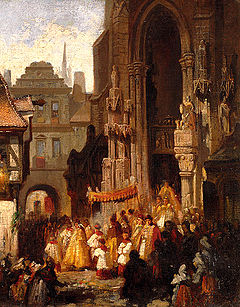
The Feast of Corpus Christi celebrates the Presence of Jesus in the Sacrament of the Body and Blood inspired by the visions of Juliana of Liège, a 13th century Norbertine canoness, and the thought of her contemporary St. Thomas Aquinas. The Thomistic term of “substantial presence” doesn’t seem to excite many people today, but the hymns Thomas wrote for the feast suggest that such terms did inspire a strong sense of devotion in the great Dominican thinker. For Thomas, the term “substance” was powerfully substantial. The elaborate Corpus Christi processions that evolved from this feast look more than a little triumphant when the Person present in the host is an Eternal Loser in the heavens but this is a loser still trying to make all of us winners for losing.

In any case, we need to remember that this presence in the sacrament is a person and a person lives a story. Is this a story we can swallow? It isn’t too hard to believe that a popular person was accused of many crimes and put to death. This is a story that has been told of many people many times, but this sort of story is a bitter pill to swallow. The Resurrection of Jesus sounds to many like a whopper that nobody can swallow, however nice it might be to swallow a story that gives us life. This is not the time or place to argue the truth of the Resurrection. Let it suffice that the death and Resurrection of Jesus is the story we swallow when we partake of the Eucharist. It is a story that touches on our vulnerability, both physical and moral, one that is sobering but also hopeful. It is a story that challenges us to be as life-affirming in the face of human death-dealing as Jesus was. There’s a lot of substance in all that!

Triumphant Loser

The Ascension is a feast of triumph where Jesus rises to Heaven to take his seat at the right hand of his heavenly Abba. There is much rejoicing in our celebration of this feast but it’s hard to pin down what the celebration is all about. Towards the beginning of his great Epistle to the Ephesians, Paul celebrates this triumph of Jesus which has brought him “far above all rule and authority and power and dominion and above every name that is named, not only in this age but also in the age to come.” (Eph. 1: 21) That’s pretty high up, about as high as anyone, even God Incarnate, can go. However, before this outburst of triumph, Paul prays that our hearts may be enlightened to perceive the hope to which we are called and “what are the riches of his glorious inheritance among the saints.” (Eph. 1: 18) So what is this hope and what are the riches that Paul would have us understand and embrace?

With combativeness programmed into us before we’re old enough to know it’s happened, our first instinct is to see the triumph of Christ along the lines of the underdog winning against the stronger team, or an amazing come-from-behind victory. But such victories, satisfying as they are for the victors (and correspondingly humiliating for the losers) are still variations on the same old same old, that is, combats with winners and losers.

What we have a hard time seeing is that Jesus, for all the triumph, is still the loser. Yes, Jesus is above every authority and power, but it is as the vanquished one, the loser, that Jesus holds this high position. It isn’t that Jesus defeated Caiaphas and Pontius Pilate in the end; Jesus lost to them. If he had won, it would have been the same old same old, which would have made losers of us all. Rather, Jesus put himself at the mercy of all that he created with his heavenly Abba and the Holy Spirit. But if any of us should jump to claim the victory over the Divine Victim, what have we really gained? Perhaps something like a stone instead of bread.

We will soon see, at Pentecost, that the Holy Spirit gives the disciples power to witness to the truth of Jesus’ death and resurrected life. The truth of Jesus’ death that they proclaim is that, although innocent, Jesus was put to death by the Roman authorities under pressure from the Jewish leaders. But Jesus’ heavenly Abba raised Jesus from the dead with the offer of forgiveness and salvation to his persecutors. The triumph of Jesus is a triumph of innocent weakness, not a triumph of might and strength in the world’s understanding of strength. Jesus accepted loss so that all of us might win in the end.

We see this triumph through losing in the stoning of Stephen in Acts 7. Stephen berates the Jewish leaders for always persecuting the just ones such as Moses and the prophets. There is no sense of the forgiveness in his harangue that fills the other apostles’ proclamation of the truth of Jesus’ death. But then Stephen sees the heavens open to reveal the Son of Man at the right hand of God. Suddenly, Stephen is no longer an accuser but one who forgives before he dies, just like the risen victim he sees in glory. That is the victory of Christ that becomes the victory of Stephen. Forgiveness even unto death is the victory celebrated in the Ascension of Christ. This is the victory that earns life-giving bread instead of a stone. There is nothing higher than that!

The Shepherd’s Voice

When Jesus speaks of himself as a shepherd, he says that the sheep “hear his voice” and they follow him because they “know his voice.” (Jn. 10: 3-4) Interestingly, although this seems fairly straightforward, John says that his listeners “did not understand what he was saying to them.” (Jn. 10: 6) We get an important clue as to the problem if we note that Jesus is speaking to the same people who had taken umbrage at his healing of the man born blind, people who said they could see when they really couldn’t. It is not surprising if these people were hard of hearing as well.

Thinking of hearing the “voice” of the shepherd reminds me of one of the anecdotes told by Oliver Sachs in one of his books about neurological patients. A group of patients recovering from strokes were listening to the speech by a president (several years past now). Most of them were laughing although they could not understand a word of it as they were suffering from aphasia. They were laughing because they knew the president was lying. It seems that undistracted by any intelligibility of the words, they could sense the tone of the voice with great clarity. One woman had the opposite problem. She could not hear the inflections but she could understand the words. Undistracted by the inflection, she knew that the words were incoherent.

Many times, Sachs demonstrates that we learn how the brain works through various malfunctions. Normally, hearing the content and the inflection is one seamless phenomenon but the separation caused by events such as a stroke show that each is done by a separate part of the brain. Although the two functions are distinct, and there are advantages to noting the distinction, we want them to work well together. In some ways, the distinction between the two helps us use them well together.

This suggests that there are two dimensions to the art of hearing the voice of Jesus the Good Shepherd. There is the intelligible content, but there is also the intonation, the way the voice modulates and sounds in the heart. Let us start with the image of the shepherd that references many passages in the Hebrew Bible. There is David, who fought lions and bears to save his sheep, Psalm 23 where the Lord as shepherd guides us through the dark valley, and most of all, Yahweh as the true shepherd in Ezekiel 34 who cares for his sheep. We have the content, then, of caring, and the intonation would also need to convey the same degree of caring, even self-risking and self-sacrificial caring. Maybe the other lections can give us more guidance.

The image of the shepherd does not appear in the vision of the early church in Acts 2, but this vision shows each member caring for all the others, giving of their own substance to those who have need. The tone of voice of caring is matched by actions of caring. In a sense, each member is a shepherd for all the others.

In First Peter, we have the theme of caring taken to extremes. The suffering Christ is the touchstone for how each of us should suffer injustice. It is not mere meekness, for it takes great courage to endure such suffering and shame when one has the power to retaliate and gain the upper hand, something Jesus did not do. In John’s Gospel, this self-sacrificial style of being the shepherd is set up at the beginning when John the Baptist calls Jesus “the Lamb of God.” At the end of John’s Gospel, Jesus asks Peter three times if he loves him and when Peter says yes he loves Jesus, Jesus says “Feed my lambs.” In Revelation, Jesus is again the Lamb slain since the foundation of the world. Jesus, then, leads the sheep as the sacrificial lamb, rather than as the sacrificer, something even King David turned out to be in the case of Uriah the Hittite. Again, the tone of voice and the action must coincide with this sense of self-giving.

Edifying and powerful as the passage in First Peter is, there is a disturbing element here. In the verse immediately preceding this passage, Peter admonishes slaves to obey their masters. Does this passage, then, condone slavery? Here is a test case for tone of voice and content. A master may well consider himself a shepherd of his slaves, but what kind of shepherd would such a master be? Does such a master share of his material substance the way that they early Christians in Acts are said to have done? If a master acted in this way, could he even really be a master? Does a master sacrifice himself on behalf of the slave as Jesus sacrificed himself for his sheep? On the contrary, doesn’t the master expect the slaves to sacrifice their lives for his sake? A master who talks a good game of caring for his slaves would come across like the president whom the aphasic patients knew was lying, and the content of his words would be fundamentally incoherent unless he really acted like the Lamb of God, in which case, he would be the slave and the slave would be free. It needs to be noted that it is a lot easier to see this passage in First Peter in this way than it was when the letter was penned or in the US before 1865. That is to say, social pressures can drown out the voice of the shepherd when he calls to us and tries to lead us in new paths.

Perhaps these thoughts can help give us a sense of Jesus’ voice and help us recognize the voice of Jesus in the words and tone of speech of those who speak to us. And perhaps these thoughts, too, can help us speak with the tone of voice of one who will follow the Lamb of God wherever he goes. And if we do try to speak in this way, let us be honest if we halt and waver. After all, Jesus halted and wavered at Gethsemane. Being a Lamb of God is not a challenge to take lightly.