Respect (3)

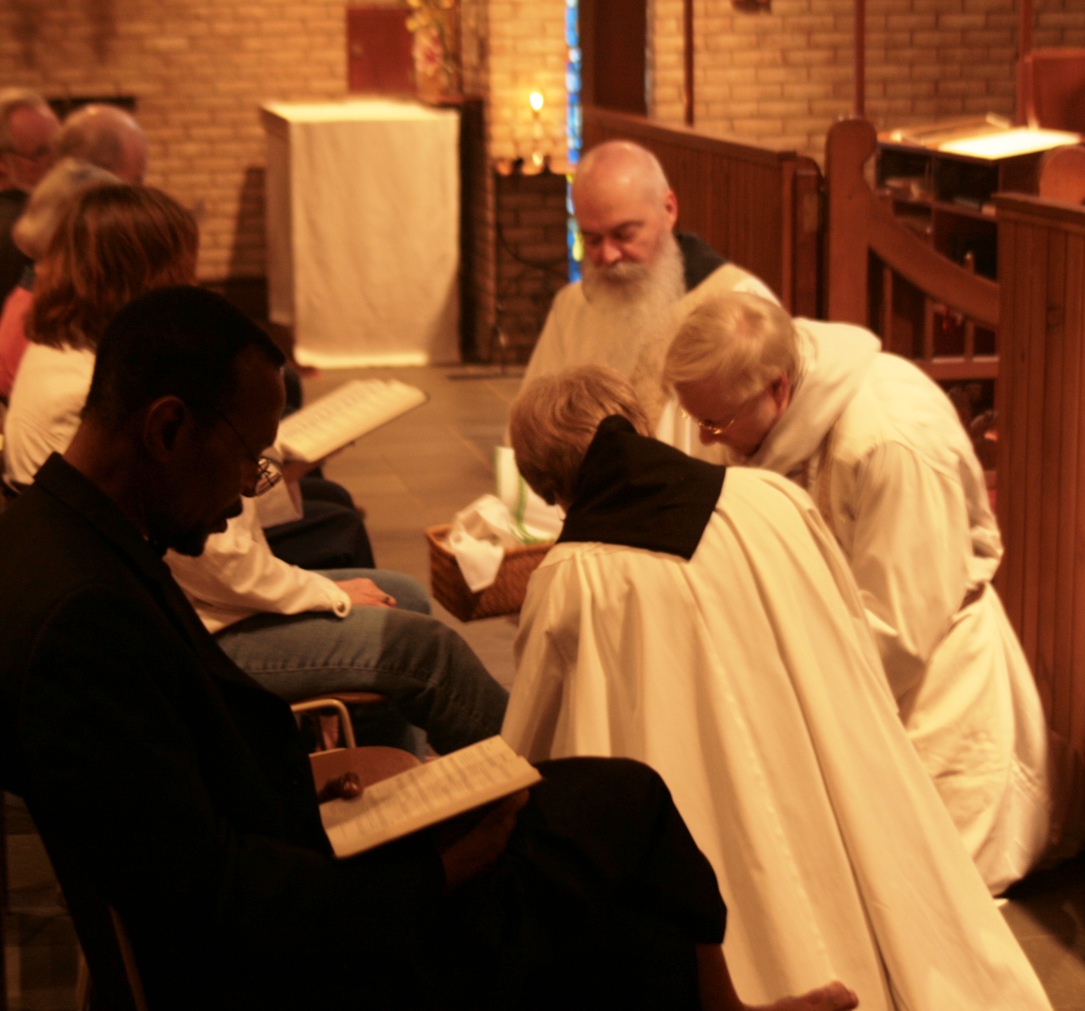
AndrewWashingFeet - CopyThe situation of the cellarer of the monastery providing for people who depend on his solicitude is quite the opposite of the person who approaches God in prayer “humbly and respectfully.” The cellarer himself would be on the other end of the stick on this one. Here is the danger of projecting worldly power on God when God is approached humbly and respectfully. If we picture God as a whimsical potentate who grants favors or withholds them in plays of power the way we do if and when we get a chance, then we slip into playing these power games with people who depend on us. This is precisely what Benedict forbids the cellarer to do. Benedict forbids such behavior because it goes against the Gospel.

St, Benedict famously insists that “all guests who present themselves are to be welcomed as Christ.” Benedict goes on to quote Matthew 25 to emphasize the point. Likewise, the cellarer, in attended to fellow monastics and guests should do the same. Benedict also says that “care of the sick must rank above and before all else, so that they may truly be served as Christ.” Once again, Benedict quotes Matthew 25. “The Lord of all things” whom we approach in prayer with our needs, who is greater than “a powerful man” from whom we might ask a favor, identifies with the humans who approach us in need.

We all have a hard time respecting people in positions subordinate to us, especially if they are needy. We instinctively look down on them because we think we are the ones with something to give or withhold. In other words, were are in the winning position and we like it that way. However, if Christ assumes the “losing” position, and Christ is the King whom we should obey, then we should be obedient to the needs of others in a respectful way. We might say that Christ makes other people respectable even if they have no respectability within themselves. The implication of this, of course, is that we also lack respectability within ourselves and it is Christ who gives us respectability.

The theological principal for saying that a person is entitled to respect just for being a human being is that we are each made in the image of God. That is true, but Christ’s identification with each person in need, and we all are in need in some ways at some times, is superadded to our creation in God’s image. This super-addition is based on Christ’s redemption of us, Christ’s having died for us. Since Christ died for everybody, Christ identifies with everybody. By identifying with each of us, Christ takes the rivalry out of the relationship. The way we relate to one another has nothing to do with winning, with having the upper hand in some way. Christ has leveled the playing field. Christ is focused on the needs of each one of us. That means Christ is focused on our own needs and also the needs of the people we encounter. It is doing what we can with another’s needs and having a kind word when we can’t. (And we often can’t fill another’s needs.) In all this, we participate in Christ’s respect for us, which makes us more respectable than we were.

Respect (2)

WilliamGuestsChurch1

[A continuation of Respect (1)]

The importance of respect can be easily seen when we think of routine encounters. Love is too freighted a term for the way we interact with, say, the person at the checkout counter of a store. It is obvious that courtesy and respect are called for but not love as it rests (and twists and turns) in the popular imagination. We all know how much we appreciate doing business with people who are respectful and how much we avoid doing business with those who aren’t. In such cases, respect isn’t much of a feeling but it is a set of actions and a manner of speaking. Although receiving respectful treatment gives us a low grade sense of well-being, disrespectful treatment tends to make us instantly angry and all sense of respect flies out the window or through the wall. Disrespect makes the smallest exchanges seem big and highly significant while we don’t think of much of respectful encounters. The thing is, both respect and disrespect are highly contagious but the latter is especially so. We tend to think we are owed respect just for being people and feel violated if we are not treated respectfully. Yet we are apt to think other people should earn our respect. This looks like a double standard but I can sympathize. This sort of attitude comes naturally to me. However, if God’s unconditional love for us is taken as a model for human relationships, it follows that we should give unconditional respect, which is harder. We can fool ourselves into thinking we only hate the sin but love the sinner, but how about respecting the sinner while hating the sin?

The chapter on the Cellarer of the monastery in the Rule of St. Benedict (Chapter 31) is the most concise and articulate view of respect and courtesy that I know. The cellarer is the monk responsible for providing for the community and guests. To do that, he needs to respect the tools and all other material goods to the extent of treating them as if they were “sacred vessels of the altar.” Here is an indication of the continuum from respect to God in prayer to respect for material reality in one’s work. The cellarer should provide “the allotted amount of food without any pride or delay lest they be led astray.” That is, the cellarer should be respectful of the needs of others and should not take advantage of his position to play petty power games with people the way some bureaucrats will with their tiny turfs. The Latin for “leading them astray” is scandalizaverit which means scandalize, place a stumbling block before the other. “Scandal” is a word imported from the Greek New Testament and is the word Jesus used when he warned against causing his “little ones” to stumble, a verse Benedict goes on to quote. Jesus and Benedict are alerting us to a human tendency that René Girard has more recently pointed to: the human tendency to make oneself a stumbling block for another by making a simple encounter a contest of wills. This is precisely what Benedict wants the cellarer to avoid. (I discuss scandal in Girard and Benedict in my book Tools for Peace.)

On the contrary, if the cellarer does not have a requested item, he should “offer a king word in reply.” When I was guestmaster for the monastery, there were times when I did not have room to accept any more guests and I kept this admonition in mind and tried to speak kindly and give encouragement for coming at another time. If the cellarer should be the one who suffers discourtesy, he should “reasonably and humbly deny the improper request.” The onus is on the cellarer to stem an escalation of disrespect by treating even a disrespectful person with respect.

Continued in Respect (3)

Respect (1)

churchDistanceBlossoms - CopyHumility and respect are the two fundamental attitudes that are most conducive to living constructively with mimetic desire and avoiding its more destructive potential. Both attitudes need to be habitual dispositions to be effective. Such habitual dispositions are not automatic the way many habits (especially bad habits) tend to be. They need to be renewed every day, every hour, or they will fall away.

Although St. Benedict attaches great importance to outward action, both in manual work and what he calls “the Work of God,” i.e. the Divine Office, Benedict also attaches much importance to the inner disposition supporting these outward observances. In his short chapter 20, “Reverence in Prayer,” Benedict says: “Whenever we want to ask some favor of a powerful man, we do it humbly and respectfully, for fear of presumption. How much more important, then, to lay our petitions before the Lord God of all things with the utmost humility and sincere devotion.” When the Gospel is read at the end of Sunday Matins, the worshippers should “stand with respect and awe.” After each psalm, we should stand in honor of the Trinity.

Humility and respect are so intertwined that it is hard to separate them. They are inseparable in the sense that one cannot have one without the other. However, there is some distinction between them in that respect is directed towards the other, whether God or our neighbor whereas humility is rooted in the self. I want to deal with respect first and then move on to humility.

The first question that comes to mind is: Why respect instead of love? Isn’t Love the primary Christian virtue? Yes, love in the sense of agape is the primary Christian virtue but I think we need to start with respect. It is a case of serving milk before solid food to make sure we are ready for it, trained “to distinguish good from evil” (Heb. 5:14). That is, respect is a prerequisite for love. If we try to leapfrog this prerequisite, there is a real possibility of mistaking lust and other noxious attitudes for love. A tragic example in the Bible is Amnon. He probably thought he loved Absalom’s sister Tamar but his use of force to rape her and his callous rejection of her afterwards makes it clear he had no respect for her and therefore no love. Love is often spoken of as a conquest or an attempt at one. Amnon conquered Tamar through a clever but devilish plot. Don Giovanni made such conquests by the hundreds If Leperello is to be believed. But does Don Giovanni show respect for Donna Anna, Donna Elvira or Zerlina in Mozart’s great opera? Not in your life. What erroneously passes for love sidesteps respect entirely and sidesteps love as well.

One never tries to win respect by conquest. There is no contest with respect, neither is there any mimetic rivalry in respect. Whereas love without respect tries to woo another person into conformity to one’s feelings for that other, respect does no such thing. Respect does not require that another person feel the way I do about anything. Respect is about relating to another, not winning anything. Maybe relating doesn’t seem like much compared to conquering another person. Actually, relating is quite an accomplishment because it involves conquering oneself.

Continued in Respect (2)

The Earthquake that Saves

abyssIn Matthew’s Gospel, the Resurrection of Jesus causes an earthquake. Just as an earthquake shakes up the earth, the Resurrection shakes us up, fatally undermines the way we have lived our lives, and gives us a radical reorientation. But did the Resurrection have to be an earthquake? Could it possibly have been a smooth transition from a good quality of life to a better one?

According to seismology, an earthquake is caused by one or more faults under the surface of the earth. A fault can hold its position for some time but it is inherently unstable and it will slide sometime or other and cause the earth to shake. The Resurrection could not help but cause an earthquake because there were faults in human culture just waiting to shift when the event occurred. A look at the Old Testament readings we read during the Vigil can point out where the faults were and still are.

The story of the Flood shows us what Cain’s murder of Abel led to: a society overwhelmed with violence. They did not need God to create a flood to carry them away; their own violence had overwhelmed them like a flood. The near-sacrifice of Isaac by Abraham refers to the institutionalization of sacrifice to stave off the meltdown of the Flood. The people were convinced that somebody must die in order that the people might be saved. That is what Caiaphas said to justify the execution of Jesus. Abraham thought somebody must die until an angel (messenger) of God told him otherwise. In Jesus Risen in our Midst Sandra Schneiders points out that God wanted neither Isaac nor Jesus to die, but while Abraham obeyed God, Caiaphas and Pontius Pilate decided otherwise. Pharaoh’s Egypt was a society held together through institutionalized sacrifice: the enslavement of the Hebrews. When plagues struck, Pharaoh blamed the Hebrews and drove them out. God transformed the event into a deliverance from slavery. Like the people in Noah’s time, the Egyptians were overwhelmed by their own violence. (When Jesus welcomed the children that his disciples tried to keep away, he showed for all time that God is not a child killer.) These are the fault lines that could only slip and shake the earth when the angel of the Lord “descending from heaven, came and rolled back the stone and sat on it.” The guards, representatives of the sacrificial culture, became “like dead men.” Death is what sacrificial cultures lead to.

The angel’s words “Do not be afraid” are at least as earthshaking as the earthquake. These words of peace turn us upside down and around in circles. What is the man we killed to stabilize society going to do to us now that he is out and about again? Why would he tell us not to be afraid? What is this world coming to? Two women both named Mary who live on the margin of the society of their time, a society that would not let them testify in court as witnesses, are asked to be witnesses to this momentous news, to the momentous presence of life. They run off with “fear and great joy.” Mary and Mary don’t get far before they meet up with Jesus who greets them and repeats the angel’s words: “Do not be afraid.” Jesus de-centers us once again by taking us from the center of religious and political power to that backwater Galilee where he will start a new life for us. St. Paul says of the Hebrews who were delivered from Egypt that we all “passed through the sea and all were baptized into Moses in the cloud and the sea.” (1 Cor. 10:2) When we renew our baptismal vows, we renewed our commitment to being overwhelmed by God’s deliverance from a sacrificial culture that creates fault lines to a new culture based on the forgiving victim. These words are spoken not just to the two women but to the two guards and to each one of us. Sandra Schneiders says: “In the Resurrection God gave back to us the Gift we had rejected. Can we accept the gift of peace this time around? Can we spread the news to others and, most important, to ourselves that we have been delivered from the flood waters of our violence to a new land, a new way of living where we do not need to be afraid?

Escape from the Denial of Death

cemetery1Richard Beck’s new book The Slavery of Death works with the powerful thesis of Ernest Becker which states that fear and denial of death fuels human aggression. I have read both of Becker’s books (Denial of Death and Escape from Evil) and I find Becker’s analysis of this phenomenon compelling. Moreover, much scientific testing has verified Becker’s theory. Beck outlines Becker’s demonstration this existential fear of death and its subsequent denial leads to striving for heroism. For Becker, heroism is a compulsive drive to succeed, to prove that one matters, and to gain recognition for one’s efforts. One might think that there is nothing wrong with any of this but this neurotic striving for “heroism” comes to the expense of other things in life such as family and friends. Moreover, the social settings for such striving tend to magnify aggressive behavior so that not only fearful individuals but the social groups as well persecute others to validate themselves.

Impressive as Becker’s insights are, they are very bleak and they don’t offer humanity any constructive way out the denial of death except, perhaps, a heavy dose of Stoicism. Most humans find this cold comfort at best and an impossible prescription at worst. Might as well join Jean-Paul Sartre in a life of existential despair.

Richard Beck brings Christian theology and spirituality to Becker’s insights which brings us into a whole new ball game. To begin with, he notes the importance the Eastern Orthodox Churches give to Death, rather than Sin being the prime enemy that Jesus must destroy. He adds depth to the slavery to “heroism” by comparing it to the “principalities and powers” of the world denounced by St. Paul. Beck then uses the social and anthropological thought of Walter Wink and William Stringfellow (who deserves to be much more remembered than he seems to be) to help us see the strength of social forces that pull us into a “heroic” mode. Much more important, Beck shows how an eccentric life can pull us out of this death anxiety so as to live a healthy, loving life. Beck is not talking about being somebody’s eccentric uncle; he is talking about living a life centered outside the self. He uses Arthur McGill as a resource for understanding how love and concern for others benefits the one doing the loving by pulling us out of ourselves. Jesus, of course, is the perfect example of eccentric living. Jesus was positioned fully out of himself out of concern for others and also his grounding in his heavenly Father. That is why, although he feared the painful death to come in Gethsemane, he had the courage to endure it. Lest one be overly daunted by the extent of Jesus’ self-sacrifice and that of people like Teresa of Calcutta, Beck also shows how important small sacrifices on a daily basis are for eccentric living. These are within reach of everybody. The “little way” of Thérèse of Lisieux is are stirring and practical example. For Thérèse, eccentric living can be as simple as pushing a wheelchair of an elderly sister who complains bitterly over every bump on the way. It is such eccentric living that leads to Jesus’s resurrected life which we are all invited to share.

Mimetic Blessing through Abraham (2): Abraham’s Offspring

Jacob_Blessing_the_Children_of_Joseph_-_WGA19117[Continuation of Mimetic Blessing through Abraham (1): Cain and Abel

God promised Abraham that he would have as many descendants as the dust of the earth. (Gen. 13:16) I like the later image of the stars in the sky and the grains of sand on the seashore (Gen 22:17) but the earlier image ties in with the creation of humanity out of dust, thus making it clear that descendants of Abraham (like us) are part of God’s ongoing creation. That’s how expansive God’s blessing and being God’s blessing can be.

When Abraham and his nephew Lot found there was tension between their herdsmen, Abraham suggested that they separate and he gave Lot the choice of taking the land to the left or the land to the right. This is quite the opposite from what most of us do which is the first see what the other desires and then desire it for ourselves. Instead, Abraham renounces desiring what his nephew desires and goes in the other direction. (The better-looking land turned out to have its liabilities but that is another story.)

Unfortunately, Abraham does not renounce mimetic desire and rivalry when it comes to his sons Ishmael and Isaac. In spite of being called to be a blessing and promised as many descendants as the dust of the earth, Abraham fails to believe that both of his sons can inherit the blessing he has been given by God. Far from fighting each other, Ishmael and Isaac play well together but they fall victim to the rivalry between their mothers. (Women are equal participants in the mimetic rivalry game in Genesis.) Abraham casts Ishmael out so that his favorite son born of Sarah can inherit the blessing. God, however, makes it clear that there is a blessing for Ishmael, too, even if Abraham did not believe it.

Following his father’s example, Isaac assumes that only one of his two sons can receive his blessing and, like Abraham, he wants to give it to his favorite son. Rebekah’s involvement in this rivalry causes this Isaac’s scheme to misfire. This time, it is the son who receives (takes) the blessing who is exiled where Jacob spends many years in rivalry with his kinsman Laban. When Esau re-enters the story on Jacob’s return, we can see that Esau has done well for himself and has no need to envy his brother’s success. Apparently there was a lot more of a blessing left for Esau than Isaac thought.

Jacob stubbornly upholds the family tradition of disbelief in the scope of God’s blessing and singles out his favorite, Joseph, over/against his ten older brothers. This time the fratricidal strife has enough brothers to create a scenario of collective violence. In contrast to the primitive sacred, however, the unanimity is not complete. Both Reuben and Judah, separately, make plans to save Joseph but they both fail. If they had stood up to their brothers, the mimetic process would likely have been redirected in a peaceful direction. The upshot of the story is that Joseph ends up becoming a blessing to Egypt and to lands far beyond and he saves his own family through his foresight in collecting food during the years of plenty. (Joseph’s making the Egyptians buy back the food that had been taken from them does make Joseph less generous than his God.)

Before he dies, Jacob blesses the two sons of Joseph: Ephraim and Manasseh. He crosses his hands to indicate that Ephraim will be greater than his elder brother, but he gives both boys the same blessing. Finally, through excruciatingly painful experience, Jacob has learned that God has blessings for all of Abraham’s offspring.

Mimetic Blessing through Abraham (1): Cain and Abel

Cain_slaying_Abel,_1608-1609Fratricide is a running thread throughout Genesis. The rivalry portrayed in its stories do not involve romantic triangles as in novels and plays, but rather, the disputes are over blessings, the other running thread throughout Genesis.

In Creation God blesses humanity with all that God has created, but humanity rejects that blessing for the sake of one tree that then shrank to a barren landscape. To begin the process of re-gathering a scattered humanity after the Tower of Babel, God calls Abraham to leave his father’s house, i.e. the scattered, rivalrous civilization he was born in, and move to a land God will show him. When Abraham leaves the entanglements of mimetic rivalry behind, whole new vistas of possibilities suddenly present themselves.

God then tells Abraham:  “I will make of you a great nation, and I will bless you, and make your name great, so that you will be a blessing” and by him “all the families of the earth shall be blessed.” (Gen. 12: 1-3) We are so habituated to getting (or taking) blessings that we often fail to notice that God said Abraham would be a blessing and a blessing not just for him and his household but for all households. The intervening verse that God will curse those who curse Abraham is discordant. If God really is in the business of blessings, then God is not in the business of cursing. After all, Jesus did not curse those who cursed him and worse. However, we could say that when we curse someone who is a blessing, and through Abraham everybody is a blessing, then we are consumed by our own cursing.

We see all this already at play in the story of Cain and Abel who fight over a blessing and the supposed lack thereof. Genesis does not tell us why God accepted Abel’s sacrifice and not Cain’s. Girard’s theory of collective violence founding culture leads me to suggest that tilling the ground was a factor. There could have been mimetic rivalry among nomadic herders of sheep but tilling the ground like Cain was all the more conducive to rivalry over particular plots of land, such as Ahab’s coveting Naboth’s vineyard. The proliferation of vegetative dying and rising deities in mythology suggests that landed economy lead to mimetic crises and their resolution through collective violence. On the other hand, when we note the alleged zero sum blessings in the fratricidal strife that follows, maybe Cain jumped to the conclusion that when Abel was blessed, there could be no blessing for him.

What is decisive is that when Cain’s offering was rejected, or he thought it was, he embroiled himself with Abel, which was also to exile God. God called out to Cain, something God continues to do with violent humans to the end of time, but Cain would not let go of his preoccupation with his brother until he had killed him.

Afterwards, Abel’s blood cried from the ground. This is a marked contrast with the fratricidal myth of the founding of Rome where the blood of Remus was silent. Like Romulus, though, Cain was a founder of culture while Abel was the first prophet as defined by Jesus in Mt. 23:35, that is, a prophet is a victim. Abel’s blood seems to have cried for vengeance. The author of Hebrews, however, says that the blood of Jesus “speaks a better word than the blood of Abel.” More proof that God is in the business of blessing and not cursing.

Proving Shylock Right—Or Wrong

ShylockThe first thing that usually pops into anybody’s mind when Shakespeare’s The Merchant of Venice comes up is the cardboard stereotyped Jew Shylock. After Auschwitz, we cannot slip into enjoying this caricature the way earlier audiences might have if so inclined. On the contrary, we are apt to dismiss the play now that we realize how lethal such stereotyping can be. The second thing about the play that usually comes to mind is Portia’s set of three boxes where it is not the gold or silver covers that lead to her riches, but the unattractive lead cover. Appearances can be misleading and so perhaps it will be worth looking for what is beneath the ugly stereotyping.

It’s hard to find any gold under the ugly exterior of Shylock’s behavior, but it is equally hard to find any gold under the apparently more attractive exterior of Antonio’s behavior. Antonio is noble in that he is willing to give surety to a loan for his friend Bassanio, thus accepting the risk, but the way he treats Shylock is shameful. In one respect, Shylock is offering to do good to an enemy, but in another, he is hoping that the interest-free loan will lead to Antonio’s downfall by the extraction of a pound of flesh. It is important to realize that both men are mimetic doubles, rivals in the quest for increasing wealth for the sake of wealth.

In Shylock’s famous speech, when he is taken to task for his vengeful terms, he insists he is exactly the same kind of man as any of his Gentile rivals:  “If you prick us, do we not bleed?” Which is what would happen to Antonio if a pound of flesh is cut out of him. “If you wrong us, shall we not revenge? If we are like you in the rest, we will resemble you in that.” Shylock’s detractors are trying to distinguish themselves from Shylock because they are merciful, but mercy is conspicuously lacking in their treatment of Shylock.

Meanwhile, Bassanio is often thought to have proven himself wise by choosing the lead casket, which wins him the hand of Portia in marriage. The speech he makes before making the choice, however, shows that he is not wise by cunning and calculating in his own desire for wealth. “Thus ornament is but the guiled shore/To a most dangerous sea.” Bassanio is so used to disseminating that dissemination is what he expects of Portia. And he is right.

The famous trial scene features Portia’s famous praise of mercy: “The quality of mercy is not strain’d,/It droppeth as the gentle rain from heaven.” This is as golden a speech as any in Shakespeare. But—mercy is—again!—lacking in dealing with Shylock. By the end of the trial, he has lost his wealth, his livelihood and his religion. Portia’s words seem to echo Ecclesiasticus 35:20: “Mercy is seasonable in the time of affliction as clouds of rain in the time of drought.”  But her actions belie the beautiful words, thus proving Shylock right when he says that when wronged, Christians revenge—just like Shylock. Unfortunately, we have a golden casket with nothing rich inside. The words, however, really are golden and invite any of us who rejoice in Shylock’s downfall to open our hearts to accept this gift from heaven.

Seeing with More than the Eyes

churchDistanceBlossoms - CopyJesus’ healing of a man born blind in John’s Gospel (chapter 9) is much more remarkable than fixing the eyes so that they can see. In order to really see, the healed man would have needed a radical overhaul of his neurological system so that his brain could grasp what was being seen. John didn’t know about neurology but he did know that really learning to see involves at least as radical an overhaul of our human system to heal our deeper levels of blindness.

John shows us the blindness surrounding the blind man when the disciples ask Jesus if it was the man’s own sin or the sin of his parents that caused him to be born blind. The notion that the poor guy sinned before he was born should be enough to show us how blind this attitude is. This blindness was compounded by excluding the blind man from the religious practices of Judaism because he was blind. Neither the Jewish leaders nor even Jesus’ disciples could see any potential worth in the blind man.

That Jesus shows the intention to take the man’s blindness as an occasion for revealing God’s work rather than for blame by putting mud on everybody’s eyes to recreate the world for us. The Jewish leaders react to the healing with anger. They seem determined from the start to discredit the healing rather than change their own way of seeing. Their search for blaming was rewarded when they discovered that the healing was done on the Sabbath.

It is important not to let Gospels stories such as this discredit the Jewish practice of the Sabbath. It was a great gift for Jews and for Christians who treat Sunday in a similar fashion, a day for renewal. That is the key: a day for renewal. The use of mud paste clearly refers back to the creation of humanity out of moist clay. The blind man is being recreated. In sharp contrast to the paralytic in John 5 who remained as paralyzed as he ever was no matter how much he carried his mat, the formerly blind man shows himself to be renewed at a very deep level. The clever way he handles the hostile questions from the Jewish leaders reveals a man with sharp intelligence and wit. Meanwhile, the Jewish leaders make it clear that their initial judgment that the blind man was a sinner and an outcast was immutable. As long as he was blind he was an outcast and once he could see, he was cast out for being healed by the wrong person in the wrong way. There can, of course, be no renewal, no re-creation if we insist on being immutable, neither can we see renewal or re-creation even when it takes place right under our noses.

But the man shows even more. James Alison’s concept of the “intelligence of the victim” suggests that the blind man had insight into what life was about and what God was about because he was blind and an outcast. He was given the opportunity of repudiating Jesus the way the paralytic did, which would have brought him approbation from the community, but instead, he staunchly defended Jesus, which landed him in the precise place of blame and expulsion as Jesus himself. It is in this place that the man really sees.

The disciples fade from the story after their question about who sinned, but far from really disappearing, their circle expands to include all of us who read and hear the story. This expansion forces us to choose: will we let Jesus re-create us in the place of shame shared with the man born blind, or will we hop out of the circle so that our lives will continue to be etched in stone?

Ignatiusly Reading

Ignatius_of_Loyola_(militant)[This is a companion post to Quixotic Reading]

Reading in a life-giving way is not primarily a matter of reading but of living; of how we read our lives. Don Quixote idolized Amadis of Gaul, Emma Bovary idolized her lovers and Werther idolized Lotte. The primary reason for the Werther effect is that readers of Goethe’s novel committed the same idolatry through mimetic desire as did Werther. If we are too embroiled in our mimetic desires to have eyes to see what Cervantes and Flaubert see, then we will only see what Goethe seems to have been able to see when he wrote Werther: the despair of desiring a woman desired by another who has made that woman unattainable. That is, the way the readers of Werther were living their lives affected their reading and their reading reinforced the way they were living their lives.

In his incisive study of Don Quixote (The Humble Story of Don Quixote; Reflections on the Birth of the Modern Novel) Cesario Bandera leads us to the heart of the Don’s problem and ours: “God-like Amadis is not God. God transcends empirical reality but does not ignore it or make it irrelevant.” The more we look at the world around us and interact respectfully with it, the less apt we are to be swept away by the fantasies of mimetic desire. God “demands an absolute act of faith beyond empirical reality, but such an act of faith does not obliterate the inherent rationality of the world ‘out there.’ The act of faith is essential only to prevent empirical reality from becoming a god unto itself, an idol.” (p.155) Bandera is alerting us to the problem of allowing our models to distort the world around us, making models like Amadis or Albert (Lotte’s husband) the lens through which we interact with the world instead of God.

Ignatius of Loyola provides an instructive contrast to Don Quixote. According to his Autobiography, Ignatius liked to read the same sorts of chivalrous romances the Don Quixote did and, while he was recovering from his battle injuries, he asked for this sort of literature, but only a life of Christ and a book of the lives of the saints was available, so he read those instead. These books changed not only what Ignatius read, but how he read. Not only did he stop to think about the things he was reading, he also stopped to think “about the things of the world that he used to think of before.” That is, Ignatius was using what he read to connect him to real life, the life God had created rather than what life looks like through the lens of an idol like Amadis. During this time of struggle and repentance, Ignatius then confesses his infatuation with the idea (not reality) of going into the service of a “certain lady,” oblivious to “how impossible it would be.”

But then Ignatius started to think about what it would be like to imitate Saint Francis or Saint Dominic who had imitated Christ? Such thoughts gave him consolation that thoughts of soldiering and chivalry did not give him. Here were models that were challenging but not impossible. Ignatius was spurred on to develop a spirituality based on the imitation of Christ, not an imitation of external actions only but, more important, of cultivating the inner disposition of Christ’s charity for others that was to become the backbone of his Spiritual Exercises. Bandera draws the contrast for us when he says that “unlike Christ, Amadis cannot give his follower what he wants without ceasing to be Amadis.” (P.157) That is, Amadis, if real, would be what Girard calls a model-obstacle whom Quixote would need to best in combat, which would change Amadis for the worse if Amadis was vanquished. Christ, on the other hand is a model without rivalry, who wishes to be imitated without rivalry. Ignatius discovered that Christ creates an abundance of charity that can only become more abundant through imitating him. The idea of imitating Jesus led to a real pilgrimage to Jerusalem and then to a real spiritual pilgrimage of imitating Christ for the rest of his life.