
Treasures in Clay Jars: Veiled Missions

GregoryIcon1When Paul says that “we do not proclaim ourselves; we proclaim Jesus Christ as Lord and ourselves as your slaves for Jesus’ sake,” (1 Cor. 4: 5) he is forcefully rooting his identity not in himself but in Christ. We are easily prone to the illusion that we each have a self that belongs to me and is mine to do whatever I please with it.

This illusion of an individualistic self is the veil “that has blinded the minds of the unbelievers who are perishing.” It is the “god of this world” who has cast this veil. The veil is what René Girard identified as the persecutory mechanism that has marred humanity since the dawn of civilization. It was precisely this system that was exposed in the Gospels’ narratives of Jesus’ death and Resurrection. When Paul says that the Gospel is veiled to those who are perishing, he does not mean that God is casting people into hell; he means that as long as the Gospel is veiled, we perish in our own violence without even realizing it. When we are not rooted in Christ so as to proclaim Christ rather than ourselves, we are caught in the winds of human desires that carry us in all directions, all of them prone to collective violence. Moreover, we fall into cunning and falsification of God’s word and the shameful things we hide. These reflections seem to continue Paul’s discussion in the previous chapter of this epistle of the veil that covers the faces of Jews when they read the Torah, but by universalizing the veiling, Paul moves the unkind words about his own people. Universalizing the veil has the great advantage of showing that neither Jew nor Gentile has the thicker veil; all of us have it when we fall into systemic scapegoating violence.

Paul appeals to creation as providing the light that takes away the veil and gives us a glimpse of the world as it is meant to be. “For it is the God who said ‘Let light shine out of darkness’ who has shone in our hearts to give the light of the glory of God in the face of Jesus Christ our Lord” (2 Cor. 4: 6). It is the fall into systemic violence that has obscured this glory. It is inspiring that this glory of the created world shows us the face of Christ, a hint that Jesus planned to enter into Creation to enjoy the world with us and didn’t come up with the plan to be incarnate just to make repairs when things went wrong.

It is perhaps this vision of creation unveiled that inspired Pope Gregory to discern what elements of the English culture could be converted rather than rejecting them wholesale. He advised Augustine of Canterbury to convert the temples rather than destroy them. Of course, just as we have to practice discernment as to what must and can be converted and subverted in another’s culture, we have to practice the same discernment with the veils placed over our own faces by our own culture. The famous story of how Gregory, before he became pope, was inspired to promulgate an English mission is a case in point. Upon seeing some fair youths in the slave market in Rome, Gregory asked who they were. On being told that they were Angles, Gregory, in uttering one of the most famous of puns, said that instead, they should become angels. If anything embodies the persecutory mechanism, it is slavery. Chesterton suggested that Gregory could (or should) have meant: “not slaves, but souls.” The veil lifted enough for Gregory to see the youths as humans in need of salvation and, as pope, he sent a mission to do just that, but the veil did not lift enough for Gregory to agitate for the abolition of slavery, much as he was willing to be a slave himself for the sake of those in need of his pastoral care. That job was left to an energetic descendent of the people converted by Gregory: William Wilberforce.

Preaching in the face of such veils, not least our own, is a daunting task and it is no wonder Paul urges us not to lose heart in the process. It is enough to make us feel like clay and Paul tells us that feeling like clay is exactly the way we should feel when faced with the task of preaching the Gospel. When we realize that we are made of clay, as Genesis 2:7 teaches us, we appreciate what a great gift are the treasures inside the clay jars that are us, a gift from God so that we can “commend ourselves to the conscience of everyone in the sight of God” (2 Cor. 4:2).

Abolishing Sacrifice to Establish Mercy

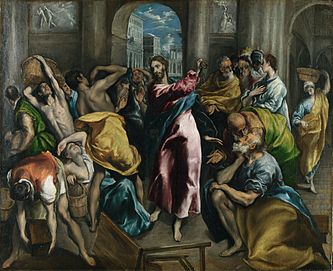
Jesus_cleansing_templeThe story of Jesus knocking over the tables in the temple and driving out the animals shakes us up but then we wonder what we should be all shook up about. Jesus’ act can be seen as the climax of repeated protests of the Hebrew prophets against the sacrificial cult in the temple. Jeremiah mocked his listeners who jabbered: “This is the temple of the Lord! The temple of the Lord! The temple of the Lord!”  (Jer. 7:4). Then there is God’s mocking question from Psalm 50 and repeated elsewhere: “Do you think I eat the meat of bulls and drink the blood of goats?” Amos proclaims God’s hatred of festivals. Most telling are the words of Hosea that Jesus quoted: “I desire steadfast love and not sacrifice, the knowledge of God rather than burnt offerings” (Hosea 6:6.) There is much debate as to whether the prophets wanted the abolition of the sacrificial cult or a reformation that would bring it in line with moral values. In driving out not only the money changers but also the animals about to be sacrificed, I think Jesus is doing a bit of guerrilla theater to prophecy the end of the temple cult, a prophecy fulfilled in 70 A.D. when the combined violence of militant Jew and the imperialistic Romans resulted in its destruction.

When asked to explain his actions, Jesus said: “Destroy this temple and in three days I will raise it up” (John 2:19) This literalist interpretation is promptly debunked by the evangelist when he says that Jesus was “speaking of the temple of his body” (John 2: 21). So much for biblical literalism. The implication that Jesus is replacing the temple with his risen body is a strong indication that he intended to abolish the sacrificial cult. What was wrong with the sacrificial cult? The quote from Psalm 69 “zeal for your house will consume me” shows us the problem if we note the context. Psalm 69 begins with “Save me O God for the waters have risen up to my neck.” The psalmist tells God that he is suffering the same reproach people level against God: “the insults of those who insult you have fallen on me.” This psalm is referred to as one of the “passion psalms” and has been interpreted as a prophecy of Christ. However, I don’t think the psalmist was gazing into a crystal ball and seeing Christ’s Passion; I think the psalmist was complaining about collective violence that was happening to him at the time. The number of persecution psalms and the fate of many prophets, suggests that the Gospels are revealing the human tendency to solve social conflicts by uniting against a victim which is precisely the outcome Jesus predicts when he explains his actions at the temple. T

he prophets consistently denounced the sacrifices made on the “high places,” pagan sacrifices to deities like Moloch who even required the sacrifice of their children. The sacrifice in the temple was more humane in that it was restricted to animals, but the practice derived from the notion that “god” was angry and would be appeased only by sacrifices. The prophets’ denunciations of the temple cult were consistently coupled with denunciations of social violence and injustice where the poor were sold for a pair of sandals as Amos complained. Although it is argued that the prophets thought the temple sacrifices were acceptable, maybe even laudable, if accompanied with righteous actions in the social sphere, but they seem to have a sneaky suspicion that the practice of sacrifice tends to encourage social injustice. The temple setup was, after all, a terrible financial burden on the poor. (I think Jesus was not edified but outraged over the widow who gave the last two coins she had to live on.) The logic of sacrifice was that some living being was always dispensable precisely as the victims of collective violence at the times of social crises were dispensable and their deaths “necessary.” Caiaphas stated the sacrificial logic baldly when he said that it was better “to have one man die for the people than to have the whole nation destroyed” (John 11:50) In modern times this sacrificial logic is expressed by the regretful term “collateral damage.” These considerations suggest that the prophets were convinced that something was fundamentally wrong with sacrificial rites.

Jesus, on the other hand, has a totally different, opposite logic; a logic that Paul says is foolishness to the rest of the world. In John 6, Jesus says that everybody the Father gives him will come to him and nobody who comes to him will be driven away. The parable of the lost sheep makes the same point that it is not the will of our Father in Heaven that even one of his “little ones” should be lost. Jesus believed this so strongly that he would accept death on the cross to make the point and, more important, return as the forgiving victim to gather all who will come to him so that none of us should be lost. The pagan deities wanted sacrifices made to them. The prophets kept trying to get it across to everybody that God pours out sacrificial love to all of us through creation and redemption and that God wants the mercy God gives us in return, not sacrifices .  Caiaphas was willing to sacrifice Jesus and anyone else who put a spoke in the wheel of the sacrificial logic. Jesus was willing to sacrifice himself rather than sacrifice any of us. That is why we do not slaughter bulls on this altar but pass around the bread and wine through which Jesus gives His very self to each one of us.

Renouncing Self-Centered Renunciation

CrossofashesWith Ash Wednesday we begin a season of self-denial featuring prayer and fasting. We also renounce other pleasures to help us curb our desires a bit more than we do the rest of the year.

The asceticism of self-denial, especially that of fasting gives us an important of the interaction between mimetic realism. There is a paradoxical effect of self-denial that we can fall victim to if we are not careful. It is possible for self-denial to focus us upon ourselves in an unhealthy way. It is I who am fasting. I am giving up pleasures I normally indulge in. If we become so fixated on ourselves, we are puffing ourselves up rather than denying ourselves. Isaiah shows how such self-centered fasting leads to quarreling and fighting and striking others with their fists. (Isaiah 58:4) If self-denial has made us so grouchy that we have to make up for what we are giving up by giving ourselves the alternate pleasure of striking out at other people and putting them down, then it is grouchiness and lashing out at others that we must fast from.
Likewise, Jesus warns us against putting on long faces so that others will admire our fasting or blowing trumpets to call attention to our almsgiving (Mt. 6: 1-2). Once again, our self-denial is being compensated for by self-indulgence in other ways. When the admiration of others is filling our egos, then we need to fast from seeking such admiration. We may well find that this renunciation is harder than renouncing food and other pleasures. As we deepen renunciation, we become aware of deeper levels of our desires that need to be turned into a more positive direction.

Given this pitfall, I suggest that we emphasize the needs of other people and renounce ourselves by thinking of them rather than about ourselves. Isaiah suggests that a better fast would be to let the oppressed go free and loosen every yoke. (Is. 58: 6). Jesus echoes Isaiah’s sentiments at the beginning of his teaching ministry by proclaiming a Year of Jubilee that would free all people of their imprisonment to debt so as to give all a new start in life. (Luke 4: 16-20 Instead of puffing ourselves up, we should build up other people. Perhaps we will find this to be a greater renunciation that cutting back on our eating habits. In any case, renunciations of food and other pleasures will help us grow spiritually only if they are the basis for reaching out to other people. When we really think of others, we have less room in our hearts to think about ourselves.


Above the Circle of the Earth

treespath1The Babylonian exile was traumatic for the Jews. Those who were taken to Babylon had to live in an alien environment quite contrary to everything they believed in. But an interesting thing happened during this exile. The sages and prophets who were living in exile came to close quarters with the mythology and sacrificial religion of their captors. When the Jews had come close to the Canaanite religion earlier in their history, the clash had taught them a few things about what the God they worshipped was all about. When the prophets saw the sacrifices of children to Moloch, they knew that this was not the kind of sacrifice Israel’s God wished and they protested these sacrifices with all their might. In Babylon, they came up against a mythology of a violent creation that took place with the dismemberment of Tiamat who, of course, was the deemed the cause of all the problems among the deities and who had to be punished. Moreover, the reason for creating the world was to make servants who would serve the gods. The sages and prophets learned from this mythology that this was not what their God was about. The God who had delivered them from the Red Sea was freeing slaves; not making them. This God had created a people by delivering them from violence and from a violent culture. They were hoping their God would do it again, and God did just that when the Persians defeated Babylon and allowed the Jews to return to their home.

The Creation narrative that begins the book of Genesis can easily be read as a refutation of Babylonian mythology. Far from creation emerging from violence, creation emerges from the Word of God which allows creation to be. The prophet we call Second Isaiah also proclaims Israel’s God to be far different, fully Other, than Marduk and his pantheon. “With whom then will you compare me, or who is my equal?” asks Israel’s God in a question so rhetorical that it stops all human mouths (Is. 40: 25.) The violence in Babylonian mythology mirrors the violence of Babylonian culture and other human cultures as both deities and humans live in the same system of retributive violence. But Israel’s God “sits above the circle of the earth” (Is. 40:22.) That is, God is outside the system. From God’s vantage point, we are all like little grasshoppers. This God is the creator “of the ends of the earth.” Not only that, but God “gives power to the faint, and strengthens the powerless” (Is. 40: 29.) Far from creating servants, God serves the creatures God has made and God serves most especially the powerless, like a rabble of slaves in Egypt and an exiled people in Babylon. Grasshoppers may be small in size but they are great in God’s care.

This vision of God as one who serves is embodied in Jesus as presented by Mark. Coming from outside the human system of violence, Jesus exorcises those who are possessed by their violent culture. Jesus serves Peter’s mother-in-law by healing her of a fever, thus allowing her to imitate Jesus by serving him, the disciples, and her family. Meanwhile, Jesus goes on to serve the many people who come to be healed of sickness and violence. Now God has come from “high above the circle of the earth” to serve us grasshoppers size.

Both Isaiah and Mark are showing us that creation is not a one-shot deal. Creation is a continuous process. God renews the strength of those who wait on God so that we can “mount up with wings like eagles.” Jesus uses the same creative power to heal sicknesses and drive away the violence that possesses us.

The question then is: Will we allow Jesus to bring us out of the exile into which violent human culture has captured us so that we can return to the world God created from the beginning—outside the System—or will we prefer to stay in exile?

The Tree of Salvation

YggdrasilRonald Murphy’s fine book Tree of salvation: Yggdrasil and the Cross in the North provides some intriguing insights into the relationship between mythology and Christianity. As the title implies, the main focus is on the Germanic cosmic tree Yggdrasil. Indeed, this Tree was converted to the Tree of life from Eden and the tree on which Christ was hung when the Norse cultures were converted to Christianity. Moreover, these people were told to abandon Odin and the other deities but were allowed to keep Yggdrasil, which became the structural principal of the stave churches and the round churches as Murphy demonstrates at length.

Although a Christian could hardly worship Odin, there are some interesting elements in his myth of interest to a Christian who uses Girard’s critique of myth. Odin had one eye, having sacrificed it for wisdom. Although the victims of primordial collective violence are arbitrary, anything, such as a physical blemish, that makes a person stand out makes that person a likely target. More interesting yet, Odin hung on the tree Yggdrasil to gain more wisdom. It is the Girardian thinker James Alison who coined the phrase “the intelligence of the victim” to indicate that the victim understands what the persecutor do not. As a likely target for violence because of his deformity, he would already have understood the sacrificial dynamics of society more than other people. The early medieval Germanic poem The Heliand and the old English Dream of the Rood both write of the cross as the cosmic tree, namely Yggdrasil. Murphy analyzes these poems well for their rich theological vision where redemption is glorious with no punitive aspects to it. (See Violence and the Kingdom of God.

Of greatest interest is the role of Yggdrasil in the Ragnarök myth. The Ragnarök myth is unique in world mythology as far as I can tell because of its future orientation. Normally the chaos  precedes civilization and culture emerges out of it. According to Girard this emergence is possible because of the collective violence that puts a tourniquet on the chaos. With the Norse, the chaotic violence concludes civilizatoin. All social order breaks down and Yddgrasil, always subject to attack by the serpent that eats at its roots, is subject to more intense attack. As humanity unravels and reaches the brink of destruction, Yggdrasil saves the couple Lief and Lifthrasir by sheltering them unto the danger is past so that they can start humanity anew.

When Murphy describes the Yggdrasil symbolism in the stave and round churches in Scandinavia with all the carved and painted leaves and the enormous central pillars in the round churches, he suggests that the church has become Yggdrasil that offers shelter from the culture of violence. Only, rather than sheltering only one couple, it shelters everybody who comes into it, making the church a symbol of what it ought to be in human culture.

The Viking culture is notorious to this day for its wanton violence and cruelty, especially for people like me who are descended from inhabitants of the British Isles. Horrible as their violence was, maybe it was that very violence that helped them understand the Gospel in new ways that we could profit from today. Their dread of eschatological violence is quite a contrast to the fascinated desire for the same in American culture today. Perhaps they had some instinct for knowing that chaotic violence would be the result of their sacrificial way of life if they were not turned around. With this emphasis on deliverance from violence, there is little or no room for a penal notion of Christ’s Atonement. Murphy’s book is a great place to start to learn about the Norse contribution to Christianity.

Liturgical Animals (3): Stories and Ritual

eucharist1Ever since stories started to be told it has been known that we resonate with them and with the actions of the characters at a very deep level. Aristotle famously called it catharsis where our own emotions are purified when we identify with the emotions of a character on stage. Girard’s theory of mimetic desire gives us increased awareness of the phenomenon. It is no accident that Girard discovered that the best novelists and playwrights had discovered it, not least Sophocles who had inspired Aristotle’s concept of catharsis. (See Human See, Human Want.)

The discovery of mirror neurons adds further scientific and anthropological understanding to the way we resonate with stories. (See Mirroring Desires.) Realizing that our mirror neurons are activated by the intentions of others, we now know that the actions of actors on stage or on the screen also activate our mirror neurons. This is why we are so affected by what they do and most particularly what they desire. By identifying with a thief who is the protagonist of a story, we easily find ourselves desiring the thief’s success although in real life we would normally not desire that at all. But then again, perhaps the story has revealed a hidden desire to steal successfully. Or, perhaps a desire that wasn’t there has been created by the thieving action. Or a combination of both.

This is where the debate about whether or not violence or any reprehensible actions should be allowed in movies or on the stage of even in books. Does the violence observed or read about make one more violent or does it cause a catharsis, thus acting as a safety valve that prevents violence in real life? As far as I can tell, the answer goes both ways. After the Columbine school shooting, a video game was blamed for motivating the killers to go on a shooting spree, but this accusation overlooks the huge number of boys in the same age bracket who did no such thing. What we are left with, I think, is the need for us to take some responsibility for what we watch and read and more important, for how we react to them. For some, watching cops and robbers programs are mild entertainment. For others, it is more a thrill of surrogate righteous violence. If it is the latter, is this surrogate thrill enough or does it lead to inflicting violence against the “bad” guys in real life and feeling righteous about it? Or, do we act these feelings of righteous indignation without knowing what we are doing? Which puts us in the position of those who crucified Jesus.

Which brings us back to liturgy. It is worth noting that Greek plays were performed as parts of religious festivals, making the expulsion of Oedipus, for example, a liturgical event. To this day, plays and classical concerts often have a quasi-liturgical atmosphere with dimmed houselights and norms for audience decorum similar to what is usually expected in church. The more raucous and extroverted actions at rock concerts and Pentecostal services are liturgical in their own right with different liturgical norms. The thing is, liturgies and plays and concerts all stimulate the same mirror neurons in similar ways.

In Christian worship, the liturgical action is bound up with stories about Israel and most particularly, the story of Jesus. The stories are drawn out in the readings from scripture and the central story of Jesus, the Paschal Mystery, is compressed in the Eucharist where the story is fed to us literally in the bread and wine. Listening to the Word activates the mirror neurons, hopefully making us identify with the heroes and heroines of faith and most particularly with Jesus. Even from ancient times, certain people have been held up as good examples to imitate. As for Jesus settling a good example, since he compared himself to a burglar at one point, we can feel naughty and subversive in following his example and yet also feel righteous about it (Mt. 24;43). The pitfall is that we might identify with the owner of the house, and so try to keep Jesus out so that our lives aren’t subverted and turned upside down. This is just one example of how a story can twist us around in several directions, leaving us to wonder which end is up.

In general, plays and concerts are not repetitious the way the Eucharist is, which tells the same old story time after time to make it sink more deeply into us each time. It should be noted, though, that many people like to hear the same symphonies time after time and some people have favorite movies they see more times than they can count. Children have a ritual sense with their favorite bedtime stories that they want to hear night after night at the same time each night. In the Paschal Mystery, there is disclosure of the deepest truths about the way we humans live but also how we ought to live and could live by absorbing the character of Jesus. This is a story that never ends.

In Exile with Jesus

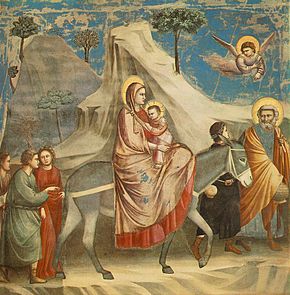
Flight_into_EgyptIn his book Banished Messiah, Robert Beck argues that Matthew frames his Gospel narrative of Jesus as a story of exile and return. With the two passages from early in Matthew’s Gospel, we can see where Beck got this idea. Before he is old enough to know what is going on, Jesus has been exiled twice. First to Egypt to escape the slaughter Herod intended for him, and then to the backwater up at Nazareth where, according to Nathaniel, nothing good could come. All this after Jesus had been born in Bethlehem, the city of David, close to Jerusalem where the action was. Not until the end of his life does Matthew have Jesus reach Jerusalem where he enters as the rightful king who is unjustly put to death.

Exile is how Empire sustains itself. The Jews knew this only too well as their exile to Babylon was one of their most formative experiences as a people. It was during their exile that the Jews came to understand fundamentally how Empire and its pagan religion operates and it was through this learning that the Jews began to really understand who really rules the world and has done so since the time of creation.

Jeremiah’s oracle that God was going to “ransom Jacob” and “redeem him from hands too strong for him” are as stirring as similar oracles of return in Second Isaiah, but Jeremiah’s oracles are all the more remarkable because he made them when he was just about out the door on his way to exile in Egypt as the Babylonians took over Jerusalem.  More remarkable yet, Jeremiah had redeemed a piece of family property just before the axe fell on his people.

Exile, then, is the condition of the powerless, the one rejected by Empire. Exile is the fate most of us fight against tooth and nail starting with our earliest socialization as children. We want to be in an in group, not an out group. We want to be at the center of power, not the periphery. And yet the periphery was where Jesus found himself by the time he was old enough to find himself. The Empire knew it could not welcome Jesus and Jesus knew that just as well.

All of this suggests that if we want to be where the action is, we’ll miss out on the real action. The real action may not seem very exciting: growing up as a human being in a backwater somewhere, where nothing good can come. And yet it is by growing up with Jesus, away from the centers of power, that we come to learn of what is important in life. We learn to value other people as people, not for what power that can broker for us. Here is where we find the lost coin, the lost sheep, the lost everything else, including what has been lost within each of us until we find Jesus where nobody else is looking.

mimetic scarcity (2)

outsideSupper1The loosening of family and tribal bonds was a second and much longer term strategy for diffusing violence resulting from mimetic rivalry. (See mimetic scarcity 1 for context.) Up to the present day it has been effective enough to be considered a good thing. But it has its disadvantages. It has led to what Norman Geres, a writer cited by Paul Dumouchel, calls “a contract of indifference.” This contract has released from obligations for violence, such as the vendettas that have scarred many social groups. That is good. But this contract as also released us from obligations to care for the misfortunes of other people. That is, we are no longer our brother’s keeper. As an instinctive reaction to violence, the various effects were never planned out and they are still not easily visible. Most seriously, the contract of indifference is deleterious to social conscience. We don’t easily see a connection between our individual actions and their social consequences. To take one example: polluting the environment just doesn’t seem to get on the radar of those who use technology at a level that does just that. It supports an individualist spirituality where saving one’s own soul is the main thing and broader social issues are off the radar.

It is the scarcity created by this “solution” that forms the founding dynamic of capitalism. The basic argument, as I understand it, is that the scarcity gives humans an incentive to try and overcome the scarcity by increasing production so that there will be more material goods than there were. This works in the sense that more material goods are produced that can be consumed by people. But scarcity is not overcome because the increase of production increases desires for goods and when this leads to more increased production, desires increase still more. Material goods never catch up with desire. Mimetic desire, where we desire things because other people desire them, further intensifies this frenzy because whole inventories of perfectly wearable shoes disappear if only a few designs are in fashion. This is how this “peaceful” solution to violence leads directly to the quiet, hidden, sacrifice of many people on the hidden altars of indifference. Indifference is just as contagious as mimetic violence. The ennui of modern humanity analyzed by legions of philosophers and social commentators witnesses to the extent of this contagion.

If Paul Dumouchel is right in suggesting that creating scarcity has roots in early humanity, created scarcity has become much more prominent in modern times. I will make only a brief historical detour to consider the Jewish tradition. The prophets exposed the truth of collective violence much more deeply and clearly than other cultures, thus attenuating the efficacy of sacrificial religion. (“I desire steadfast love, not sacrifice” Hos. 6:6) Did this prophetic exposure increase use of the solution of scarcity to limit violence? The countless oracles against oppression of the poor suggest that scarcity was alive and well in early Jewish society. Perhaps the surrounding cultures, still grounded in sacrificial religion, still had stronger social bonds for caring for each other’s’ needs. Maybe. An historical study of this matter would be welcome.

In pleading for the poor and oppressed, the Jewish prophets were clearly aware of the problems created by scarcity and loosening social bonds and so were trying to increase the scope of “family.” That is, far from loosening ties, we are to strengthen them and extend them. By inviting all of us into being siblings of him, Jesus also encouraged us to be brothers and sisters of one another: the whole church, all of humanity is family. Jesus is most explicit in this teaching in Matthew 25 where “the least of these” are all part of Jesus’ family and therefore ours as well. It is this sense of family that motivated St. Paul to take up a collection in his various churches so as to give famine relief to the brothers and sisters in Jerusalem.

This is a hard saying. First the Jewish prophets and then Jesus, by his death as a result of collective violence, throws a monkey wrench into the first “solution” to violence. But before he died, Jesus, along with the prophets who preceded him, threw another monkey wrench into this second solution. We are given an ascetical double whammy. We have to renounce the solidarity that leads to mimetic strife and then to collective violence, but not only must we retain these same ties, we must strengthen and extend them when it comes to providing for others. That is, the borders that made providing for family tenable have been exploded. Not only that, but if these are “solutions” to violence resulting from intensified mimetic rivalry, and both have been exploded, then we have to discipline ourselves to renounce that rivalry. In analyzing the land enclosures in England, Dumouchel noted the mimetic rivalry of the lairds that caused them to desire better productivity of their lands that brought on scarcity without reducing any material goods in their environments. Make no mistake. I am not suggesting we have to renounce capitalism. We have to exchange goods and services somehow. But renouncing mimetic strife will change the social complexion of capitalism as it changes everything else.

One of the reasons this social demand for social solidarity seems so onerous is because we tend to hear it through the filter of “the contract of indifference.” That is, we think the entire burden falls on each of us individually. We forget even before we hear it that we are invited into a family, a family that is the Body of Christ. We do not have to take responsibility for others, each on our own little lonesome. That would be rugged individualism all over again. Instead, we are encouraged to take responsibility as members of a Body. Jesus reaches out to everyone through each and every one of us. Our personal responsibilities are collective responsibilities.