
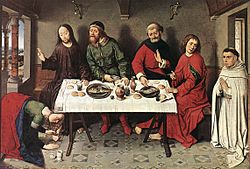
 We have a tendency to think of salvation as a personal matter. To some extent it is, but the way salvation is presented in scripture, it is never personal in an individualistic sense. In the case of the famous story of “The Sinful Woman,” we easily focus on the woman whose dramatic action is enough to grab our attention. However, her act is a public drama. Moreover, in very few words, Luke paints the social context of the woman’s behavior. She is a “sinful woman.” We are not told the nature of her sinfulness, so that is not relevant to what we should learn from the story. Simon, Jesus’ host at the dinner, assumes that Jesus should have known that the woman was a sinner and he should not have allowed her to anoint and dry his feet with her hair, actions that further proved the woman’s sinfulness in Simon’s mind. Simon may have been expecting Jesus to have supernatural discernment, but he may have simply expected Jesus to know who had a bad reputation and who didn’t. In any case, it is a social judgment that has labeled this woman as sinful. That is, this woman shows all the signs of being the community scapegoat who helps everybody else feel good about themselves.
Jesus’ brief parable of the two debaters can be understood as presenting salvation in a social context. The two debtors gives us, in miniature, an image of society where everybody is in debt in the sense of being sinful, even if the sinfulness of each person is not equal. We can see this indebtedness on a horizontal level as each person has wronged somebody else. In a religious culture, such as the Jewish one, the notion of everybody being indebted to God would, of course, also come to mind. The problem with Jesus’ parable is that if we see ourselves as parts of a society full of moral debt, then scapegoating one particular sinner ceases to be viable.
Simon’s grudging answer to Jesus’ question that the one who owed more would love more suggests that Simon is beginning to see the implication of the parable and it is making him uncomfortable. Jesus’ proclamation that the woman’s sins are forgiven leads to muttering and outrage from Simon and his other guests. If the moral debt of even one person is forgiven, then how can the community have a scapegoat? Forgiving the scapegoat was totally unforgiveable! The important thing is that it was not just the woman as an individual who was offered forgiveness, but everybody in the social system. The catch was, and is for us today, that we have to renounce the “comfort” that a social scapegoat gives us before our communities can be healed. As with so many of his parables, this story in Luke leaves us hanging. Will Simon and his friends accept forgiveness, or will they remain outraged by it, thinking that they don’t need it. The same question faces us as well.
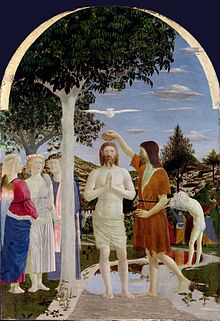 There is much theology that treats the Trinity as a mathematical game, trying to work out how three can be one and one can be three. But math, important as it is for many things, is not the way of salvation.

 An early Easter throws many things awry, not least the saints’ calendar. St. Benedict’s day is normally celebrated on March 21, but this year, it was transferred to Monday after Easter Week. Thinking about St. Benedict in terms of Easter reminds me of what he said about Lent in Chapter 49 of his Rule.
 Luke’s version of Jesus’ Resurrection is much the gentlest among the synoptic Gospels. No earthquakes and no women running off so afraid that they can tell nobody what they had seen at the empty tomb. The women were, indeed, terrified of the two men in “dazzling clothes” who appeared to them. But by the time, but before long they have remembered, with prompting from the men in white, Jesus’ words to them.
 Jesus’ prayer in the garden of Gethsemane may well have been the loneliest moment of all for Jesus. His disciples were not able to stay awake with him. Much worse, his disciples still seem not to have understood anything of what Jesus had tried to teach them. At what he knew would be his last meal with his disciples, a meal when he had poured himself into the bread and wine to give his life to his disciples and all others who would follow him, his disciples fought yet again about who was the greatest. (Lk. 22:24–26) As he had done many times before, he told his disciples that the one who would be first would be the one who served, but he must have realized his words had had the same effect as before.
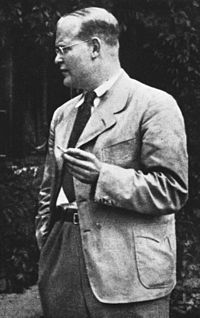 Passiontide is an appropriate time to reflect on the life and witness of Dietrich Bonhoeffer. Charles Marsh’s book A Strange Glory is a great resource for this.
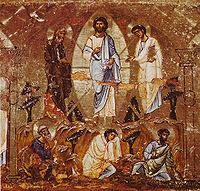 We celebrate the Transfiguration of Jesus at the end of Epiphany to prepare ourselves for Lent. This is a joyous feast where the Light of Mount Tabor should inspire us for the days of penance and then entering into the Paschal Mystery of Christ. However, there is a discordant element in the reading from St. Paul that I want to focus on. He, too, writes of the inspiring light of the Transfiguration, but he also writes about the veil over Moses’ face. This refers to the story in Exodus where Moses put a veil over his face when he came down from Mount Sinai with the tablets of the Law because his face shone too brightly for his fellow Israelites to look upon. (Ex. 34: 29–34) Paul goes on to say that the Jews remain veiled when they hear the words of the Law. In light of Holocaust, this verse causes much uneasiness, all the more so as it has been used to justify anti-Semitic attitudes and behaviors.
 Paul’s famous Hymn of Love zeroes in on what love, as agape, is all about: “Love is patient; love is kind; love is not envious or boastful or arrogant or rude. It does not insist on its own way; it is not irritable or resentful; it does not rejoice in wrongdoing, but rejoices in the truth.” (1 Cor. 13:4–6) In these qualities, we can see love as a deep renunciation of mimetic rivalry. Insisting on our own way, being resentful, rejoicing in the shortcomings of others, are all ways of putting ourselves on top of other people. Surely this short list is meant to stand for any attempt to put ourselves above other people. As long as we try to “win,” we lose at love. When we are willing to “lose,” we win at love.
 Imaginary Visions of True Peace