On Being Living Stones

altarWhite 1

Sermon for the Anniversary of the Dedication of the Abbey Church, May 9

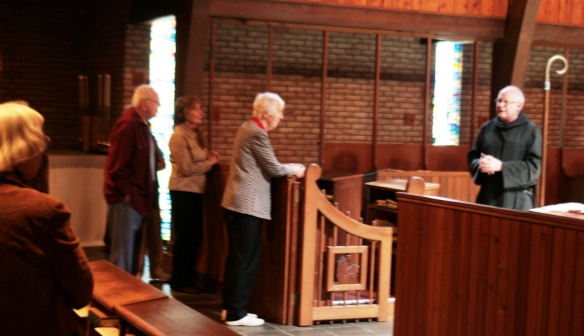
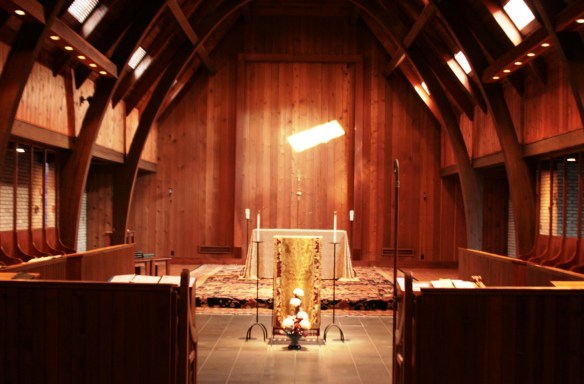
The abbey church has been a profound delight for me to pray in since I first visited here to discern if I had a monastic vocation. I’m still here, so maybe I do. I missed out on the Anglo-Catholic setup we once had which I am sure was also beautiful, but I deeply appreciate the simplicity of our worship space that has nurtured me and many others for many years. Our church is something to celebrate.

Much as I love this building and its space, I think the best way to celebrate it is to reflect on how we can be the Church with the help of this Church building. Solomon admitted that the temple could not contain God since not even the heavens can contain God. Moreover, we hope we don’t need Jesus’ ministry of throwing money changers out of our church. Peter gives us a powerful image for how we can be the church: “like living stones, let yourselves be built into a spiritual house.” (1 Pet. 2: 5) In being living stones, we imitate Jesus who was the stone rejected by the builders. This reference to Psalm 118 is used many times in the New Testament, often by Jesus himself. It means that the life and teaching of Jesus that was rejected by nailing Jesus to the cross has become the basis of a whole new culture and way of life in Jesus. We are called to be living stones built by the Holy Spirit into a new temple supported by Jesus, the cornerstone.

Stones are solid and surely we are to be solid in our commitment to Christ and to each other. It is the solidity of stones that makes them strong enough to support each other. We need to be as strong  as that if we are going to support one another. Stones, however, can be rigid and rigidity makes them hard and cold. Such stones are dead. But Living stones are vibrant so that they resonate deeply with each other. Unlike dead, rigid, stones, living stones are permeable to each other and most importantly to Christ.

Although our abbey church isn’t built with actual stones, but is mostly built of wood and brick, may this church that we celebrate today open us to each other and to Christ so as to transform us into living stones receiving life from the rejected cornerstone.

The Strangest Victory of All

Cemetary2Easter is a great celebration, but it is a strange celebration. It isn’t like celebrating an election won or winning the World Series. It most certainly isn’t like celebrating victory in war. But if we have trumpets and kettle drums to augment the shouts of Alleluia!” we might forget the strangeness sometimes and get carried away by a sense of triumphant victory.

The sober but profound truth is that we are celebrating the resurrection of a loser. Jesus was not voted into office; he was handed over to the authorities who put him to death. Jesus did not win a war; he refused to fight one. His disciples were downhearted because they thought Jesus was the one who was going to restore Israel, and he obviously didn’t do it. When he rose from the dead, some of his disciples thought he might restore Israel after all, but he still didn’t. All Jesus did was have quiet meetings with his unfaithful followers who had trouble recognizing him. During those meetings, Jesus explained the scriptures to try to help us understand why he could only win by losing. We still have trouble understanding this.

Jesus did win a victory; a great victory. But it was a victory Jesus won by losing. That is, if Jesus had defeated the Roman Empire by force and restored Israel in that way, Jesus would have lost, and so would everybody else. For defeating an enemy by force is the way the world normally works, so if Jesus had won in that way, the world would not have changed and the rule of defeating one another by force would continue to rule the world as it always has. But Jesus triumphed over triumphalism, thus defeating trimphalism for all time.

The Resurrection proves that it is Jesus who rules the world and not those who defeat others by force, least of all empires. If that is the case, then Jesus rules in an odd way. For Jesus does not give marching orders and intimidate people to do what he wants. (Unfortunately, many pastors do that on Jesus’ behalf.) Jesus rules the world by gathering those who will join him into a community of vulnerability and forgiveness. Of course, the vulnerable and forgiving lose in the game of life which is ruled by force.

It is frustrating to see the powerful prey on the weak and not only not does Jesus not tear the oppressors apart but Jesus teaches us not to do that. But the victory Jesus won on the cross was the victory of losing and the victory of Jesus’ Resurrection is the continuation of Jesus’ losing ways. What is so frustrating is that there is so much forgiving to do that it is overwhelming. Many of the news stories I read about make forgiving very difficult for me. The worst thing about these news stories is that they show how unforgiving our society is. Given that, it is a blessing beyond imagining that Jesus is gathering us in a different way. If Jesus had not won by losing, we would all be losers without even knowing how deep our loss is. But Jesus has won the great victory so that He can give us his life of mercy and love for us to pass on to others. We also are relieved of the responsibility to “win;” we only need be faithful in works of mercy. This is the way to life for ourselves and for all other people. This is the restoration of Israel. This is what we celebrate when we cry out: “Alleluia! The Lord is Risen! The Lord is risen indeed!”

Jesus Between the Prisoners

crossRedVeil1We rightly meditate on the sufferings of Jesus during Holy Week. But in Matthew 25, Jesus made it clear that the sufferings of others were also his sufferings. So it is also suitable to meditate on the sufferings Jesus bears with others.

There is such an epidemic of violence and oppression at this time that one hardly knows where to start. But denouncing violence and oppression in general is not helpful, so I will focus on something that I have been reflecting on lately: the US prison system.

Out of sight is out of mind for many things but it applies to the US prison system more than most. There are many who prefer it that way. Not only those who benefit from the prison system but also those who don’t want to know. I can understand not wanting to know. I would be much happier if I knew a lot less of the US prison system. The problem is, Christian charity requires knowing when people are being treated like Christ–as in Christ being brought before Caiaphas and Pilate and then nailed to the cross.

In a series of essays recently published in honor of the social activist Will D. Campbell And the Criminals with Him, and in other books I have read, the systemic horror and dehumanization of almost everybody involved in the prison system has been brought home to me. The incarcerated are vulnerable to their wardens and guards in ways that make human dignity very hard to retain. What disturbs me most is the social vengeful spirit that feeds the prison system. It is this vengeful spirit that drives the incarcerated out of sight and out of mind. There is no room for forgiveness. I don’t mean that forgiveness means letting people go free without any consequences; forgiveness means seriously rehabilitating people and giving them a chance when they are released. We forget that Christian ethics teaches that all people deserve to be treated with dignity at all times. Treating people with dignity includes making people accountable for what they do. Huge sentences without parole or reducing prisoners to one meal a day do not accomplish that.

Rather than scold ourselves for our prison system, however, I would rather spread encouragement through a story I heard at a conference over a year ago by Preston Shipp, who repented of being a prosecuting attorney in Tennessee. While he was still holding that position, he was asked by a professor he had had at Lipscomb College, to teach a course in the woman’s prison on criminal justice. This is a program where half the class consists of Lipscomb students and half the class is made up of inmates of the prison. The best and most perceptive student in the class was an inmate named Cyntoia Brown. It was a shock to Preston when he got a finalized brief on the case of Cyntoia Brown and discovered that he himself had denied the appeal without, obviously, really examining the case. (Cyntoia had murdered a man who was abusing her at the age of sixteen.) Talk about not knowing what one is doing, as Jesus said on the cross. In the book I mentioned above, we also get the story from Cyntoia’s point of view. She said that she had her own stereotypes about what a prosecuting attorney teaching the class would be like only to have those stereotypes knocked away by this highly affirming man whose teaching opened the door for her to feel human again. But then she got her copy of the brief denying the appeal of her sentence. She felt deeply betrayed and Preston hardly knew how he could face her, but he did. Yes, in the midst of this unforgiving prison system, Cyntoia forgave Preston and Preston accepted her forgiveness. Can we follow her example along with that of Christ?

A video of the incident is available on YouTube at https://www.youtube.com/watch?time_continue=2&v=dQpQlqN8EY0

Sight and Vision Recreated

sideAltarsIcons1When I last posted a blog post on the story of Jesus healing a man born blind (Jn. 9), I suggested in passing that Jesus’ daubing the man’s eyes with mud mixed with his spittle and asking him to wash it at Siloam recalled the creation of the first human out of clay in Genesis 2. This time around, I noticed that this detail is repeated three times to give it a strong emphasis. First when John narrates the action, second, when his neighbors ask him how it is that he can see, and third, when the Pharisees question the man. This is three times in the span of nine verses. Then, after confirming with the man’s parents that he had indeed been born blind, the Pharisees ask him again how he regained his sight. The man offers to tell his story yet again but the Pharisees cut him off. Even so, we have been reminded once again of what Jesus has done. That’s a lot of emphasis.

This thrice and almost four-times repeated telling alerts us to the importance of the link between this miracle and creation, thus making it an act of re-creation. The obvious symbolism of blindness and sight suggest that Jesus is re-creating something more than eyesight for the man born blind. What blindness is Jesus healing? According the French thinker René Girard, humanity has been blind since its birth by what he calls the “scapegoat mechanism.” That is, since the dawn of humanity social tensions have been solved through suddenly uniting against a victim. Girard also says that this scapegoat mechanism only worked for early societies because people were blind to what they were doing. Girard then argues that it is the Gospels that have definitively revealed the truth of the scapegoat mechanism. (For an introduction to Girard’s thought see Violence and the Kingdom of God.)

This story indeed thrusts us right in the middle of the scapegoat mechanism and the blindness it causes. We can see the ever-increasing circles of persecutory violence depicted in this story from the disciples’ assuming that the man was born blind because somebody sinned to the Pharisees expelling the healed man from the synagogue and setting their sights on Jesus.

For those of us who had something of a “eureka!” experience upon encountering Girard’s thought there is the danger of thinking that this insight into the scapegoat mechanism is a quick fix. Now we know the problem; we can fix it and stop persecuting people any more. It doesn’t work that way and the creation imagery in John’s story tells us why. John is telling us that we need the same radical make over in order to see that a person born blind needs in order to gain intelligible sight. If we need to be recreated in the same way, then the preliminary insight into the scapegoat mechanism is only the beginning of a long journey of being re-formed into Christ. The baptismal imagery of the water washing the clay deepens this need for re-forming.

Those of us working with Girard’s thought now have a history of several decades of struggling to become more and more aware of ways that we scapegoat others. One of the more dangerous pitfalls is what we call “scapegoating the scapegoaters.” This sounds and feels so righteous, but it falls into exactly the same pattern as the Pharisees we are denouncing in this story.

Girard’s insight into the scapegoat mechanism is not a quick fix; it is a very slow fix that takes a lifetime of prayer, meditation, alert practice in our social relationships and, most of all, constant vigilance over our inner pull toward scapegoating others. All this time, we have to be as malleable as moist clay so that God can re-create us and re-form us in God’s Desire for us and for humanity.

Two books I have written dealing with the practicalities of spirituality are Tools for Peace and Moving and Resting in God’s Desire.

Setting Our Hearts on God’s Treasure

purpleFlower1Jesus’ teachings on the right and wrong ways of fasting are true and important but I would rather talk about treasure and our hearts. Treasure is a much brighter and exciting thing to think about then renunciation and fasting. What child doesn’t like a treasure hunt? Why else is Treasure Island such an archetypal novel?

What is the treasure we should seek? A treasure is whatever we set are hearts on. If we desire diamonds, then diamonds are our treasure. But even if we find a diamond mine in our back yards, we won’t have the treasure Jesus is talking about. Jesus’ admonition to “store up treasures in heaven” sounds like we store them for an after-life. But let us remember that this verse comes roughly in the middle of the Sermon on the Mount which outlines the real treasure we should seek: “Do not resist an evil doer” (Mt. 6: 39) and “Love your enemies.” (Mt. 5: 44)

We call these treasures? If we set our hearts on these teachings, they do indeed become treasures, treasures we have in the here-and-now, treasures that “neither moth nor rust consumes.” (Mt. 6: 20) These are treasures that remain safe as long as we set our hearts upon them. How about that as a challenge for Lent and on into Eternity?

Transfiguration on to Way to the Cross

crossRedVeil1The transfigured light that radiated from Jesus has inspired many as an image of our potential for holiness. Some Eastern Orthodox spiritual writers such as Gregory Palamas and St. Seraphim of Sarov believed that they saw the light of Mount Tabor within.

Jesus’ self-designation “the Son of Man” is also rich in possibilities for humanity. Walter Wink famously suggested that the phrase “Son of Man” refers to a newly created humanity in Christ. This fits well with St. Paul’s use of the phrase “New Humanity” in Romans 5. For the likes of the disciples and us entry into the new humanity in Christ is not smooth sailing into transfigured light. The disciples quickly return to arguing about who is the greatest. We all know the anger and other discordant feelings that overtake us quickly every time we sense any hint of the transfigured light in our lives. Even Moses and Elijah were both compromised with violence which they had to overcome in the same way we have to overcome our own violent impulses, petty as they often are.

Jesus’ transfiguration is linked to the journey he is about to make to Jerusalem and we know what happened to him there. Jesus was transfigured, then, because he was willing to die in Jerusalem if that turned out to be necessary for opening the way to a new humanity. Jesus tells his disciples as much when he admonishes them not to tell anyone what they have seen until “the Son of Man has been raised from the dead.” (Mt. 17: 9) At that time, Jesus opened the way for a new humanity that would not require human bonding through the death of one for the sake of the people as Caiaphas would have it, but a new humanity that would join in seeking for even one lost sheep, strenuous and dangerous as such seeking could be, and then rejoicing when that sheep was found. (Lk. 15: 3–7)

That the Transfiguration takes place on a mountain recalls Mount Sinai, where God began the renewal of humanity. The first Commandment that “you shall have no other gods before me” and the last one “you shall not covet” cover our relationships with God and neighbor and create a sandwich with the eight other commandments. More recently there is the Mount where Jesus preached his sermon to renew humanity through non-retaliation and forgiveness, precisely the human qualities Jesus himself showed as the risen forgiving victim. This is the transfigured light that shines in the darkness so that the darkness cannot overcome it. (Jn. 1:3)


See also: How is the Gospel Veiled?  and The Transfigured Glory of God’s Children

On Expecting Patiently in God

simeonThe Feast of the Presentation of Jesus in the Temple is a belated closure to the Christmas Season. Since the excitement of Christmas and New Year’s Day is long past, we may have assumed Christmas was over, but the Presentation of Jesus is the last of the Infancy Narratives. The Christmas Cycle began with Advent, the time of expectation of God’s coming to us. In Simeon and Anna, we come full circle with two more people who were waiting for the consolation and redemption of Israel. Anna had been waiting for 57 years, with nothing to show for it until that day.

To wait in expectation as Anna did takes much patience. For most of us, expectation is coupled with impatience. If we expect something, we expect it now. There should be no delay when it comes to what I expect. God’s time is shown here to be different than ours. The many centuries during which Israel had been expecting consolation and redemption were a lot more years than Anna had spent coming to the temple fasting and praying.

Expectation can lead to rivalry and even violence. This is all the more likely when expectation is coupled with impatience. The more impatient we are, the more likely we are to act precipitously to bring about the consolation and redemption of our own people. This is what happened in Israel. Few, perhaps nobody at all, had the patience of Simeon and Anna and were violently hastening the redemption and consolation of Israel. This haste resulted in the destruction of the Temple in 70 A.D.

Expectation is, however, quite different when we give ourselves over to it in patience and in God. The patience and presence of God wear away the trap of violent rivalry. Patience in God also made Anna and Simeon responsive to the Holy Spirit so that they came to the Temple at the right time to see the Christ Child.

More important, patience in God broadened the expectation of Anna and Simeon. Although Simeon had been waiting for the “consolation of Israel,” when he held the child in his arms, he said that he had seen the salvation “prepared in the presence of all peoples.” Not only was this child the glory of God’s people Israel, he was “a light for the revelation to the Gentiles,” the very people from whom they were expectantly waiting for deliverance.

Patience in God also deepened the expectation so that Simeon realized that Jesus would be a “sign that is opposed,” one who would reveal the “inner thoughts of many.” This child, then, was not destined to be a consolation and redemption of Israel in a comfortable or cosy way, but would console and redeem Israel and the Gentiles (i.e. everybody else) by revealing the truth of how we build human culture on collective violence and then offering us redemption through embracing this truth.

We also see patience on the part of Joseph and Mary who offered a pair of turtledoves or two young pigeons as required of the Law for those who were poor. Many years later, Jesus would again make the offering of a poor person who had been opposed and so “reveal the inner thoughts of many” as they “look on the one whom they have pierced.” (Zech 12: 10)

Silence

fumie

Fumie

Shusaku Endo’s novel Silence has haunted, troubled, and uneasily edified many readers, me among them, since it was written. Scorsese’s film does the same, although the visual effects amplify the haunting, troubling and uneasy edification. The novel follows the book very closely. Very little, perhaps nothing, has been left out of the book by the movie. This review is primarily a response to the movie but it is a review of the book as well.

Certain dimensions of the novel/movie are brought out with the help of the French thinker René Girard. Girard discovered the anthropological trait of what he called “mimetic desire” in the greatest of Western novels, such as Don Quixote and Brothers Karamazov and in the plays of Shakespeare. Mimetic desire is imitating, not the actions of another, but the desires of another. Girard goes on to analyze ways that mimetic desire becomes conflictual and escalates to rivalry, not over a boy friend or a girl friend but ultimately to a struggle for power. Girard called this “mimetic rivalry.” Endo was one of those great novelists who revealed deeply the workings of mimetic rivalry.

SPOILER ALERT: The plot is discussed in much detail, including the ending.

We this mimetic rivalry at work in the opening scene. Rodrigues and Garupe, zealous young Jesuits, wrangle with their superior over whether he will grant permission to go to Japan in spite of the persecution so that they can search for their beloved teacher Ferreira. The superior acts like a battle ax who is used to commanding others but the young Jesuits wear him down. Those in religious orders know how common it is for one to practice religious “obedience” by persuading the superior to grant permission to do what the person under vows wishes to do. This scene reveals both the generous fervor of the young priests and the arrogance of their delusion that they can take on Imperial Japan. Much later, the Japanese inquisitor, Inoue, says of Rodrigues: “The man is arrogant—he will break.” And he does.

There is no mimetic rivalry but only generous love on the part of Rodrigues in his ministry to his small village congregation. In playing the role of the priest, Andrew Garfield lets the love for the people flow and overflow from his face. The people were desperate for tokens and Rodrigues gave them all he had and then had to detach all the beads of his rosary in a prophetic divestment of his prayer discipline.

Once Rodrigues (who had separated from Garupe) is apprehended, the mimetic game becomes very complex and deadly. Rodrigues is very sure of himself and of his faith. He thinks he can meet any challenge. The arrogance of his stout defense of the Faith overflows from Garfield’s face as strongly as did his love for his congregation. He challenges the doddering old man who is questioning him to take him to the chief inquisitor, only to set the old man and his attendants into a soft chuckling fit. When Rodrigues asks what’s so funny since he had not told a joke, the old man tells him he is Inoue, the chief inquisitor. Issei Ogata, who acts the role of Inoue, is quite extraordinary in the way he eyes dance around his dynamic smiles and smirks as he speaks gently but with ruthless cunning.

Inoue presents to Rodrigues a parable of a man who had four wives who quarreled with one another. Finally, he threw out all four of them and lived in peace. Rodrigues said the man was wise. Inoue told him that the wives were Spain, Portugal, England, and Holland. We have here in a nutshell the international situation of mimetic rivalry. The priest, of course, is determined to convince Inoue to accept the one true “wife,” the Church. For a Catholic, this is the truth but Inoue laughs it off as another strand of rivalry threatening Japan.

The pivotal scene is Rodrigues’s meeting with Ferreira, the beloved teacher he had sought. Ferreira had indeed apostatized and he came wearing Buddhist robes. In the book, the silence between the two men is portrayed primarily by Rodrigues being stunned by the clean-shaven face, since Ferreira’s beard had been such an integral part of him. In the movie, Liam Neeson is extraordinary in the way conflicting emotions of guilt, arrogance, shame, and more cross his face. Another mimetic struggle begins as Ferreira has been given the task of convincing the student who had imitated him in Christ to imitate him in apostasy. Rodrigues is angrily self-righteous in his reaction to his teacher, convinced he could never do such a thing. The dialogue is very subtle with multiple meanings to Ferreira’s words. That is, a Christological dimension emerges, but it is undermined by Ferreira’s scorn for the Japanese he had come to convert. He sums it up: “Nothing grows in a swamp.” Ferreira and Inoue had come to agreement that Japan lacks the soil for Christianity to grow.

Ferreira explains how, before his apostasy, he was wrapped and placed upside down in a hole with a small incision cut into side of his head to bleed slowly and slow the flow of blood into the head which could have hastened his death. Rodrigues responds by challenging the inquisitor to do the same to him. He will outdo his superior in endurance.

However, the Japanese had learned some things in their mimetic struggles. It had once been the practice to torture and kill the priests so that they died for their people. Now, they were torturing the Christian people so that they would die for their priest. Rodrigues had already seen three of his followers be crucified in the water and then was forced to see four Christians drowned because Garupe refused commit apostasy. Rodrigues also had to look on as his friend ran into the water to die with his martyred people.

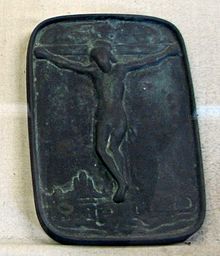
Late at night, Rodrigues heard the moans of the members of his congregation who had been arrested with him as they were held upside down inside the pits. Ferreira was brought in to put more pressure on Rodrigues to apostatize by trampling on the fumie, an image of Christ. As the priest looks down on the image of the crucified Christ, he hears the voice say: “Trample! Trample! It is to be trampled on by you that I am here. ” And so Rodrigues tramples on the fumie and the people are spared an agonizing death. From then on, all the fire drained out of Garfield’s face as the priest became one with the trampled Christ.

Throughout the movie, there is the inner struggle of Kichijiro. Already an apostate hiding in China but longing to return to his own county, he brought the Jesuits to Japan. He committed apostasy again and then ran to Rodrigues to make his confession. Then he betrayed Rodrigues and then came again to confess and receive absolution. He comes again after Rodrigues has apostatized. The priest says nothing, but his face says that is because he no longer feels qualified to absolve him. But when Kichijiro runs off, Rodrigues makes the sign of the cross.

The Japanese persecutors “won” the mimetic match, but Christ, by urging the priest to trample on his image, has embraced the priest, the persecuted Christians, and the persecutors of Imperial Japan.

Over the years, Rodrigues and the other Christians who had also trampled on the fumie are required to repeat the act time and again as a “formality.” So it is that the persecuted Christ returns time and again for the ceremony to repeat his embrace of the country.

There is much noise in the movie Silence. There is the noise of Rodrigues’s fervent declarations of faith before Inoue which dissolves when he tramples the fumie. There is the roar of the surf that is superbly photographed. There is the excruciating noise of the tortures and the even more excruciating inner noise of the psychological tortures. Then there is the silence of the trampled Christ. Although the book is of modest length, the movie is very long. The length is a strong challenge to the viewer and it guarantees that nobody will be entertained by this movie. But the length also creates space for the silence of the trampled Christ.

In the silence of the trampled Christ, there is no mimetic rivalry.

A Musical Note

The Scottish composer James MacMillan, one of the greatest living composers, and a Roman Catholic, wrote his large third symphony as a response to Endo’s novel. There are the sounds of Japanese percussion instruments. There are snarky musical figures that suggest the mockery of the inquisitor. There are grinding discords suggesting the tortures of persecution. The music is as consistently tense as the story the book tells. The silence of the trampled Christ is barely audible.

On Following the God of All Victims

WilliamGuestsChurch1In our readings for today, we celebrate the Week of Christian Unity with the short narrative of Jesus calling his first disciples (Mt. 4: 18–22) and Paul’s rebuke to the Corinthians for their discord and divisiveness (1 Cor. 1: 11–13). The light in the darkness proclaimed by Isaiah (Is. 9: 2) shines brightly on the first scenario but is much obscured in the second.

The situation in Corinth is aptly described by René Girard’s term “mimetic rivalry.” That is, the rivals are mirror images of each other. It is significant that Paul does not mention any issues of disagreement, even though we know from other sources that he had issues with Cephas (Peter.) Girard has taught us that when mimetic rivalry escalates, the issues fall away and we get the chaos of rivalry for the sake of rivalry. Girard goes on to suggest that in ancient societies this chaotic rivalry repeatedly resolved itself through suddenly focusing on one victim who was put to death. Peace, for a time, followed this atrocity. Girard goes on to aver that when this same scenario was committed against Jesus of Nazareth, the truth of this collective violence was unveiled to the extent that it could never again create peace, not even for a time, as it did before. Through Christ, God has presented us with the challenge of either renouncing our participation in chaotic mimetic rivalry or participating in the total destruction of civilization. [For an introduction to René Girard see Violence and the Kingdom of God.]

When we look at the scenario in Corinth denounced in Paul, a scenario we can all recognize in our families, social groups, work places, charity organizations, and even (sometimes especially!) in our parish churches, it appears that Christianity has failed. Actually, the situation is more complicated than that. A big part of the problem is that Christianity has succeeded too well. Or perhaps we should say Christianity has succeeded in a way that threatens to make the situation worse and more dangerous.

The unveiling of collective violence by the Cross has led to an ever-accelerating increase in sympathy for victims. We see this early in Christianity through the charitable work to relieve poverty and disease with hospitals being one of the great Christian inventions. We fret, quite rightly, about serious problems with racism in contemporary America but we do well to remember that racism has been practiced by all people of all times and places and it is only in places where the Gospel has had an influence that anybody has seen racism as a problem and acted on that perception.

While to be a victim was such an unmitigated disgrace in the ancient world that one would do anything to avoid that stigma, preferably by victimizing somebody else, to be a victim has become a badge of honor. This is indeed a badge of honor for people like those who generously risked their well-being and lives during the Civil Rights Movement in the 1960’s, but it looks like shameless exploitation of real victims by those who feel victimized when called to account for injustices and crimes inflicted on others.

This division between real victims and imposters, a division that is often far from clear, is not the problem of division that concerns me during the Week of Christian Unity. The deeper problem is what I am inclined to call a chaos of victims. We have today a plethora of real, legitimate victims, even if the plight of some might seem more urgent than others. Here is the rub. Not only do we have the social chaos of those who continue to victimize others through brute force such as rape or economic exploitation, and the social chaos of many who just don’t care, we have the social chaos of advocates for victims and victims trying to ameliorate their own circumstances. Put in a nutshell: we have a chaos of mimetic rivalry between the favorite victims of some advocates against the favorite victims of other advocates. Here is the heart of the most serious divisions within Christianity in our time. This is not a chaos of those wanting or willing to hurt others; this is a chaos among those who willingly sacrifice themselves for the benefit of others.

In such a situation, it is inevitable that those of us concerned with the vulnerable and the helpless will be more sensitive to some victims more than others. This increased sensitivity to some victims can look like indifference to others and can become downright hostile in situations where equal advocacy between causes is difficult and sometimes impossible.

I am not saying this from outside the fray. I am very much inside it, very much involved in all the mimetic issues I am describing. I know that I respond to the needs of some victims more than others. The complexity of this tension among those of us who wish to help others is enough to lead to despair but we have a light in the darkness in the calling of Jesus to follow Him. Jesus is not a Messiah divided among many victims and their advocates; Jesus is a Messiah for all victims and their advocates. It is surely this call and not any intellectual or moral perspicacity of my part that makes it possible for me to even define this problem as I have. The call to discipleship is a call for repentance on many levels, ranging from our moral own violence and lassitude to the rivalry for the sake of rivalry such as at Corinth, to our rivalry over the causes of real victims. It is this very complexity that requires us to seek a conversion of society and not just our individual selves. Here is where I see the biggest challenge to Christian unity.

Sharing God’s Riches

creche1-copyLike every culture, the Jews had to face fundamental decisions as to how open or closed they would be to others. The default mechanism tends to be flight or fight. In discussing remaining social groups living close to the level of what he calls “traditional” societies, Jared Diamond observed this phenomenon. A stranger wandering into the territory of a different tribe had better come up with a common ancestor or the encounter could prove fatal.

The type of encounters with other nations has an effect on such decisions. In the case of the Jews, most encounters were bad. Slavery in Egypt was followed by both cultural and military threats from the Canaanites who tempted the Jews to forsake the God who had delivered them from Egypt. Encounters with the Assyrians and Babylonians were catastrophic. But then the Persians destroyed the Babylonian Empire and invited the Jews to return to their homeland and revive their cultural and religious traditions. It is surely no accident that the return from Babylonian exile and resettlement back in their homeland coincided with the first expressions of openness to other cultures on the part of the Jews such as we have when Isaiah proclaims: “Nations shall come to your light, and kings to the brightness of your dawn.” (Is. 60:3) With Isaiah, we have the breakthrough insight that the God who brought them out of Egypt and then delivered them from Babylon was the God for all people and not just them. Although Adam Smith took the title of his famous book The Wealth of Nations from Isaiah 60:5: “the wealth of the nations shall come to you,” the prophet encourages a much more profound exchange than that of capital: an exchange of the riches of the Jews’ religious tradition for the riches other nations can bring to that same tradition. Unfortunately, retrenchment followed, climaxed by the expulsion of all foreign wives at about the time of the building of the second temple.

At the time of Jesus’ birth, the relationship between the Jews and the Gentiles, the other nations, was complex and tense. Their religious traditions were mostly tolerated but at times menaced by the Romans. Although some individual Gentiles became God-fearers, practicers of Jewish piety such as the Centurion who built the synagogue at Capernaum, (Lk. 7: 4-5) there were few friendly relations between Jews and Gentiles. And yet in the face of this tension, Matthew sees in the visit of the Magi to the infant Jesus a fulfillment of Isaiah’s prophecy of the exchange of wealth between the two peoples.

It was for St. Paul to return the gifts to the Magi. After his dramatic conversion, he was called to preach the Good News of Jesus, a Jew, to the Gentiles. To the surprise of many Jews who followed Jesus, “the Gentiles have become fellow heirs, members of the same body, and sharers in the promise in Christ Jesus through the gospel.” (Eph. 3: 6) That is, Jesus dissolved the fundamental division between Jew and Gentile when he was crucified by a collaboration between the two peoples who had suddenly come together for that brief moment. But when Jesus was raised from the dead as the forgiving victim, he bridged the gap between nations with one comprehensive act of forgiveness.

Ever since Paul’s commission, the Church has been tempted to retrench herself as the Jews did after building the second temple. This is to fall back into the default hostility to the stranger that Jared Diamond saw as part of “traditional” humanity. What the feast of Epiphany celebrates is the generosity of God who shares God’s riches with all so that all people can share this same richness with all others, not least with strangers who can then soon cease to be strangers.