Dwelling in Sacred Space

When I read Mircea Eliade as a college student, one of the first things I learned from him was the importance of sacred space, of a designated space being the center of the world. The designation might seem arbitrary in that it could be any space, sort of like Winnie-the-Pooh and Christopher Robin planting a pole in the ground and proclaiming it the North Pole. But once a space was designated as sacred, it truly was sacred ground and treated as such. Although the sacred space could be anywhere to begin with, there is a tendency to see certain landscapes, such as tall mountains and luminous lakes, as more likely to be considered holy space than others.

The early humans who designated sacred space didn’t have any notion of confining God to a certain spot. They instinctively knew that God is everywhere, but they also felt the need to focus. Solomon shares the same insight in his prayer at the dedication of the Temple in Jerusalem when he says: “But will God indeed dwell on the earth? Even heaven and the highest heaven cannot contain you, much less this house that I have built! “ (1 Kings 8: 27) Although the Israelites knew that God is everywhere, the temple was a focal point for Jewish piety. The Psalmist exulted in dwelling in the temple with God and longed for it desperately when torn away from it when taken into exile. I have the same sort of experience with the churches I worshiped in while growing up and with the Abbey Church where I have worshiped for more years than I can count. During the Eucharist, I keep getting the sense that the Abbey Church has become the center of the world as the bread and wine is consecrated. Not that the abbey is the only center of the world. There are countless more. As a practical matter, it is much easier to appreciate the fact that God is everywhere and act accordingly when a particular place is entered at a specific time to focus on God. By practicing decorum and reverence in a designated place, we are more apt to practice decorum, and reverence elsewhere.

Stemming from the insight of early humans and Solomon that the Temple cannot contain God are the various prophetic critiques of misuses of the temple for personal advantage of one sort or another. Jeremiah, for example, warned against trusting in words such as “This is the temple of the Lord! The temple of the Lord! The temple of the Lord.” (Jer. 7: 4) Hosea insisted that God preferred mercy to burnt offerings. (Hos. 6: 6) Jesus’ act of driving out the money changers was a climax of such prophecies. In Matthew’s version of this story, Jesus then heals the blind and the lame, (Mt. 21: 14) suggesting that such healing is much more in line of what the temple is for than changing money to keep the sacrifices going. Matthew’s placing of these acts of healing seem out of context, but they allude to an odd incident when David attacked the Jebusites and took the city. The defenders taunted David by saying that even the blind and the lame would be able to stop him. (2 Sam. 5: 6) David was believed to hate the blind and the lame as a result of the taunt, but it is more likely that David hated the able-bodied defenders who taunted him. One could say that Jesus was fulfilling David’s conquest of Jerusalem by healing the blind and the lame. In the end, nobody is going to stop Jesus.

John adds that Jesus implied that he himself is the Temple when he said that if the Temple is destroyed, he can rebuild it in three days. (Jn. 2: 19) St. Paul and St. Peter famously extended the human temple to everybody. St. Paul said that each of us is God’s temple, (1 Cor. 6: 10) and St. Peter said we are all living stones “built into a spiritual house.” (1 Pet. 2: 5) Jesus was a particular person who lived on earth at a particular time and place, but he has extended his sanctity as a temple to each of us, not least the blind and lame whom he cured in the temple. In his climactic teaching in Matthew, Jesus said that what we do and don’t do for the “least” of people is done, or not done, to him. (Mt. 25) Peter adds depth to this teaching by reminding us that Jesus was the stone rejected by the builders which has become the cornerstone. (1 Peter. 2: 7) God continues to build God’s house, God’s temple with stones rejected by those who would build human culture.

Just as sacred space can be, and is, anywhere and everywhere, everybody can be, and in fact is, a temple of God. We should treat ourselves and each other accordingly with decorum and reverence.
On Being the Temple of God

The brief story of the widow putting two small coins into the temple treasury, the only coins she had to live on, has often been touted as an edifying story about sacrificial generosity. I’ve come to seriously doubt that Jesus intends us to see it that way. Yes, the woman is generous and one can think of her many successors who built St. Patrick’s Cathedral in New York with their hard-earned pennies. But just before the woman comes with her two small coins, Jesus has castigated the scribes who “devour widows’ houses.” Moses and the prophets constantly championed the widows and orphans, and yet a person who is supposed to be championed is instead devoured by the system. What Jesus knew and the poor widow didn’t, is that the temple was a lost cause; it was going to be destroyed.

But Jesus also knew that the temple was a holy place. Hence his fury that it had been turned into a den of thieves. When Jesus was a child, he knew that the temple was the place where he should be about his Father’s business. (Lk. 2: 49) Religious anthropologists know very well that there is a human need for sacred space, space that focuses one on God and makes one feel closer to God. Hence the devotion of the poor widow in Jerusalem and the widows and other people with meager resources donating towards the building of St. Patrick’s Cathedral.

The destruction of the temple in 70 A.D. was a shock to both the Jewish and Christian communities and both communities had to build their traditions out of the ruins. After all, the first followers of Jesus also worshiped in the temple when it was still extant. The Jews recreated their tradition by embodying the Temple sacrifices through their daily practice developed in the Talmud. As for Christianity, John, in his Gospel, quoted Jesus as saying that if the temple should be destroyed, he could rebuild it in three days, meaning, as John goes on to say, that Jesus was referring to his body as the real Temple. (Jn. 2: 19–21) The author of Hebrews picks up this theme. By being the once-and-for-all offering for sin, Jesus has replaced the temple where sin offerings were made, with his own body. (Heb. 9: 24–28) For Christians, then, the temple has been replaced by Jesus as the focal point, the sacred space. But if Jesus has entered the heavenly sanctuary not made by human hands, as the author of Hebrews says, then where does a Christian find holy space?

Over the centuries, many church buildings have been built to fulfill this need, some of them overwhelming cathedrals, others storefronts. For me, one of the most moving entries into sacred space was a modest building, unadorned except for a cross strategically placed so as to be hard to notice, with a worn linoleum floor inside. But this is where a small group of Christians had worshiped for years in East Germany. These people had spent their whole lives giving up two small coins in their worship of God.

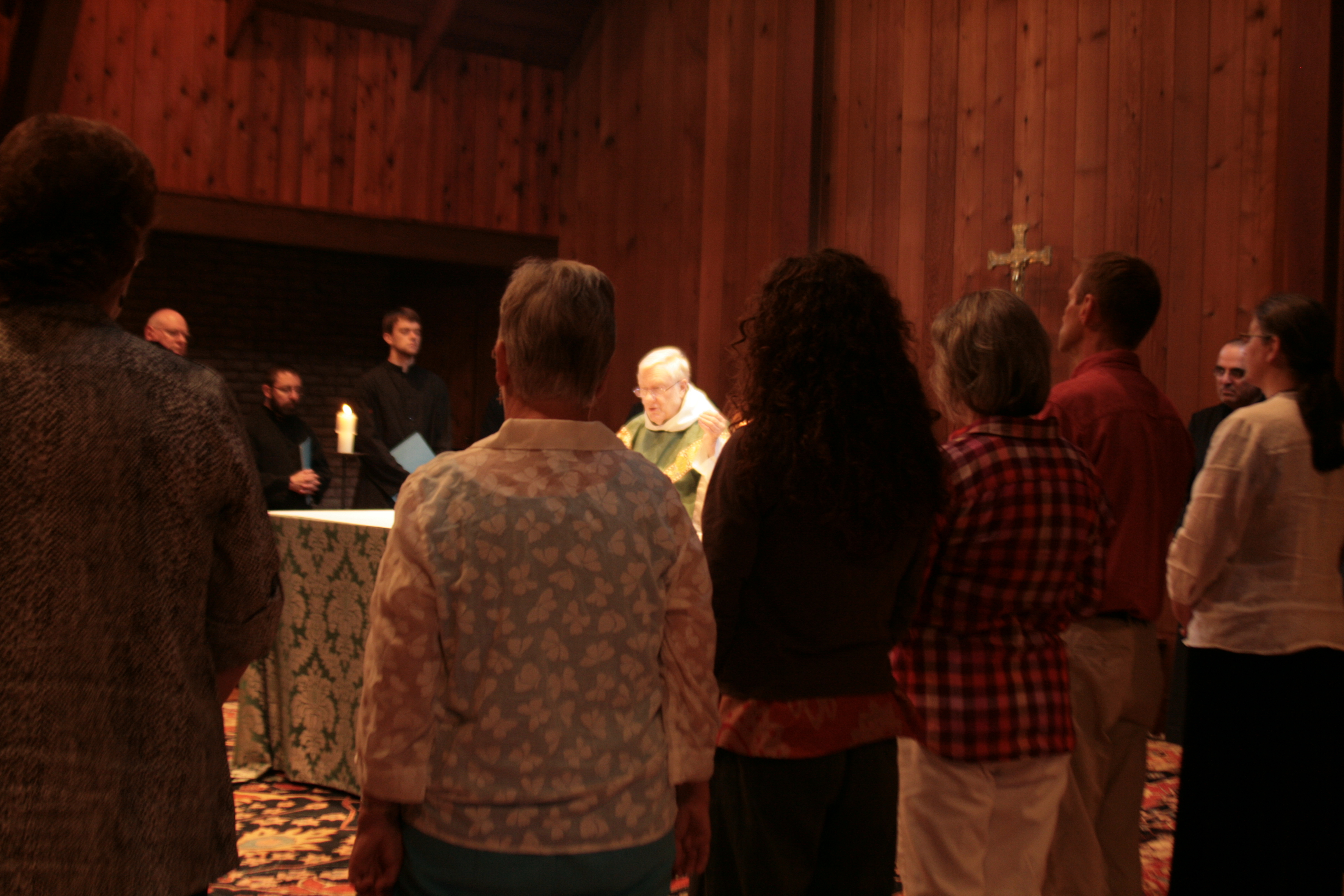
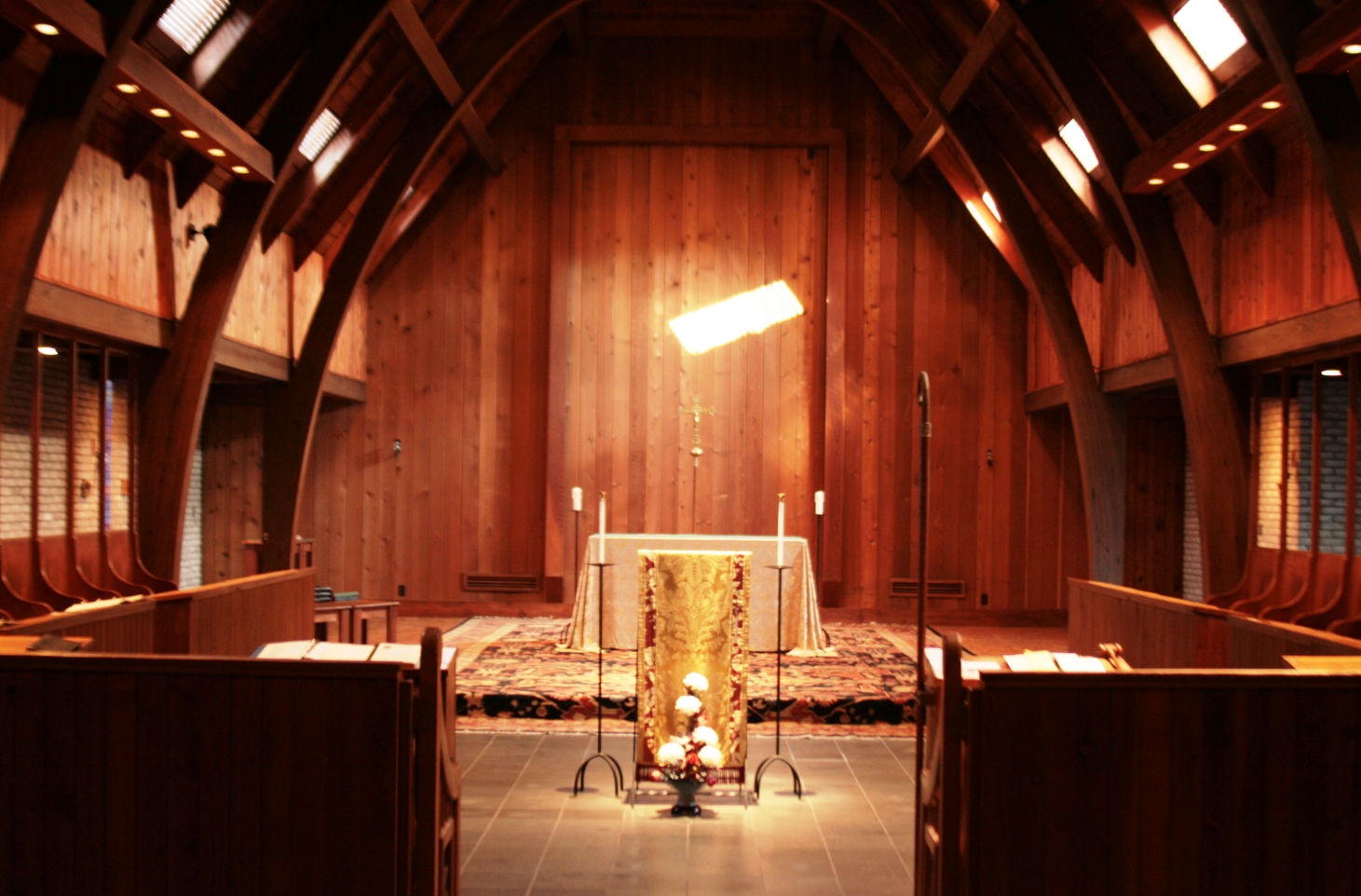
But, as the Risen Jesus revealing himself in the breaking of the bread shows, Jesus, is not only the true Temple of God but he makes all of us into the Temple that is His Body. That is why Paul, in line with John and the author of Hebrews, says that we are made the Temple of God by and in Christ. (1 Cor. 3: 16) Just as Jesus is the Temple by giving his whole life, we are part of the same Temple when we give all of our lives to God and neighbor. That is, the temple of God is everywhere as is the case in the Book of Revelation, where there is no temple because the Lamb has become the Temple. (Rev. 21: 220 At St. Gregory’s, it strengthens our prayerful focus on God to have the abbey church to go to several times a day, just as it helps to have set times for prayer to help us cultivate an attitude of prayer at all times. When we had a couple of weeks when we couldn’t pray in the church because the furnace had broken down, I missed the sense of focus the church gives us. But it is at least as important not to imprison our prayerful focus on God in a church space, but to keep the walls permeable to the rest of the world so that we are always in God’s Temple because we are God’s Temple. As the true Temple, Jesus broke bread at an inn just as we break bread at the Eucharist in the church.

See also: God’s Kingdom in Two Small Coins

A Church of Living Stones

altarWhite 1When we celebrate an event like the anniversary of the consecration of the Abbey church, we are brought up short by the many negative things scripture says about temples and church buildings. Solomon humbly notes that not “even Heaven or the highest Heaven” can contain God, let alone a dinky temple in a backwater of civilization. Many of the prophets expressed discomfort or worse over the idea. David had wanted to build a temple but Nathan said God nixed it because David had fought too many battles that had made him impure for the task. A big part of the problem was that God wanted more elbow room than a temple would give. One of the more dramatic denunciations was Jeremiah’s admonition not to put any trust in stammering: “This is the temple of the Lord, the temple of the Lord, the temple of the Lord.” Fast forward to Jesus and we have him throwing the money changers and animals out of the temple.

What’s wrong with having a temple or a church building? Although Christians can and have worshiped in private houses, there are many practical reasons for having a building dedicated to worship, among them the problem of a host and hostess or their servants having to clean house before and after the service. Mircea Eliade famously pointed out humanity’s need of sacred space to draw attention to the Divine. St. Benedict affirmed the importance of the oratory in the monastery when he said that nothing else should be done there and nothing should be stored there so that there would be no mistaking this being the place for prayer and nothing but prayer. In throwing out the money changers, Jesus said that temple should not be a marketplace but a place of prayer.

There is an interesting detail in Matthew’s account of the cleansing of the temple that helps us understand Jesus’ actions in the temple. Jesus healed the blind and the lame who came to him there. We easily skip over this detail because Jesus was healing the blind and the lame all the time so yet another healing session doesn’t seem worthy of note. An obscure verse in Second Samuel sheds some light on this. When David brought his troops into Jerusalem, the Jebusites insulted David by saying that even the lame and the blind would turn him back. David reacts to the insult by heaping scorn on all lame and blind persons and barring them from the “house,” presumably once it was built. This was hardly fair to handicapped persons.

Jesus, by healing the lame and the blind was giving a strong signal that maybe he was the Messiah but if so, he was not a Davidic Messiah who would conquer by military might. More important, Jesus is giving us a positive teaching rather than simply denouncing the sacrificial cult. In short, Jesus was demonstrating, in action, the word of Hosea that God prefers mercy rather than sacrifice, a verse Jesus quoted more than once. In his first Epistle, Peter says we should rid ourselves of malice and all guile, insincerity, all slander and envy” so that we can become “living stones” “built into a spiritual house.” We are the ones who are called to be the temple of God, the Church grounded in Jesus who is the true temple. Being living stones that prefer mercy to sacrifice is how we do it. If we so allow ourselves by the grace of God to become such living stones, then having a place dedicated to precisely that is more than just fine.

Christian Community (3)

vocationersAtTable1The best-known image of the Church in the New Testament is the analogy of the human body with the Church which is the Body of Christ (1 Cor. 12:12-28). The implication is that as the various parts of a body add up to a unity, the various members of the church, different as we are, also make up a body. This analogy suggests each part must be well-coordinated with all the others. We can see this readily—and impressively—in athletic maneuvers such as acrobatics or in the artistry of a ballet dancer or musician. This image suggests a deep intuition on St. Paul’s part into mimetic desire. Just as each part of the human body must be sensitive and synchronized with each other, so must each member of Christ’s Body resonate with one another. As with the body, this resonance needs to be preconscious, an ongoing awareness of and sensitivity to the other members. The most essential elements of this sensitivity are accepting the other members and not overstepping limits. St. Paul says one part cannot say it doesn’t need another part. His extension of the analogy to a list of various ministries in the church makes it clear that if a foot wants to be a hand, the body won’t walk very well. Neither will the body work well if a foot is amputated. These destructive outcomes happen if the parts of the body fall into mimetic rivalry. The comic character Bottom in Shakespeare’s Midsummer Night’s Dream is a perfect example of overstepping boundaries. At the rehearsal of the play to be performed before the Duke’s court, Bottom first accepts the part assigned to him but then demands every other part as it is doled out to the cast. The absurdity of Bottom’s demands is clear enough if we try to imagine him doing all the parts in the play himself. It is the same absurdity if the neck tried to do all the walking.

Another image of the Church comes in the First Epistle of Peter. The author envisions the community of Christ as a “holy house” made out of “living stones.” (1 Pet. 2: 5) This image reminds us of St. Paul’s admonition that individually and corporately we should each be a Temple of God. (1 Cor. 3:16) It is significant that Peter calls the building a house and not a temple although it is a place where priestly ministry takes place. I see here a hint that Christ’s household is not a place set apart but a place for everyone, sort of like the City of God that doesn’t have a temple because the whole place is one. We have a sense of unity-in-diversity in this image as well. There are many stones and each has to be in its proper place or the house collapses. The stones are not inert but living, vibrant. Again each living stone should resonate with all the other living stones, another powerful image of mimetic desire working constructively.

Another biblical image that I don’t recall seeing used as an image of the Church, but one that could be, is that of the vine and the branches (John 15: 1-9).Here, we are all to be connected with one another through our rootedness in Christ. This image stresses our resonance with the Desire of God but also our connectedness with others through God’s Desire.

These images of the Church complement one another. The Body of Christ has possible pantheistic overtones if taken too far so that the distinction between us and Christ is blurred. But we are, all of us, called to act the part of Christ in the world. The body is dynamic. It can be still for a time to meditate, but usually it is going places and doing stuff. This body and should go out and minister to people in need. The image of the holy house made of living stones is more static. The dynamism is in the living stones while the building stays in one place. This holy house is to be open for the Holy Spirit to fill it and just as open for people to enter and be in it. That is, we are to be living stones creating a loving environment of hospitality for all. The image of the vine and the branches is the most contemplative. While the other two images emphasize the relationships between the members, the image of the vine and the branches emphasizes the grounding of all members in God. It is an important corrective to the pantheistic pitfall of the Body of Christ image.

In themselves, these images are inspiring ideals. The reality is something different. St. Paul himself knew this full well. Just before presenting the Church as the Body of Christ, he had castigated the Corinthians for their disorderly and exclusionary suppers where some gorge themselves in front of their poorer and hungrier brothers and sisters. This same epistle began with Paul’s outrage over the divisions within the church with its party slogans that reinforced the divisions. Likewise, Luke’s claim that “the whole group of those who believed were of one heart and soul, and no one claimed private ownership of any possessions, but everything they owned was held in common” (Acts 4:32) was wishful thinking as the subsequent story of Ananias and Sapphira makes clear. Rather than throwing out these images as unrealistic, we need to keep them before us as models we constantly fail to live up to. Without these images, we would just act like the Corinthians without a second thought. We will have to look again at the reality in relationship to these ideal images.

Then there is the matter of the stones. These living stones aren’t just any stones. The cornerstone had been rejected by the builders. What does this mean for the other living stones we are supposed to be? That is another question for further reflection.

Go to Christian Community (4)