

Myth Become Fact

crosswButterfliesOne of the more memorable phrases culled from C.S. Lewis is Christ is “myth made fact.” The notion kind of sneaked up on Lewis during the process that lead to his conversion to Christianity.  An offhand remark by his friend T.D. Weldon, a fellow Oxford don and, like Lewis at the time an avowed atheist, made a deep impression on him over the years: “Rum thing, that stuff of Frazer’s about the Dying God. It almost looks as if it really happened once.” Of course, that is precisely the claim of the Gospels.

Lewis’ insight is worth comparing with René Girard’s view of Jesus in relation to mythology. Girard, of course, also studied Frazer’s writings about deities, mainly vegetative deities, dying and rising. Frazer, seems to have absorbed Jesus into the other myths, blurring the distinction between them. Girard, on the other hand, believes that both the myths and the Gospel accounts refer to real events. Here, he also differs from Lewis who seems to have thought of myths as something like cosmic poetry, dealing with timeless truths, such as the vegetative cycle in temperate climates where nature, like Persephone, dies and then rises again. For Girard, all myths, in their origins, are made fact.

Girard’s thesis of sacred violence asserts that social tensions in early societies were resolved, if they were resolved at all, by collective violence that was very real. Mythology then became something of a cover up of this event while still alluding to it. The rising from the dead in such mythology would be the deification of the victim who, in retrospect, was seen as the solution for the problem for which the victim was earlier blamed. Tying such mythology into the vegetative cycle raises suspicions for me that this development, if it did not originate in agricultural societies, was greatly furthered within them. After all, the claiming of land by a tribe would easily inspire other people to desire that land. In such a setting, social tensions leading to the victimage mechanism would happen much quicker than in hunter/gatherer societies. Girard’s thesis also suggests that the real cycle is not in nature but in human activity. That is, an act of collective violence holds a society together for only so long before it needs to happen again. The mythological cycle, then, is a vicious cycle.

For Girard, then, the Gospel narrative of Jesus dying and rising is not the historicization of a timeless truth, but an instantiation of a scenario that had been happening in reality, in time, since the dawn of humanity. What’s new about the Gospels is that the story is told straight out and the victim is claimed to be innocent and was unjustly murdered. For Girard, it isn’t so much a case of myth become fact as the truth behind myth revealed.

As a Christian, Lewis retained sympathy for the myths of dying and rising deities, regarding them as great poetry. Girard, of course, is not so affirming of mythology, as he sees it as obscuring the truth. However, Girard’s point of view does not necessarily mean that myths are bad poetry. Moral goodness and ascetic goodness are not equivalent, after all.

There is a deeper reason though for being open to Lewis’ sympathy. It was the pathos of a deity like Balder who was killed through collective violence that moved Lewis, and it was the same sensitivity that should make the passion of Jesus deeply moving as well. (Interestingly, Lewis went through a period where the dying pagan deities moved him more than the story of Christ; perhaps a residue of his resistance to conversion.) Although a myth such as that of Tiamat, who was blamed for Babylon’s primordial chaos and torn to pieces, does not try to inspire sympathy for a victim the way the Psalms of Lament do, we can see a woman victimized by the people who made a strenuous effort to avoid seeing what they were doing.

There is a deeper reason for sympathy for myth. Deplorable as the countless acts of collective violence were and continue to be, Girard’s thesis also demonstrates how profoundly people were caught up in this mechanism so that they could not escape without intervention from God. It is precisely this intervention from God to free humans in bondage that Paul celebrates time and again in his epistles. If we need this intervention from God in Christ, then we are hardly in a position to be judgmental against the first humans that fell into the same traps we do.
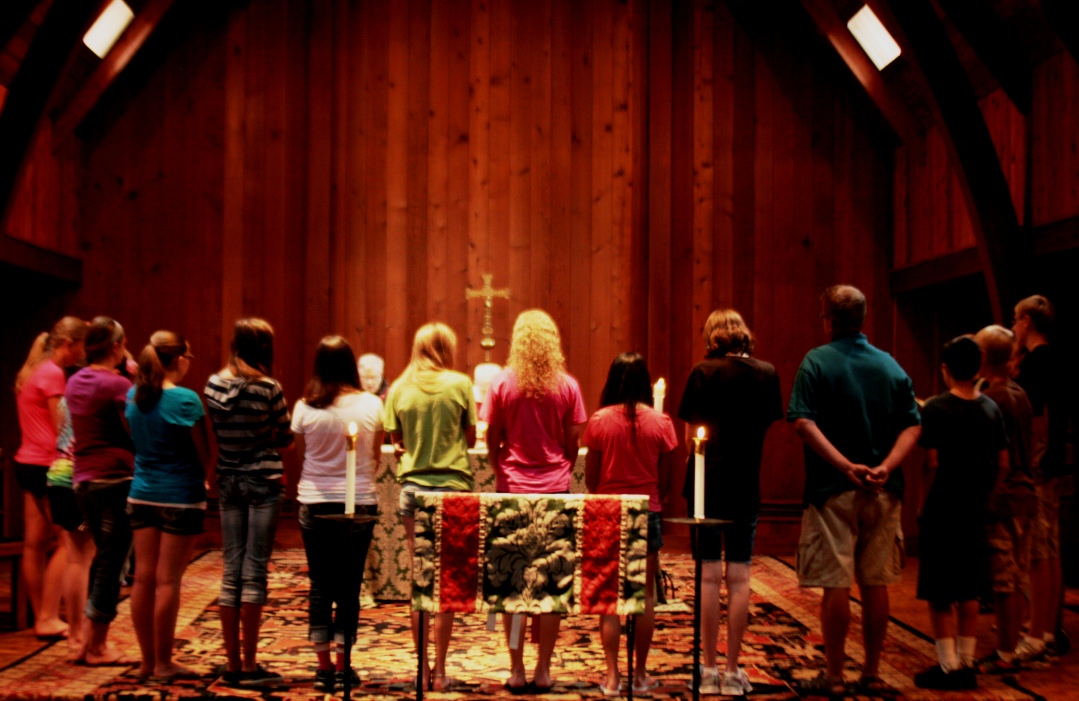

Eucharist (3): Discerning the Body

eucharist1St. Paul solemnizes his recounting of Jesus’ breaking bread and passing the cup of wine by saying that he is passing on to the Corinthians what he had received from the Lord. The words Paul uses here are specialized terms for receiving and passing on a sacred tradition. The only other time Paul uses these terms is to testify to Jesus’ Resurrection appearances. Resurrection and eating and drinking to “proclaim the Lord’s death until he comes” go together. After all, does not the Lord come every time we eat the bread and drink the wine?

These solemn words are an island of peace and tranquility in the middle of a storm of human passions amounting to farce. Preceding them is Paul’s denunciation of the insensitive and chaotic eating habits where some people bring opulent meals to church and eat in front of poorer members who have little or nothing to eat. The deterioration of the sharing in the wilderness that began in John’s Gospel has only gotten worse. After holding up Jesus’ shared meal as a model, Paul warns against eating and drinking judgment by “not discerning the body.” Paul may be warning us not to fail to discern Christ’s body in the bread, but he is not thinking in individualistic terms. Christ’s body surely refers to the church and, given the context, Paul is concerned with failure to recognize this corporate body in the way we share, or fail to share what we have with the community. In his fit of tempter, Paul seems to suggest that the Body and Blood of Christ make people sick cause some to die. But considering how strongly Paul insists on God’s freed Gift of grace, Christ Body and Blood can only be more free grace and forgiveness. However, when we fail to see the Body and Blood in Christ in others, sickness, hunger and many more social ills will abound.

With a church in shambles, is the miracle of the Feeding in the Wilderness a distant memory? I noted in the first article in this series that memory is not just recalling something in our heads. Memory is making present. When we eat the death of Jesus, we enter into our own discord that tears the Body apart with cries such as “I am of Cephas!” “I am of Apollos!”  When we eat the Resurrection of Jesus, we eat the forgiveness with which Jesus greeted is disciples to gather them back together. We also eat the feeding in the wilderness and Jesus’ Desire to heal the people brought to him.

We are not left as orphans who have to try to stuff some ideal of human relating into our heads. We are invited to act with others the human drama of entering into God’s Desire for ourselves and all others. Most important, we are fed with the substance of God’s desire to quicken us on the way.

 Eucharist (1): Christ our Passover

Eucharist (2): Feeding in the Desert

Baptism: Overwhelmed by Christ’s Love (3)

lakeGray1All of the biblical types of baptism that I have reviewed in the first two posts of this series stress the social nature of this sacrament. In the Paschal Mystery, we die to one way of relating (or misrelating) with people to live to a totally new way of relating to others. The traditional triad of renunciations of the world, the flesh, and the devil confirms this social element of baptism. The three are nearly synonymous but their varying shades of meaning are illuminating.

The New Testament word kosmos (world) has mainly negative connotations, especially in John’s Gospel where it means, not the material world as created by God, but the social world organized in opposition to God. In baptism, then, we renounce organizing ourselves socially around scapegoating and persecution. It is important to remember, though, that it was this very kosmos that God loved so much that God gave his only son so that this kosmos might not perish. As Jesus was overwhelmed by the kosmos in his death, we, too, may be overcome by it if we renounce it.

Flesh does not refer to the material aspect of our existence, but rather to the tendency live our embodied lives without reference to God. When we live in the flesh, our social lives are dominated by mimetic rivalry that consumes us. The contentions that Paul denounced in his first letter to the Corinthians was cited as an example of living by the flesh. If we renounce the flesh, we renounce this contentious way of relating and we allow our embodied lives to be guided by the Holy Spirit in whom there is no rivalry or resentment.

Renouncing the devil does not mean renouncing a wicked supernatural creature with horns and a pitchfork. The New Testament word skandalon refers to no such thing. Rather this word means a stumbling block, an obstacle. When we live according to the flesh, we allow other people to be stumbling blocks to our desires and we do the same to them. That is, our rivals become the organizing principles of our life rather than God. In scripture, the Satan is also the accuser, which is what rivals do. They accuse each other endlessly as opposed to praising God endlessly.

The renunciations as formulated in the 1976 Book of Common Prayer amount to much the same thing. Renouncing “Satan and all the spiritual forces of wickedness that rebel against God” may seem to imply supernatural forces. I do not rule out such angelic beings who, themselves, put themselves into mimetic rivalry with God, but the anthropological level is what is most important to us in renouncing skandalons in this life. The opposition of such stumbling blocks can seem so strong that they seem transcendent but are really an accumulation of human desires out of control. Renouncing “the evil powers of this world which corrupt and destroy the creatures of God” acknowledges the systemic evil of the kosmos which we must renounce and “the sinful desires that draw [us] from the love of God” point to our own responsibility to do what the fourth question asks of us, to “turn to Jesus Christ and accept him as [our] savior” and “put [our] whole trust in his grace and love.”

As noted in my last post, the new beginnings promised by the deliverances from the Flood and from the Red Sea were so daunting that, in both cases, those who were delivered returned to the old way of relating with each other and the same has happened with the Church. Baptism is a once-in-a-lifetime sacrament in the sense of being an initiation, that is a beginning. A beginning is just that; it is not the middle and certainly is not the end. Baptism is a beginning that must be sustained day by day, hour by hour. St. Paul’s admonition to “take off” the old person and “put on” the new person are verbs used for taking clothing on and off. Living by the Spirit in baptism, then, is allowing Christ to clothe us rather than the rivals who are usually the ones who define us. Being renewed in Christ leads us into a quality of life that we don’t easily imagine. These new clothes seem much too big for us and we get lost in them. Can we allow Christ to stretch us to fit into the new clothes of the resurrected life?

See Baptism: Overwhelmed by the Love of Christ (1)

See Baptism: Overwhelmed by the Love of Christ (2)

Baptism: Overwhelmed by Christ’s Love (1)

lakeGray1“We were buried therefore with him [Jesus] by baptism into death, so that as Christ was raised from the dead by the glory of the Father, we too might walk in newness of life.”  Rom. 6:4

If baptism is our initiation into Christ, our entry into the Paschal Mystery, then baptism is the underlying, ongoing dynamic of our lives in Christ. Dying and rising with Christ is something we need to do every day. The Greek word baptismo means to be overwhelmed, inundated. In baptism we are overwhelmed by and inundated with the Paschal Mystery. I will explore this mystery by looking at a few key scripture passages that give us variations on this one theme.

Jesus himself was baptized in the River Jordan by John the Baptist. For John, it was a baptism of repentance from the violent society of his time, to prepare for God’s winnowing fork in “the wrath to come.” But when Jesus comes, he does not bring a winnowing fork; he only brings himself and asks to be baptized. As he is baptized, the heavens open, the Spirit descends, and a voice from heaven says “This is my beloved Son with whom I am well pleased.”

These words refer to two key verses in the Hebrew Bible that tell us what baptism is all about. These words ring out in Psalm 2, addressed to the king, the Messiah, who is being singled out from the nations that are raging together and rising up against the Lord and his anointed. The inundation of baptism draws Jesus out of the inundation of the nations raging with each other. In Jesus, we too are drawn out of this inundation in the sense of being freed from raging against everybody else. We are not freed from being the target of these raging nations when they unite against the one who has been freed from their wrath. These same words also refer to Isaiah 42:1, the first line of the first song of the Servant of Yahweh. Throughout these songs, we find that the servant has been called out of a violent society and becomes the victim of that society’s violence. Unlike the psalmist who threatens the raging nations with a rod of iron, the Servant does not retaliate in any way against the violence inflicted on him. In baptism, we too are overwhelmed by the Servant’s suffering but then we are overwhelmed by the Servant’s vindication by God.

John’s Gospel does not narrate the baptism of Jesus but, as in so many other instances, John shows us the underlying story in a different key. When Nicodemus approaches Jesus by night, Jesus tells him that one cannot see the kingdom of God without being “born anew,” born “from above” by water and the Holy Spirit. Jesus seems only to compound Nicodemus’ puzzlement (and ours!) by suddenly shifting to Moses raising the bronze serpent in the wilderness. However, the bronze serpent was raised during a social crisis in the form of a plague. (Both the disease and the violence against Moses were contagious.) The phrase “lifted up” refers to Jesus being raised on the cross and then being raised from the dead. The bronze serpent, then, becomes an image of Jesus being raised on the cross to draw all people out of the society overwhelmed by violence into a new society as free of the violence as Jesus is himself.

This is the context of the famous words that follow: “For God so loved the world that he gave his only Son, that whoever believes in him should not perish but have eternal life.” If God so loves the world, then God is not bringing a winnowing fork or a rod of iron, but is bringing only himself, wounds from the cross and all, to lift all of us out of the world’s overwhelming violence to overwhelm us with his love.

See Part 2

Resentment: the Glue that Keeps us Stuck Together

fireworksBeing carried away by the contagion of the crowd is an obvious enough danger to some of us try to escape this danger by avoiding whatever the Crowd does. People who reject the Crowd are often people who have been rejected by the Crowd, such as those of us who failed to be in the “in” group at school. The position of an outsider easily becomes a jaundiced view, a “sour grapes” kind of view that sees how silly the Crowd is or how dangerous it is or could become if it needs to reinforce its cohesiveness through going beyond ostracism to persecution. For one who sees these dangers, it seems that all one has to do is reject the Crowd and become independent, free of the contagion that has engulfed everybody else.

But how free are we when we reject the Crowd? Not as free as the one who tries it thinks. Rejecting the crowd sucks us back into it at least as firmly as it sucks those who mindlessly allow themselves to be carried away by it. Actually, the attachment is usually even stronger than it is for the one who is carried away because rejecters are obsessed with what they reject. The name for this attempt at alienation is resentment.

What I have said about mimetic desire and the connections it creates with other people as soon as we are born and are capable of conscious thought tells us that we simply cannot, no matter how hard we try, break off these connections with others. Trying to pull away only adds to the tension, like a stretched rubber band, only the rubber band of mimetic desire is unbreakable. This is why children and teens who are relegated to the “out” group remained tied to the people who rejected them. Both the rejecters and the rejected use each other to define themselves. It is the scenario of the royal family who does not invite their unpopular relative to the child’s christening and the rejected relative comes anyway, bearing a curse that immobilizes the kingdom. Likewise, the tension of resentment freezes a social system, leading to a breakdown such as happened with the US government this month.

Resentment, then, tends to make the resenter the mirror image of the crowd. The resenter hates everything the crowd likes and does because the crowd likes it and does it. The resenter is prone to persecuting the crowd in thought and sometimes, tragically, in deed as much as the crowd persecutes its victims. When resenters get together to form their own anti-group, they tend to reproduce the persecutory dynamics of the crowd. I should, know, my high school memories are filled with this sort of thing from the viewpoint of a resenter.

The bottom line is that we cannot gain freedom from others by pulling away. We only tighten their hold on us and ours on them. Neither can we gain freedom by seeking power over the crowd by being the one who sways the crowd. The crowd sways the leader as much as the leader sways the crowd. The only way out I can see is to seek to gain freedom with other people. Following St. Paul’s admonition to think of the needs of others is the way to do this. In seeking the needs of others, we seek their freedom. We can only do this by letting go of resentment. Seeking the freedom of others leaves us vulnerable to those who do not reciprocate. However, by renouncing our own resentments, we already gain a measure of freedom that cannot be taken away from us. It is this freedom that makes it possible for us to use our connectedness to others to move the social system in a dynamic of mutual giving and receiving.

See Mimetic Desire and Mimetic Rivalry

Mimetic Desire and Truth (5)

???????????????????????????????????????????In my last post, I showed how the premiere place for perceiving truth, the place of the victim, has been distorted. The problem is, if a person in in the place of the victim deals with it by making victims of others, as so many abused people have done, then that person is no longer in the place of the victim and has lost “the intelligence of the victim.” Unfortunately, such people are so caught up in feeling entitled to make victims of others and with the mimetic rivalry I mentioned as to who is the greatest victim, that do not know that they do not have the victim’s “intelligence.”

The revelation of the true victim in the Gospels is very different. Jesus was not only the innocent victim; Jesus was the forgiving victim. No wishing for the limbs of his enemies to tremble or shake or that they be swept away, greenwood or dry, as the Psalmist wished for him! It is Jesus’ forgiveness which gives him a true view of humanity so that he saw the potential for Matthew and Zacchaeus and, after his Resurrection, of Paul when nobody else did. The place of the victim, then, is the place of truth when the victim is forgiving.

When the victim is forgiving, as Jesus was, is, and will be forever, then mimetic desire takes a sharp turn away from rivalry and moves again in the expansive direction of sharing. The forgiving victim does not pose as the greatest of victims; the forgiving victim only wants healing for everybody, including and, especially for the victimizers. The desire that the forgiving victim shares is a desire for the well-being of all, a desire that does not allow for rivalry as rivalry would undermine this desire of universal healing.

In a sense, we have come full circle from where I started with expansive mimetic desire that initiates young people into food and games and art and many other things that are good and desirable. This original mimetic desire, if we wish to call it that, is akin to the good of creation. We were created with mimetic desire for precisely this purpose. The universal fall into mimetic rivalry and its ensuing social crises is Original Sin. (Note the mimetic rivalry between Adam and Eve, Cain and Abel and humanity’s rivalry with God by building the Tower of Babel.) The recovery of expansive mimetic desire through Jesus the forgiving victim is restorative and redemptive. St. Paul said repeatedly the Christ’s redemption did not return us to original good creation; it brought us to a whole higher level of well-being that is grounded in forgiveness.

Since truth is grounded in creation, it follows, as Thomas Aquinas demonstrated, that the truth of things resides in the mind of God. That is, God sees what God has made and knows the depths of all that God has made in all truth. Insofar as we humans see things as God sees them, we see them truly. Our growing awareness of mimetic desire, however, shows us that seeing the truth is not a solitary endeavor; it is a corporate matter. Only through the expansive mimetic desire of sharing what is desirable can we, together, have a reasonably accurate apprehension of truth. Since truth is grounded in God, God becomes a partner in this corporate effort. Given the fallenness of humanity through rivalrous mimetic desire, it is through the forgiving victim that we can recover a vision of the world as God sees it in all its profound desirability.

See Mimetic Desire and Truth Series

See Mimetic Desire and Mimetic Rivalry for all posts on this topic

The Good Shepherd in the Desert

goodShepherdIf Jesus is the “living interpretive principle of scriptures, as James Alison says, then the Parable of the Good Shepherd who leaves the ninety-nine to search out the one lost sheep should be a powerful and accurate interpretive lens for other passages in scripture.

In the RoCa lectionary, this Gospel is coupled with a tense episode in Exodus 32. As he comes down the mountain with the tablets of the Ten Commandments, he finds that Aaron has set up a golden calf for the Israelites to worship. God tells Moses to get out of the way so that his wrath can “burn hot against them.” Doesn’t sound like a good shepherd.  Instead, it is Moses who acts out the part of the good shepherd by interceding with God, as Abraham did earlier to avert the divine wrath from the people. At the end of this same chapter, there is another narration of Moses coming down the mountain. This time, he is so furious he breaks the tablets and then rallies the Levites to his side to slay thee thousand people who were worshipping the golden calf. Although Moses claims to be doing God’s work, what we have is a narrative of human rather than divine violence. Moses doesn’t look like a good shepherd this time, but the morning after this monstrous slaughter, Moses intercedes with God to forgive the people although it is a bit late for the three thousand who were slain. This strange doubling of narrations seems to point to a debate in the Jewish tradition moving in the direction of unveiling God’s love for God’s people.

In 1 Corinthians 10, St. Paul refers to this incident by saying “we must not indulge in immorality as some of them did, and twenty-three thousand fell in a single day.” (He ups the death toll.) In isolation, this is about the chilliest verse in the Pauline epistles but in its sacramental context, it is much more in keeping with Jesus the Good Shepherd. Leading into this verse, Paul says that “we were baptized into Moses in the cloud and in the sea, and all ate the same supernatural food and all drank the same supernatural drink.” This, in turn, recalls the reinterpretation of the Flood in 1 Peter where the water corresponds to the baptism that delivered Noah and his family and delivers us now. The Genesis story clearly indicates a social meltdown with a few, probably the intended victims, escaping. The Exodus story refers to the social meltdown in Egypt that lead to the expulsion of the Israelites. In the desert, the Israelites had their own social meltdown centered around rivalry between Moses and Aaron. (Arnold Schönberg’s opera Moses and Aron portrays this rivalry with great insight.) For both Peter and Paul, baptism is the deliverance from the surrounding sacrificial society into the Kingdom centered on the Eucharist, the new way of gathering without need of victims and certainly not needed the slaughter of three thousand. Paul is not, then, warning his readers against a wrathful deity but against a wrathful society that will engulf them if they return to its sacrificial ways, just as a relapse into the wrathful society of Egypt lead to a meltdown in the camp and the deaths of thousands.

Jesus the Good Shepherd does not strike dead those who re-enter a sacrificial society that today manifests hardness of heart to the extent of trying to prevent fundamental ministries such as feeding the hungry. Instead, Jesus enters into the heart of the society to bring back all who are lost. Rather than starting a bloodbath, we should intercede for all such people as Moses did and follow Jesus in searching for the lost.

See also: The Communal Good Shepherd

PETER AND PAUL: The Church’s Quest for Mimetic Unity

Sts_Peter_and_PaulThe presence of two strong personalities roughly the same sphere of influence is a perfect recipe for mimetic rivalry that can tear the social fabric apart until it is resolved either through implosion or collective violence against a victim. There is evidence that precisely these sorts of tensions played out between Saints Peter and Paul but there is also evidence of attempts at reconciliation between the two and further reconciliation on their behalf in the early Church to provide a very different model for the relationship between two strong outstanding personalities.

In the Acts of the Apostles Luke seems to have taken great pains to balance the impact of the missionary work of these two apostles under the guidance of the Holy Spirit. That Peter drops out of the narrative half way through the book and the seemingly abrupt ending with Paul awaiting trial in Rome diminishes the importance of even these great saints and emphasizes their subordination to the Holy Spirit. At the momentous Council of Jerusalem where the two apostles meet, at the heart of the book, the situation is ripe for conflict, but Luke presents the Council as an amicable solution to their conflict. Luke heightens the reconciliation by having Peter speak up Paul him in with words that sound a lot like a speech Paul could have made himself. That is, Peter imitates Paul to support his position at a time when he could have become a mimetic double in conflict with him. Peter’s earlier struggle over the appropriateness of preaching to of the Gentiles resolved by his vision of a sheet coming down from Heaven with both clean and unclean animals on it sets up this reconciliation. James plays the role of the mediator who states the amicable solution that allocates a separate sphere for Jews and Gentiles so that the two groups need not compete but are given space to follow the guidance of the Spirit. Paul’s letter to the Galatians tells a different story full of tension. Although Peter and gave Paul received “the right hand of fellowship” in Jerusalem, he later found it necessary oppose Peter “to his face” for rejecting table fellowship with Gentiles. Perhaps Peter had suffered a relapse of his own tendency to be swayed by the wrong mimetic crowd, such as happened to him in the courtyard of the high priest when he was surrounded by fellow Jews were against that fellowship. We never learned if this quarrel was ever healed between them in this life before it was healed posthumously in the hagiography and liturgy of the Church but there are hints that it probably was.

In writing to the Corinthians, Paul took pains to quell rivalry that had triangulated him with Peter by taking them severely to task for using such slogans as: “I am for Paul,” “I am for Cephas.” Far from fanning the flames of conflict, Paul distances himself from it in no uncertain terms and renounces any possible gain he might get from the “Paul” Party in Corinth. Although Peter is not believed to be the author of the Second Epistle bearing his name, it is significant that he refers to “our brother Paul, who is so dear to us.” At the very least, these words attest to the Church’s corporate effort to maintain a peaceful relationship between the two apostles. Peter says that Paul wrote “with the wisdom that is his special gift,” but then he cautions his readers that some points in Paul’s letters are hard to understand and are “easily distorted by uneducated and unbalanced people.” Tension and reconciliation between the two great apostles are themselves held in close tension here. A generation later, St. Clement of Rome writes the Corinthians to rage over an “abominable and unholy schism” in the community fueled by jealousy and envy. As a counter-example, Clement describes the deaths of Peter and Paul, stressing the harmony between the two great apostles. A century or so later, St. Ireneaus called the Church of Rome “the greatest and most ancient Church, founded by the two glorious apostles, Peter and Paul.” Archaeological investigations along the Appian Way have unearthed rooms with inscriptions honoring both saints together and a bronze medal dating from the first half of the second century pictures the heads of the two saints on the same side of the medal.

The Golden Legend, a 13th century compilation of saints’ lives by Jacob of Voragine is not the book one goes to for the most accurate history of the early church or anything else, but it is one of the best books for studying the way saints have been presented as models to the faithful. In his entry on Paul, Jacob explicitly curbs the alleged rivalry with St. Peter when he says: “We find that at different times Paul is portrayed as Peter’s inferior, as greater than Peter or as Peter’s equal, but the fact is that he was inferior in dignity, greater in preaching, and equal in holiness.” Jacob seals this unity by affirming the early Church’s legend that they were martyred under Nero on the same day. Before they were parted for their executions, Jacob records that Peter and Paul exchanged benedictions of each other.

This reconciliation between these two apostles is effected by their sharing the same feast day on June 29 when the other apostles get a day each for themselves. The Magnificat antiphon for First Vespers of this feast says: “Peter and Paul were at one in their love of the Lord: neither in life nor death were they divided.” The second half of this text comes from David’s lament for Saul and Jonathan (2 Sam. 1:23), so that a verse referring to the protracted mimetic struggle between David and Saul is applied to another problematic relationship to heal whatever division there may have been in real life and offer the Church a model of mimetic amity.

How Are We Saved?

yellowTulips1The New Testament and two thousand years of Christian preaching has consistently proclaimed that the death and resurrection of Jesus Christ has opened the way of salvation for all humanity. Precisely how this mysterious, earthshaking event has done that   has raised more questions than answers. It is understandable that the focus would tend to be on the death of Jesus since the event is so dramatic and creates intense emotional effects in Jesus’ followers. However, understandings of the atonement of Jesus through this route have raised long-standing problems that cry out for a fresh approach. The growing realization that the killing of Jesus was just plain wrong on the part of many Christians, and not just those influenced by the thought of René Girard,  opens a way for a re-thinking of atonement theology that can support a deep spirituality grounded in God’s unconditional love for all people. As article I wrote for the Abbey Letter Saved By the Life of Jesus contributes to this re-thinking that actually reclaims the Gospel for us. It is included in the collection of articles in Come Let Us Adore. You can read it here.

Abraham out on Highway 61

sideAltarsIcons1The near-sacrifice of Isaac by his father Abraham, the Father of Faith, is the most troubling of stories. It should be. Chaim Potok’s young protagonist Asher Lev remembers the shiver he felt when he first heard the story. What is most troubling is the suspicion that Abraham was right to be willing to sacrifice his son. But was he? Jeremiah says Yahweh denounced the sacrifice of children, saying “that such a thing had never entered my mind.” (Jer. 19:5) Perhaps we are right to be troubled by any notion that Abraham was right to even let the idea enter his mind and even more troubled by any thought it ever entered into God’s mind.

Bob Dylan makes a bitter burlesque of the story in his song “Highway 61 Revisited.” The “god” who requires the sacrifice is a bully, warning Abraham that if he doesn’t comply: “Next time you see me, you’d better run.” To the question: “Where do you want to see this killing done? God said out on Highway 61”, the place for “a thousand telephones that don’t ring” and where to “put some bleachers out in the sun” to stage the start of the next world war. As with so many Dylan songs, the imagery reveals a society filled with mimetic rivalry and victimization where sacrifice and war become a spectator sport.

Soren Kierkegaard’s searing Fear and Trembling is at least as troubling as the biblical story. SK’s category of the “teleological suspension of the ethical” raises fears that the author celebrates Abraham’s willingness to do the deed. (What the fancy phrase means is: anything at all God says to do is right—end of story.) However, this troublesome category is coupled with what SK called “infinite resignation.” This is what Abraham had when he was willing to kill his son by God’s command. However, infinite resignation falls far short of faith and faith is what the biblical story and SK’s book is all about. Faith is receiving back what is given with infinite resignation “by virtue of the absurd.” Still troubled?

The most clear and piercing critique of this “infinite resignation” I know of comes in the powerful poem retelling this story by the World War I poet Wilfred Owen. Abraham builds parapets and trenches around the wood, suggesting the sacrifice of sons sent off to the war. But when the angel of the Lord admonishes Abraham to “slay the ram of pride instead of him . . . the old man would not so, but slew his son,/ and half the seed of Europe one by one.” This poet, one of many young victims of the war, and the creator of the bitter irony that poets like Bob Dylan use so well, has revealed once and for all the sacrificial horror of “infinite resignation.” That is, anyone infinitely resigned to sacrifice oneself without faith will also sacrifice others, especially one’s own children, also without faith.

The typological interpretation of the story where it stands for God the Father’s being willing to sacrifice His only begotten son is also troubling. But Jesus did not go to the cross with infinite resignation. Rather, by “virtue of the absurd,” he believed that God, being the God of Abraham, Isaac, and Jacob was God, not of the dead, but of the living.” (Mt. 22:32) St. Paul says we are saved by the faith of Christ, the faith that, on the cross, embraced not death, but the life of his heavenly father. The virtuous absurd, then, is the ecstatic embrace of God’s love so filled with life that there is no room for death for anybody.