
Liturgical Animals (3): Stories and Ritual

eucharist1Ever since stories started to be told it has been known that we resonate with them and with the actions of the characters at a very deep level. Aristotle famously called it catharsis where our own emotions are purified when we identify with the emotions of a character on stage. Girard’s theory of mimetic desire gives us increased awareness of the phenomenon. It is no accident that Girard discovered that the best novelists and playwrights had discovered it, not least Sophocles who had inspired Aristotle’s concept of catharsis. (See Human See, Human Want.)

The discovery of mirror neurons adds further scientific and anthropological understanding to the way we resonate with stories. (See Mirroring Desires.) Realizing that our mirror neurons are activated by the intentions of others, we now know that the actions of actors on stage or on the screen also activate our mirror neurons. This is why we are so affected by what they do and most particularly what they desire. By identifying with a thief who is the protagonist of a story, we easily find ourselves desiring the thief’s success although in real life we would normally not desire that at all. But then again, perhaps the story has revealed a hidden desire to steal successfully. Or, perhaps a desire that wasn’t there has been created by the thieving action. Or a combination of both.

This is where the debate about whether or not violence or any reprehensible actions should be allowed in movies or on the stage of even in books. Does the violence observed or read about make one more violent or does it cause a catharsis, thus acting as a safety valve that prevents violence in real life? As far as I can tell, the answer goes both ways. After the Columbine school shooting, a video game was blamed for motivating the killers to go on a shooting spree, but this accusation overlooks the huge number of boys in the same age bracket who did no such thing. What we are left with, I think, is the need for us to take some responsibility for what we watch and read and more important, for how we react to them. For some, watching cops and robbers programs are mild entertainment. For others, it is more a thrill of surrogate righteous violence. If it is the latter, is this surrogate thrill enough or does it lead to inflicting violence against the “bad” guys in real life and feeling righteous about it? Or, do we act these feelings of righteous indignation without knowing what we are doing? Which puts us in the position of those who crucified Jesus.

Which brings us back to liturgy. It is worth noting that Greek plays were performed as parts of religious festivals, making the expulsion of Oedipus, for example, a liturgical event. To this day, plays and classical concerts often have a quasi-liturgical atmosphere with dimmed houselights and norms for audience decorum similar to what is usually expected in church. The more raucous and extroverted actions at rock concerts and Pentecostal services are liturgical in their own right with different liturgical norms. The thing is, liturgies and plays and concerts all stimulate the same mirror neurons in similar ways.

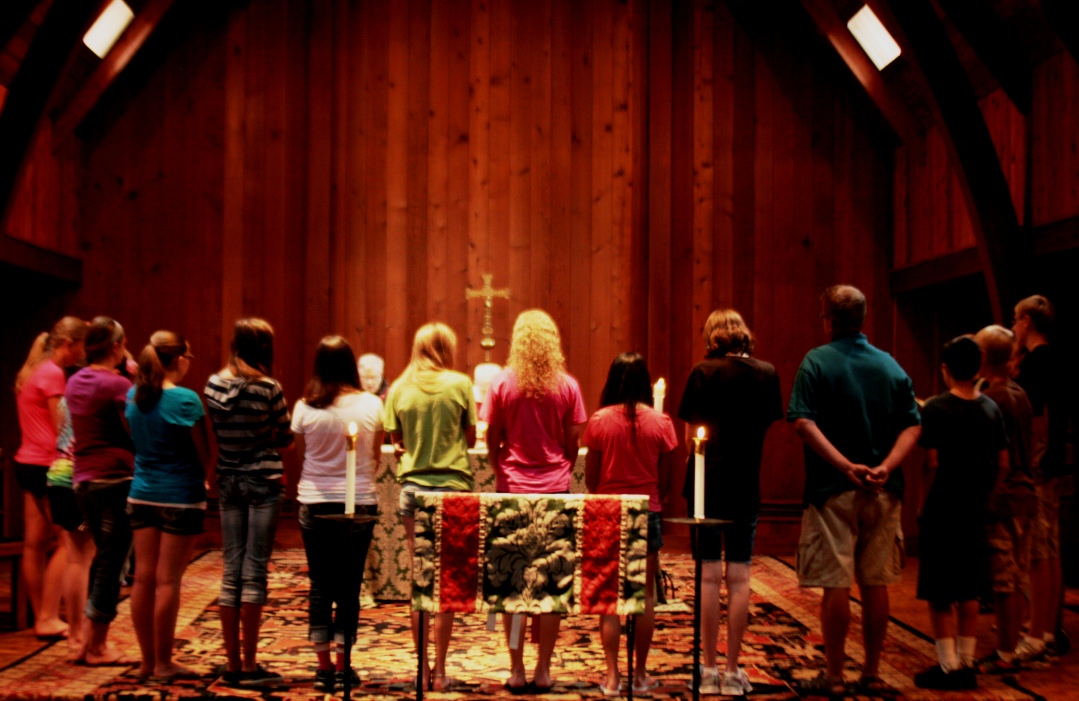
In Christian worship, the liturgical action is bound up with stories about Israel and most particularly, the story of Jesus. The stories are drawn out in the readings from scripture and the central story of Jesus, the Paschal Mystery, is compressed in the Eucharist where the story is fed to us literally in the bread and wine. Listening to the Word activates the mirror neurons, hopefully making us identify with the heroes and heroines of faith and most particularly with Jesus. Even from ancient times, certain people have been held up as good examples to imitate. As for Jesus settling a good example, since he compared himself to a burglar at one point, we can feel naughty and subversive in following his example and yet also feel righteous about it (Mt. 24;43). The pitfall is that we might identify with the owner of the house, and so try to keep Jesus out so that our lives aren’t subverted and turned upside down. This is just one example of how a story can twist us around in several directions, leaving us to wonder which end is up.

In general, plays and concerts are not repetitious the way the Eucharist is, which tells the same old story time after time to make it sink more deeply into us each time. It should be noted, though, that many people like to hear the same symphonies time after time and some people have favorite movies they see more times than they can count. Children have a ritual sense with their favorite bedtime stories that they want to hear night after night at the same time each night. In the Paschal Mystery, there is disclosure of the deepest truths about the way we humans live but also how we ought to live and could live by absorbing the character of Jesus. This is a story that never ends.


Mimetic Laughter

outsideSupper1Laughter is one of the more pleasant things in life, but is it just a frill? In his book The Phantom of the Ego,” Nidesh Lawtoo discusses the importance Georges Bataille attached to laughter for the emerging consciousness of a newborn child. Laughter is one of the first things a baby learns in imitation of a mother, father, or other caregiver. So it is that laughter comprises the first bond a newborn child makes. Interactions with babies may seem silly, something to be transcended with intellectual maturity and so we don’t value laughing with babies.

At its best, laughter is spontaneous and infectious. How many times do we laugh without knowing why, just because other people are laughing? When children are laughing helplessly as part of playing, happiness spreads to everyone around them. We don’t want to be left out of the joke, even if we don’t know what it is. Just think of some of our best times when we laughed with family and friends with no other reason than we were together and we got caught up in laughter.

There is a darker side to laughter, however. Actually it is a darker side of us and our mimetic desires, rather than a darker side of laughter. Often laughter is used to wound others, to score points against others, to put others down to lift ourselves up. Almost as soon as they learn how to speak, small children use laughter in this way. School playgrounds are filled with this sort of thing. Children learn all this from their elders, of course. Just as they imitated the spontaneous laughter of those around them as infants, they imitate the cruel humor that surrounds them as they grow older. Unfortunately, children usually learn this mode of laughter through being shamed by adults who think ridicule is a good way to train children for the hard knocks of life. Laughter continues to be a bond between people, but it is a bonding at the expense of someone, a butt of jokes, a victim.

When he discourages laughter as a sign of pride, St. Benedict certainly had this darker side of laughter in mind, although it is possible that he had a blind spot for the value of spontaneous, bonding laughter. Certainly, when laughter is a put-on act to gain attention, it is the opposite of spontaneous and it is a prideful act, an act seeking to dominate by drawing attention to oneself at the expense of others. I discuss this at length in my book Tools for Peace.

We get so habituated to using laughter as a weapon instead of a bond of love that we hardly know what the latter is. One way back is to use the wit we acquire to learn to laugh at ourselves and help others laugh at themselves. At its best, a comedy does just that. In Mozart’s “The Marriage of Figaro,” discussed in an earlier post, laughter is used as a means to overcome mimetic triangles and tensions and bring reconciliation. Shakespeare does this sort of thing masterly in comedies such as “Twelfth Night” and “As You like It.” In “The Merchant of Venice,” Shakespeare sets a trap for the unwary, leading us into joining the persecution of Shylock before unmasking this derisory laughter for what it is.

Life is too serious and awesome a thing to be left to sourpusses who always want to be on top of somebody else. We all need heavy doses of spontaneous, selfless laughter shared with others.


Renouncing Resentment

buddingTree1Since resentment keeps us locked into the groups and individuals who feel have hurt us, it behooves us to let go of our resentments, as I suggested at the end of my post “Resentment: the Glue that Keeps us Stuck Together.” As everyone who has tried it knows, letting go of resentments is one of the greatest challenges in life. Concentrating on letting go of our resentments is counter-productive as this technique keeps us focused on the very thing we are trying to get rid of. It is like the childhood game: Try to get through one minute without thinking of strawberry shortcake. Obviously, all one can think of for the next minute is strawberry shortcake.

The thing to do is think of something else, and/or think of the sources of our resentments in a new way. At the end of my last post, I gave an example of the latter by bringing in St. Paul’s recurring admonition to think of others and their needs ahead of our own. We can often gain a degree of sympathy of the people we resent if we see some of the brokenness they suffer and see our own brokenness mirrored in them. (It is this mirroring effect that often makes us wish to escape this truth through projecting it on to others.) The something else that is most effective for redirecting focus is, at least for a Christian like me, Jesus the Forgiving Victim. The emphasis here is on “forgiving victim.” Far too many Christians have used the memory of Jesus’ death as a cause for resentment with tragic results.

Actually, thinking isn’t really the way to handle resentment because resentment isn’t a matter of thought; it’s a much more visceral phenomenon. It isn’t that we decide to be resentful because it’s a nice thing to do and we can decide to stop being resentful at the drop of a wish. Resentment is something that grabs us before we know it has grabbed us and resentment does not loosen its hold on us easily. It is as if resentment, like a virus infecting one’s body, has its own blind urge for survival no matter what damage it does to anything else. So, when I talk about redirecting attention to Jesus the Forgiving Victim and to the people we resent in the light of Jesus who has forgiven them as much as He has forgiven us, I mean that we have to undergo a revolution of the whole, embodied person. I didn’t say that we should initiate the revolution; I said we should undergo it. That is, we have to let go in a very deep way so that the Desire of the Forgiving Victim can become our visceral desire, a desire much deeper than the desire of resentment which is locked into the same resentful desire of other people.

Basic spiritual practices such as liturgical prayer, deep reading of scripture and meditation (contemplative prayer) are, or should be, practiced at this same deep visceral level so that they can open us up to being filled with the Desire of the Forgiving Victim. Praying with others is a means of being in a group that gains cohesion by praying without resentment rather than persecution, which breeds resentment. The more solitary practice of meditation is still made in solidarity with others, thus seeking to relate us to God and other people without resentment. In a short blog post, renouncing resentment sounds like a simple matter. Well, it is simple, but it takes years of devoted practice.

Each time we allow the Forgiving Victim to remove any resentment we harbor, we glimpse a bit more of the new Heaven and the new Earth coming down from Heaven into the midst of our lives.

[I discuss spiritual practices in reference to the Rule of St. Benedict in my book Tools for Peace]

Resentment: the Glue that Keeps us Stuck Together

fireworksBeing carried away by the contagion of the crowd is an obvious enough danger to some of us try to escape this danger by avoiding whatever the Crowd does. People who reject the Crowd are often people who have been rejected by the Crowd, such as those of us who failed to be in the “in” group at school. The position of an outsider easily becomes a jaundiced view, a “sour grapes” kind of view that sees how silly the Crowd is or how dangerous it is or could become if it needs to reinforce its cohesiveness through going beyond ostracism to persecution. For one who sees these dangers, it seems that all one has to do is reject the Crowd and become independent, free of the contagion that has engulfed everybody else.

But how free are we when we reject the Crowd? Not as free as the one who tries it thinks. Rejecting the crowd sucks us back into it at least as firmly as it sucks those who mindlessly allow themselves to be carried away by it. Actually, the attachment is usually even stronger than it is for the one who is carried away because rejecters are obsessed with what they reject. The name for this attempt at alienation is resentment.

What I have said about mimetic desire and the connections it creates with other people as soon as we are born and are capable of conscious thought tells us that we simply cannot, no matter how hard we try, break off these connections with others. Trying to pull away only adds to the tension, like a stretched rubber band, only the rubber band of mimetic desire is unbreakable. This is why children and teens who are relegated to the “out” group remained tied to the people who rejected them. Both the rejecters and the rejected use each other to define themselves. It is the scenario of the royal family who does not invite their unpopular relative to the child’s christening and the rejected relative comes anyway, bearing a curse that immobilizes the kingdom. Likewise, the tension of resentment freezes a social system, leading to a breakdown such as happened with the US government this month.

Resentment, then, tends to make the resenter the mirror image of the crowd. The resenter hates everything the crowd likes and does because the crowd likes it and does it. The resenter is prone to persecuting the crowd in thought and sometimes, tragically, in deed as much as the crowd persecutes its victims. When resenters get together to form their own anti-group, they tend to reproduce the persecutory dynamics of the crowd. I should, know, my high school memories are filled with this sort of thing from the viewpoint of a resenter.

The bottom line is that we cannot gain freedom from others by pulling away. We only tighten their hold on us and ours on them. Neither can we gain freedom by seeking power over the crowd by being the one who sways the crowd. The crowd sways the leader as much as the leader sways the crowd. The only way out I can see is to seek to gain freedom with other people. Following St. Paul’s admonition to think of the needs of others is the way to do this. In seeking the needs of others, we seek their freedom. We can only do this by letting go of resentment. Seeking the freedom of others leaves us vulnerable to those who do not reciprocate. However, by renouncing our own resentments, we already gain a measure of freedom that cannot be taken away from us. It is this freedom that makes it possible for us to use our connectedness to others to move the social system in a dynamic of mutual giving and receiving.

See Mimetic Desire and Mimetic Rivalry

Mimetic Desire and Truth (5)

???????????????????????????????????????????In my last post, I showed how the premiere place for perceiving truth, the place of the victim, has been distorted. The problem is, if a person in in the place of the victim deals with it by making victims of others, as so many abused people have done, then that person is no longer in the place of the victim and has lost “the intelligence of the victim.” Unfortunately, such people are so caught up in feeling entitled to make victims of others and with the mimetic rivalry I mentioned as to who is the greatest victim, that do not know that they do not have the victim’s “intelligence.”

The revelation of the true victim in the Gospels is very different. Jesus was not only the innocent victim; Jesus was the forgiving victim. No wishing for the limbs of his enemies to tremble or shake or that they be swept away, greenwood or dry, as the Psalmist wished for him! It is Jesus’ forgiveness which gives him a true view of humanity so that he saw the potential for Matthew and Zacchaeus and, after his Resurrection, of Paul when nobody else did. The place of the victim, then, is the place of truth when the victim is forgiving.

When the victim is forgiving, as Jesus was, is, and will be forever, then mimetic desire takes a sharp turn away from rivalry and moves again in the expansive direction of sharing. The forgiving victim does not pose as the greatest of victims; the forgiving victim only wants healing for everybody, including and, especially for the victimizers. The desire that the forgiving victim shares is a desire for the well-being of all, a desire that does not allow for rivalry as rivalry would undermine this desire of universal healing.

In a sense, we have come full circle from where I started with expansive mimetic desire that initiates young people into food and games and art and many other things that are good and desirable. This original mimetic desire, if we wish to call it that, is akin to the good of creation. We were created with mimetic desire for precisely this purpose. The universal fall into mimetic rivalry and its ensuing social crises is Original Sin. (Note the mimetic rivalry between Adam and Eve, Cain and Abel and humanity’s rivalry with God by building the Tower of Babel.) The recovery of expansive mimetic desire through Jesus the forgiving victim is restorative and redemptive. St. Paul said repeatedly the Christ’s redemption did not return us to original good creation; it brought us to a whole higher level of well-being that is grounded in forgiveness.

Since truth is grounded in creation, it follows, as Thomas Aquinas demonstrated, that the truth of things resides in the mind of God. That is, God sees what God has made and knows the depths of all that God has made in all truth. Insofar as we humans see things as God sees them, we see them truly. Our growing awareness of mimetic desire, however, shows us that seeing the truth is not a solitary endeavor; it is a corporate matter. Only through the expansive mimetic desire of sharing what is desirable can we, together, have a reasonably accurate apprehension of truth. Since truth is grounded in God, God becomes a partner in this corporate effort. Given the fallenness of humanity through rivalrous mimetic desire, it is through the forgiving victim that we can recover a vision of the world as God sees it in all its profound desirability.

See Mimetic Desire and Truth Series

See Mimetic Desire and Mimetic Rivalry for all posts on this topic

Mimetic Desire and Truth (4)

crucifix1In my last post in this series, I noted that mimetic rivalry inevitably distorts truth and that it creates victims. The mutual involvement of rivals with each other precludes their seeing each other truly and it makes them oblivious to the people who are affected by their rivalry. René Girard has demonstrated about as well as it is possible when examining the human behavior at the dawn of civilization that social meltdowns were resolved by collective violence that were covered up by myths that obscured the reality of what had happened. When Jesus said that the devil is a murderer and a liar from the beginning (John 8:44) he was not talking about a supernatural figure who was doing the damage; he was making an anthropological statement about human responsibility. That is, the violence of mimetic rivalry inexorably leads to mendacity. Philosophers might quibble with each other about where the limitations of the human intellect are for perceiving truth, but the real problem with perceiving the truth is rooted in the human will. The more involved we are in mimetic rivalry, the less truth we can see.

These considerations lead to the conclusion that truth is found, not in some fancy theory of human knowledge, but in the reality of the victim. It is this reality that is revealed in the numerous psalms of lament where the psalmist is constantly surrounded by enemies who blame him or her for all of the calamities inflicted upon the people. This truth is definitively revealed in the Passion narratives of the Gospels where Jesus is revealed as the innocent and forgiving victim vindicated by God. Andrew McKenna called it “the epistemological privilege of the victim.” Some privilege! James Alison coined the term “the intelligence of the victim.” René Girard consistently deflects postmodernists who insist there is no center of truth anymore by pointing to the reality of the victim as the starting point for perceiving truth.

This sounds simple but mimetic rivalry has twisted this truth in some subtle ways. In a way, the Gospels did the job of revealing the truth of the victim too well. As far as I can tell, nobody, not even Socrates, cared to be in the place of the victim before the Gospels were written. By the beginning of the twenty-first century, the most intense mimetic rivalry is precisely over who is the greatest victim. Everybody, every social group wants to be the most victimized victim and to hold that position at the expense of all other victims. CEO’s who rake in millions of dollars in bonuses while they ruin the finances of thousands of people claim to be victims when they become objects of opprobrium. Well, objects of opprobrium are victims, but they don’t know what they are doing. In every conflict between social groups or between individuals, each side, each person is very much aware of the truth of their own victimhood. What none of these people see at all is the truth of the victimhood of their enemies. Least of all do rivals over victimhood see the victims that their rivalry is creating.

The key to truth, then, has become violently distorted in our time. Fortunately, there is more to this key than what we humans have done to it and we will revisit this key in the final post of this series.

Continue on to Mimetic Desire and Truth (5)

See Mimetic Desire and Truth Series

See Mimetic Desire and Mimetic Rivalry for all articles on this subject

Mimetic Desire and Truth (3)

Xenia1In my last post in this series, I noted the example of Polixenes in The Winter’s Tale who showed a reasonably accurate view of reality by praising the qualities of Hermione, but that the jealous rage of her husband Leontes distorted the reality deeply. It is the same distortion that happens in the nursery when children fight over one toy as if it were the only one when the reality is that there are many toys to play with. Mimetic rivalry over romantic partners will likewise distort the human reality in a school or other social setting. In a non-rivalrous situation, girls can imitate each other in finding various boys desirable and, like Polixenes, can admire the choices their friends make. But if two or more girls are in rivalry with each other, perhaps over something such as the position of captain on the girls’ field hockey team, then they will cease to see the qualities of the boys more or less for what they are. It is often said that love, especially infatuations, is blind, but conflicted mimetic desire is much more blind than that.

It is important to distinguish honest disagreement from rivalry. In both cases, there is mimetic desire but in the former case, it is a shared desire to arrive at truth or discernment of right action. In the latter case, the two people are trying to outdo each other for the sake of outdoing each other. The shared mimetic desire is a victory over the other and truth and right action fall by the wayside.

The movie “Doubt” is an excellent illustration of this kind of situation. With Father Flynn and Sister Aloysius are permanently locked in mimetic rivalry, it is not possible that the truth of whether or not the priest has abused Donald Miller, the Afro-American boy in the parish school, can be known and that is why the movie never resolves the question. Donald Miler, of course, is clearly a victim of this strife regardless of what has or has not really happened.

There is a qualitative difference between honest disagreement and rivalry but it is also a fine line between them.  We can easily start with honest disagreement and fall into rivalry if we allow ourselves to become more obsessed with the person we disagree with than with trying to see what is true and what should be done. This matter calls for constant self-examination where we continually ask ourselves as honestly as we can: What side of this line am I on? How far on that side am I? We also have to keep alert to whether we are actually listening to what the other is saying or if we are only thinking about what we want to say. If we neglect this self-examination, we are pretty certain to fall over into the wrong side of this divide and become lost in mimetic entanglements.

A shared mimetic desire for truth does not guarantee that truth will be reached since our viewpoints cannot encompass all relevant realty but it is a sine qua non for reaching some semblance of the truth. On the other hand, when we are locked in mimetic rivalry with others, it is not just some abstract principle of what is true that is a casualty, but real human beings will suffer as victims, like Donald Miller in “Doubt.”

Continue on to Mimetic Desire and Truth (4)

See Mimetic Desire and Truth Series

See Mimetic Desire and Mimetic Rivalry

Bewitched, Bothered, and Repentant

???????????????????????????????????????????The persecution of so-called witches in Salem Massachusetts in 1693 is well-known as a notorious event in American history. Not so well-known is the spiritual journey of one of the judges on the panel that ordered the execution of the twenty convicted prisoners. The biography of him by Eve Laplante is not a particularly good book with its chronological skips and copious details that are of not great interest, but she does bring the remarkable land telling story to light.

Samuel Sewall was a good and generous and devout man. Bracket out his voting for the twenty executions and one finds nothing reprehensible about him and much to commend. What happened?

The type of Calvinistic spirituality in colonial Boston posited a God of boundless mercy but a god who could just as quickly break out in wrath. When several of his children died in infancy, Sewall wondered what he had done to deserve this grief. When the English government revoked the colonial charter and  then French and Indians attacked and destroyed coastal cities to the north, he wondered what the community had done to deserve these calamities.

Laplante describes Salem Village as “beset with squabbles” where “neighbor battled neighbor over land boundaries, crops, and grazing rights.” Moreover, the congregation habitually battled with successive ministers over due compensation for their work. Not surprisingly, the witchcraft accusations started in the home of the incumbent minister, Samuel Parris. Many of those accused were involved in the various ongoing disputes and many of the accusers were servant girls suddenly empowered to get back at those who were normally their social betters.

Samuel Sewall, accepting the social advancement that came with the appointment to the panel of judges, was among those trying the cases. All of those condemned were convicted on what was called “spectral evidence.” This was the phenomenon of one or more witnesses seeing a spectral image of the accused person committing foul deeds of the devil. There can be no more powerful image for the mirage thrown up by what René Girard calls the skandalon, the stumbling block. One’s rival has been transformed into a spectral image of wickedness.

In the days of the primitive sacred, according to Girard, one death was enough to reconcile a community. In Salem, twenty deaths and counting wasn’t nearly enough. Girard leads us to expect this to be the case in the wake of the Gospel’s unveiling of the truth of collective violence. There are two fundamental reasons the witch trials ceased and the remaining prisoners were all freed. 1) There was never any unanimity that the witches were guilty. One judge had resigned early on in protest. Sewall’s own minister at Third Church was among the clergy who opposed the persecutions. 2) There was no end in sight if the persecutions continued. Anyone at all could be accused regardless of social position.

Although Sewall kept a thorough diary of events and thoughts, the months during these witch trials are surprisingly and dismayingly empty. This is a huge disappointment for one who would like more insight into Sewall’s reflections at the time, but the empty pages speak volumes that no amount of words could tell. Sewall could not face what he was doing.

There are some hints as to what lead to Sewall’s public declaration of guilt and remorse during worship at Third Church. Sewall had been publically snubbed by his minister on more than one occasion. That probably made him think. During a family funeral service for yet another dead child, his eldest son read from Matthew the verse that includes: “”I will have mercy and not sacrifice,” a key verse for the unequivocal love of God and total rejection of persecutory violence.

Through this sobering experience, Sewall went on to show insight into two major issues way beyond that of almost all of his contemporaries. 1) In spite of the Indian attacks that had been the scourge of the colony, Sewall wrote of the inherent dignity of native Americans as worthy of salvation on an equal footing with his own race. 2) Sewall wrote the first anti-slavery treatise composed on North American soil, using the story of Joseph as his proof-text.

Like St. Paul, Samuel Sewall learned some things about victimization from being a persecutor. We can all learn from the man who stood in the midst of his congregation with his head bowed while his minister read his confession.

Human Swords, God’s Peace

vocationersAtTable1Jesus’ words that he came not to bring peace but a sword (Matthew) or division (Luke) are startling, coming from a man who is commonly referred to as “the Prince of Peace.” Does this mean that Jesus is a war-god of some sort after all? Since Jesus never used a sword and rebuked Peter from using one at Gethsemane, and died rather than call on legions of angels to defend him and beat up his enemies, and approached his disciples and even the persecutor Paul with forgiveness after rising from the dead, it is fair to assume that Jesus is not in the least encouraging swords and divisions, but is warning us that we will have both as long as we experience the world in terms of us vs. them.

The approach to scripture inspired by René Girard and colleagues such as Raymund Schwager and James Alison is strongly committed to an unequivocally loving God who seeks only peace as opposed to any two-faced Janus-like deity who is capriciously loving one moment and wrathful the next. This approach tends to interpret “wrath” associated with God as human projections that distort the truth of God’s unconditional love. Basic to Girard’s thinking is the conviction that humans tend to unify conflictive societies through scapegoating vulnerable victims with collective violence. Society has regained peace—for a time—but at a cost to at least one person. This sort of a peace simply has to be disrupted once and for all by a God who is unequivocally loving and who wishes that not even one person be lost. According to Girard, this is precisely what Jesus did by dying on the cross and exposing the reality of collective violence for what it is.

As a result, we now have a world where there is an ever heightening awareness of victims, but a serious lack of anywhere near a corresponding awareness of the need for forgiveness. Without forgiveness, awareness of victims increases resentment and escalated conflict. Since the awareness of victims does not allow collective violence to bring peace to a society, there is nothing to stop the escalation of violence. As resentment grows rampant, it infects every level of society including the family so that family counselors are in great demand to try and talk people into giving up their resentment against those closest to them. They often fail as much as conflict mediators in political hotspots and for the same reason. Resentment becomes a defining factor of many lives and defining factors are not easily given up. So it is that the coming of Jesus the forgiving victim has brought swords and divisions.

The offer of peace and forgiveness, for all of the divine love behind it, inevitably causes division between those who accept it and those who don’t. There are two possible reactions to such a choice and a unanimous conversion to God’s peace wasn’t in the cards then any more than it is today. (Of course we humans stack the deck heavily against peace.) For those of us who seriously try to choose peace, it is tempting to think we are on the “peaceful” side of this division but we need to realize that the Word, the forgiving victim, is a divisive two-edged sword “piercing to the division of soul and spirit” and “discerning the thoughts and intentions of the heart” as the author of Hebrews puts it. That is, the pure forgiveness of the divine victim shows up the least bit of resentment we allow ourselves to harbor in the farthest, darkest, corners of our souls.

The escalation of violence occurring right at the time of this writing is a sure cause of discouragement. What we can do is take hope, primarily for ourselves, but also for our personal relationships and for humanity as a whole that the offer of peace from the forgiving victim remains open to all of us at every time of day and night and this offer will never end no matter what we do with our swords and divisions.

Mary’s Blessedness, Everybody’s Blessedness

MaryMary has been both deified and vilified. It seems the main reason she has been vilified is precisely because she has been deified. The dogma of the Assumption of Mary into heaven, traditionally celebrated by Roman Catholics on this day, tends to suggest deification and thus provoke a corresponding denigration. Why should this particular Jewish girl be raised to such heights? Sound theology has always been clear that Mary was a human being and not a deity. Any glorification of her is a glorification of her divine son who gave his mother whatever glory that she has. Like the rest of the world, Christianity has had its superstars who are put on a pedestal and everybody on a pedestal draws detraction as a matter of course.

Mary’s real glory is that she was a human being every much as the rest of us. That is, she was and is a Jewish girl. Mary is, of course, inseparable from the Incarnation of the Word in her womb. Although Mary’s son was (and is) divine, Jesus was (and is) fully human, like you and me. In his excellent book Sheer Grace, Drasko Dizdar says that Mary, far from being a deity or demigod, “is the utterly and simply human subversion of this deification of human “archetypes” into the divine feminine.’” This is what the famous words of Mary in the Magnificat are all about when she says God “has cast down the mighty from their seats and has lifted up the lowly.” If such words simply mean other people become just as mighty as the ones who were cast down, then the words change nothing for humanity. The ones who are raised up are lowly and continue to be raised up only by remaining lowly. The proud are scattered in the “imagination of their hearts.” The rich are sent away empty because their hearts are too full of their desires to have room for God. What is so subversive about Mary, then, is her humanity. While other humans try to make themselves more than human by being movers and shakers, Mary is blessedly content to be human. As Dizdar says, Mary is a whole human being “as God has always intended the human creature to be as creature.”

Throughout, the Magnificat is a song of praise of God, not of Mary herself. All generations call her blessed because of what God has done. Mary only did what every human being should do, rarely as it actually happens: She said “Yes;” she didn’t say “Maybe,” or “No.” Saying “Yes” is what is so extraordinary about Mary. If this simple response makes her so singular among human beings, it only shows how the rest of us fail to be human beings. Far from isolating herself, Mary proclaims her solidarity with all God’s people, the promise made to all Abraham’s children.

Does all this relegate the belief in the Assumption of Mary to mere mythology that must be discarded in our modern age? Not at all, if we open our hearts to the Love God shows to the created world in its sheer materiality. Dizdar says that God’s love “is so concrete (‘body’) and complete (‘and’ soul’) that it draws into itself (‘assumes’) our happily (‘blessed’), sovereignly free (‘virgin’) and simple, created humanity “(‘Mary’), into the very life of God (‘heaven’).”  If we glorify Mary for an allegedly singular grace or denigrate her for allegedly getting “special treatment,” we only show how readily we project our rivalrous desires on Mary and God. Far from being a special grace, the Assumption is God’s invitation to all of us to enter the depths of our created humanity that God loves unconditionally.