
On Hosting Jesus

I like to think I know who the good guys are and who the bad ones. It’s a practical skill that helps one get along in life. When one meets a stranger, one way to find out if this stranger is good or bad is to note who the stranger thinks is good and who is not. If the stranger likes the people I like and hates the people I hate, chances are the stranger is good. But if the stranger offers friendship to a bad person, I write off the stranger.

In Jericho, at the time Jesus came to town with his disciples on the way to Jerusalem, (Lk. 19: 1–10) everybody knew that Zacchaeus was a bad guy. The ridiculous figure he made of himself by climbing a sycamore tree to gawk at the stranger come to town just proved the point. So it came as quite a shock when Jesus called out to the bad guy and said he needed to stay at his house. I know I grumble if somebody commends somebody I don’t like, so I can sympathize with the people of Jericho when they grumble at the stranger’s lack of discernment.

Now one might think the people of Jericho were envious of Zacchaeus, because Jesus had singled him out to go to his house. Although there is no indication that anybody in Jericho wanted to invite the stranger and his followers to their home, perhaps the fact that the bad guy, Zacchaeus, had shown a strong desire to entertain the stranger, suddenly made the stranger desirable. Or, more likely, they coveted the commendation that Zacchaeus had received without wanting to take on the burden of hospitality. Or did they want to have anything to do with him? This stranger had shown that he has bad taste in people.

At this point, we could each ask of ourselves: would I like to have Jesus come into my home? Into my life? We become much more conscious of what our home is like when company comes. We also become much more conscious of what kind of people we are when somebody comes to see us. We want to make both our homes and ourselves presentable in a way that we might not bother to do if nobody comes calling. So what would it be like to have Jesus into my home?

When Jesus was walking the earth and was limited in time and space, there was only one house he could have visited at a time. Today, we know that Jesus has no such spatial limitation. He can come into the home, into the life, of everybody on the planet and every other planet that has intelligent life. So there is no zero sum game when it comes to Jesus.

But do we really want Jesus with us? Imagine Jesus being with us every minute, every second of the day. This would make us constantly aware of Jesus, something Benedict in his Rule admonishes his monks to be. How do we behave if Jesus is with us, closely with us? Does it make a difference in how we conduct our lives? In the case of Zacchaeus, it made a very big difference. But what about us? Or, if we think about it, would we rather that Jesus pass us by and visit somebody else?

There is also the problem of the company Jesus keeps. Maybe we can put up with Zacchaeus because we see him being a good guy. But what about the people on our lists of bad guys? How do we feel if somebody we thought was bad shows good qualities of kindness and generosity? Are we edified, or disappointed that we have to cross the name off the list? The problem is that if Jesus comes into our lives, we get all the other people Jesus associates with as well. Are we ready to cope with that?
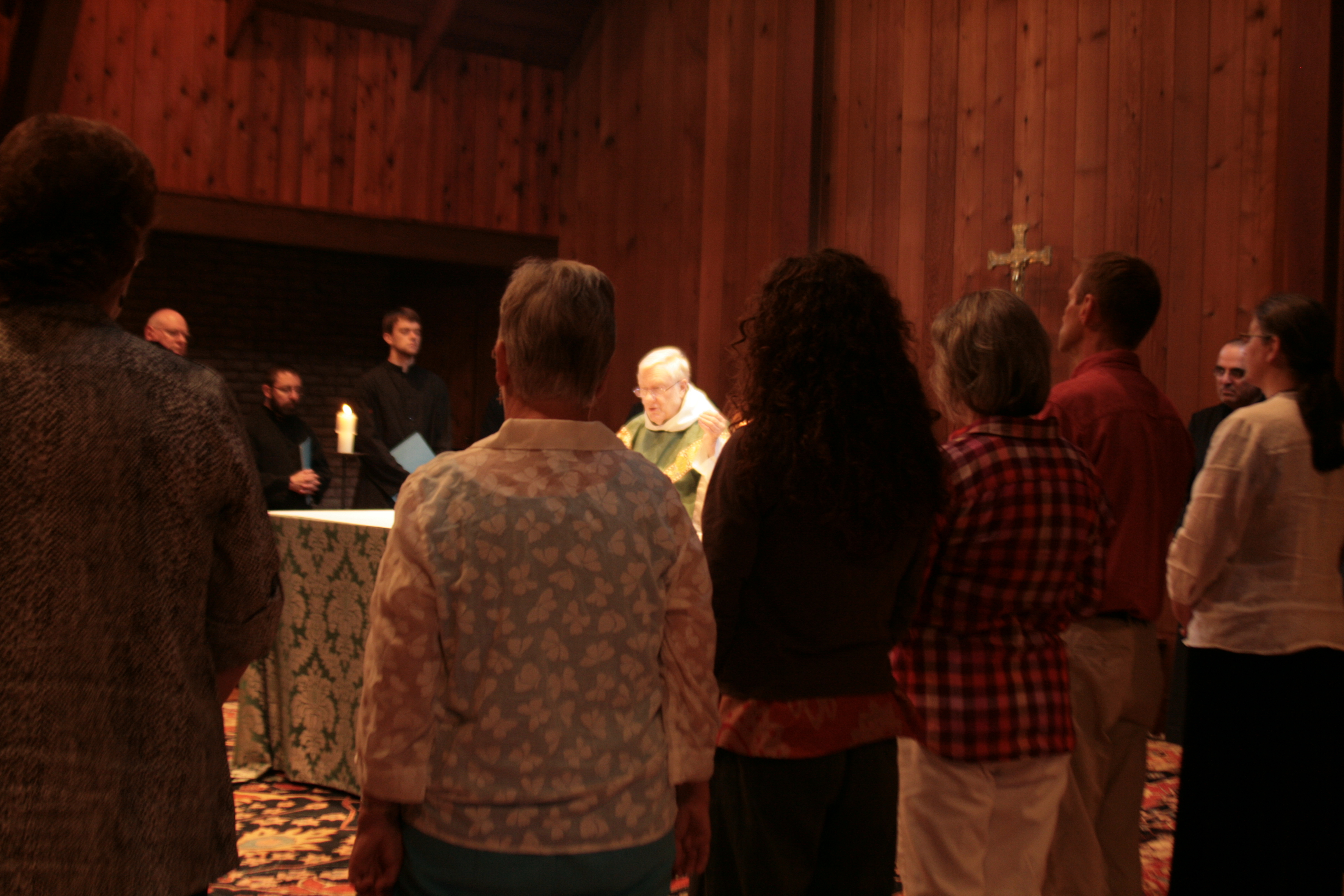

The Passion in the Eucharist

The Eucharist makes present the death and Resurrection of Jesus at each celebration, regardless of the occasion. So it is that we don’t even celebrate the birth of Jesus without celebrating his death as well. But in commemorating the Last Supper of Jesus, the Eucharist on Maundy Thursday is particularly close to the Passion, being the meal during which Jesus was suffering the anxiety he was soon to express at Gethsemane.

While reflecting on this matter, I came across a few lines on this very theme by Gerard Manley Hopkins, one of my favorite poets. They made up an epigraph of a chapter in Brian Zahnd’s new book The Wood Between the Worlds,” a powerful meditation on the Cross, Not only was I moved by the lines, but I was surprised to come across some lines by Hopkins that I didn’t recognize since I thought I had studied all of his poems multiple times. That little mystery was solved when I found out that it is an early work, one written while still a student at Oriel College in Oxford, and still an Anglican. So it is only included in the most complete collections of his works. I might have read it before without it registering, but the few lines singled out in Zahnd’s book really caught my attention, as I’ve said.

The poem is called “Barnfloor and Winepress” and it pulls together the Passion of Jesus and the Eucharist into an inextricable knot, making it most appropriate for Maundy Thursday. With wrenching, sometimes violent imagery embodied in hard sounds that put Hopkins, even in this early work, decades ahead of his time, the poem provides a powerful example of how the ugliness of Jesus’ crucifixion permanently affected the aesthetic possibilities in all of the fine arts as the ugliness is sublated in the moral beauty of Jesus’ self-sacrifice and his vindication in the Resurrection. The first stanza includes these lines that use the Eucharistic imagery of the making of bread:

Thou that on sin’s wages starvest,
Behold we have the joy in harvest:
For us was gather’d the first fruits,
For us was lifted from the roots,
Sheaved in cruel bands, bruised sore,
Scourged upon the threshing-floor;
Where the upper mill-stone roof’d His head,
At morn we found the heavenly Bread,
And, on a thousand altars laid,
Christ our Sacrifice is made!

And in the second stanza, lines using grape and wine imagery to the same effect:

Thou whose dry plot for moisture gapes,
We shout with them that tread the grapes:
For us the Vine was fenced with thorn,
Five ways the precious branches torn;
Terrible fruit was on the tree
In the acre of Gethsemane;
For us by Calvary’s distress
The wine was racked from the press;
Now in our altar-vessels stored
Is the sweet Vintage of our Lord.

We have in these powerful stanzas a kind of transubstantiation, not only of the Eucharistic elements that Hopkins was clearly believing in as a high-church Anglican, but a transubstantiation of the suffering of Christ into the Eucharistic elements. The violent human sacrifices throughout human history, both before Christ and after Christ up to the present day, are transmuted into the bloodless sacrifice on the altar. (The phrase “terrible fruit” reminds me of Billy Holiday’s “Strange Fruit.”) No wonder Brian Zahnd refers to this poem in a chapter that argues that the crucifixion of Jesus is the ultimate center of human history. Even while humans continue to commit the same old same old violence as we see most painfully in Ukraine and Gaza right now, God has transformed all of it for all time. Hopkins expresses this insight in poetry:

In Joseph’s garden they threw by
The riv’n Vine, leafless, lifeless, dry:
On Easter morn the Tree was forth,
In forty days reach’d heaven from earth;
Soon the whole world is overspread;
Ye weary, come into the shade.

And then the profoundest transubstantiation of all: the transubstantiation of us into partricipation in the divine nature, one not untouched by the sufferings of Christ supporting our own:

The field where He has planted us
Shall shake her fruit as Libanus,
When He has sheaved us in His sheaf,
When He has made us bear his leaf. –
We scarcely call that banquet food,
But even our Saviour’s and our blood,
We are so grafted on His wood.

God’s Kingdom as Gift

treeBlossoming1There is only one simple qualification for being a disciple of Jesus: give up everything. That’s one whale of a qualification. So hard is this qualification that earnest Christians have thought of many ways to soften Jesus’ words without washing all meaning and challenge out of them. My New Testament professor at Nashotah House, O.C. Edwards, suggested that this qualification means we have to give up everything that comes between us and God. That is, if parents, children, spouses, friends, or fellow members of a community help us draw closer to God, we don’t have to give them up. The same would go for material possessions. Even Benedictine monks have to use things in this world in order to live so we can’t give up having anything at all. The trick is to use things in such a way that the work and recreation we do with them draws us closer to God rather than farther away.
We could phrase this approach by saying that the problem is not possessions but possessiveness. God gives us parents, children, siblings, and friends as gifts. Likewise we should give each ourselves as gifts to other people. The things we use in the world are likewise gifts from God and should be treated accordingly. The problem comes when we prefer to take other people and things rather than receive them. In such cases, the intensity of love we feel for others is actually possessiveness rather than love. We are told to “hate” parents, children, siblings, and friends so as not to be possessive of them. Taking people and things is the result of putting ourselves in competitive relationship with other people. When we compete with others, we have to win and a victory is something we earn, not a gift. This same competitiveness carries over to our attitudes toward possessions. As the French thinker René Girard teaches us, we often want things that other people have or want to have things at the expense of others so that we can claim a victory over them. Of course, competitiveness is a bottomless pit. If we win one round, we always fear losing the next. If we have to have more than other people, or at least as much, we have to keep on accumulating more things no matter the damage our hoarding does to others. In all this, the people we try defeat and our lust to win through possessions become stumbling blocks between ourselves and God. This is what we have to give up.

Paul’s Letter to Philemon illustrates this point very well. Slavery, very common up to the present day (although now other terms such as “trafficking” are often used for it), is perhaps the ultimate in possessing other people. Onesimus was a runaway slave. Paul experienced Onesmimus, not as a possession but as a gift, a person who freely gave of himself to serve Paul while he was a prisoner. Paul is tempted to be possessive and keep Onesimus for himself but he offers Onesemus to Philemon as a gift, clearly hoping that Philemon will give Onesimus back to Paul as a free gift. Paul makes it clear that he is not giving Onesimus back as a slave; instead, he is giving Philemon back as a beloved brother “both in the flesh and in the Lord.” (Philem. 16) If Philemon receives Onesimus as a brother in Christ, he can hardly continue to possess him as a slave.

I’ve always seen Paul’s letter as an artful piece of emotional blackmail, but for all his manipulative rhetoric here, Paul is basically passing on to Philemon Jesus’ invitation to the Kingdom with its one qualification. This sounds simple, but in the heat of daily battles, we find that the possessiveness born of competitiveness is very hard to renounce and it amounts to carrying our cross daily. If we can daily renounce our possessiveness, we will indeed receive everything from God and from others as Gift.

God’s Reconciliation: A Thought on the Feast of Saints Peter & Paul

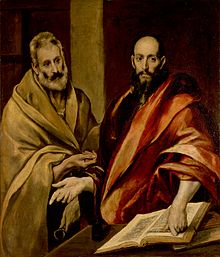
220px-Greco,_El_-_Sts_Peter_and_PaulIt is interesting and a bit ironic that we celebrate Saints Peter and Paul on the same day. Although there are famous icons of the two embracing one another in Christian love, the two seem not to have had an easy time getting along in real life. Although the two appeared to have been somewhat reconciled at the Council of Jerusalem in Acts 15, in his letter to the Galatians, Paul says that he opposed Peter “to his face” for backing down from what he thought they had agreed on. (Gal. 2: 11) The final chapters of John’s Gospel suggest tensions between the “Beloved Disciple” and Peter, and/or some tension between the two communities derived from them. The Beloved Disciple rests on Jesus’ breast at the Last Supper while Peter stubbornly tries to prevent Jesus from washing his feet. In her book Courting Betrayal,” Helen Orchard argues that Peter was resisting the slavish action of Jesus in washing his feet because he did not want to stoop so low himself. The episode of the Empty Tomb in John shows a rather awkward dance between the two where the Beloved Disciple gets there first but waits at the entrance and allows Peter to go in first. In this little tangle of a narration, both seem to have been first but not in the same way; which suggests some attempt to overcome the tension. In the final chapter of John, after the threefold question to Peter: “Do you love me?,” Peter points to the Beloved Disciple and asks” What about him?” Jesus answer basically tells us it is none of his business.
Peter is redirected to the threefold command he has just been given: “Feed my sheep.” Here is the key for overcoming tension and competition. When we compete with another, we become preoccupied with our rivals and nobody else. What does this do for pastoral care?  The preoccupation of rivals with each other answers the question quite clearly. It is tempting to say that pastors should never fight so as not to undermine their ministries, but there are times when we do have to stand up for the people we minister to. Paul stood up to Peter because he was paying close attention to the pastoral needs of the Galatians and other Gentiles he preached to. There are times in his epistles when Paul comes across as disputatious and rivalrous but in this instance, he was holding his focus on how to feed the sheep entrusted to him and trying to help Peter see the need of the Gentile sheep for himself.

Scripture does not tell us how this conflict ended as far as these two men are concerned although subsequent tradition claims that they were indeed reconciled. Likewise, the Johannine literature stemming from the Beloved Disciple was integrated into the New Testament, creating a deeper unity then Peter and the Beloved Disciple seem to have had. The art of differing and reconciling with others is much too complex to be taught in a brief sermon, but we have a couple of basics to get us started. 1) Keep our attention focused on those who depend on us for pastoral support; 2) Remember that Divine Providence can and will work out a deeper harmony underlying our conflicts and it isn’t always up to us to solve them, which means that, as Peter was told to stop worrying about his rival, we should stop worrying about our own rivals quite so much. And now for a third thought: Both Peter and Paul had much to repent of and they did just that. Can we do the same?

The Breath of the Trinity

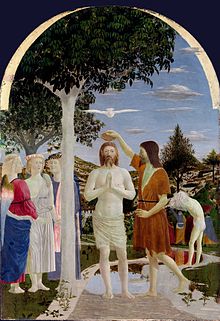
Piero,_battesimo_di_cristo_04There is much theology that treats the Trinity as a mathematical game, trying to work out how three can be one and one can be three. But math, important as it is for many things, is not the way of salvation.

The Church, of course, didn’t preach the Trinity just to solve a mathematical puzzle; the Church preached the Trinity because that seemed to be the best, maybe the only way, to preach salvation. Jesus, a human being, was so god-like that his followers concluded that he wasn’t just like God but was God when, among other things, Jesus exerted divine power to walk on water and still the waves of the Sea of Galilee. Then Jesus sent the Holy Spirit, the Advocate, to do the godlike things he had done. So it was that the disciples experienced three Persons acting like God in a way that only God could act. That’s why theologians have been trying to do the math ever since. We shall reflect on one of the most important of the godlike acts of Jesus and the Holy Spirit.

Jesus got in trouble with the religious authorities for many things, but probably the most serious of them was claiming the power to forgive sins. He did this when the paralytic was brought down through the roof by his friends so that he might be healed, (Mk. 2:5) and he did it again when the Sinful Woman poured perfume over his feet at the house of Simon. (Lk. 7: 47) The Pharisees were incensed because Jesus, a human being, was doing what only God could do. The Gospel writers agreed that only God could forgive sins and Jesus had, in fact, done what only God could do.  Before he died, Jesus promised to send the Holy Spirit to be an Advocate who would lead them further into the truth of who Jesus was. When the risen Jesus breathed on the disciples in the upper room, he passed on to them and, through them to us, the ministry of forgiveness of sins. (Jn. 20: 22–23) Fifty days later, Peter exercised this power to forgive sins when his listeners asked him what they needed to do to be saved. (Acts 2: 38)

The Trinity, then, is not a mathematical puzzle but a story of sin and forgiveness. In spite of some outbursts of anger, Yahweh claimed to be a God who was chesed, a Hebrew word meaning full of loving kindness and mercy. The attitude of the Pharisees towards the paralytic and the Sinful Woman suggests that they thought forgiveness should stay up in the heavens where it belonged and not get mixed up with humans on the earth. In our angrier moments we tend to feel the same way. But Yahweh’s hesed did get mixed up with humanity: first in the person of Jesus and then in the disciples through the Gift of the Holy Spirit. So it is that we humans are given the Gift, not only of having our sins forgiven, but we have the Gift of forgiving the sins of other people. Note that it isn’t we who forgive, but it is God who forgives through us. That is, the divine act of forgiveness that came the earth in the person of Jesus has, like the Holy Spirit, spread throughout the whole world.

Forgiveness is the air we breathe. Unfortunately, just as we can pollute the air, we can pollute the breath of the Holy Spirit through our own wrath. But fortunately, there is no getting rid of God’s hesed. It is all around us and we can breathe it any time we wish. And when we wish it and breathe in the Spirt, we share the life of the Holy Trinity with other people and so help them share the same forgiving life.

Benedict’s Easter

BenedictChurchStatue1An early Easter throws many things awry, not least the saints’ calendar. St. Benedict’s day is normally celebrated on March 21, but this year, it was transferred to Monday after Easter Week. Thinking about St. Benedict in terms of Easter reminds me of what he said about Lent in Chapter 49 of his Rule.

Why would we want to think about Lent when we have just survived it and are now celebrating Easter? Well, Benedict famously thinks we should practice lent all year round. That means we should practice lent during Easter too. And here we thought we had Lent over with for a year! So why would we want to go back to Lent? For one thing, Benedict thinks that we should “wash away the negligences of other times” during Lent. That’s really a good thing to do all the time, rather than waiting for Lent to do it. Benedict also says that we should “look forward to holy Easter with joy and spiritual longing.” If it’s Easter already, what do we need to look forward to it? But when we realize Benedict wasn’t thinking about looking forward to jelly beans and chocolate, it becomes clear that Benedict has an eschatological yearning in mind.

Longing for Easter, of course, is yearning to actually live the life of the Resurrection. Benedict expresses this Easter yearning at the end of the Prolog to his Rule when he says that we shall run with “our hearts overflowing with the inexpressible delight of love.” Sounds like a good thing to have all year round. It is this Easter Joy that Benedict says we should run toward, not walk and certainly not dawdle. Benedict’s admonition to long for Easter helps us understand why we should run towards Easter even though Easter is already here. It is one thing for Easter to arrive in the course of days. It is another thing for God to inspire us with the life of Jesus’ Resurrection all year round. It is yet another thing for us to be inspired by the Resurrected life of Jesus. Washing away our negligences and running rather than wasting any more time helps us to be inspired by the Resurrected life by opening our hearts to the “inexpressible delight of love.”

treeBlossoming1

Handing Ourselves Over

crosswButterfliesLuke’s version of Jesus’ Resurrection is much the gentlest among the synoptic Gospels. No earthquakes and no women running off so afraid that they can tell nobody what they had seen at the empty tomb. The women were, indeed, terrified of the two men in “dazzling clothes” who appeared to them. But by the time, but before long they have remembered, with prompting from the men in white, Jesus’ words to them.
Among the words the women were reminded of was that “the Son of Man must be handed over to sinners, and be crucified.” (Lk. 24:7) The key word is that Jesus was “handed over.” Jesus was put into the power of the sinners. However, something much deeper had happened than that. If we look back to Jesus’ prayer at Gethsemane, Jesus struggled with the fear that his ministry had come to nothing, but then he handed himself over to his heavenly Abba. (See Gethsemane) It was only after handing himself over to his Abba that he allowed himself to be handed over into the power of sinners.

The death of Jesus is also portrayed more gently in Luke than in Mark or Matthew. Luke does not include Jesus’ anguished cry: “My God, My God, why have you forsaken me!” although Jesus did cry out in a loud voice. What he then said was: “Father, into your hands I commend my spirit.” (Lk. 24: 46) At the last, Jesus in handing himself over to sinners, had really handled himself over to his heavenly Abba. The words, in themselves, seem serene, but, in Gethsemane, where Jesus made his decision to hand himself over, his stress was so great that his sweat became “like drops of blood.” Commending himself to his Abba was not easy.

On Easter morning, Jesus found himself alive because he did not try to grab his life with force, but rather, Jesus had given it up. Grabbing his own life with force would have entailed using force to lead an insurrection against the Roman Empire. In doing so, he could, for a time have thought that his ministry had come to something after all. But by trying to make his life secure, he would have lost it. (Lk. 17: 33) In receiving his life from his heavenly Abba, Jesus had the Abba’s life to give to all. This is why it was futile for the women to look for the living among the dead. (Lk. 24: 5) Jesus, very much alive, was not there. He was among the living, walking on the Road to Emmaus, seeking to make Cleopas and his companion more alive than they were, so that their hearts would burn as Jesus explained the scriptures to them. If Jesus had not given up his life to gain it, he would not have had such overflowing life to give to others.

We too, are called to hand ourselves over to Jesus’ heavenly Abba. As our world grows more violent, we are tempted to do something rather than hand ourselves over to our Abba, but doing something in violent situations tends to keep them violent. Instead, we need to create space for the heavenly Abba to give us the life He gave to His own Son. In this way, we participate in Jesus’s death and in his glorious Resurrection.

How Is the Gospel Veiled?


transfigurationWe celebrate the Transfiguration of Jesus at the end of Epiphany to prepare ourselves for Lent. This is a joyous feast where the Light of Mount Tabor should inspire us for the days of penance and then entering into the Paschal Mystery of Christ. However, there is a discordant element in the reading from St. Paul that I want to focus on. He, too, writes of the inspiring light of the Transfiguration, but he also writes about the veil over Moses’ face. This refers to the story in Exodus where Moses put a veil over his face when he came down from Mount Sinai with the tablets of the Law because his face shone too brightly for his fellow Israelites to look upon. (Ex. 34: 29–34) Paul goes on to say that the Jews remain veiled when they hear the words of the Law. In light of Holocaust, this verse causes much uneasiness, all the more so as it has been used to justify anti-Semitic attitudes and behaviors.
Unfortunately, the lectionary stops short of the two verses that are of upmost importance for putting the veil in perspective. The reading concludes with 2 Cor. 4:2 where Paul says: “We have renounced the shameful things that one hides; we refuse to practice cunning or to falsify God’s word; but by the open statement of the truth we commend ourselves to the conscience of everyone in the sight of God.” At this point, Paul is no longer talking about the Jews and the Law; he is talking about the right conduct expected of any follower of Christ. The next two verses bring back the image of the veil: “And even if our gospel is veiled, it is veiled to those who are perishing. In their case the god of this world has blinded the minds of the unbelievers, to keep them from seeing the light of the gospel of the glory of Christ, who is the image of God.” What is crucial is that the veil is not cast over the minds of Jews reading the Law; the veil is cast over all who are unbelievers. Moreover, it is “the god of this world” that has cast the veil. This is a veil cast over everybody.

Is the same veil cast over the Jews? Is this veil cast over those of who follow Christ? The answers are Yes and Maybe in the sense of Probably.

The longer answer to the first question is answered in Galatians 5:6: “For in Christ Jesus neither circumcision nor uncircumcision counts for anything; the only thing that counts is faith working through love.” Circumcision was and is the prime cultural marker for Jewish males. In Paul’s time, uncircumcision was the cultural marker for the Gentiles. Paul is saying that, in Christ, neither of these markers matter. That means that no cultural markers count for anything in Christ. That is to say, any cultural marker is a veil. There is only one veil that covers the Gospel and that one veil is trusting in ones’ own cultural markers instead of trusting fully in Christ. If any of us claim that anyone of another culture is under a veil, we have put a veil over ourselves. (Paul was Jewish, so he was engaging in a self-critique when he wrote of the veil over his fellow Jews.)

This goes a long way to the longer answer to the second question. All of us are trained from birth to affirm our culture and family. We also derive identity from political parties, churches, schools of thought, social sets, and much else. That in itself does not constitute a veil, but if these ways by which we define ourselves take precedence over Christ, they veil us from the Gospel. Such identifications are the specialty of “the god of this world.” If we accuse other people of being veiled, we only put the veil over our own faces and so fail to see the Glory of God revealed on Mount Tabor. So let us examine ourselves for anything that casts a veil over Christ and cast it off so that we cast ourselves onto the mercy of Christ’s Glory.

Beloved Children of God

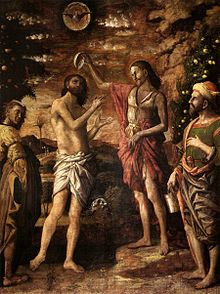
Baptism_of_ChristAt his baptism, Jesus heard a voice from Heaven saying: “You are my Son, the Beloved; with you I am well pleased.” (Luke 3: 22) These words ring out in Psalm 2, addressed to the king, the Messiah, who is being singled out from the nations that are raging together and rising up against the Lord and his anointed. Similar words are spoken to the Servant of Yahweh in Isaiah 42:1. Throughout these songs of the Suffering Servant, he is being called out of a violent society to become instead the victim of that society’s violence. Unlike the Psalmist who threatens the raging nations with a rod of iron, the Suffering Servant does not retaliate against the violence inflicted on him. Jesus begins his mission, then, with a powerful acclaim of unconditional love from his Heavenly Father, a sense of unconditional love he will offer to all who will listen.

As the inundation of baptism draws Jesus out of the inundation of the nations raging with each other, in Jesus we too are drawn out of this inundation of rage. But we are not freed from being the target of these raging nations when they unite against the one who has been freed from their wrath any more than Jesus was. Rather, in baptism, we too are overwhelmed by the Servant’s suffering but also overwhelmed by the Servant’s vindication by God.

When Jesus was called out by his heavenly Father, Jesus experienced his father as “Abba.” This is the Aramaic word a child would use to address his or her father. This word even appears in Romans 8: 15 when Paul says that it is by the Holy Spirit that we cry out: “Abba, Father!” In Isaiah 43: 1, the prophet says that Israel has been called by name, that we belong to Yahweh. This suggests that as Jesus was called the son of the heavenly Abba, we, by extension, are also called children of the same heavenly Abba. In this way, Jesus makes himself the brother of every one of us as we share the same Abba.

Longing for God’s Desire

treespath1In one way or another, human desire has always indicated that something is lacking. My stomach is empty so I desire to fill it with food. I don’t have as much money as I would like for the necessities and treats I want so I feel empty until I get enough money to get them. I lack the satisfaction of seeing my favorite baseball team win unless they win. If they do win, I am back to square one with the same emptiness and the same desire by the next day.

René Girard’s theory of mimetic desire pushes the lack that leads to desire a step further. We don’t just lack possessions or a girlfriend; we don’t know what food or what girl to desire until we see what food and what girl somebody else desires. As we learn from scientists’ study of our mirror neurons, we don’t necessarily desire what other people want because they want it or we think they want it. Rather our desires automatically resonate with the desires of others and we need to learn to navigate these resonances as part of human maturation. This prevents us from automatically copying every desire we see in others but the less conscious we are of the impact others’ desires have on us, the more likely we will be driven by others’ desires and the more empty we will be as a result.

Those desires of ours that are drawn from other people easily become conflictual. When that happens, the emptiness opened by mimetic desire deepens into an abyss. When we are wrapped up with a rival, it is never enough to have what the rival wants. As Girard points out, we need to become the other person. We believe (wrongly) that the other person has a certain fullness of being that we don’t have because they have—or seem to have—what we want but don’t have. So it is that we covet not just the ox or wife or car of another but the very being of another person. This is why we never have enough money or possessions or anything else as long as we are in rivalrous relationships. For Girard, this is not an ontological statement but an anthropological one. That is, it is about human relationships. The problem is that we can covet the being of another person until the end of the world and we’ll come up empty. Since the alleged fullness of being on the part of another is illusory, we are only “chasing after wind” (Eccl. 1:14).

Christian thinkers have consistently averred that we are instilled with a longing for God as a gift from God and that this longing means that we cannot be totally satisfied with anything else, no matter how wonderful. As the Psalmist says: our souls “thirst for the living God” (Psa. 42: 2).If we see mimetic desire as fundamental to humanity, it follows that this trait is willed by God and used by God in a fundamental way for our salvation. The certain lack of being caused by mimetic desire gives us an ongoing openness to God, an opening for God to enter into us and dwell within us as Jesus promised us in John’s Gospel. We are created to resonate with the desires of others so that we can resonate with the Desire of the other Other. The phrase “cdeep calls from deep: (Psa. 42: 7) has often been interpreted as the depths of our humanity crying out to the depths of God. This depth is our desire resonating mimetically with God’s Desire. While it is an illusion to think that a human rival has a plenitude of being, God really does have such plenitude. Moreover, God is infinitely generous with God’s plenitude of being. If we open ourselves to God’s Desire, we participate in that Desire is such a way that we can be equally generous with others.