
When Jesus speaks of himself as a shepherd, he says that the sheep “hear his voice” and they follow him because they “know his voice.” (Jn. 10: 3-4) Interestingly, although this seems fairly straightforward, John says that his listeners “did not understand what he was saying to them.” (Jn. 10: 6) We get an important clue as to the problem if we note that Jesus is speaking to the same people who had taken umbrage at his healing of the man born blind, people who said they could see when they really couldn’t. It is not surprising if these people were hard of hearing as well.
Thinking of hearing the “voice” of the shepherd reminds me of one of the anecdotes told by Oliver Sachs in one of his books about neurological patients. A group of patients recovering from strokes were listening to the speech by a president (several years past now). Most of them were laughing although they could not understand a word of it as they were suffering from aphasia. They were laughing because they knew the president was lying. It seems that undistracted by any intelligibility of the words, they could sense the tone of the voice with great clarity. One woman had the opposite problem. She could not hear the inflections but she could understand the words. Undistracted by the inflection, she knew that the words were incoherent.
Many times, Sachs demonstrates that we learn how the brain works through various malfunctions. Normally, hearing the content and the inflection is one seamless phenomenon but the separation caused by events such as a stroke show that each is done by a separate part of the brain. Although the two functions are distinct, and there are advantages to noting the distinction, we want them to work well together. In some ways, the distinction between the two helps us use them well together.
This suggests that there are two dimensions to the art of hearing the voice of Jesus the Good Shepherd. There is the intelligible content, but there is also the intonation, the way the voice modulates and sounds in the heart. Let us start with the image of the shepherd that references many passages in the Hebrew Bible. There is David, who fought lions and bears to save his sheep, Psalm 23 where the Lord as shepherd guides us through the dark valley, and most of all, Yahweh as the true shepherd in Ezekiel 34 who cares for his sheep. We have the content, then, of caring, and the intonation would also need to convey the same degree of caring, even self-risking and self-sacrificial caring. Maybe the other lections can give us more guidance.
The image of the shepherd does not appear in the vision of the early church in Acts 2, but this vision shows each member caring for all the others, giving of their own substance to those who have need. The tone of voice of caring is matched by actions of caring. In a sense, each member is a shepherd for all the others.
In First Peter, we have the theme of caring taken to extremes. The suffering Christ is the touchstone for how each of us should suffer injustice. It is not mere meekness, for it takes great courage to endure such suffering and shame when one has the power to retaliate and gain the upper hand, something Jesus did not do. In John’s Gospel, this self-sacrificial style of being the shepherd is set up at the beginning when John the Baptist calls Jesus “the Lamb of God.” At the end of John’s Gospel, Jesus asks Peter three times if he loves him and when Peter says yes he loves Jesus, Jesus says “Feed my lambs.” In Revelation, Jesus is again the Lamb slain since the foundation of the world. Jesus, then, leads the sheep as the sacrificial lamb, rather than as the sacrificer, something even King David turned out to be in the case of Uriah the Hittite. Again, the tone of voice and the action must coincide with this sense of self-giving.
Edifying and powerful as the passage in First Peter is, there is a disturbing element here. In the verse immediately preceding this passage, Peter admonishes slaves to obey their masters. Does this passage, then, condone slavery? Here is a test case for tone of voice and content. A master may well consider himself a shepherd of his slaves, but what kind of shepherd would such a master be? Does such a master share of his material substance the way that they early Christians in Acts are said to have done? If a master acted in this way, could he even really be a master? Does a master sacrifice himself on behalf of the slave as Jesus sacrificed himself for his sheep? On the contrary, doesn’t the master expect the slaves to sacrifice their lives for his sake? A master who talks a good game of caring for his slaves would come across like the president whom the aphasic patients knew was lying, and the content of his words would be fundamentally incoherent unless he really acted like the Lamb of God, in which case, he would be the slave and the slave would be free. It needs to be noted that it is a lot easier to see this passage in First Peter in this way than it was when the letter was penned or in the US before 1865. That is to say, social pressures can drown out the voice of the shepherd when he calls to us and tries to lead us in new paths.
Perhaps these thoughts can help give us a sense of Jesus’ voice and help us recognize the voice of Jesus in the words and tone of speech of those who speak to us. And perhaps these thoughts, too, can help us speak with the tone of voice of one who will follow the Lamb of God wherever he goes. And if we do try to speak in this way, let us be honest if we halt and waver. After all, Jesus halted and wavered at Gethsemane. Being a Lamb of God is not a challenge to take lightly.

 St. Paul proclaims the Resurrection of Jesus as a radical game changer. It is a passage from death to ourselves to a new life in Christ. This proclamation is often understood as an individual conversion. It is that but it is much more. During his life, Jesus proclaimed the kingship of God. A kingship, of course is social, not individual, much as we like to fancy ourselves kings and queens of our little castles. The kingship of God looked like a lost cause when Jesus died, but after being raised from the dead, Jesus leads us into the kingship that we rejected when we crucified him. It is important to note that Paul was not writing to an individual but to a community, indeed, the community that at the time represented all humanity as Paul knew it. St. Paul proclaims the Resurrection of Jesus as a radical game changer. It is a passage from death to ourselves to a new life in Christ. This proclamation is often understood as an individual conversion. It is that but it is much more. During his life, Jesus proclaimed the kingship of God. A kingship, of course is social, not individual, much as we like to fancy ourselves kings and queens of our little castles. The kingship of God looked like a lost cause when Jesus died, but after being raised from the dead, Jesus leads us into the kingship that we rejected when we crucified him. It is important to note that Paul was not writing to an individual but to a community, indeed, the community that at the time represented all humanity as Paul knew it.
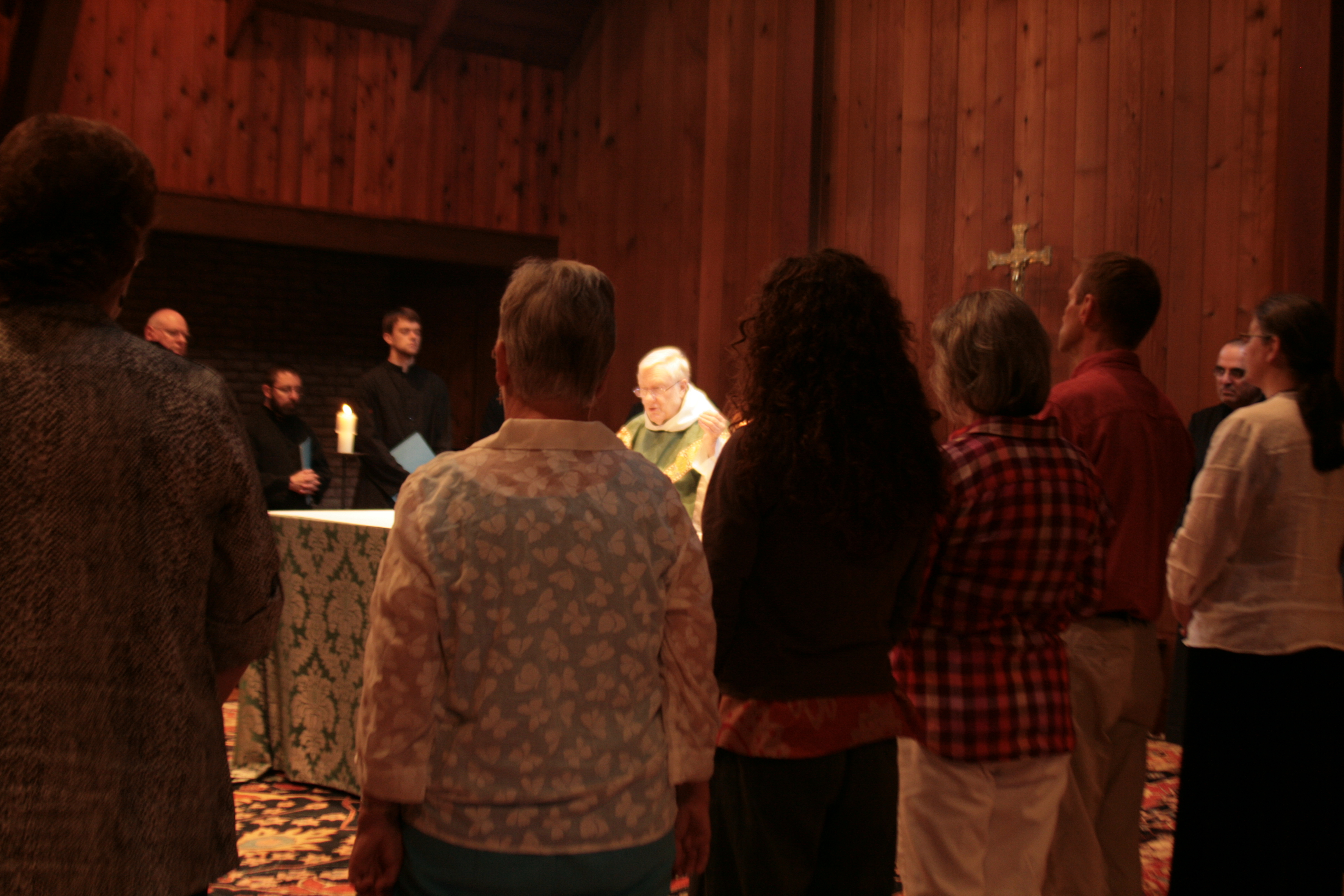 The Passover is the formative event for Jews, the event that constitutes them as a culture. The Last Supper, the Eucharist, is as formative for Christians. Although there is debate as to whether the Last Supper was a Passover meal, the association with that feast is clear enough for Jesus’ supper to have incorporated and redefined Passover. The big question is: What is the culture that these events are intended to form?
 There is only one simple qualification for being a disciple of Jesus: give up everything. That’s one whale of a qualification. So hard is this qualification that earnest Christians have thought of many ways to soften Jesus’ words without washing all meaning and challenge out of them. My New Testament professor at Nashotah House, O.C. Edwards, suggested that this qualification means we have to give up everything that comes between us and God. That is, if parents, children, spouses, friends, or fellow members of a community help us draw closer to God, we don’t have to give them up. The same would go for material possessions. Even Benedictine monks have to use things in this world in order to live so we can’t give up having anything at all. The trick is to use things in such a way that the work and recreation we do with them draws us closer to God rather than farther away.
 Imaginary Visions of True Peace