

Jesus’ Escape to the Kingdom

crosswButterfliesThe Ascension is among the most puzzling festivals in the church calendar. The contradictory accounts of the event are a puzzle but one thing the accounts by Luke and John’s Gospel share is to connect Jesus’ departure with his sending the Holy Spirit. Jesus said the Holy Spirit would come to lead them into the truth. What truth did the disciples need that they hadn’t learned already from their teacher? Did Jesus have to leave before the disciples could hear the Holy Spirit?

During his ministry, Jesus warned his disciples three times that “he would be rejected by the elders, the chief priests, and the scribes, and be killed, and after three days rise again.” These warnings came precisely at the times the disciples thought that a Maccabean-like revolution against the Romans was just around the corner: when Peter proclaimed Jesus to be the Messiah, right after the Transfiguration, and when James and John asked if they will sit at Jesus’ right and left in his kingdom.

After his Resurrection, Jesus tried again to get across to the disciples what his kingdom was really all about. When Clopas glumly said that he and his companion had hoped that Jesus “was the one who was to redeem Israel,” Jesus, not yet recognized by them, rebuked them for their slowness of heart in believing what “the prophets have declared.” Then he “interpreted to them all the things about himself in all the scriptures.” Later, Jesus appeared to the twelve and explained that everything written about him in “the law of Moses, the prophets, and the psalms must be fulfilled. “Since the phrase “the Law and the Prophets” was used to refer to the whole Hebrew Bible, the special mention of the psalms is significant. The psalms include many laments over persecution from the standpoint of the victim. Jesus went on to say that when the scriptures say that the Messiah was “to suffer and to rise from the dead on the third day,” it means that “repentance and forgiveness of sins is to be proclaimed” in Jesus’ name to all nations, beginning from Jerusalem. Proclaiming repentance and forgiveness is a very different proposition from starting a revolt to restore the kingdom to Israel.

When, in spite of hearing this teaching for forty days, the disciples asked their Risen Lord: “Is this the time when you are going to restore the kingdom to Israel?” Jesus must have banged his head against the nearest tree and cried out: “I’m out of here!” This repeated question may have convinced Jesus that the disciples were never going to stop asking him to restore kingdom of Israel as long as he was walking on the earth with them. Maybe Jesus was planning all along to leave after forty days; maybe he planned to stick around indefinitely but this question was the last straw.

Jesus’s Ascension put paid to any notion of his leading a second Maccabean-type revolution. The disciples were left with no choice but to try doing what Jesus told them to do when he breathed on them and said: “Receive the Holy Spirit. If you forgive the sins of any, they are forgiven them; if you retain the sins of any, they are retained.” Jesus’ kingdom is to preach repentance and forgiveness to the whole world until everybody has repented, been forgiven, and has forgiven everybody.
Cleaning Up Our Unclean Acts

eucharist1Peter was surprised when he had a vision of a sheet carrying all the animals listed in the Law as unclean accompanied by a voice telling him that God had made them clean. Peter was even more surprised when he was told to go to the house of an unclean Gentile named Cornelius and preach the Gospel to him. That is, God had made all humans clean.

We all have a hard time living without the comfort of knowing that some people, some things, are unclean. This fear that sustains us is the fear of what is Other. All we have to do is get to know “unclean” strangers and we will be happy and no longer afraid.

René Girard, however, would give us pause. Girard is often invoked when there is need to scold people for creating “out” groups to make them feel good about their “in” groups. Actually, Girard alerts us to our problems within our “in” groups. Prior to our fear of the Other is our fear of what is the same. Rivalry and the violence rivalry lead to does not originate in battles with strangers but with those closest to us. In Genesis, almost all of the strife is between brothers.

Girard suggests that this fratricidal strife tends either to the death of a brother or a reconciliation through killing somebody else. At the dawn of humanity, a tribe first struggled with rivalry within its own ranks and either imploded through its violence or came together through killing one of its members, who then was designated at Other, the monster who caused the commotion. Then the tribe held itself together on an ongoing basis by warring on other tribes who were designated as Other. In this regard we are not one wit wiser than the most “primitive” of people. A fundamental practice of statecraft today is to deal with rivalry and tensions within a nation by designating an enemy that the whole nation must fight.

Anthropologists such as Mary Douglas have demonstrated the human tendency to divide foods between those deemed clean and those considered unclean. Eating is the central activity of a community. We eat with those who are closest to us. However, as noted above, we also fight most with these same people who are closest to us. By dividing the food we eat between clean and unclean, we create a barrier between us and other people, between us as the “in” group and those in the “out” group. That is, we relieve our communal tensions by banding against those who eat “unclean” foods.

Here we come to the importance of Jesus’ admonition to his disciples, while at table, that they (we) love one another. Some scripture scholars have poured cold water on idealistic readers by saying that John was concerned only with love within the community. But Jesus’ saying that others will know we are Jesus’ disciples by our love makes it clear that this loves does extend beyond the immediate community. These reflections on “clean” and “unclean” further suggest that fostering non-rivalrous love within the community allows the community to reach out to others. This love will make everything and everybody clean and bring us all to one great table in the Heavenly Banquet.

Crying out with Palm Branches in our Hands

AndrewPalmSunday1Jesus entered Jerusalem to the acclaim of crowds strewing branches before him and proclaiming him the king. A few days later, the same crowd gathered before Pilate to cry out for Jesus’ crucifixion. What happened?

Before answering this question, it is helpful to recall another crowd that went out into the desert to see John the Baptist. “What did you come out to see?” John asked them. “A reed blowing in the wind?” John suspects that people have come out in droves because people were coming out in droves. That is, it was the “in” thing to do. Fast forward a few months and we have a crowd at Herod’s palace supporting Salome’s request for John’s head on a dish. What did they come to see?

The post Ignominious Glory—Glorious Ignominy: a Doxology goes a long way in explaining this phenomenon. One can’t help but suspect that people are crying out because everybody else is crying out, no matter what the outcry is about. Advertising usually does not advertise the product but its alleged popularity. Political campaigns do the same thing. What would happen if people stopped to listen to what people were actually saying instead of crying out what they think everybody else is crying out?

It so happens that the Gospels do precisely this. The suggestion that the Gospels are Passion narratives with long introductions gives short shrift to what the Gospels are about. What these “long introductions” do is tell us at great length what Jesus actually said and what he taught. They also tell us what Jesus did before he was nailed to the cross, i.e. he healed people and cast out demons and he unilaterally forgave sins. These “long introductions” also tell us why the power brokers in Judea and Jerusalem wanted Jesus dead. By reading these “long introductions” to the Passion narrative, we are drawn away from crying out what everybody else is crying out and waving signs that only proclaim what the current fashion is believed to be. Instead, we are drawn into a very different social mimetic process, a process that builds up mutual respect between people, seeing people as they really are and as they really can become when they receive the unilateral forgiveness that Jesus gives them, a social process of not retaliating for wrongs done, a socially mimetic process of forgiving debts, of sharing what we can, of offering healing to others.

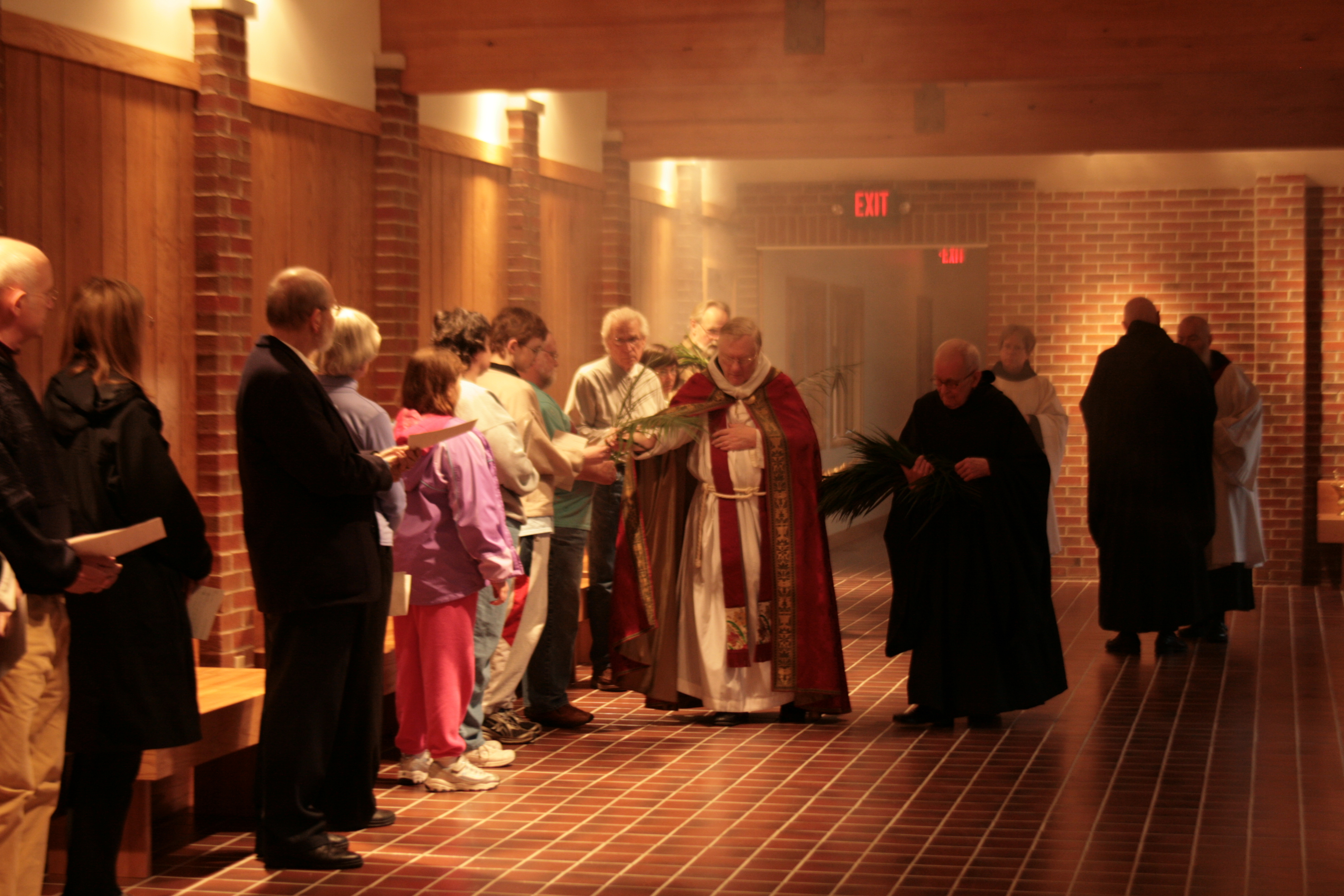
It is instructive that the Palm Sunday liturgy begins with everybody playing the part of the crowd welcoming Jesus with palms and then, a bit later, we hold these palms while acting the part of the crowd in crying out for Jesus’ death during the reading or chanting of the Passion. What we need to do afterward is return to the “long introductions” to see what the fuss was about and hopefully, hear the cock crow as did Peter.

I develop these ideas in my book Tools for Peace.

Turning on Ash Wednesday

altarDistance1As we begin the season of penitence on Ash Wednesday, we do well to put penance in a context beyond our individual selves. René Girard’s concept of mimetic desire tells us that our “individual selves” are merely an illusion; our desires are unavoidably caught up in the desires of other people. (see Human See, Human Want) With that being the case, cleaning up our “own” desires simply does not do the job.  Instead, we must clean up the desires we share with others, and that means relating to others.

Early in his great poem “As Wednesday,” T.S. Eliot zeroes in on healing shared desire by following the first lines about hoping to turn his life: “Desiring this man’s gift and that man’s scope/I no longer strive to strive towards such things.” That is, the tenth commandment about coveting includes coveting the God-given gifts of others and their insights. If we turn from our entanglements with the desires of others, we will affirm and rejoice in their gifts and insights and in doing so, will awaken to the gifts and insights that we have within us to give to others.

In Matthew’s Gospel, Jesus follows his teaching on renouncing mimetic rivalry (turn the other cheek, etc.) with a solemn caution against using “good” actions such as repenting, fasting, almsgiving, and praying as occasions for competing with others so as to desire gifts and insights of others.  If we practice piety “in order to be seen by others,” then our piety is locked in our competition with others and not on God. That is why God cannot reward such piety which isn’t piety at all. The Desert Monastics also found themselves falling into the trap of competitive asceticism. On of the reasons Benedict, in his Rule, asks his monastics to tell the abbot about their Lenten disciplines is to put the practice of each into the context of building community. All this is compiling treasure on earth just as much as fattening our bank accounts.

The alternative to “praying in secret” may seem to be individualistic but it is really a matter of being an individual before God, which is a different thing. (An individualist flaunts his or her individuality over/against others—another thrust in a life of fencing.) Rather, “praying in secret” grounds each of us in God so that we can rejoice in God’s giftedness of others and ourselves. More important, it is precisely in the midst of these admonitions against flaunting our piety that Jesus teaches us the Our Father which reaches its climax with the petition that God forgive us as we forgive others.

As we turn again back to God, let us look at the turnings we must do in our relationships, realizing that unhealthiness in our relationships is not the same thing as the unhealthiness we may see in ourselves as individuals, although there is a relationship between the two. With T.S. Eliot, let us not even try to want the gifts of others but instead turn to the gifts we have to give to others.

For more about Lent in the Rule of St. Benedict in dialogue with Girard, read Tools for Peace

Rivalry and Competition (Or, the World Serious)

The time of the World Serious, as Bullwinkle and others called it, is a good time to reflect on why someone like me who doesn’t like rivalry is a baseball fan. I was raised in the Detroit era when Al Kaline was a star, so maybe that has something to do with it. Obviously, I can’t expect God to favor one team or another. More obviously, we need to keep games in perspective. Winning the World Serious is not as important increasing social justice for economically challenged people I have come to see a distinction between rivalry and competition. Rivalry is centered on the rival, making the rival an idol, in an attempt to win at the rival’s (and other people’s) expense. Competition can be undergirded by a deeper cooperation. For example, competitors in a game collaborate to create a well-played game that is fun for the participants, such as playing tennis or golf with friends, or playing professional baseball games that give fans pleasure along with some agony when my team blows a big lead in the last inning. Perhaps this distinction is of some use in economic issues as well. Capitalist theory tends to encourage completion as beneficial to the public good because companies that try to have the best product at the best price will deliver quality to the consumer. It is hard to see how as many useful and fun innovations would have been created without the spur of competition. I am skeptical, though, about Adam Smith’s contention that an “invisible hand” makes selfish motifs contribute to a sound and fair economy. Divine Providence surely is about a benevolent God fostering divine benevolence in humanity. However, the line between constructive competition and destructive rivalry can be very thin. Baseball games sometimes descend into brawlgames where pitchers throwing at opposing batters tit-for-tat. Likewise, competition can be cutthroat when companies only want to destroy other companies. I could go on with quite a rant about the toxic atmosphere of American politics when politicians should be collaborating to discern how to work for the public good, but aren’t. If it is all about winning, then it is toxic rivalry. If it’s about having fun with others, then it is healthy competition. When we fall into the middle, we have some spiritual work to do.  We need to remember the words of St. Paul that we don’t run for a wreathe that will wither, but for a prize that never fades.