
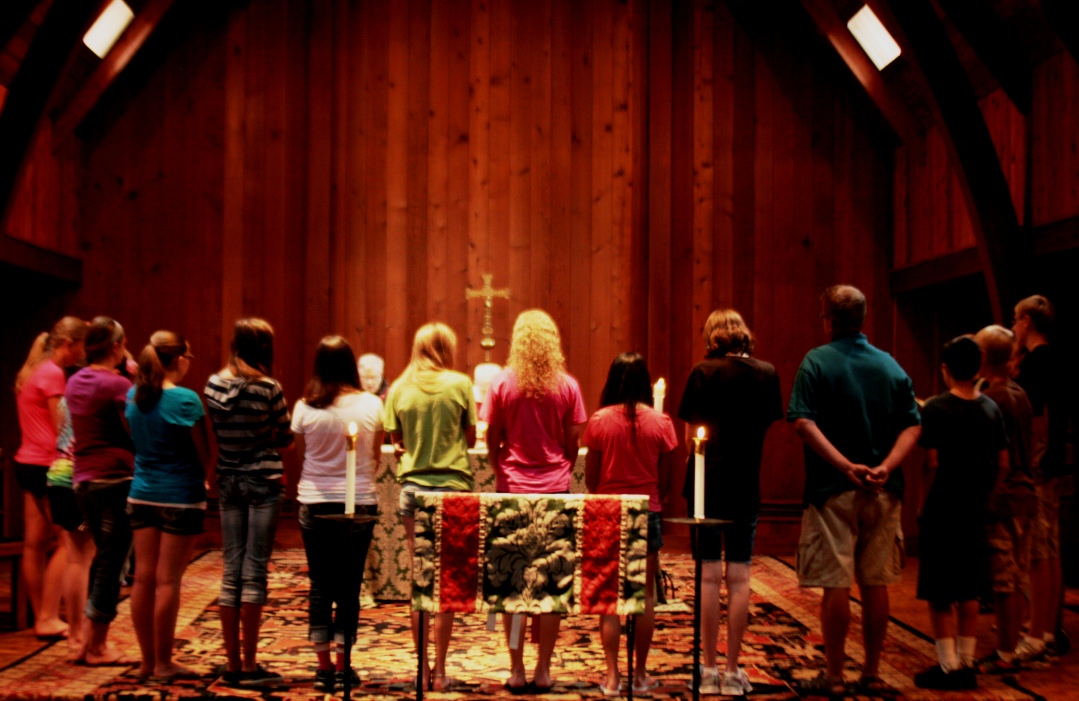
On Gathering with Those who Keep Oil in their Lamps

eucharist1Like many parables, the Parable of the Wise and Foolish Maidens is obvious and yet puzzling in some respects. The notion of forfeiting eternal life for failing to be prepared at a certain level is oppressive, but we can lift this degree of oppression by noting that the Kingdom of God is something we are supposed to be living NOW, in this life. This is what we are to be prepared for. If we are prepared NOW for the kingdom, entering more deeply into the Kingdom when we die will take care of itself.

It is worth noting that just before this parable, Jesus has thrown out the parable of the household where the wicked servant beats his fellow servants and gets drunk with the drunkards. Here we have an image of the violence humanity commits and suffers for not being alert to God’s Kingdom. Ironically, the wicked servant thinks the Master is delayed when the Master is already there in the servants he is beating. In contrast, the Foolish Maidens do not commit violence, but they fail to do anything that would stand up to violence such as that of the wicked servant.

I also think it significant that the parable is about two groups of maidens rather than just two maidens. As one who uses the thought of René Girard as a tool for interpreting scripture, I am inclined to interpret this parable in turns of contrasting human groups, each governed by a collective desire they share within that group. The wise maidens who have extra oil for their lamps are a community whose members encourage one another so as to keep their lamps burning. When they care about the Bridegroom and those the Bridegroom identifies with, their lamps burn yet more. I know how valuable it is to live in a community of men who all encourage me to remain ardent in prayer and kindness to those who come here, which makes it easier for me to encourage them in turn. The Foolish Maidens are quite the opposite. Here is a community, if one even wants to call it that, where the members encourage each other to remain apathetic and so strengthen apathy among themselves. Apathy is just as contagious as ardor, if not more so. When the people around us act (or fail to act) out of apathy, our own lamps are sure to burn lower and lower and eventually go out.

When the Wise Maidens say there is not enough oil to share when the Bridegroom comes, they are wrong in one respect. The strengthening of ardor among themselves could easily catch the foolish Maidens into its burning. The problem is that it is very difficult to extricate oneself from a group whose process has a strong grip on us and it is even much more difficult yet to change a whole group around all at once. Not even with the best will in the world could the Wise Maidens have enough oil burning to do that. The Foolish Maidens are like the drunkards in the previous parable who let the wicked servant beat the other servants and then drink with him. The Wise Maidens have the strength to stand up to the violence and witness to a nonviolent way of living. The Foolish Maidens may not be violent themselves, but they will be swept away by violence when it comes. We really do have to pay attention to the company we keep and how we keep it. The Wise Maidens do need to find ways to reach out to their Foolish sisters without getting caught in their apathy.

Finding themselves flatfooted when they realize the Bridegroom is here, the Foolish Maidens compound their foolishness by running off to the store in the middle of the night. With some stores open 24/7 these days, this act isn’t quite as irrational now as it was then but it is irrational enough. What they are doing is running away from the Maidens who have their lamps lit and away from the Bridegroom. They would have better off to stay with the Wise Maidens and the Bridegroom. It may have been humiliating to have empty unlit lamps but the Bridegroom is the one who lights the lamps of those who hold them out. They also would have been in a position to start catching the ardor of the Wise Maidens. By running off, they get plenty of oil but they have missed the chance to encounter the Bridegroom and those the Bridegroom identifies with. All of this is a perfect image of the kind of crowd panic in reaction to a problem that ensures that it only gets worse.The foolish maidens will almost certainly just let the oil run out all over again.

As with the wicked servant who thought the Master was delayed, the Maidens think the Bridegroom is delayed. The truth is that the Bridegroom is always already HERE. We can turn to the Bridegroom in love at any time and we can respond to the least of those the Bridegroom identifies with at any time they show up. THIS is what we have to be alert to and prepared for. There is lasting damage to being unprepared through apathy for the Bridegroom’s presence. I’m sure all of us can think of opportunities that we squandered and there is now no way to go back and make them good. The Forgiving Victim will still redeem all of us, but the diminishment and needless pain we have allowed always remains. Let these memories that we regret motivate us to stay close to the Bridegroom who lights our lamps in the company of others who will encourage us to keep our lamps lit.

Rivalry over Pure Music

angel trumpetMark Evan Bonds’ book Absolute Music: the History of an Idea deals with the most fundamental question in musicology. There are many music lovers for whom the subject is meaningless but some music lovers, including me, like to reflect on these matters. These days, music appreciation courses routinely teach the distinction between absolute music and program music. The latter paints a picture (say, a lake) in tones or tells a story (such as in Dukas’ “The Sorcerer’s Apprentice.”) The former doesn’t refer to anything beyond itself. The basic question, though, is whether or not music is its own isolated world, manipulating tones with no reference to anything else at all, or is related to the world in some way. This latter possibility could suggest that, say Schubert piano sonatas express emotions even if they are hard to define in words.

The title might lead a potential reader to think that Bonds is defending absolute music. That is not the case. Bonds is studying the history of this idea and along the way leaves us with an argument that a commonsense position that music is its own world but connects with phenomena elsewhere in the world. Central to this study is Edward Hanslick whose book Von Musikalischer-Schöne is pivotal to the debates it touched off, although Hansklick was neither the first by a long shot nor the last to make the argument he made (which Bonds examines at length.) (Sorry, the German title is hard to translate; it means something like “the musically beautiful.) Hanslick’s book did have the merit of being lucidly written in a field of thought that produced turgid and obscure tomes. Hanslick’s arch-enemy was Richard Wagner who lampooned Hanslick in the character of Beckmesser in Die Meistersinger.

Bonds’ own writing is very lucid and a great pleasure to read. One does not need to have technical knowledge of music to read this book. The key terms are clearly defined to help the reader understand the debate. There is also much about the characters of the principal debaters of what became the most intense musical debate in Europe for several decades in the 19th century. What the personal element shows is that the heat of debate distorts clear thinking and leads to exaggerated positions that get derailed from common sense and the evidence. More important, the debaters simply failed to understand accurately what their opponents were saying. Bonds traces the debate to the point where some reconciliation (for the time anyway) took place and even shows evidence of softening on the parts of Hanslick and Wagner. And yet neither could get over their personal animosities enough to admit publicly the changes in their positions, let alone reconcile with a hated adversary.

The personal elements in this debate interest me as my study of the thinking of René Girard and his colleagues has given me a keen interest in the phenomenon of what Girard calls “mimetic rivalry.” In light of Girard’s thinking, another personal element stands out for me. Hanslick began writing his book in the wake of the revolutions of 1848-9. This turmoil, climaxed for him by witnessing crowd violence that killed a hapless victim, motivated Hanslick (in Bond’s judgment as well as mine) to find in music a pure refuge from such human turmoil. This shows up in Hanslick’s insistence on the purity (reinlichkeit) of music. This same thing happened in the twentieth century. During and after World War I, there was a strong movement to absolutize music, to isolate it from human affairs. Igor Stravinsky was a ringleader here. That is ironic. His ballet The Rite of Spring (premiered in 1913) can be seen a prophecy of the sacrificial bloodshed about to tear Europe apart. After the war, Stravinsky insisted that it was an abstract symphonic poem. This same kind of thing happened after World War II with another wave of insistent manifestos that tried to tuck music into isolated boxes.

As for me, a Schubert piano sonata is a world with its own beautiful musical argument that spills out into the worlds of real human hearts. Maybe this is a bit fanciful, but there are times when I think Schubert was subtly undermining the Austrian Empire in his dramatic shifts of keys and the uncertainty of which end was sometimes up.

American war Sacrifice

crossRedVeil1The escalation of militarized violence has reached bewildering levels in the USA. Kelly Denton-Borhaug gives us an important theological response centered on the theme of sacrifice.

First, Denton-Borhaug surveys the militarization of our society which will be an uncomfortable eye-opener for most of us. Recruitment is taking place in our public schools and has infiltrated our computer games which are being more and more designed to train us for real war that is no game—or shouldn’t be.

One of the most disconcerting elements of our society’s militarization is the large number of Christians who are avidly supporting our wars. Denton-Borhaug zeroes in on the rhetoric of sacrifice which she suggests is the keystone of the presidential speeches since 9/11. The sacrifice being made on our behalf by those serving in the military is noble, sanctified. How dare we oppose those who make these great sacrifices? Well, there is the matter of the countless people “over there” who are being sacrificed without having enlisted with the US military for the job. These deaths are countless because the US military does everything it can to prevent counting their deaths.

Denton-Borhaug analyzes the Christian theologies of sacrifice, especially substitutionary atonement, that makes Jesus’ death a sacrifice required by the Father, or at least the cosmos. What has been happening is that political rhetoric is syphoning off the Christian resonances of sacrifice, corralling the sacrifices required of war as if the god of war were the God of Christ. Much of this works on subliminal levels.

Those of us working with the thought of René Girard and his colleagues see ourselves in a different place regarding sacrifice, but Denton-Borhaug has problems here as well. Girard himself she mentions almost in passing, only to suggest that Girard sees it as human nature to be violent so not much can be done with it. Mark Heim’s fine book Saved from Sacrifice is examined in some depth. Although Denton-Borhaug respects Heim’s attempt to get away from a theology of sacrifice, she thinks he fails. The failure hinges on Heim’s (and Girard’s) notion that only through his sacrificial death could Jesus reveal the truth of sacred violence.

I think Heim and Girard are right about this but Denton-Borhaug has pointed to an important point. If Jesus’ death is considered “necessary” in any way whatever, then it is vulnerable to the military rhetoric that proclaims the sacrifices of war as “necessary.” Girard avoids philosophical and theological terminology and so does not consider the category of contingency. This is where theological analysis is necessary for Girard’s anthropological insights. Granted, the power of mimetic desire analyzed by Girard was highly likely to lead to the violent outcomes of collective violence leading to sacrificial rites. But to retain any sound doctrine of Original Sin, we must insist that this violent outcome at the dawn of humanity was contingent. The same applies to Heim’s analysis of the Atonement. Heim is as clear as it can be that Jesus’ death was not necessary as far as God was concerned. If it was “necessary,” it was “necessary” for humans. Given the weight of history and the situation in Judaea at the time Jesus lived, it seems highly unlikely any other outcome was possible for Jesus’ earthly ministry but we have to insist that the death of Jesus was contingent. That is, the truth of sacred violence could have been (and actually was) revealed through Jesus’ teaching. It was not “necessary” for Jesus to be killed to reveal this truth, but that is what happened. Knowing Mark Heim as I do, I am almost certain this is his position. I have taken the time to go over this section of the book in more detail to show how the challenge from Denton-Borhaug can help those of us who use Girard’s thought to sharpen our thinking in this area.

In a broader sense, Denton-Borhaug has trouble with sacrifice and for good reason, since the militarized rhetoric is such a powerful form of emotional and spiritual blackmail that really has ruined many of the brightest and best of our younger generation. One need only note the traumatized lives, high rate of homelessness and suicides of our veterans to see how thoroughly they have been made sacrificial victims. Denton-Borhaug has trouble understanding the nobility of Christian martyrdom in the early centuries, not realizing the degree to which it was nonviolent resistance to the Empire. In fact, her practical suggestions are along the lines of actively making peace, a “theology of work” she calls it which amount to much sacrifice as well as resistance to violent political structures.

A thought-provoking and important book that helps us grapple with a major ongoing crisis in our time.

For an introduction to René Girard’s thought see Violence and the Kingdom of God

Jesus the Rejected Cornerstone among the Weeds

field1Jesus’ parable of the wheat and the weeds inflicts on us the discomfort of being told that we have to put up with the people we don’t like but the end of the parable and the explanation of it afterwards give us the comfort of knowing that the people we don’t like will get it in the end. But does Jesus really mean to give us this “comfort?”

When we consider the workings of mimetic desire, the image of a field densely filled with plants intertwined with each other is easily seen as an image of our entanglement with the desires of other people, some of whose desires we covet, others we try to separate ourselves from. Of course, each person who wants something we want and we don’t think it can be shared, is an enemy, a weed who should be pulled out, expelled from the garden. In such a situation, each of us is prone to considering ourselves to be one of the intended, desirable plants while the others are weeds. Of course, when we are preoccupied with how “weedy” everybody else is, we are totally wrapped up with them in our hostility. It is easy, then, to understand this parable as teaching us to mind our own business and not worry about everybody else. The trouble with this interpretation is that we are all in the thick of this garden whether we like it or not and we need to find a constructive way to live with everybody else in it. A deeper interpretation that is often offered, and one I have much sympathy with, is that we should commend everybody else to God and let God deal with them. To make this work, we have to commend ourselves to God as well, or we think we are commending those bad guys to God but we are good guys who can take care of ourselves. Moreover, the word for “letting” the weeds grow is aphete, which also is used in the New Testament to mean “forgive.”

If we give this parable a Christological interpretation, everything looks different. In being the stone rejected by the builders, Jesus was a weed. That’s the way Caiaphas and Pontius Pilate and Herod saw him. Jesus identified himself with a lot of “weeds” on the way to the cross such as the woman with a bad name in town who washed his feet at Simon the Leper’s house and the tax collectors Zacchaeus and Matthew. Every planter knows that it can be difficult to tell an intended plant from a weed. This is why well-intentioned but uninformed “helpers” are the bane of gardeners. If we try to weed out the garden based on our own judgment, we are likely to weed out Jesus himself.

The explanation of the parable seems to be at cross-purposes with the parable itself. Many scholars absolve Jesus of having ever given it, relegating the explanation to a later redactor to the text finalized in Matthew, as Simon Joseph argues with such vengeful texts in The Nonviolent Messiah. Or, we can argue that Jesus was giving us a parody of what an obtuse listener who lacks ears to hear takes away from the parable, as Paul Nuechterlein suggests on his site Girardian Reflections on the Lectionary. The trouble is, self-righteousness takes us to such extremes that it is impossible to parody. Let’s take a look at where the “explanation” takes us. First, we become preoccupied with weeding out the undesirable plants. Second, we identify with the angels who weed the garden. Third we think we shine in righteousness that blinds us to our self-righteousness. That is, we play the role of God, which is idolatry. The end result is weeping and wailing and gnashing of teeth for everybody and no harvest for anybody.

If we look forward to harvesting as opposed to weeding, we get a totally different scenario that fits well with the parable itself. When it comes to harvesting, weeds just don’t matter. The only thing that does matter is picking the fruits and bringing them in so they can offer sustenance to others. When it’s all about harvesting, things start to look a lot like the heavenly banquet that all of us can share without worrying about who is wheat and who is a weed.

Difficulties in Forgiving: Joseph and his Brothers

Joseph_and_His_Brethren_Welcomed_by_PharaohThe story of Jacob’s return to Esau illustrates the difficulty of believing in, let alone accepting forgiveness. (See Difficulties of Forgiveness (1): Jacob and Esau) The story of Joseph and his brothers takes us primarily through the difficulties of forgiving.

As a youth, Joseph is a victim of collective violence. As is often the case with such victims, Joseph has been singled out both for adulation (by his father) and opprobrium (by his brothers). In contrast to the origin of collective violence as envisioned by René Girard there are a couple of cracks in the unanimity to kill the victim. Both Reuben and Judah differ and try to save Joseph but their plans are foiled. If either had had the courage to stand up to the other brothers, each would have had an instant ally and together they would likely have turned the tide and saved Joseph from his near-death in the pit.

Joseph’s serene words that it was God, not his brothers, who had sent him to Egypt and that although they had meant him harm, God had used it for good, taken by themselves, suggest an easy forgiveness on the part of Joseph, but the story is—well—another story.

While Esau welcomed Jacob back with open arms in spite of the harm Jacob had done him, Joseph does no such thing. Like Esau, Joseph has done very well in spite of his brothers’ intent to hurt him, in fact he benefitted in the end from what they had done to him, but Joseph holds back and remembers his youthful dream where his brothers bowed to him. Joseph goes on to play an elaborate series of mind games that amount to torture. It is possible that Joseph’s harsh way of speaking to his brothers was an act, the beginning of an educative process, but I can’t help but feel that the anger was very real and at least a little raw. As a test to see if they can treat the youngest, Benjamin, better than they treated him, it was hardly necessary to lock Simeon in prison for a year and threaten his own family with starvation if they didn’t obey all of the demands that could make little sense to them. Joseph’s father Jacob also suffers because of this treatment, which may also be intentional. In my pastoral experience, I have found that one who was a favored child carries a heavy burden from this favoritism rather than finding it a blessing. Sadly, while Jacob never showed any repentance for the way he treated Esau, Joseph’s brothers have such a guilty conscience that they think that their suffering at the hands of Egypt’s steward is a just punishment for what they had done to Joseph.

As things turn out, it is Judah, not Joseph, who triggers Joseph’s forgiveness by offering himself as a slave to spare Benjamin that fate. Since Judah had wanted to save Joseph in the first place, he is not a reconstructed persecutor but a man showing a compassionate heart for a younger brother that he has always had. The difference is that while Judah was cowardly before, he is brave this time around and his bravery is awarded. Joseph is won over and he forgives his brothers, but not until he has worked through tons of anger on his own part. It was his intention to put his brothers to the test, but in a sense he himself was put to the test by Judah. Fortunately, Joseph had the grace to give up his control of the situation which he had lost anyway and cry on the necks of his brothers.

Following carefully in our own hearts Joseph’s steps to forgiveness: his anger, his pride, his manipulations, and but also his crucial willingness to accept help from a brother when he needed it, can be a way for us to track our own difficulties of forgiving the hurts we have received in life and move through them to an awareness that although certain people intended us harm, God has used these harmful actions for good.

For more on the difficulties of forgiveness see A Miserable Gospel.

Humility (1)

garden1Humility tends to evoke images of groveling before potentates, as when Anna was ordered to bow before the King of Siam. Such popular images project human images on God that have nothing to do with Jesus who was more interested in finding the lost sheep of Israel than having anybody bow down to him.

The first and most fundamental step of humility for St. Benedict is that we keep “the fear of God always before [our] eyes and never forget it.” That is, before humility is anything else, humility is living in the presence of God. This is indeed something very different from groveling in the dust. This step reminds us of our constant need for God and also of God’s sustained presence in our lives. It is precisely in our desires that our need for others shows itself. We often think of needing others to fulfill our desires but it is really more a case of needing others to desire at all as René Girard has demonstrated. (See Human See, human want) We tend to deny our need for the desires of others and to claim these desires for ourselves, which is an act of serious pride. Humility involves, then, accepting the interaction of our desires with the desires of others and accepting our mutual need of each other’s desires. But as this first step of humility teaches us, we most need to be in tune with our need for God’s Desire.

We tend to forget not only God’s presence but, even more seriously, God’s Desire when we are immersed in the desires of other people. Our involvement with the desires of other people tends to become rivalrous, which draws us further from God’s Desire. The more we are grounded in God’s Desire and never forget it, the more constructive we are apt to be in the way we act in terms of the desires of others. For example, we are freer to treat others with respect and courtesy when we don’t need to “win” any human encounters because we are grounded in God’s Desire that has nothing to do with winning but has everything to do with providing for others.

The inner attitude of living in the memory of God’s presence is balanced in the twelfth and final step of humility with the external deportment that corresponds with the former. Humility should be noticeable whether one is “at the Work of God, in the oratory, the monastery or the garden, on a journey or in the field, or anywhere else.” In other words, at all times and all places. Once again we have outer action and inner attitude reinforcing one another just as they should during worship. The last thing Benedict would want would be for someone to put on an act. When we let our actions flow out from right inner attitudes, then these actions are natural with no sense of putting on airs. The more one is mindful of living in God’s presence, the more natural the deportment of humility will be. Moreover, paying attention to this outward deportment does tend to have a humbling effect that strengthens the right inner attitude.

(More about Humility can be read in Andrew Marr’s book Tools for Peace)

The Power of the Ascended Lord

Human_headed_winged_bull_facingAscension Day is a feel-good celebration of Jesus seated at God’s “right hand in the heavenly places, far above all rule and authority and power and dominion, and above every name that is named, not only in this age but also in the age to come.” If Christ is reigning like that and we are reigning with Him and sharing in Christ’s power, then we too are over everybody else just as Jesus is over everybody else. Sounds like a good deal. Or is it? Let’s take a closer look at what this power of Christ is all about.

Getting a sense of how power and especially omnipotence applies to God is tricky. After all, we dream of being omnipotent and invulnerable so we assume that the Master of the Universe wishes the same thing. Not a good assumption.

René Girard noted that power is attributed to the primordial victims of collective violence. (See Violence and the Kingdom of God) That is, the victim was powerful enough to be the cause of the social meltdown and also powerful enough to be the solution to the violence. (The reality, of course, is that such victims were normal humans with no supernatural powers.) The Gospels reveal Jesus as a vulnerable human being who clearly did not cause the social crises of first-century Jerusalem and whose death brought about no solution to it. Whatever power Jesus has, it isn’t this power. The illusion of the power of the victim should make us suspicious about how we attribute power to God.

A second and more common image of power is the imperial structure. In the days of Isaiah and other prophets, Assyria was such an image. The statues and friezes of winged bulls are symbols of this kind of power. This is the kind of power the apostles seem to have been thinking of when they asked Jesus: “Lord, is this the time when you will restore the kingdom to Israel?” (Acts 1:6) Jesus’ ascension right after hearing this question was a firm No.

When Paul says that Jesus is far above all rule and authority and power and dominion, and above every name that is named, not only in this age but also in the age to come,” he is saying that Jesus is far above and beyond all cultures that rely on sacrificial violence and the Assyrian-Roman impositions of power. That is, the power of Christ is to bring us out from these cultural practices. But are we being brought out of the world to escape these cultural entanglements? Sorry if you were hoping for that.

crosswButterfliesPaul concludes this section of Ephesians with powerful irony: “God has put all things under [Jesus’] feet and has made him the head over all things for the church, which is his body, the fullness of him who fills all in all.” Paul is using the common image of military victim where the victor lays his foot on the head of the vanquished, making the loser his footstool. But under Jesus’ foot is not the head of the vanquished but Jesus’ own Body, the Church. This is the Body of the crucified one who was raised from the dead and returned as the forgiving victim. Jesus’ reigning in Heaven at the right hand of the Father is coterminous with Jesus living with us here on earth, sharing our vulnerability to the imperial structures of power who continue to act like the Assyrians and the Romans.

If we are the Body of the forgiving victim, then forgiveness, not rulership, is what reigning with Christ is all about. This power to forgive was the gift the risen Christ breathed into the disciples (Jn. 20:23)  In John, Jesus says that it is this “Spirit of truth” who abides in us. When we keep Jesus’ words, he and the Father and the Spirit will come and dwell within us to empower us with their love for one another and for us and for all those whose sins (including our own!) need forgiving.


Freud’s Illusion and the Paschal Mystery

Cemetary2In December 1927, the New York Times announced that Freud had doomed religion with his book The Future of an Illusion. In The Authenticity of Faith: the Varieties and Illusions of Religious Experience, psychologist and professing Christian Richard Beck evaluates this claim. Beck points out that Freud did not debunk religion by refuting the classical proofs of God’s existence but by arguing that religion was ego-centric wishful thinking that we must outgrow. We could respond by suggesting that atheism is wishful thinking; a wish not to be accountable to God. There is that but there is much value in taking Freud’s critique seriously to see if it holds up to Christianity as it is actually lived which is what Beck does.

Beck turns to Ernest Becker to evaluate Freud’s thesis. Becker (the focus of Beck’s book Slavery to Death) argued that denial of death was a prime motivation in human behavior, leading us to seek “heroic” acts levels to stave off the reality of death, an example of what Freud called sublimation. (See Escape from the Denial of Death)  It happens that there have been many scientific studies of Becker’s thesis by his followers and they tend to show that the more one is reminded of mortality, the more rigidly one defends one’s worldview and denigrates others. This applies to any worldview, not just Christianity.

Beck then brings in the Psalms of lamentation (a large chunk of the Psalter) and the spiritual darkness that Mother Teresa admitted to as counter-indications that wishful thinking is the only dynamic in Christianity. Beck could just as easily have brought in St. John of the Cross who wrote about “the dark night of the soul.” Beck then turns to William James who pre-dated Freud in his scientific study of religious experience that was published in The Varieties of Religious Experience. James distinguished between “healthy-minded” believers and “sick souls.” The terms are misleading in that “healthy-mindedness” is superficial and leads to denial of life’s difficulties and so is not really that healthy. Meanwhile, “sick souls” wrestle with cognitive dissonance and inner darkness in a way that makes them more resilient and authentic in the long run. The Psalmist of lament, Mother Teresa and St. John of the Cross would be “sick souls.” Beck notes that the charges Freud and Becker make about wishful believers applies well to what James called the “healthy-minded” but not at all to the “sick souls.” Dietrich Bonhoeffer’s famous distinction between “cheap grace” and “costly grace” seems to fit James’ distinction quite well.

Since there had been no scientific investigations of James’ categories, Beck has filled this gap with his own field work. First, participants were given a questionnaire to give ratings as to how “healthy-minded” or “sick-souled” they were and then they were given a task such as to evaluate an essay by a Christian and one by a Buddhist. Not surprisingly, the “healthy-minded” respondents denigrated the Buddhist while the “sick souls” were much more tolerant in their attitudes. The same result came with tests on comfort with the Incarnation (such as whether one admits Jesus might have had diarrhea) or evaluating two works of art, one imaging healthy-mindedness, the other more focused on life’s pain. In each case, there was strong confirmation of James’ distinction of different believers.

It is worth mentioning René Girard’s theory of the origin of religion in collective violence in this context. Girard does not think that early humans wished for pie in the sky and then made up a religion to get it. Rather, they responded to social crises by killing or expelling a victim. The camaraderie that resulted from this act and the institutionalization of sacrifice was the payoff. (See Two Ways of Gathering) In fact, belief in a heavenly afterlife is quite a latecomer in world religion. The social solidarity of collective violence can easily be achieved these days without a deity. Freud himself made a dogma of his ideas and expelled all dissenters. In Girard’s thinking, it is the Gospel accounts of Jesus’ suffering and death that expose sacred violence for what it is. Girard’s thought adds weight to the correlation between being “healthy-minded” and prone to expelling those who differ. Beck does not say anything about the Paschal Mystery, but the cross at the center of Christianity should be enough to suggest that Christianity has its own built-in critique of wish-fulfillment in Freud’s sense or “healthy-minded” religion in James’ sense. One need only read the Epistles of Paul to see this self-critique at the origins of Christianity. I think Beck would agree since he sees a much deeper love among the “sick souls” than among the “healthy-minded” and he notes that in 1 Corinthians Paul says that love is the greatest virtue of all.

Beck’s exploration of Freud and James is of great importance for coming to grips with a theological anthropology and pointing in the direction of authentic faith and genuine spirituality.

Respect (2)

WilliamGuestsChurch1

[A continuation of Respect (1)]

The importance of respect can be easily seen when we think of routine encounters. Love is too freighted a term for the way we interact with, say, the person at the checkout counter of a store. It is obvious that courtesy and respect are called for but not love as it rests (and twists and turns) in the popular imagination. We all know how much we appreciate doing business with people who are respectful and how much we avoid doing business with those who aren’t. In such cases, respect isn’t much of a feeling but it is a set of actions and a manner of speaking. Although receiving respectful treatment gives us a low grade sense of well-being, disrespectful treatment tends to make us instantly angry and all sense of respect flies out the window or through the wall. Disrespect makes the smallest exchanges seem big and highly significant while we don’t think of much of respectful encounters. The thing is, both respect and disrespect are highly contagious but the latter is especially so. We tend to think we are owed respect just for being people and feel violated if we are not treated respectfully. Yet we are apt to think other people should earn our respect. This looks like a double standard but I can sympathize. This sort of attitude comes naturally to me. However, if God’s unconditional love for us is taken as a model for human relationships, it follows that we should give unconditional respect, which is harder. We can fool ourselves into thinking we only hate the sin but love the sinner, but how about respecting the sinner while hating the sin?

The chapter on the Cellarer of the monastery in the Rule of St. Benedict (Chapter 31) is the most concise and articulate view of respect and courtesy that I know. The cellarer is the monk responsible for providing for the community and guests. To do that, he needs to respect the tools and all other material goods to the extent of treating them as if they were “sacred vessels of the altar.” Here is an indication of the continuum from respect to God in prayer to respect for material reality in one’s work. The cellarer should provide “the allotted amount of food without any pride or delay lest they be led astray.” That is, the cellarer should be respectful of the needs of others and should not take advantage of his position to play petty power games with people the way some bureaucrats will with their tiny turfs. The Latin for “leading them astray” is scandalizaverit which means scandalize, place a stumbling block before the other. “Scandal” is a word imported from the Greek New Testament and is the word Jesus used when he warned against causing his “little ones” to stumble, a verse Benedict goes on to quote. Jesus and Benedict are alerting us to a human tendency that René Girard has more recently pointed to: the human tendency to make oneself a stumbling block for another by making a simple encounter a contest of wills. This is precisely what Benedict wants the cellarer to avoid. (I discuss scandal in Girard and Benedict in my book Tools for Peace.)

On the contrary, if the cellarer does not have a requested item, he should “offer a king word in reply.” When I was guestmaster for the monastery, there were times when I did not have room to accept any more guests and I kept this admonition in mind and tried to speak kindly and give encouragement for coming at another time. If the cellarer should be the one who suffers discourtesy, he should “reasonably and humbly deny the improper request.” The onus is on the cellarer to stem an escalation of disrespect by treating even a disrespectful person with respect.

Continued in Respect (3)

Ignatiusly Reading

Ignatius_of_Loyola_(militant)[This is a companion post to Quixotic Reading]

Reading in a life-giving way is not primarily a matter of reading but of living; of how we read our lives. Don Quixote idolized Amadis of Gaul, Emma Bovary idolized her lovers and Werther idolized Lotte. The primary reason for the Werther effect is that readers of Goethe’s novel committed the same idolatry through mimetic desire as did Werther. If we are too embroiled in our mimetic desires to have eyes to see what Cervantes and Flaubert see, then we will only see what Goethe seems to have been able to see when he wrote Werther: the despair of desiring a woman desired by another who has made that woman unattainable. That is, the way the readers of Werther were living their lives affected their reading and their reading reinforced the way they were living their lives.

In his incisive study of Don Quixote (The Humble Story of Don Quixote; Reflections on the Birth of the Modern Novel) Cesario Bandera leads us to the heart of the Don’s problem and ours: “God-like Amadis is not God. God transcends empirical reality but does not ignore it or make it irrelevant.” The more we look at the world around us and interact respectfully with it, the less apt we are to be swept away by the fantasies of mimetic desire. God “demands an absolute act of faith beyond empirical reality, but such an act of faith does not obliterate the inherent rationality of the world ‘out there.’ The act of faith is essential only to prevent empirical reality from becoming a god unto itself, an idol.” (p.155) Bandera is alerting us to the problem of allowing our models to distort the world around us, making models like Amadis or Albert (Lotte’s husband) the lens through which we interact with the world instead of God.

Ignatius of Loyola provides an instructive contrast to Don Quixote. According to his Autobiography, Ignatius liked to read the same sorts of chivalrous romances the Don Quixote did and, while he was recovering from his battle injuries, he asked for this sort of literature, but only a life of Christ and a book of the lives of the saints was available, so he read those instead. These books changed not only what Ignatius read, but how he read. Not only did he stop to think about the things he was reading, he also stopped to think “about the things of the world that he used to think of before.” That is, Ignatius was using what he read to connect him to real life, the life God had created rather than what life looks like through the lens of an idol like Amadis. During this time of struggle and repentance, Ignatius then confesses his infatuation with the idea (not reality) of going into the service of a “certain lady,” oblivious to “how impossible it would be.”

But then Ignatius started to think about what it would be like to imitate Saint Francis or Saint Dominic who had imitated Christ? Such thoughts gave him consolation that thoughts of soldiering and chivalry did not give him. Here were models that were challenging but not impossible. Ignatius was spurred on to develop a spirituality based on the imitation of Christ, not an imitation of external actions only but, more important, of cultivating the inner disposition of Christ’s charity for others that was to become the backbone of his Spiritual Exercises. Bandera draws the contrast for us when he says that “unlike Christ, Amadis cannot give his follower what he wants without ceasing to be Amadis.” (P.157) That is, Amadis, if real, would be what Girard calls a model-obstacle whom Quixote would need to best in combat, which would change Amadis for the worse if Amadis was vanquished. Christ, on the other hand is a model without rivalry, who wishes to be imitated without rivalry. Ignatius discovered that Christ creates an abundance of charity that can only become more abundant through imitating him. The idea of imitating Jesus led to a real pilgrimage to Jerusalem and then to a real spiritual pilgrimage of imitating Christ for the rest of his life.