
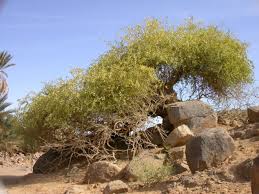
On Being a Mustard Shrub

The Parable of the Mustard Seed is one of the most famous parables of Jesus, one that gives us hope that a small beginning can have an impressive ending, or so we think. This notion of an impressive ending comes from the versions of this parable in Matthew and Luke. ((Mt. 13: 31–32; Lk. 13: 18–19) There, the mustard seed grows into a tree, although Matthew does call it a shrub that turns into a tree. Mark, most likely the earliest version, and closest to Jesus, simply says that the mustard seed grows into the “greatest of all shrubs.” (Mk. 4: 3-32) A shrub, even a sizeable one, doesn’t seem so impressive, especially when we realize that mustard shrubs were considered intrusive weeds in Jesus’ time. What is Jesus getting at? We can get a lot of help by looking at some contexts for the parable.

This parable seems almost certainly to be inspired by a similar parable in Ezekiel: “This is what the Sovereign Lord says: I myself will take a shoot from the very top of a cedar and plant it; I will break off a tender sprig from its topmost shoots and plant it on a high and lofty mountain. On the mountain heights of Israel I will plant it; it will produce branches and bear fruit and become a splendid cedar. Birds of every kind will nest in it; they will find shelter in the shade of its branches. (Ezek. 17: 22-23) With the prophet, we have Yahweh taking something small, a twig, and making something great and impressive out of it: a tree on a mountaintop that shelters birds. So it is easy to see why later versions of Jesus’ parable would move in this direction. But in Mark, the seed is smaller and less impressive than a twig, and the mustard shrub is much less impressive than the splendid cedar. Moreover, cedars are cultivated for their wood; mustard shrubs are weeds. A triumphalist vision in Ezekiel has been downsized quite a bit by Jesus. So again, what is Jesus getting at?

In Mark, the Parable of the Mustard Seed is immediately preceded by The Parable of the Growing Seed where, after seed is scattered on the ground, “the earth produces of itself, first the stalk, then the head, then the full grain in the head.” (Mk. 4: 26-29) In this parable, the growth seems natural, something that happens by itself. We sense the mystery of God’s creation that brings plants into being and makes them grow. The mustard shrub also grows naturally, but it is an intrusion that is planted intentionally, perhaps an image of the intrusiveness of God’s kingdom. And yet the mustard shrub is also an image of welcoming, a place for birds to build their nests, an image of inclusiveness from what we might call an outcast plant.

The two parables of plant growth are preceded by a more elaborate parable with much the same imagery: the Parable of the Sower. Although analogies of natural growth are there, the emphasis is on failure. Most of the seeds fall on rocky soil or among thorns or on the roadside and bear no fruit. This parable coincides with the disciples’ first signs of failure; they do not understand the parable. As the Gospel progresses, the failures of the disciples increase, culminating in the desertion at Gethsemane, Peter’s denials, and then the women running from the empty tomb, saying nothing to nobody. The seed falling on paths, rocky ground, or thorns looks like the disciples. We don’t even have a mustard shrub; we only have scattered seeds that don’t grow at all.

But God can create out of nothing. God did this in the beginning, and God does it again after Jesus’ Resurrection. (Note that the first word of Mark’s Gospel is arche, beginning.) And St. Paul says that, in Christ, “the new creation has come.” (2 Cor. 5: 17) In Jesus’ parables, what little seed did fall on good soil yielded thirty, sixty or a hundredfold. The mustard shrub was just enough for the birds of the air to come and make their nests. How did even this much come from such massive failure? We have a hint at the New Creation when, in the face of the disciples’ failures to accept his coming death, Jesus tells his disciples that they will be handed over to councils and beaten in synagogues and will stand before governors and kings because him. (Mk. 13: 9) This prophecy leaps out of the frame of the Gospel narrative to the witness of the apostles recorded in Acts. The Parable of the Mustard Seed leaps even further out of the frame. In the face of our human failure, there will still be an intrusive, unimpressive kingdom that most people don’t want, a kingdom like a shrub which opens its branches to God’s people to further, with Paul, Christ’s ministry of reconciliation. (2 Cor. 5: 18)

See also Sowing Parables in our Hearts

Jesus the Rejected Cornerstone among the Weeds

field1Jesus’ parable of the wheat and the weeds inflicts on us the discomfort of being told that we have to put up with the people we don’t like but the end of the parable and the explanation of it afterwards give us the comfort of knowing that the people we don’t like will get it in the end. But does Jesus really mean to give us this “comfort?”

When we consider the workings of mimetic desire, the image of a field densely filled with plants intertwined with each other is easily seen as an image of our entanglement with the desires of other people, some of whose desires we covet, others we try to separate ourselves from. Of course, each person who wants something we want and we don’t think it can be shared, is an enemy, a weed who should be pulled out, expelled from the garden. In such a situation, each of us is prone to considering ourselves to be one of the intended, desirable plants while the others are weeds. Of course, when we are preoccupied with how “weedy” everybody else is, we are totally wrapped up with them in our hostility. It is easy, then, to understand this parable as teaching us to mind our own business and not worry about everybody else. The trouble with this interpretation is that we are all in the thick of this garden whether we like it or not and we need to find a constructive way to live with everybody else in it. A deeper interpretation that is often offered, and one I have much sympathy with, is that we should commend everybody else to God and let God deal with them. To make this work, we have to commend ourselves to God as well, or we think we are commending those bad guys to God but we are good guys who can take care of ourselves. Moreover, the word for “letting” the weeds grow is aphete, which also is used in the New Testament to mean “forgive.”

If we give this parable a Christological interpretation, everything looks different. In being the stone rejected by the builders, Jesus was a weed. That’s the way Caiaphas and Pontius Pilate and Herod saw him. Jesus identified himself with a lot of “weeds” on the way to the cross such as the woman with a bad name in town who washed his feet at Simon the Leper’s house and the tax collectors Zacchaeus and Matthew. Every planter knows that it can be difficult to tell an intended plant from a weed. This is why well-intentioned but uninformed “helpers” are the bane of gardeners. If we try to weed out the garden based on our own judgment, we are likely to weed out Jesus himself.

The explanation of the parable seems to be at cross-purposes with the parable itself. Many scholars absolve Jesus of having ever given it, relegating the explanation to a later redactor to the text finalized in Matthew, as Simon Joseph argues with such vengeful texts in The Nonviolent Messiah. Or, we can argue that Jesus was giving us a parody of what an obtuse listener who lacks ears to hear takes away from the parable, as Paul Nuechterlein suggests on his site Girardian Reflections on the Lectionary. The trouble is, self-righteousness takes us to such extremes that it is impossible to parody. Let’s take a look at where the “explanation” takes us. First, we become preoccupied with weeding out the undesirable plants. Second, we identify with the angels who weed the garden. Third we think we shine in righteousness that blinds us to our self-righteousness. That is, we play the role of God, which is idolatry. The end result is weeping and wailing and gnashing of teeth for everybody and no harvest for anybody.

If we look forward to harvesting as opposed to weeding, we get a totally different scenario that fits well with the parable itself. When it comes to harvesting, weeds just don’t matter. The only thing that does matter is picking the fruits and bringing them in so they can offer sustenance to others. When it’s all about harvesting, things start to look a lot like the heavenly banquet that all of us can share without worrying about who is wheat and who is a weed.

The Prodigal Father and His Sons

???????????????????????????????????????????

The famous parable traditionally known as the Parable of the Prodigal Son (Lk. 15:11–32) is the quintessential illustration of pre-emptory forgiveness, one that closes the case on Jesus’ teaching on vengeance and forgiveness. This parable is better called “The Parable of the Prodigal Father and His Two Sons.” The opening of the parable draws a triangle: “There was a man who had two sons.” We expect tension out of a triangle, and we get it right off the bat when the younger son asks for his share of the property. The father accedes to his son’s request (demand?) and the younger son goes off with the proceeds. The elder son stays at home with his share of the property, at least geographically. What kind of father would be so foolish? Why would a young man leave a father who would give him whatever he wanted? Was it to get away from his brother? The stories about paired brothers in Genesis predispose us to suspect that the two brothers are mirror images of each other.

The parable goes on to say that the younger son “squandered his property.” Literally, he “scattered his substance.” That is, the younger son, while trying to forge an individual selfhood separate from his father and brother, completely loses himself in dissolute living. Geographical distance has not freed him from continuing to be a mirror image of his older brother. Then comes a famine and the social crisis that comes with it. Chances are that the scarcity was magnified by created scarcity. In such a social crisis, there must be a victim. A foreigner is particularly vulnerable to being a victim in such a crisis. The younger son fit the bill perfectly. He was deserted by everybody, in spite of all the money he spent on his women and carousing friends. Nobody was willing to take him in. He ended up as a servant who feeds the pigs (an unclean animal for Jews) and “no one gave him anything.” In this desperate situation, the younger son recalled how well-fed his father’s servants were, and he “came to himself.” Perhaps it was embarrassment that made him want to return as a servant, but perhaps he also didn’t want to re-enter the triangle with his father and brother.

The father’s ecstatic reception of the lost son and subsequent celebration blows apart the family triangle, leaving no room for mimetic strife. In contrast to the mimetic process that organizes society around a dispensable victim, the indispensable victim who is no longer lost has been found. The elder son, however, wanted to preserve the old triangle. His sour attitude suggests that he still needs to have his younger brother live irresponsibly. The elder brother’s universe would collapse if his younger brother began to play a responsible role in family affairs. No wonder the younger son ran away from a brother like that!

When the older brother keeps his distance, the father runs out to him with the same solicitude he showed the returning younger son. The elder son’s disingenuous accusation of not being allowed to celebrate is shown up for what it is. Apparently, the elder son never thought to celebrate with his friends until his father threw a party for that son of his. What the elder son has done is put himself into competition with his younger brother, when there is no need for competition. This sort of mimetic rivalry creates a stumbling block in the way of forgiveness. It remains to be seen whether or not the younger brother will forgive the elder for his unforgiving attitude.

We are likely to judge the younger brother for his callous irresponsibility and the elder brother for his amazing insensitivity. But if we do that, we find ourselves ensnared in the mimetic struggle between the two brothers, comparing them and taking sides until our own capacity for love is obscured and our capacity for celebration fizzles. The Prodigal Father does neither. He does not upbraid the younger son for leaving; neither does he upbraid his elder son for being such an insufferable prig. He only invites both of them to the party. Most of us have a hard time even wanting to be a father like that!

The parable ends with this challenge of forgiveness and unconditional love: Do we rise to the challenge of the Prodigal Father and renounce our irresponsibility and self-righteousness?