
Brought Near by the Blood of Christ

In the second chapter of Ephesians, Paul presents a powerful vision of human unity and reconciliation: a household of God with Jesus the cornerstone. What beautiful words for sore ears, ears sore from the discord and violence breaking out in the world even as we celebrate the Holy Mysteries of the altar. This fact of discord and violence makes it clear that we have not reached this vision. Moreover, there is more than a hint of violence in the fact that the reconciliation has been brought by the blood of Christ. (Eph. 2: 13) The blood of Christ is often skimmed over as a formula to set up something more pleasant, but it refers to a death by torture on a cross of a man who spent a life trying to offer healing and reconciliation.

The French thinker René Girard suggested that from the dawn of history, human society has had a tendency to resolve social tensions through focusing on one person who is blamed for the social tensions. When the person is put to death, things are more peaceful—for a time. The root problem, the entanglement of human desires that leads to violence when it is believed that the objects of desire cannot be shared, does not change, so the cycle starts all over again until, once again, the shared desire reaches concord through focusing the blame on one person, or a group of persons. Girard called it “unanimity minus one.”

This is precisely the story that the Gospels tell: the story of a society ripped apart by many tensions until, suddenly, miraculously, all of the parties that are at each others’ throats suddenly come to an agreement that Jesus must die. But the Gospels proclaim this victim to be innocent, not the one who tore society apart, but the one who tried to bring reconciliation. Indeed, the tensions in Jesus’ time were not resolved with the result that Jerusalem was destroyed in A.D. 70. That this was so was not by chance. The cycle of collective violence only “worked” because the truth was covered up and denied. The Gospels blew the cover, making sure that it will never “work” again, no matter how hard we try.

And yet Paul proclaims a cosmic reconciliation as a result of this violent death. Why? Because Jesus was raised from the dead as the forgiving victim. Paul himself experienced Christ’s forgiveness in a powerful way on the road to Damascus. Jesus did not just preach about forgiving one’s enemies; Jesus practiced it as the risen victim. In so doing, Jesus inaugurated what Paul calls a new creation, a new humanity, a chance for humanity to start over and get it right this time. But when we look at the discord and violence, it is clear we haven’t gotten it right yet. There is some good news inspired by the Good News that is the Gospel, however, namely the massive amounts of charitable work done around the globe to build up dignity for people who are ground down by the discord and violence.

In Mark, we see Jesus having compassion on the people “because they were like sheep without a shepherd.” (Mk. 6: 34) Jeremiah castigated the shepherds who destroy and scatter the sheep. (Jer. 23: 1) When there is no shepherding or bad shepherding, humanity falls into the cycle of violence that resolves on a victim, the scapegoat. Jeremiah conveyed God’s promise of real shepherds who will care for them. (Jer. 23: 4) Paul insists that Christ is this shepherd, but not a shepherd who nags and scolds but one who shepherds through forgiveness. As the Gentiles and Jews had united in putting Christ to death, Paul says that Christ unites Jews and Gentiles through forgiveness as the risen victim. So Jesus has reconciled Jew and Gentile “to God in one body through the cross, thus putting to death that hostility through it.” (Eph. 2: 16)

Throughout his preaching, Paul proclaimed this reconciliation of Jew and Gentile, hoping and believing it could happen soon and be the consummation of creation. Yet, that did not happen. Jewish persecution of Christians embittered the early church and anti-Jewish attitudes wrecked havoc on the Church, culminating in the Nazi Holocaust.

Although Gentile-Jewish relations continues to be a burning issue, in the U.S., relations between white and black people is front and center. Black people have been victimized beginning with the slave trade, but it is important to realize that committing such atrocities destroys the humanity of those of us who perpetrate it just as the persecution of Jews destroyed not only Jews but persecutors. Julia Robinson Moore, a black historian and theologian who uses Girard’s thought, has found evidence that the enslavement and suppression of blacks correlates with increased tensions between white people. So it is that blacks become collective victims of social problems among whites. As the Afro-American theologian James Cone said, Jesus is most present on the lynching tree.

In many ways it is frustrating to have Paul’s great vision of reconciliation when the reality of the present time hits us in the face. But it is important to be profoundly grateful for the vision. Proclaiming peace to those who are far off and those who are near is a guiding star, a way for us to be oriented. This vision gives us something to aim for, to hope for. Among other things, this vision gives us a means to test the shepherds who would lead us. Who is more apt to gather and build up? Who is more apt to scatter and destroy? Jesus became such a shepherd by getting all the people to sit together and eat together with what seemed very few loaves of bread and fishes. Such a vision challenges us to want it, really want it. Since this vision means that all of us will be changed, even changed radically, it can be frightening enough for us to hold back. All the more reason to pray to want to want this vision of reconciliation.

This vision can also point to both big and small ways to live it out. Julia Robinson Moore leads a reclamation project for the graves of enslaved persons. She takes students on field trips to spruce up the slave graveyards and she bring the descendants of slaves and enslavers together when they are ready for that move, giving all a chance to affirm the full humanity of the other and to seek mutual healing.

For an introduction to the thought of René Girard see: Living Stones in the House of the Forgiving Victim and Living Together with our Shared Desires.

Glamor and Glory Transfigured

It is a source of insight that the word “glamor” normally refers to a pleasing quality, one that makes the rich and famous rich and famous, but it can also mean a spell that exerts power over other people. When we think of a Hollywood actress as glamorous, we think that is a good thing, but such an actress does tend to put a spell on those devoted to her. Such careers are considered glorious, also a good thing. The word “glory” has a rich ambiguity in biblical studies. When we read the word “glory” in scripture, especially as an attribute of God, we think it means something wonderful, and sometimes it does. But the Greek word doxa can mean the opposite: disgrace. As James Alison said in one of his writings, doxa actually means “reputation.” A reputation can be good or bad. When applied to humans, glory, doxa, is associated with human glory that tends to be violent, for example a victor in war. That was the kind of glory that Roman emperors strove for and often got. If we find life dull or downright oppressive, then we crave for some glamor and glory. We want to be bespelled by someone glamorous. The glory of a victory parade for a victorious football team makes life exciting and well, glorious. For the winners anyway. Not so much for the losers.

I have come to see that these concepts of glamor and glory were instilled in me before I had any way of knowing it was happening. They were two of many filters that informed my reactions to life and still do as reflex reactions. It is unavoidable that such a thing should happen to me and everybody else. Humans are cultural animals and that means we get cultured. Becoming aware of how we are cultured and then trying to change the culture when that is desirable, is a an important challenge. René Girard, gave us much insight into this phenomenon when he wrote about the natural way humans share desires. We don’t live with our own desires, as we think; rather, we live in a sea of desires of others all around us. The desires for glamor and glory are among the desires shared among all of us.

This inculturation had an affect on how I first reacted to the story of the Transfiguration of Jesus on Mount Tabor. One could say that the image of a resplendent Jesus cast something of a glamor on me, especially with the help of Raphael’s great painting. There was much that was theologically sound in this reaction. I took it as a vision of the potential transfiguration of all creation, as Gerard Manley Hopkins said: “the world is charged with the grandeur of God.” Many gloriously beautiful works of music also transfigure the world. The Transfiguration made Jesus look like a winner, what with hanging out with two heavyweight bigwigs from the Hebrew scriptures, and in a sense that was true, but Jesus was not the kind of winner who gets ticker tape parades down Fifth Avenue.

Countering this inculturation of glamor and glory was the awareness that Jesus was about to begin the trip to Jerusalem where he was going to die on the cross. Adding a celebration of the Transfiguration at the final Sunday of Epiphany, the last Sunday before Lent, did a lot to shift attention in that direction, but there was still a tendency to think of the Transfiguration as an encouragement to the disciples—and to us—before the grimness of Lent sets in and we follow the Way of the Cross. The reactions of the disciples—the closest disciples of Jesus—fits the same inculturation of glamor and glory that I grew up with two thousand years later.

What I have come to see–and I have to give credit to thinkers like René Girard and James Alison for this—is that the disgrace of crucifixion is the glamor and glory, not the transfigured light. That is, Jesus wins glory by losing. It is because Jesus became the victim of the religious and secular powers that Jesus showed his radiance as the transfigured human. This kind of transfiguration is ugly when we take the gold plate and jewels off so many crosses gilded by them and focus on the ugly death on the cross. But this ugliness shows us the truth of the violence we inflict on each other in our search for glamor and glory. In Mark, Jesus calls himself “The Son of Man.” Much ink has been spilled on defining the phrase, but the most convincing interpretation is that it means roughly the true human being. In order to be true, Jesus had to undergo an ugly death of suffering precisely because so many other people had suffered death and mutilation and humiliation before Jesus and continue to do so, up to the present day. Much of this inflicted suffering has resulted in glory and glamor for the winners but Jesus has shown us the truth of that glory and glamor, and it isn’t pretty.

Should we toss out all bejeweled crosses? I think not. The thing to do is discern the truth in the glitter. In the great hymn Crux fidelis, the cross is “richly jeweled” but it is consecrated by the Lamb’s blood when Jesus was “nailed and mocked and parched.” We can appreciate the glamor of movie stars and electrifying pianists, but we need to watch for victims when glory has rolled over them in its wake. To quote Paul: ‘For God, who said, “Let light shine out of darkness,’ made his light shine in our hearts to give us the light of the knowledge of God’s glory displayed in the face of Christ.” (2 Cor. 4: 6) The face of Christ is a crucified face. Paul confirms this when he says: “We always carry around in our body the death of Jesus, so that the life of Jesus may also be revealed in our body” (2 Cor. 4: 10) Yes, the Transfiguration does point to the Resurrection and Ascension, but the only route is through the cross. The ugly death of Jesus is the source, the stream of living water flowing by the tree of life whose leaves offer healing for all nations. (Rev. 22: 2)

For more about René Girard see: Living Stones in the House of the Forgiving Victim and Living Together with our Shared Desires

Called to Repent

The calling of Jesus’ first four apostles in Mark is inspiring but it doesn’t make a lot of sense when we think about it. A complete stranger calls four complete strangers and they drop everything and follow him. (Mk. 1: 16–20) We can soften the improbability by noting that it is possible, even likely, that Jesus and these four men had sone acquaintance beforehand. but–let’s face it—answering a call from someone like Jesus just doesn’t make sense except maybe to the person who actually receives the call, and even then, the call tends to be a lot more compelling than sensible. At l east that’s what I still how I feel about my call to the monastic life. After all, a call from God tends to be disruptive to the life one has been living such as being a fisher on the shores of Lake Galilee. Does this call have anything to do with us?

We might try to distance ourselves from this calling by thinking that the apostles were exceptional people, but Mark and the other evangelists stress the ordinariness of the people called by Jesus. It’s professional religious people like ministers and monastics who should feel out of place with those first called. This ordinariness raises the suspicion that God, as Creator, calls everybody whom God has made. Such a call, then, is the norm, not an exception. This supposition is confirmed when St. Paul designates those called by God as members of an ekklesia, a word that means: “Those called out.” So all of us are called and the call makes no sense unless we accept that we are grounded in God as our creator, in which case God’s calling makes perfect, divine, sense. What else is involved with God’s calling of us?.

Jesus’ call of the four fishers follows straight upon Jesus call for repentance because the kingdom of God has come near. (Mk. 1: 15) What do we repent from? From fishing? Nothing wrong with that. As one who loves fish and seafood, I wouldn’t want all fishers to stop their work. Mark says that Jesus’ preaching began right after John had been put into prison. So persecuting prophets like John the Baptist is something we might want to repent of. But what if we are peaceful people who don’t persecute prophets, or think we don’t? In the Book of Jonah, the prophet calls on the Ninevites to repent—and they do! Since they were a violent society, one that had attacked Israel and destroyed the Northern kingdom, they had a lot of violence to repent of. But what if we aren’t invading other peoples’ countries? Jonah’s call for the Ninevites’s repentance circles back to Israel and the rest of us in a couple of ways. If Nineveh can repent surely Israel can repent; we can repent. More to the point, since Ninevites were violent enemies to Israel, who wants them to repent and become God’s people like us? Jonah didn’t want them. The call to witness to and welcome such strangers gets to the nub of what repentance is all about. It can be pretty disruptive to what we’re used to.

In his First Epistle to the Corinthians, Paul offers some cryptic directions for how we might repent: “those who have wives should live as if they do not; those who mourn, as if they did not; those who are happy, as if they were not; those who buy something, as if it were not theirs to keep; those who use the things of the world, as if not engrossed in them.” (1 Cor. 7: 29–31) Does this mean we should repent of marriage, shopping, mourning, or being happy? As Paul would say: “Me genoito!”—by no means! We can get some help with this passage by looking at the concept of mimetic desire on the part of the French thinker René Girard. Mimetic desire, as Girard conceives it, is the human tendency to want something, not because I want it but because somebody else wants it. This can lead to peaceful sharing but it can and does lead to violence. In this problematic passage in First Corinthians, Paul is showing his own profound insight into mimetic desire. It is bad enough to want what someone else has got just because that person has it and presumably wants to keep it. This scenario is greatly exacerbated when the person who has something purposely (though sometimes subconsciously) tries to inflame other peoples’ desire for what one has. Dostoevsky understood this problem profoundly. His intensely puzzling novel The Idiot becomes understandable when one realizes how Parfyon Semyonovich Rogozhin is stirring Prince Mjishkin’s desire for Natasha Philppovna in order to vindicate his own desire for her, and Aglaya Ivanova Epanchin, in turn, tries to intensify Natashya’s desire for the Prince, whom she had in hand until she played this game—all of this unfolds with tragic results. Paul would have us steer clear of this pitfall by being detached, not only from what we don’t have, but at least as much from what we do have. This misuse of mimetic desire is what Paul would have us repent of. This sort of detachment transforms the way we experience the world.

As Jesus’ ministry progresses, the disciples don’t look good, and Mark’s portrayal of them is the most negative. Perhaps the most egregious example of the disciples’ obtuseness is the way the disciples fight over who is the greatest in the face of Jesus’ predictions of his upcoming death and resurrection. Such infighting imitates the Ninevites rather than the Lord they are ostensibly following. Constant repentance, then, is needed to help us clarify what following Jesus is all about, and we have to expect it to take time. So let’s not waste any time getting started.

On Taking the Lowest Place

Jesus’ parable of the important seats is easy to understand. It’s one of the first parables I learned as a young child in Sunday school. It could easily have come from any of the sitcoms I watched at that age. I can imagine Jackie Gleason barging into a dining hall and rushing for the best seat at the table, followed by his spluttering rage when he’s told he has to sit over in a corner.

In this parable, Jesus shows a profound awareness of social contagion, a phenomenon analyzed with much insight by René Girard. What Girard articulates is our human tendency to receive desires from other people. In the case of the banquet, the more some people want the best places, the more other people will want the best places just because other people want them. If some people think some places are the best and rush for those, then other people will desire those places because other people want them.

One way to get some perspective on this parable is to reflect on the kind of person who rushes for the best seat and the kind of person who holds back. The kind of person who holds back is apt to be more kind than the other, or at least not so unkind. The thing is, reaching the best seat can be a kind of pyrrhic victory. One might have the prestige of being a CEO, the president of the United States, or the center of a social set, but if such a one treats people badly, that person will not be liked or respected on a personal level, even if there is respect for the position. It’s a way of saying one might gain the world and lose one’s soul. One has lost one’s soul to the social contagion that blunts concern for the well-being of other people. In fact, although this parable doesn’t speak of darker alternatives, it is easy to imagine the rush for the highest place resulting in a violent free-for-all. This is what Girard says is likely to have happened at the dawn of humanity, and the free-for-all resulted in everybody converging on a victim. It isn’t easy to escape the power of this social contagion but if one takes notice of Jesus, then one sees an alternative.

To begin with, Jesus is not giving us a social strategy for getting the best place by being laid back. Jesus would have us realize that grabbing one of the best places at a dinner party or pushing for social dominance over others is not where our priority should be. Rather than trying to get the highest place, one should be content with the place one happens to have and do the best one can in that place while attending to the needs of others, which is the best way to be given a higher place due to one’s accomplishment. But there is more.

Jesus didn’t just take a middling place; he took the lowest place. His preaching ministry, for all the acclaim it received from many people, gained the opprobrium of those who thought they had the highest places and wanted to keep them. These people sentenced him to a criminal’s death, death on a cross. That was the lowest place there was in the Roman world at the time. But then Jesus was raised from the dead by his heavenly Abba and raised to his Abbas’s right hand in Heaven which is about as far up as one can go. Such is the Christological level of this parable. Who would have thought that a sitcom scenario could outline the story of our redemption?

For more on René Girard, see Violence and the Kingdom of God, Living Stones in the House of the Forgiving Victim, and Living Together with our Shared Desires.
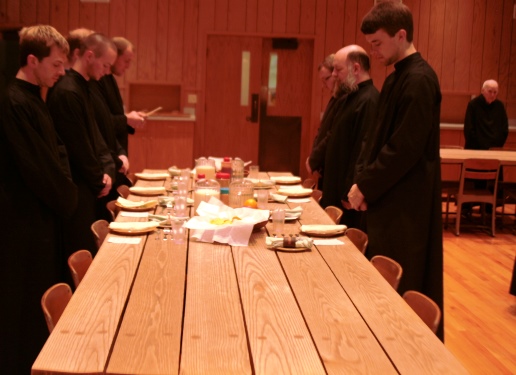
On Being Called by God

AndrewPreaching1The narratives of the call of Isaiah, Paul, and Simon Peter bring to mind my own experiences of God’s call. In my case, it wasn’t quite like being attacked by a Cherubim in church, getting knocked down on the Road to Damascus or being told to throw out the fishing nets one more time and being overwhelmed by the catch.

I did quite a lot of fishing as a child for the simple reason that my father loved it and my family spent most summer vacations at a fishing lodge. I lost interest in fishing by the time I was a teenager but the contemplative aspect of fishing stayed with me as I became a monk. While praying the Divine Office and praying silently in the Abbey Church, I constantly sense God calling me out of my self-preoccupations and self-indulgence to the wider concerns of God.

I had the call of Isaiah memorized when I was a choirboy because I sang an overwrought anthem to that text, ending with the prophet’s quiet volunteering to be sent by God. Even then, I had intimations that I might be called to the ministry although I was put off by how much kneeling I would have to do. Even so, one Sunday when our whole family was too sick to go to church, I led the four of us in the Office of Morning Prayer. As for kneeling, liturgical renewal dealt with that.

During my late high school and college years, I was a self-styled religious rebel who didn’t like the way God ran the universe. Like Paul, I was quite vocal about saying what I thought to anyone who would listen and to others who would rather not. By hindsight, I realize that I was being called all that time until I listened sufficiently to get on the track that led me to St. Gregory’s Abbey. By then I had come to realize that God doesn’t try to run the universe but God has pointed out ways we can run it better than we’re doing it if only we would listen.

It is tempting to think that one is special if one senses a call from God, as if God would surely call a superior person such as myself. But Isaiah, Paul, and Simon Peter all felt differently when approached by God. In each case, the call convicted them and pulled them out of the way they were living to a radical change of attitude and activity. In my case, I had to realize that a seminary I went to after graduating from college was the wrong choice for me, one fueled by my rebellious attitude. Only then could I hear the call to a seminary much better suited for me.

In God’s mission charge to Isaiah, God tells him to tell the people: “Keep listening, but do not comprehend; keep looking, but do not understand.” (Is. 6: 9) Jesus uses these same words to characterize the response he got from his own preaching. Some way to be “ catching people.” (Lk. 5: 10) There are many ways one can understand what it means to be a person of unclean lips living “among a people of unclean lips.” (Is. 6: 5) René Girard writes of the human tendency to share desires so intensely that they become rivalrous. When that happens, we may have ears but we will not hear what other people are saying and we will not hear what God is saying to us. In my case, I had cast myself so deeply into rivalry with God that I drowned out the direction of my call for many years. Since the most vulnerable people in a society bear the brunt of the rivalry of the powerful, deafness to the cries of the poor go unheard with only prophets like Isaiah to defend them.

Paul received his call from the resurrected Christ who asked Paul why he was persecuting him in the act of persecuting his people. John’s Gospel has a variant of the story of the overwhelming catch of fish placed after the Resurrection which raises the intriguing question of whether or not Luke placed a resurrection narrative in an early chapter of his narrative. In any case, after deserting Jesus, the disciples did need to be called a second time by the resurrected Christ. Jesus was raised from the dead because first he was killed in an act of collective violence, the sort of persecution Girard argues is the result of a society allowing itself to be swamped in rivalry where we have ears but fail to hear.

Since God’s call to each of us entails preaching the Word and, much more important, witnessing to it in our ways of living, we are fundamentally spreading our repentance to others to open their ears as well. The hazard is that a sense of rivalry can enter through the back door if we treat our ministry of witnessing as a contest in which we try to “defeat” the other and win a “victory.” What we need to do is listen to ourselves in God, and listen to others as God listens to them, and use our listening skills, based on repentance, to help other people learn to listen.

For an introduction to the thought of René Girard, see Violence and the Kingdom of God  and Living Stones in the House of the Forgiving Victim.

The Eleventh Commandment

monksinChoir1The rich man who asked Jesus what he needed to do to inherit eternal life and then walked away grieving when Jesus told him to sell all that he owned (Mk. 10: 21) is a warning to all of us, rich or poor. Jesus’ added warning that it “is easier for a camel to go through the eye of a needle than for someone who is rich to enter the kingdom of God” only makes the warning all the more dire. Paul strengthens the warning further when he tells Timothy that “the love of money is a root of all kinds of evil,” (1 Tim. 6: 10) Bucking these warnings is our formation from earliest childhood that money is both good and necessary and more of it is always better than less.

Money is not an individual matter; money is a system. It has to be if it’s going to be a medium of exchange. As a system, money gains power over all of us who use it. This is a power that easily distorts the moral conscience. In this regard, it is telling that in the commandments Jesus lists to the rich man, all are from the Ten Commandments except “You shall not defraud.” (Mk. 10: 19) Perhaps this is an eleventh commandment, or perhaps it is a version of: “You shall not covet.” (Ex. 20: 17) The more power money gains over us, the more likely it is that we will defraud others in order to get more of it. Indeed, most rich people in Palestine gained their wealth at the expense of poor farmers during hard times. Amos denounces those who “ trample on the poor and take from them levies of grain.” (Am. 5: 11) Such people turn “justice to wormwood, and bring righteousness to the ground.” (Am. 5: 7) Here we see courts of justice and the spoken word brought in with oppression of the poor as one knotted system.

The thought of the French thinker René Girard demonstrates that economic systems, like other interlocking social systems, are part of an all-pervasive system generated by what Girard called “mimetic desire.” That is, when one person wants something, other people are more apt to want it. The more somebody wants something, the more other people want it, not because of the intrinsic vale of whatever is valued but because something is valued. The interlocking of shared desires permeates society, making society a more tightly knotted system than the economical one. This is what the tenth commandment not to covet is all about. Jesus’ eleventh commandment deepens the tenth: you shall not steal what you covet because you have the social and economic power to do so. Coveting is not a vice only for the rich. I am among those who are seriously offended by what some preachers call “the Prosperity Gospel,” which seems to contradict Jesus’ words to the Rich Man. Somewhere (sorry, I can’t remember where), I read that many people who are attracted to the “Prosperity Gospel” are not rich but poor. In mimetic desire, other people model desires for other people. That is, other people tell me and show me what to desire. In the case of the “Prosperity Gospel,” rich people model to the poor what they should desire. We see the same phenomenon among Jesus’ disciples when, after being told how hard it is for a rich person to enter the Kingdom of God, asked Jesus: “Then who can be saved?” (Mk. 10: 26) The economic system, then, is fueled by the deeper system of mimetic desire wherein everybody wants to be like the rich landlords who break the tenth and eleventh commandments.

Jesus, then, is not inviting one person who happens to be rich to change; Jesus is asking all of us to change in such a way that the system is changed. The omnipresence of mimetic desire makes it clear that, important as it is to reform economic structures, it isn’t enough to do the job on its own. Our hearts need a makeover individually and collectively. It is this new system of the heart that Jesus inaugurated at the beginning of his teaching ministry when he proclaimed a Jubilee of freedom from being either a debtor or a creditor. (Lk. 4: 16–21)

St. Paul’s collection for the Church of Jerusalem (2 Cor. 8: 1–15) can be seen as an example of what economy can look like if we give our hearts to the tenth and eleventh commandments. Interestingly, the Macedonians, out of their poverty “overflowed in a wealth of generosity on their part.” (2 Cor. 8: 2). This makes one wonder if the Macedonians were more able to thread the eye of the needle than the Rich Man. Paul adds a Christological dimension with the example of Jesus who, though he was rich, yet for our sakes he became poor, so that by his poverty we might become rich. (2 Cor. 8: 9) Jesus was asking the Rich Man and each of us to do what He Himself had already done by coming into our world and its systems driven by mimetic desire. Here mimetic desire becomes redirected to desiring the good of other people, giving new vitality to Jesus’ famous words quoted by Paul: “It is more blessed to give than to receive.” (Acts 20: 35)

See also my blog post: Paul’s Collection for Jerusalem.

For an introduction to René Girard and his theory of mimetic desire, see: Violence and the Kingdom of God and Living Stones in the House of the Forgiving Victim.

The Elusive Trinity

KatrinaCrossAbraham1The Trinity is a fundamental doctrine for Christianity but Christianity is a story of salvation before it is a set of doctrines. The Trinity is no exception. If we get the story right, we might get the doctrine right, but if we get the story wrong, then we get the doctrine wrong for sure.
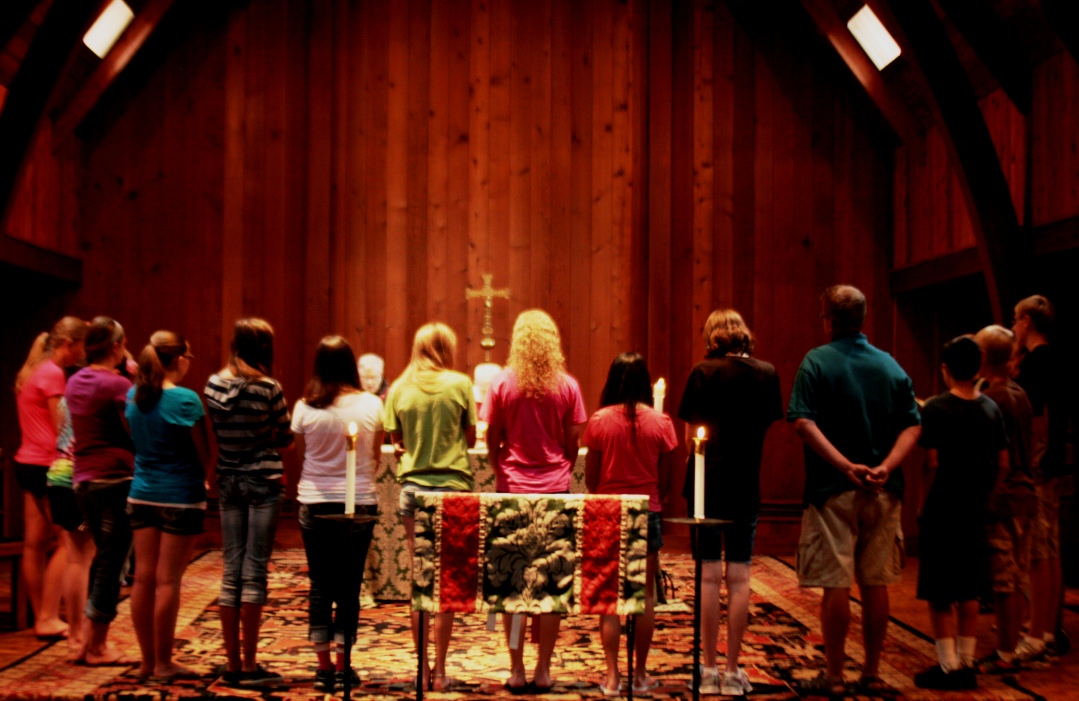
John 3 tells of Nicodemus coming to see Jesus at night, suggesting he is in the dark. Jesus’ words to Nicodemus: “Very truly, I tell you, no one can see the kingdom of God without being born from above,” (Jn. 3:3) don’t seem to follow from what Nicodemus has just said. It sounds like the answer to a question that was not asked. Is there an implied question to what Nicodemus did say? The only implied question I can pick up is: “How do I do the signs that you do?” If so, Jesus is saying that Nicodemus is asking the wrong question. Jesus says first that Nicodemus must be born again, or born from above, most likely both. Jesus “clarifies” the matter by saying that Nicodemus must be “born of the Spirit,” which is a problem since, like the wind, nobody knows “where it comes from or where it goes..” (Jn. 3: 8) Here, one Person of the Trinity enters into this story.

So far, Nicodemus is showing difficulty in knowing what he really wants, further indicating that he is in the dark. We are tempted to laugh at him for his obtuseness, but we would do well to ask ourselves if we really know what we want? So asking ourselves inserts us into the story where all of us are in the same pickle as Nicodemus, which is to say, we are all in the dark. René Girard is helpful here when he suggests that all of us don’t know what we want and so we all look to other people to show us what we want. That is, if we see (rightly or wrongly) other people wanting something, we tend to want it too. Girard also gives us the insight that since none of us knows what we really want, we end up in a social muddle that is fraught with conflict. In Romans, Paul tells us that “all who are led by the Spirit of God are children of God.” (Rom. 8: 14) So, even though we don’t know what we want we can be born anew, from above, into the Kingdom if we let this Spirit, whom we can’t understand or grasp, lead us.

Then, in another non sequitur, Jesus tells us a mini-story: “No one has ascended into heaven except the one who descended from heaven, the Son of Man.” (Jn. 3: 13) While Nicodemus and the rest of us have been thinking of rising above our humanity, Jesus has come down to take on our humanity and only then did he rise back up to heaven. So, trying to do the signs that Jesus did by some human technique is bound to fail and will keep us in the dark. But Jesus then retells a mysterious story in Numbers as a variant of the first story. During a medical and social crisis of plague in the wilderness, the sort of crisis Girard warns us will happen when we don’t know what we want, Moses was instructed to raise a bronze serpent so that any who look upon it are healed. Jesus is now claiming that he is the “bronze serpent” raised up on the cross. Raising Jesus on the cross is the result of our muddle over not knowing what we want and falling into violence as did the Jews in the desert. Yet looking at Jesus on the cross to the point of really seeing what we have done offers us a cure of our violence. Not only that, but so looking at Jesus will give us eternal life. In John, this phrase does not refer primarily to life after death but to the quality of life here and now (and presumably after death as well.) Being cured of our violence certainly is a way to an improved quality of life. This is the way of being born again, from above, of being children of God. Once born from above, our desires become much clearer and they are focused on the well-being of other people. More important, after coming down from heaven, Jesus did not return there until after he was raised up on the cross. What is above and what is below has gotten thoroughly turned around. We now have two members of the Trinity in our story.

Then Jesus briefly tells the same story in a different way: “For God so loved the world that he gave his only Son, so that everyone who believes in him may not perish but may have eternal life.” (Jn. 3: 16) Jesus was not sent to condemn the world, although there was much to condemn, but Jesus was sent so that the world might be saved through him. Paul says that the Holy Spirit cries out within us: “Abba! Father!” This exclamation makes us joint heirs with Christ if we allow our desires to be formed by the Desire that flows through all three persons of the Trinity.

When presented as just a doctrine, the Trinity looks like an mutual admiration society of three. When presented as a story, the Trinity is a union of three persons dedicated to creating and re-creating humanity and all creation.

On Being Branches Connected to the Vine

eucharist1The image of the vine and the branches in John 15 gives us a powerful image of closeness both between ourselves and God and also with each other through our grounding in God.

Each of us is a branch connected to the vine which is Jesus. Jesus is telling us that the desires of each and every one of us must be rooted in His Desire, which is the same Desire as that of his heavenly Father. Between Jesus and his Father, there is no rivalry and Jesus does not enter into rivalry with us. From our side it tends to be a different story. We experience rivalry so constantly that it is very hard to imagine a relationship without rivalry. Just note how political and social debates are saturated with it.

Jesus’ words start to sound threatening when he talks about branches withering, being thrown away, and then burnt. However, it isn’t Jesus who cuts off the branches; it’s branches that cut themselves off. Life rooted in Christ has to be rooted in Christ. This is, or should be, a tautology, but we have a folk saying about cutting off the limb we’re sitting on. People who center their lives on one or more rivals instead of Christ are doing just that. Once cut off from the vine, we are consumed with rage with our rivals, a strife that burns us up.

We often think of union with God as individualistic but that is not so. On the contrary, union with the vine unites us with all of the other branches. This means we share our union with the vine with everybody else’s union with the vine. It is by being united to others through Christ that we have the ability, through grace, to act towards others in God’s Desire rather than through our rivalistic tendencies. Since there is no rivalry in Jesus, there is no way that Jesus would encourage rivalry with others who are connected to him. In his first epistle, John says that we should love one another because “love is from God” and God is love. (1 Jn. 4: : 7–8) Again, God’s love for us is deeply connected with our love for one another. God abides in us insofar as we love one another. If we cut ourselves off from God, we cut ourselves off from other people and if we cut ourselves off from other people, we cut ourselves off from God.

The image of the vine and the branches is, above all, Eucharistic. The Eucharist is a public event. The wine in the Eucharistic celebration is the blood of Jesus that he gave to heal all of us of our violent ways. The blood of Jesus on the altar shared with each of us makes present to us the death of Jesus at the hands of persecutory humans as it also makes present the risen life of Jesus. In exchange for the way we betray Jesus with our violence, we receive the gift of life through deep union with Jesus, a union like that of the branches to the vine. We associate blood with violence, such as with the term “bloodshed,” but blood is the life within us and it is life that the Risen Jesus gives us through his Blood. This is the wine, the blood, that flows from the vine to the branches to connect us to Christ and to each other.

What Kind of Spirit was Jesus Casting Out?

wreckedTrees1When Jesus opened his teaching ministry, Mark says that the people were “astounded” because he taught them“as one having authority, and not as the scribes.” (Mk. 1: 22) Oddly, Mark doesn’t include anything of what Jesus said. The Greek work exousia is much stronger than the English word that translates it. “Powerful authority” would bring us closer to the meaning. That Jesus’ teaching was not like that of the scribes doesn’t give us much more to go on as to the content, but it indicates that this authoritative teaching was distinct from those who were normally considered the teaching authorities.

However, Jesus did something. Dramatically. He cast out an unclean spirit. In our time, we have trouble understanding what this is about and how we might draw any practical teaching from it. We tend to dismiss unclean spirits as coming from a primitive mindset and bring the affliction up to date by considering it a psychological problem which sends the poor man to a treatment facility far way from us.

I suggest that René Girard’s teaching on what he called “mimetic desire” gives us a richer approach. Basically, Girard’s insight is that our desires do not originate from within ourselves but are derived from other people; we all resonate deeply with each others’s desires. This resonance is fruitful if one person’s enthusiasm for a song inspires me to like the song so that we both enjoy the song. This resonance is more threatening if all of my friends hate a song I like so that I begin to doubt that I liked the song after all. This resonance with the desires of another becomes more dangerous if it becomes rivalrous as it does if two people desire to write and sing the best song. Some rivalrous relationships are more or less a fair fight but many times it is not. A strong-willed person, especially one with social power, can impose his or her desire on another in destructive ways. This is what happens in childhood trauma. Girard also teaches that a whole society can unite in a desire to destroy a person which is not a fight at all but a demolition.

However we understand the possession of this man, it is the imposition of something alien and oppressive. This is what a supernatural spirit would have done and maybe that was the case. But Girard’s teaching of mimetic desire shows us how an alien invasion could have afflicted this man and created a state of bondage through human agency. We get an important clue as to the nature of this alien invasion when the unclean spirit says: “I know who you are, the Holy One of God.” (Mk. 1: 24) We often think that Jesus told the unclean spirit to be silent because the spirit was correct and Jesus didn’t want people to know that yet. But Robert Hamerton-Kelly points out that the term “Holy One of God” refers to Israel’s priesthood. One of the main jobs of the priest was to expel anybody who was “unclean.” Jesus’ silences the unclean spirit, then, because the spirit is wrong. Jesus does not represent a priesthood who expels the “unclean.” Quite the opposite. Jesus is expelling the collective attitude that the man is unclean when it is the crowd’s spirit that has invaded the man and declared him unclean. By casting out this spirit, Jesus makes the man clean and so that he can rejoin the community. If the community accepts what Jesus has done.

The crowd confirms that casting out the unclean spirit is Jesus’ teaching when it asks: “What is this? A new teaching—with authority! He commands even the unclean spirits, and they obey him.” (Mk. 1: 27) Jesus is not healing an individual; he is healing a community. Or, Jesus is giving the community the opportunity to be healed. For healing to take place, the community must renounce the rivalry that had been imposed on one vulnerable person. In his stimulating book The Desire of the Nations, Oliver O’Donovan confirms the conflation of teaching and power in Jesus. (O’Donovan, 89) Picking up on the political aspect of exousia. O’Donovan goes on suggest that Jesus is using his authority to liberate Israel while treating “the fact of Roman occupation casually, with little respect and less urgency.” (O’Donovan, 93) That is, Jesus was focused on strengthening Israel rather than attacking the Roman Empire. Mark shows that Jesus’ liberation of Israel includes judging the leadership both of the teachers (the scribes) and the priests. Jesus’ action/teaching caused quite a sensation as word “spread throughout the surrounding region of Galilee..” (Mk. 1: 28) A sensation is not the same as a healing. The excitement could easily be mistaken for a communal healing when it only reproduces the scapegoating process. We are left with the question of whether or not our communities accept the healing of Jesus where the unclean spirits of human persecution are cast out or if we will be swept away on the excitement of the crowd.

For an introduction to René Girard see: Violence and the Kingdom of God.