
Forgiveness as Gift

Jesus’ teachings of love for one’s enemies and returning good for evil (Lk. 6: 27–31) are deeply inspiring and edifying as long as one doesn’t live by them. There is a tendency to regard these teachings as one regards a beautiful work of art: wonderful to look at but not something to guide my life. In any case, this teaching suddenly becomes not so beautiful when somebody maliciously wrongs me. All of a sudden, revenge is as compelling as it is sweet. That is to say, forgiveness is very difficult when the wrong is serious, when one has suffered badly on account of what another person has done. People who suffered serious abuse as children struggle with the pain all their lives and understandably have great difficulty forgiving their abusers. Pressuring such a person to do the “Christian” thing tends to amplify the pain of the abuse.

Taken in isolation, the moment Joseph forgives the brothers who had sold him into slavery (Gen 45: 4–9) seems to work smoothly, making forgiveness seem simple. But if one considers the whole story of which this moment is the climax, it is clear that the forgiveness did not come easily. The ordeals that Joseph subjected his brothers to once he recognized them may possibly be a calm and calculated attempt to test their moral fibre, giving them a chance to show improvement, but the ordeals come across to me as vengeful and punishing. Would Joseph have kept Benjamin in Egypt and sent the other brothers away if nobody protested the orchestrated framing of Benjamin? Who knows? It is Judah’s offer to take his brother’s place that breaks down the hostility Joseph had shown up to then. And when their father dies, the brothers still fear that Joseph will take revenge on them and Joseph has to reassure them.

The Anglican theologian Sarah Coakley noted that in the Hebrew Bible, forgiveness is considered to be the prerogative of God alone. The only verb besides the Hebrew verb “to forgive” which was reserved to God alone is bara, “to create.” Creation and forgiveness make a powerful pair of prerogatives. This is why when Jesus pronounced the forgiveness of sins, he was accused of claiming to be God. Perhaps it is as impossible for humans to forgive as it is impossible for humans to create a world out of nothing. But if it is not our place to forgive sins, why does Jesus tell us to forgive even our enemies? If we are not capable of forgiving them, which often seems to be the case, is Jesus asking us to do the impossible?

Paul’s powerful proclamation of the resurrection of the body in 1 Cor. 15 doesn’t seem to be relevant to the question of forgiveness, but maybe we should examine the question in case it is relevant after all. Paul makes it clear that the resurrection body is a gift from God. (1 Cor. 15: 38) We are not capable of giving ourselves a resurrection body and nobody is telling us that we should try. Is forgiveness as impossible as giving ourselves a resurrection body? If the resurrection body is a recreation, then maybe the answer is Yes. Later on, Paul tells us that the physical body is created out of the dust, as was the body of Adam, and we are created in that image. But the heavenly body is created according to the image of “the man from heaven,” which is Christ. Could it be that Jesus, in claiming the divine prerogative of forgiveness, is passing on that prerogative and ability to us as fundamental to the our re-creation in Christ? Joseph forgives his brothers in the context of divine providence. Such discernment makes forgiveness much more possible. For myself, I have experienced forgiveness, not as an accomplishment, but as a gift from God. I did not forgive another person; God forgave that person through me.

Let us return to the notion that Jesus’ teaching on love of enemies is like a beautiful work of art. Are we really unaffected by a work of art that we admire deeply? No. A work of art may not seem to have any practical value, but it has an effect on one who encounters it. Over time, the effect of a work of art can sink down into a person to the extent that it brings about a small transformation. How much more could the beauty of Jesus’ teaching of forgiveness and love of enemies sink more and more deeply into us over time, bringing us closer and closer to what Paul called “the Mind of Christ?”

Difficulties in Forgiving: Joseph and his Brothers

Joseph_and_His_Brethren_Welcomed_by_PharaohThe story of Jacob’s return to Esau illustrates the difficulty of believing in, let alone accepting forgiveness. (See Difficulties of Forgiveness (1): Jacob and Esau) The story of Joseph and his brothers takes us primarily through the difficulties of forgiving.

As a youth, Joseph is a victim of collective violence. As is often the case with such victims, Joseph has been singled out both for adulation (by his father) and opprobrium (by his brothers). In contrast to the origin of collective violence as envisioned by René Girard there are a couple of cracks in the unanimity to kill the victim. Both Reuben and Judah differ and try to save Joseph but their plans are foiled. If either had had the courage to stand up to the other brothers, each would have had an instant ally and together they would likely have turned the tide and saved Joseph from his near-death in the pit.

Joseph’s serene words that it was God, not his brothers, who had sent him to Egypt and that although they had meant him harm, God had used it for good, taken by themselves, suggest an easy forgiveness on the part of Joseph, but the story is—well—another story.

While Esau welcomed Jacob back with open arms in spite of the harm Jacob had done him, Joseph does no such thing. Like Esau, Joseph has done very well in spite of his brothers’ intent to hurt him, in fact he benefitted in the end from what they had done to him, but Joseph holds back and remembers his youthful dream where his brothers bowed to him. Joseph goes on to play an elaborate series of mind games that amount to torture. It is possible that Joseph’s harsh way of speaking to his brothers was an act, the beginning of an educative process, but I can’t help but feel that the anger was very real and at least a little raw. As a test to see if they can treat the youngest, Benjamin, better than they treated him, it was hardly necessary to lock Simeon in prison for a year and threaten his own family with starvation if they didn’t obey all of the demands that could make little sense to them. Joseph’s father Jacob also suffers because of this treatment, which may also be intentional. In my pastoral experience, I have found that one who was a favored child carries a heavy burden from this favoritism rather than finding it a blessing. Sadly, while Jacob never showed any repentance for the way he treated Esau, Joseph’s brothers have such a guilty conscience that they think that their suffering at the hands of Egypt’s steward is a just punishment for what they had done to Joseph.

As things turn out, it is Judah, not Joseph, who triggers Joseph’s forgiveness by offering himself as a slave to spare Benjamin that fate. Since Judah had wanted to save Joseph in the first place, he is not a reconstructed persecutor but a man showing a compassionate heart for a younger brother that he has always had. The difference is that while Judah was cowardly before, he is brave this time around and his bravery is awarded. Joseph is won over and he forgives his brothers, but not until he has worked through tons of anger on his own part. It was his intention to put his brothers to the test, but in a sense he himself was put to the test by Judah. Fortunately, Joseph had the grace to give up his control of the situation which he had lost anyway and cry on the necks of his brothers.

Following carefully in our own hearts Joseph’s steps to forgiveness: his anger, his pride, his manipulations, and but also his crucial willingness to accept help from a brother when he needed it, can be a way for us to track our own difficulties of forgiving the hurts we have received in life and move through them to an awareness that although certain people intended us harm, God has used these harmful actions for good.

For more on the difficulties of forgiveness see A Miserable Gospel.

Mimetic Blessing through Abraham (2): Abraham’s Offspring

Jacob_Blessing_the_Children_of_Joseph_-_WGA19117[Continuation of Mimetic Blessing through Abraham (1): Cain and Abel

God promised Abraham that he would have as many descendants as the dust of the earth. (Gen. 13:16) I like the later image of the stars in the sky and the grains of sand on the seashore (Gen 22:17) but the earlier image ties in with the creation of humanity out of dust, thus making it clear that descendants of Abraham (like us) are part of God’s ongoing creation. That’s how expansive God’s blessing and being God’s blessing can be.

When Abraham and his nephew Lot found there was tension between their herdsmen, Abraham suggested that they separate and he gave Lot the choice of taking the land to the left or the land to the right. This is quite the opposite from what most of us do which is the first see what the other desires and then desire it for ourselves. Instead, Abraham renounces desiring what his nephew desires and goes in the other direction. (The better-looking land turned out to have its liabilities but that is another story.)

Unfortunately, Abraham does not renounce mimetic desire and rivalry when it comes to his sons Ishmael and Isaac. In spite of being called to be a blessing and promised as many descendants as the dust of the earth, Abraham fails to believe that both of his sons can inherit the blessing he has been given by God. Far from fighting each other, Ishmael and Isaac play well together but they fall victim to the rivalry between their mothers. (Women are equal participants in the mimetic rivalry game in Genesis.) Abraham casts Ishmael out so that his favorite son born of Sarah can inherit the blessing. God, however, makes it clear that there is a blessing for Ishmael, too, even if Abraham did not believe it.

Following his father’s example, Isaac assumes that only one of his two sons can receive his blessing and, like Abraham, he wants to give it to his favorite son. Rebekah’s involvement in this rivalry causes this Isaac’s scheme to misfire. This time, it is the son who receives (takes) the blessing who is exiled where Jacob spends many years in rivalry with his kinsman Laban. When Esau re-enters the story on Jacob’s return, we can see that Esau has done well for himself and has no need to envy his brother’s success. Apparently there was a lot more of a blessing left for Esau than Isaac thought.

Jacob stubbornly upholds the family tradition of disbelief in the scope of God’s blessing and singles out his favorite, Joseph, over/against his ten older brothers. This time the fratricidal strife has enough brothers to create a scenario of collective violence. In contrast to the primitive sacred, however, the unanimity is not complete. Both Reuben and Judah, separately, make plans to save Joseph but they both fail. If they had stood up to their brothers, the mimetic process would likely have been redirected in a peaceful direction. The upshot of the story is that Joseph ends up becoming a blessing to Egypt and to lands far beyond and he saves his own family through his foresight in collecting food during the years of plenty. (Joseph’s making the Egyptians buy back the food that had been taken from them does make Joseph less generous than his God.)

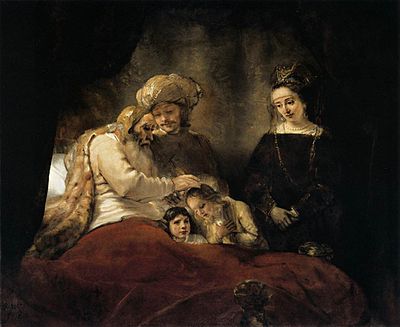
Before he dies, Jacob blesses the two sons of Joseph: Ephraim and Manasseh. He crosses his hands to indicate that Ephraim will be greater than his elder brother, but he gives both boys the same blessing. Finally, through excruciatingly painful experience, Jacob has learned that God has blessings for all of Abraham’s offspring.

Twin Killings

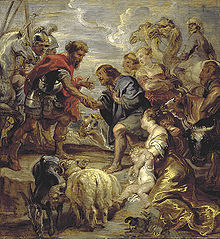
220px-Rubens_Reconciliation_of_Jacob_and_EsauIn baseball a twin killing is a double play: two outs on one batted ball. “Two for the price of one,” as the great Detroit Tigers great sportscaster Ernie Harwell called it. Double plays are a legitimate part of baseball. But there is another kind of twin killing that has been a part of humanity until close to the present day that is not legitimate: the killing of twins.

Why was one, and sometimes, both twins been killed in early societies? René Girard suggests that it was the fear of what he called “mimetic doubles,” two people united through conflict. After the social chaos was resolved by collective violence, societies created structures to prevent the repeat of the chaos as much as possible. Twins, especially identical twins, were too much of an image of the indifferentiation that lead to conflict. They could not be allowed to live. During the time of chaos, indifferentiation was precisely the problem as differences between people melted in the heat of conflict. It is obvious to us now that these babies were innocent victims of society’s fear of mimetic doubles, but in today’s society where social differences are dissolving, perhaps we should fear, not twin babies, but mimetic doubles.

The authors of Genesis had no illusions about the danger of mimetic doubles. Brothers paired off against each other are the driving force of the book, culminating in Joseph’s brothers ganging up on him. Jacob and Esau were twins. The conflict that kept them apart for many years finally resolved in an uneasy reconciliation as Esau turned out to be more forgiving for the wrongs done him than Jacob ever believed possible.

Lois Lowry’s chilling dystopia The Giver also has a twin killing. The society is shown to be peaceful but colorless. (Literally so, as we learn when the protagonist, Matthew, begins to see colors.) It becomes apparent that everything is designed to prevent conflict. There is no courtship or sex; medication stifles the latter and babies are grown in test tubes, implanted in adolescent girls, and distributed to couples, each of whom gets one boy and one girl. Not surprisingly, the cost of this “peaceful” society is high. When Matthew is apprenticed to the Giver, he learns that it is his job to keep track of everything that is happening via TV monitors but to do nothing unless asked, as the job is consultative only. A day or two before Matthew makes his escape, he watches his own father “release” one of two twin babies with a lethal injection, the normal way of releasing somebody. (The elderly are so released at a certain age after a celebration of their lives.)

Much else is shown to be wrong with this society but the killing of a twin shows clearly enough that preserving the peace by squelching mimetic doubles inevitably institutionalizes violence, even if, as in Lowry’s society, it is kept invisible. René Girard would argue that one of many effects of the Cross and Resurrection is that we don’t kill twins and we have the freedom to build God’s kingdom where we actualize the freedom shown by Esau to forgive and then later by Joseph to his brothers. It is no longer possible for social structures to contain the potential violence of mimetic doubles in conflict. It is possible, and in our times, necessary to renounce conflict, even if it means forgiving the theft of a blessing. This renunciation leads to its own blessings. After all, Esau had done pretty well for himself while Jacob was away.