Gathering to Give Life to Victims

eucharist1Since the dawn of humanity, humans have gathered most quickly and powerfully around a victim. (See Two Ways of Gathering and Violence and the Kingdom of God.) Just think of how quickly we gravitate around whoever is currently seen to be to blame for whatever is going wrong in the world today. This gathering, however, is always at the expense of at least one person or group of people. A similar and yet very different gathering around a victim occurred when the eleven disciples saw the risen Jesus in Galilee and “worshiped him.” (Mt. 28:17) The huge, even infinite difference in this gathering is that the victim is alive and is gathering people around victims, “the least of those who are members of [his] family.” (Mt. 25:40) Ever since, Christians have gathered in worship around Jesus and his fellow victims, primarily in the Divine Office and the Eucharist.

The Divine Office is structured prayer that is uses the Psalter and other biblical canticles as the primary vehicle of prayer. Much can be said of the psalms but the thing that jumps out at anyone who prays them with any frequency is the many outcries of victims. “They surrounded me like bees; they blazed like a fire of thorns; in the name of the Lord I cut them off!  I was pushed hard, so that I was falling, but the Lord helped me.” (Ps. 118: 11-13) Verses such as these raise the question of whether we gather “like bees” around another person, or if we are entering the circle of bees in solidarity with the victim. Being a victim tempts us to anger, bitterness and violence. “Cutting off” our assailants in “the name of the Lord” is the reflex reaction, but is the opposite of what Jesus himself did in the same position. These rough verses help us renew our awareness of our own violent reactions to being victimized, even (especially!) petty matters such as being slighted by another. If we focus on Jesus when we are in the place of the victim, we find that the Lord has made the rejected stone the “chief cornerstone” that is “marvelous in our eyes.”

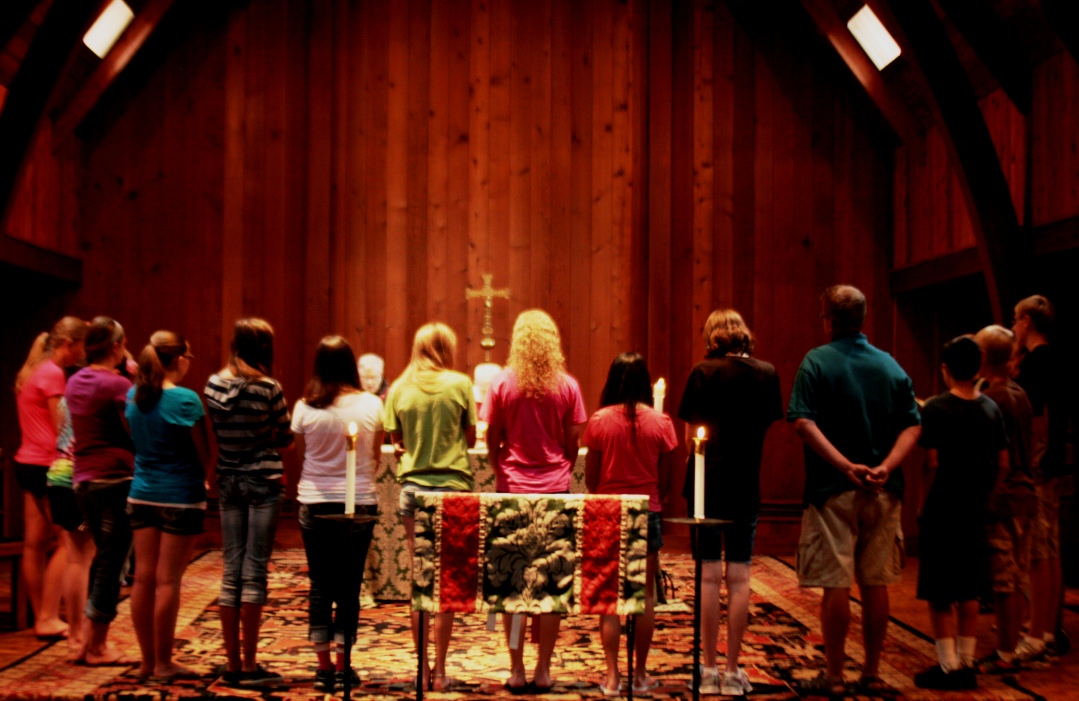
In the Eucharist, we gather around an altar which has been transformed into a table where, instead of laying out a sacrificial victim for slaughter, we place a piece of bread and a cup of wine to share among those present. We do this in memory of Jesus’ Last Supper, suffering, death, and Resurrection. The Greek word anamnesis does not mean a mere memory but to make present. That is, we enter the place of the victim with Jesus when we gather around the table. In so gathering, we feed on Jesus’ forgiveness of us for our own victimization are our challenged by this forgiveness to give this same life to others, both in terms of physical needs and emotional and spiritual sustenance. (See Miserable Gospel)

In his Rule, St. Benedict says that prayer should be made with “utmost humility and sincere devotion.” Entering the place of the victim with Jesus leads to both humility and devotion, attitudes that allow us to follow Benedict’s admonition that we sing the psalms (and also break bread in the Eucharist) “in such a way that our minds are in harmony with our voices.” (I develop these thoughts on the Divine Office in Tools for Peace)

The Prophet Between the Fox and the Hen

turkeys1We often think of a prophet as a person who speaks the word of God such as Elijah and Isaiah do, but Jesus gives us a deeper definition of what a prophet at the climax of his diatribe against the scribes and Pharisees in Mathew: “so that upon you may come all the righteous blood shed on earth, from the blood of righteous Abel to the blood of Zechariah son of Barachiah, whom  you murdered between the sanctuary and the altar.” (Mt. 23:35) Here, the prophet is one who says not a word but speaks the Word of God nonetheless in the sense that Abel’s blood cries from the ground.

This diatribe is often cited as a proof that Jesus, at least at times, was violent. It is worth noting, however, that Jesus didn’t shoot an automatic rifle at anybody; he spoke truth to presumptive power with a two-edged sword for a tongue. More importantly, these harsh words are followed by Jesus’ wish that he could gather his “children together as a hen gathers her brood under her wings.” Here we see very clearly the Two Ways of Gathering outlined in my blog post of that title.

In Luke, the lament over Jerusalem is put in a different, but similar, context. Warned by some Pharisees that Herod wants to kill him, Jesus calls him “that fox.” (Lk. 13:32) In preaching on this Lukan text, Prior Aelred here at St. Gregory’s, drew out the comparison of the fox and the hen. In the face of a threatening fox, Aelred suggested that Jesus might have been a better protector by being a tougher animal, such as the Lion of Judah. But no, Jesus assumed the role of a vulnerable hen gathering her chicks. Aelred went on to extoll Vicki Soto and her colleagues at Sandy Hook who covered as many of their small pupils with their bodies as they could to protect them, a contemporary embodiment of Christ the vulnerable, protective hen.

A fox scatters, while a hen gathers. What if Jesus had chosen to be a lion to deal with that fox Herod? It occurs to me that a lion would scatter all foxes who might threaten the chicks. Sort of like a superhero crushing the bad guys so that good guys like us can get on with our lives. Aelred noted that Jesus the Hen is not a popular image in Christian lore as is the Lion of Judah. The problem is, if Jesus the Hen gathers, then not only is Jesus the Hen trying to gather the scribes and Pharisees,  but Herod and his court as well, thus robbing us of more favorite enemies.

Stumbling blocks in the Desert: the Temptations of Jesus

freshBread1When Jesus went out into the desert after his baptism, he became aware of the fundamental temptations he would have to fight throughout his life. James Alison helps us understand the social nature of these temptations by pointing out that “devil” (diabolous) means “divisive obstacle.” Such an obstacle requires two or more people to stumble over it. That is temptations are unavoidably social.

The social implications of the first temptation are spelled out in John 6 where Jesus feeds the multitude in the desert. The feeding is a sign of God’s willing of abundance (see Divinely Created Abundance) but bread, like any material good, exists in a social context.  The temptation presented here is to align bread with economic and political power. The people who have been fed fall into this temptation and try to seize Jesus and make him king (the glory of all the kingdoms of the word–see Ignominous Glory). Jesus had to resist the temptation, go off alone, and then return to preach about bread from heaven, bread that is a gift from God.

In the temptations, the devil taunts Jesus as being the “son of god.” Likewise, when Jesus casts demons out of people possessed by them, the demons call Jesus “the son of god.” Thinking back to the attempt to seize Jesus and make him king, Jesus’ ordering those he has healed to tell nobody makes a lot of sense. Jesus was focused on healing those who had need. The demons tried to politicize the healings to make them part of a thrust for social power. This dimension is particularly apparent in the name of the demon possessing the man of Gadara: Legion.

When Jesus predicts his imminent suffering and death, Peter is called a “satan” when he tries to dissuade Jesus from following that course. As with “devil,” the word “satan” means a stumbling block. Lacking support from his closest followers could only have multiplied Jesus’ difficulty in holding the course laid out by his heavenly father. How much better would it be to fling himself off the roof of the temple and force his heavenly father’s hand? The devil was right to quote the verses from Psalm 92. God would bear up the son of man, but not until the son of man had truly and deeply put himself into the unforced hands of the heavenly father by allowing himself to be handed over into the hands of angry sinful humans.

Like Jesus, we must be alert to where the stumbling blocks are in our relationships with other people and with God. Like Jesus, we must learn that the stumbling blocks are too heavy for human hands to lift and toss away. Like Jesus, we must turn to our heavenly father who is always waiting for us to ask him to toss the stumbling blocks away.

Turning on Ash Wednesday

altarDistance1As we begin the season of penitence on Ash Wednesday, we do well to put penance in a context beyond our individual selves. René Girard’s concept of mimetic desire tells us that our “individual selves” are merely an illusion; our desires are unavoidably caught up in the desires of other people. (see Human See, Human Want) With that being the case, cleaning up our “own” desires simply does not do the job.  Instead, we must clean up the desires we share with others, and that means relating to others.

Early in his great poem “As Wednesday,” T.S. Eliot zeroes in on healing shared desire by following the first lines about hoping to turn his life: “Desiring this man’s gift and that man’s scope/I no longer strive to strive towards such things.” That is, the tenth commandment about coveting includes coveting the God-given gifts of others and their insights. If we turn from our entanglements with the desires of others, we will affirm and rejoice in their gifts and insights and in doing so, will awaken to the gifts and insights that we have within us to give to others.

In Matthew’s Gospel, Jesus follows his teaching on renouncing mimetic rivalry (turn the other cheek, etc.) with a solemn caution against using “good” actions such as repenting, fasting, almsgiving, and praying as occasions for competing with others so as to desire gifts and insights of others.  If we practice piety “in order to be seen by others,” then our piety is locked in our competition with others and not on God. That is why God cannot reward such piety which isn’t piety at all. The Desert Monastics also found themselves falling into the trap of competitive asceticism. On of the reasons Benedict, in his Rule, asks his monastics to tell the abbot about their Lenten disciplines is to put the practice of each into the context of building community. All this is compiling treasure on earth just as much as fattening our bank accounts.

The alternative to “praying in secret” may seem to be individualistic but it is really a matter of being an individual before God, which is a different thing. (An individualist flaunts his or her individuality over/against others—another thrust in a life of fencing.) Rather, “praying in secret” grounds each of us in God so that we can rejoice in God’s giftedness of others and ourselves. More important, it is precisely in the midst of these admonitions against flaunting our piety that Jesus teaches us the Our Father which reaches its climax with the petition that God forgive us as we forgive others.

As we turn again back to God, let us look at the turnings we must do in our relationships, realizing that unhealthiness in our relationships is not the same thing as the unhealthiness we may see in ourselves as individuals, although there is a relationship between the two. With T.S. Eliot, let us not even try to want the gifts of others but instead turn to the gifts we have to give to others.

For more about Lent in the Rule of St. Benedict in dialogue with Girard, read Tools for Peace

Outcasts at the Manger

altarXmasStar1We like to be insiders and hate to be outsiders, don’t we? Well, let’s look at some insiders and outsiders in the Christmas story. The people who stayed at the inn in Bethlehem were insiders. A betrothed couple and their newborn baby were outsiders. Shepherds were outsiders, hated and distrusted by all. So why would the angel of the Lord show such bad taste in revealing the birth of the Savior to them?

The Magi were highly-placed insiders in their own country, most likely top advisors of royalty. So why would they travel to another land where they were outsiders? If the star was up there for all to see, why did these foreigners from without and outcasts from within Jewish society respond when others did not?

The Magi, used to being insiders, went straight to the top, to the ultimate insider, King Herod, to inquire about which newborn child the star was indicating. Ironically, Herod was an Idumean, not a full-blooded Jew. He had power, but he was an outsider. Herod’s reaction to the Magi’s inquiry showed Herod to be an outsider to humanitarian feelings once he thought his power was threatened. Mixed racial background aside, being rich and powerful pushes one to the margins of society as much as the poverty of the despised shepherds.

These days, we easily see Herod as an outsider, an intrusive foreign element entering the story only to stir up trouble and grief. The shepherds and the Magi are insiders, like us. How did that happen?

There is a certain sleight of hand that turns us and certain chosen others into insiders when it suits us. Not only do we not wish to be outsiders, we don’t like to be challenged by outsiders. If we realize that the shepherds and Magi and the Holy Family themselves are outsiders, our identities are shaken at a deep level. If it is outsiders who appreciated the richness of the Christ Child, maybe the same thing happens today. After all, some nonbelievers care more about the poor than rich Christians and a Hindu early in the twentieth century believed in the Sermon on the Mount more than the Christians of his time.

The greatest irony is that Christ was born to save all people, to make insiders of all of us. The problem is, we don’t want to be insiders with those who are outsiders and we certainly don’t want outsiders to join us. After all, what would we do if there were no outsiders?

Imitating Saint Andrew Following Jesus

AndrewRefectory1Mimetic desire, especially when it is good mimesis, is easily overlooked. Usually it’s jousts and fisticuffs that get our attention. Mimetic rivalry drives the plots of novels. Mimetic sharing only drives the plots of lives lived well. (See Human See, Human Want)

When it was time for me to be clothed a novice, I chose Andrew as my religious name because of the example Andrew set by promptly answering Jesus’ call. I hoped, and still hope, that my patron would and will inspire me to listen for Jesus’ call every day, every hour, and follow that call. As a bonus, Andrew was the patron saint of Scotland and my Marr ancestors came from there.

As I listened to the Gospel at Mass this morning, I was struck by the communal aspect of the following. It wasn’t just Andrew who heard the call and followed Jesus; Andrew heard the call and brought his brother Peter with him. That is, Andrew entered the mimetic process of following Jesus and drew Peter into that same mimetic process. The next day, James and John were drawn into the same good mimesis of following Jesus, a rerun of yesterday’s story. That’s what good mimesis does. Like mimesis of any kind, it is contagious and it replicates itself.

Curiously, Andrew drops out of the Gospel accounts after his dramatic call except for noticing the boy with the loaves and fishes in the wilderness that touched off the greatest bonanza of good mimesis in world history. It is the other three, Peter, James and John who form the inner group of disciples who witnessed the raising of Jairus’ daughter, were present at the Transfiguration, and then fell asleep at Gethsemane. It is tempting to feel that my patron was slighted, but that would be bad mimesis.

It is more encouraging to notice that Andrew was also curiously absent in the fights among the disciples as to who was the greatest. This in-fighting helps make the Gospels “interesting” as it drives the plot until the mimetic issues in Jerusalem take over. Maybe Andrew just wasn’t “interesting” enough to mention. Maybe Andrew wasn’t pushy enough.

The point to being a follower of Jesus is not to be part of the inner circle of the inner circle. The point is to hear the call of Jesus and to listen to the way Jesus is calling others. This way, everybody and nobody is the greatest in the greatest story ever told.

Life of Benedict

The only biography of St. Benedict is by St. Gregory the Great. Gregory highlights the ways Benedict’s life was lived in imitation of the great figures in Scripture and most importantly of Christ himself. I have posted an article called Imitating Elisha that analyzes Gregory’s Life of Benedict with René Girard’s concept of mimetic desire. The result is a rich vision of the spiritual life for any Christian.

Two Ways of Gathering

A strange gathering of devout Jews from every nation took place a little over two thousand years ago in Jerusalem. These Jews were bewildered to hear a group of Galileans speaking in each of their languages. A new and exciting gift of understanding was unfolding in their midst. In their perplexity some thought the Galileans were drunk.

Peter explains this strange gathering by telling his fellow Israelites about a very different gathering that had taken place just a few weeks earlier where everybody conspired to crucify an innocent man. The Pharisees, Sadducees and the Roman authorities, constantly at loggerheads about just about everything, suddenly and miraculously came to an agreement to put Jesus to death.

Peter goes on to say that this man was “handed over to you according to the definite plan and foreknowledge of God” and killed “by the hands of those outside the law.” That Jesus was killed unjustly, by those outside the law, indicates that God’s plan and foreknowledge should not be equated with God’s will. To the contrary, Peter insists that the execution of Jesus was contrary to God’s will. Peter’s next announcement was even more startling: “God raised him up, having freed him from death.” The risen victim, “sitting at the right hand of God” has poured out the Holy Spirit that everybody was seeing and hearing. In declaring that the crucified and risen Jesus was the Messiah, Peter was claiming that a radically new understanding of life was being given through the Holy Spirit.

Quotations from the psalms that accompany the apostolic preaching indicate that the story of people at enmity making peace by agreeing to persecute a person is then blamed for the discord in the community is actually an old story. The opening verses of Psalm two express this old story succinctly: “Why did the Gentiles rage . . . . the rulers have gathered together against the Lord and against his Messiah.” Children do the same thing on the playground every day.

What was truly strange about the gathering by the Holy Spirit was that people were being gathered without creating a victim. Instead, the victim of just a few weeks past has risen from the dead to gather God’s people in a radically new way based on sharing God’s love for every person.

 Tools for Peace explores how Benedictine spirituality helps us live in the gathering in the risen forgiving victim.