

John 3: 16: “God so loved the world that he gave his one and only son” seems to be almost everybody’s favorite Bible verse. I don’t mind being a non-conformist when called to be and I have been known to get a conceited pleasure out of being one, but this is among my favorite verses too. However, the very popularity and familiarity of the verse can perhaps dull us to its power to impact our lives.
I will work with what seems an innocuous question: What is the world that God loved enough to send the Son into it? The word kosmos in normal usage had a neutral connotation, meaning the world in general, the world that happens to be. This corresponds to normal usage in English. In John’s Gospel, however, the word has a highly negative connotation, closer to the negative connotations of “worldly,” only much stronger than that. Most New Testament scholars interpret the word as John uses it as “the world-against-God, the world in rebellion against God,” as I learned it in seminary. Curiously, much preaching on this particular verse, including my own, seems to make it an exception; thinking of the world in a neutral way. But what if this isn’t an exception? What does this verse look like then? What does the world hostile to God look like, and what kind of deity would want to get messed up with it?
The reading from Numbers gives us a snapshot of the world against God. One would think that their deliverance from Egypt would earn some gratitude on the part of the Israelites, but all they do is grumble angrily about the hardships in the wilderness. (Num. 21: 5) When attacked by poisonous snakes that image their poisonous behavior, they repent. That’s something, but they Israelites show a pattern of turning against God time and time again when things get tough. The snake Moses puts on a pole saves the people. This smacks of sympathetic magic but surely God is telling us something here. What we have is poison driving out poison. Many medicines operate on the same principle; the Greek word pharmakon from which we get the word “pharmacy” means both medicine and poison. Somehow, God uses the poison of rebellion to cure the rebellion, perhaps because the plague reveals the truth of the poison of their rebellion. Paul writes that to the Ephesians that they “followed the ways of the world”—using “world” in much the way John does—following the desires and thoughts of “the flesh.” (Eph. 2: 2–3) One could say they were deserving of wrath because they embodied it.
In the John’s Gospel, we see much of “the world” in the sense of the rebellious world. The debates between Jesus and the enemies John calls “The Jews” are very intense. Their accusations that Jesus is possessed of a demon when he offers them freedom from sin make them look demon-possessed themselves. (Jn. 8: 48) These debates make painful reading on account of their ferocious character. In contrast to the frenzied emotive outburst of rebellion in these debates, John also shows us the cold calculating style of rebellion. When Lazarus is raised from the dead, they react to the resurrected life with a plot to kill Lazarus as well as Jesus since people are following Jesus because of this resurrection. And then there is the cold calculation of Caiaphas who says that it is better that one man die for the people than that the whole people perish. (Jn. 11: 50) John seems to have no love for these enemies of Jesus. Surely God can have no love for them. John’s dramatic portrayal of their enmity tends to reinforce our own rejection of these enemies. But these enemies are the kosmos. They are the kosmos God loved deeply enough to send his beloved son into it.
Right before John declares this love on God’s part, Jesus alludes to the serpent in the desert: “Just as Moses lifted up the snake in the wilderness, so the Son of Man must be lifted up, that everyone who believes may have eternal life in him.” (Jn. 3: 14–15) Jesus has turned this unsettling and cryptic gesture into a prophecy. The poison of rebellion on the part of Jesus’ enemies leads to Jesus being raised on a cross and the poison of this rebellion becomes the cure for the very same rebellion. In Ephesians, Paul, who himself had been a rebellious enemy of Jesus, experiences this very same love that motivated God to give God’s only begotten Son to make him, and us, who were dead in transgressions, alive in Christ. Not only alive, but raised up with Christ and seated with him in the heavenly realms. (Eph. 2: 4–6)
All of this sounds great–and it is beyond great–but John warns us of the judgment that the Light came into the world and we preferred darkness to light. (Jn. 3: 19 ) As the kosmos works to protect its rebellion to this blinding light, it falls into blinding darkness. How? If we slip into the default neutral understanding of “world” in the great verse proclaiming God’s love, we think this “world” is us—the good guys, and the world in rebellion is some other world—the bad guys who rebelled against Jesus. Paul had no illusions of this sort after his Damascus experience. But do we see the truth of our own grumbling in the deserts in life? Do we see ourselves as part of the kosmos Jesus loves in spite of our rebellion? Asking ourselves these questions as honestly as we can is a fundamental Lenten practice. Further on in Ephesians, Paul stresses that Christ’s raising us to His life has destroyed the barrier that had polarized Jew and Gentile–the ultimate embodiment of an us vs. them spirituality in Paul’s day. If we think this love is intended for us and not for them, we have fallen deeply into the darkness, preferring it to the Light that came into the world. Being among those who believe and have eternal life, then, is not a mental act of thinking something is true; it is about opening our eyes to the light, letting that light blind us, and then stumbling in the light instead of in the dark. It is this bumbling and stumbling that leads into the quality of life that is eternal life where there are many rooms in the Father’s house. (Jn. 14: 2)
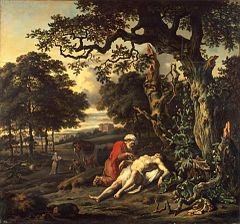 Many of us instinctively think that knowing is something we have in our heads, something we can recite, like a catechism. This is the sort of knowing that the lawyer demonstrates when he recites, correctly, the two great commandments when Jesus encourages him to answer his own question as to what he must do to inherit eternal life. (Lk. 10: 27) But then the lawyer shows a certain ignorance, a missing piece. He doesn’t know who or what his neighbor is. Jesus answers this question by telling a story that pinpoints exactly the missing piece in the lawyer’s cognition.
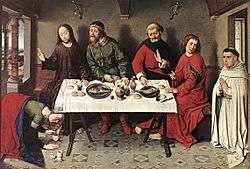 We have a tendency to think of salvation as a personal matter. To some extent it is, but the way salvation is presented in scripture, it is never personal in an individualistic sense. In the case of the famous story of “The Sinful Woman,” we easily focus on the woman whose dramatic action is enough to grab our attention. However, her act is a public drama. Moreover, in very few words, Luke paints the social context of the woman’s behavior. She is a “sinful woman.” We are not told the nature of her sinfulness, so that is not relevant to what we should learn from the story. Simon, Jesus’ host at the dinner, assumes that Jesus should have known that the woman was a sinner and he should not have allowed her to anoint and dry his feet with her hair, actions that further proved the woman’s sinfulness in Simon’s mind. Simon may have been expecting Jesus to have supernatural discernment, but he may have simply expected Jesus to know who had a bad reputation and who didn’t. In any case, it is a social judgment that has labeled this woman as sinful. That is, this woman shows all the signs of being the community scapegoat who helps everybody else feel good about themselves.
 Jesus’ prayer in the garden of Gethsemane may well have been the loneliest moment of all for Jesus. His disciples were not able to stay awake with him. Much worse, his disciples still seem not to have understood anything of what Jesus had tried to teach them. At what he knew would be his last meal with his disciples, a meal when he had poured himself into the bread and wine to give his life to his disciples and all others who would follow him, his disciples fought yet again about who was the greatest. (Lk. 22:24–26) As he had done many times before, he told his disciples that the one who would be first would be the one who served, but he must have realized his words had had the same effect as before.
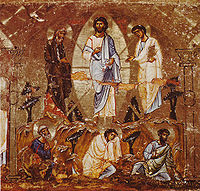 We celebrate the Transfiguration of Jesus at the end of Epiphany to prepare ourselves for Lent. This is a joyous feast where the Light of Mount Tabor should inspire us for the days of penance and then entering into the Paschal Mystery of Christ. However, there is a discordant element in the reading from St. Paul that I want to focus on. He, too, writes of the inspiring light of the Transfiguration, but he also writes about the veil over Moses’ face. This refers to the story in Exodus where Moses put a veil over his face when he came down from Mount Sinai with the tablets of the Law because his face shone too brightly for his fellow Israelites to look upon. (Ex. 34: 29–34) Paul goes on to say that the Jews remain veiled when they hear the words of the Law. In light of Holocaust, this verse causes much uneasiness, all the more so as it has been used to justify anti-Semitic attitudes and behaviors.



 Imaginary Visions of True Peace