God’s Eternal Choice

During the Christmas season, we celebrate the Incarnation: the mystery of God becoming a human being. For such a thing to happen, there must be an intersection of time and Eternity. Understanding time is easy, Or is it? I think we can all sympathize with St. Augustine of Hippo when he said he understood time until you asked him to explain it. Maybe we can’t explain time but it has familiarity in that we live in it the way a fish lives in the water. Eternity is something else. We don’t live in it and we really can’t conceive of living in it. We might be tempted to say that Eternity is the opposite of time, but that isn’t right. My theology professor said that Eternity has nothing to do with time. That means Eternity can’t even be the opposite of time as that would be to relate the two and that is what can’t be done. We could say that Eternity is for God and time is for us and leave it at that. But once Jesus was born, time is for God as well as for us. Does this mean that Eternity will be for us some day? But if Eternity should be a future possibility, it would be connected with time after all. Does that mean Eternity won’t be Eternity any more? Maybe we just haven’t begun to grasp what Eternity is all about.

God’s being eternal is one of the reasons that God is usually thought to be unchanging and unchangeable. But to consider the notion of God changing, or not changing, relates God to time yet again. More to the point, there is the Biblical record of God’s interacting with time bound creatures such as we. So whatever it might mean for God to be unchanging, it doesn’t mean that God is some cosmic blob that never does anything. The first chapter of Ephesians offers us a powerful vision of what an unchanging but dynamic God is like. The “God and father of our Lord Jesus Christ” has “blessed us in Christ with every spiritual blessing in the heavenly places.” (Eph. 1: 3) Moreover, we have been chosen “before the foundation of the world” and destined for adoption as God’s children “according to the good pleasure of his will.” (Eph. 1: 4-5) A God who blesses and chooses us from the foundation of the world is infinitely active rather than infinitely motionless. But Paul is also telling us that this will of blessing and choosing is constant. It may be active, infinitely active, but it is steady, unchanging.

We have a powerful example of the effect of God’s active, steady blessing and choosing in the 31st chapter of Jeremiah. Israel’s experience in time has been nothing short of catastrophic. Babylon invaded Jerusalem, destroyed the temple, and deported the more important people to Babylon, leaving Jerusalem in ruins. Jeremiah himself proclaimed Yahweh’s presence in the midst of this disaster because of the sins and apostasy of the people. But in the 31st chapter, Jeremiah is prophesying the return from the Babylonian exile: “See, I am going to bring them from the land of the north, and gather them from the farthest parts of the earth, among them the blind and the lame, those with child and those in labor, together; a great company, they shall return here.” (Jer. 31: 8) With God interacting in time, a great new thing is about to happen, but what, in time, is great and new, and unheard of, is a result of a steady act of blessing and choosing on the part of God. This steady and unchanging will shows itself both in bringing Israel to repentance and restoring Israel to its homeland.

On Christmas Day, we celebrated the birth of Jesus. The Logos who was with God in the beginning, became a human baby as vulnerable as any other baby. (Jn. 1: 1) On this second Sunday after Christmas, we see Jesus at the age of twelve, talking with the elders in the temple and asking them questions. That is, we are seeing a child asking questions about life and seeking answers as children are apt to do as soon as they are old enough to think about such things. This brings us into the paradox of an unchanging God developing in time as a human being. That God would do such a thing tells us that for us, living in time as we do, developing over time by asking questions is a good thing to do. We are also alerted to the significance, in the context of Eternity, of every little thing we do now in time. Here, we are at the beginning of Jesus’ life, but over the next few months, we’ll follow him to the end and beyond. Indeed, Paul says that it is through Jesus Christ that we are adopted as God’s children in God’s unwavering will and choice. That is, Paul is presupposing both the Cross and the Resurrection when he proclaims the destiny chosen for us by God. It is good for us that God’s will is not changeable, but what about us who are changeable? Insofar as our will isn’t so good, it is a good thing that it is changeable with a chance of a change for the better. This is what Israel needed when the consequences of their apostasy brought about the Babylonian Exile. Asking questions and listening to the answers as Jesus did can help bring us to abiding in God’s will that will not change in relation to any one of us or in relation with anybody else.

See also As Jesus Grew

Brought Near by the Blood of Christ

In the second chapter of Ephesians, Paul presents a powerful vision of human unity and reconciliation: a household of God with Jesus the cornerstone. What beautiful words for sore ears, ears sore from the discord and violence breaking out in the world even as we celebrate the Holy Mysteries of the altar. This fact of discord and violence makes it clear that we have not reached this vision. Moreover, there is more than a hint of violence in the fact that the reconciliation has been brought by the blood of Christ. (Eph. 2: 13) The blood of Christ is often skimmed over as a formula to set up something more pleasant, but it refers to a death by torture on a cross of a man who spent a life trying to offer healing and reconciliation.

The French thinker René Girard suggested that from the dawn of history, human society has had a tendency to resolve social tensions through focusing on one person who is blamed for the social tensions. When the person is put to death, things are more peaceful—for a time. The root problem, the entanglement of human desires that leads to violence when it is believed that the objects of desire cannot be shared, does not change, so the cycle starts all over again until, once again, the shared desire reaches concord through focusing the blame on one person, or a group of persons. Girard called it “unanimity minus one.”

This is precisely the story that the Gospels tell: the story of a society ripped apart by many tensions until, suddenly, miraculously, all of the parties that are at each others’ throats suddenly come to an agreement that Jesus must die. But the Gospels proclaim this victim to be innocent, not the one who tore society apart, but the one who tried to bring reconciliation. Indeed, the tensions in Jesus’ time were not resolved with the result that Jerusalem was destroyed in A.D. 70. That this was so was not by chance. The cycle of collective violence only “worked” because the truth was covered up and denied. The Gospels blew the cover, making sure that it will never “work” again, no matter how hard we try.

And yet Paul proclaims a cosmic reconciliation as a result of this violent death. Why? Because Jesus was raised from the dead as the forgiving victim. Paul himself experienced Christ’s forgiveness in a powerful way on the road to Damascus. Jesus did not just preach about forgiving one’s enemies; Jesus practiced it as the risen victim. In so doing, Jesus inaugurated what Paul calls a new creation, a new humanity, a chance for humanity to start over and get it right this time. But when we look at the discord and violence, it is clear we haven’t gotten it right yet. There is some good news inspired by the Good News that is the Gospel, however, namely the massive amounts of charitable work done around the globe to build up dignity for people who are ground down by the discord and violence.

In Mark, we see Jesus having compassion on the people “because they were like sheep without a shepherd.” (Mk. 6: 34) Jeremiah castigated the shepherds who destroy and scatter the sheep. (Jer. 23: 1) When there is no shepherding or bad shepherding, humanity falls into the cycle of violence that resolves on a victim, the scapegoat. Jeremiah conveyed God’s promise of real shepherds who will care for them. (Jer. 23: 4) Paul insists that Christ is this shepherd, but not a shepherd who nags and scolds but one who shepherds through forgiveness. As the Gentiles and Jews had united in putting Christ to death, Paul says that Christ unites Jews and Gentiles through forgiveness as the risen victim. So Jesus has reconciled Jew and Gentile “to God in one body through the cross, thus putting to death that hostility through it.” (Eph. 2: 16)

Throughout his preaching, Paul proclaimed this reconciliation of Jew and Gentile, hoping and believing it could happen soon and be the consummation of creation. Yet, that did not happen. Jewish persecution of Christians embittered the early church and anti-Jewish attitudes wrecked havoc on the Church, culminating in the Nazi Holocaust.

Although Gentile-Jewish relations continues to be a burning issue, in the U.S., relations between white and black people is front and center. Black people have been victimized beginning with the slave trade, but it is important to realize that committing such atrocities destroys the humanity of those of us who perpetrate it just as the persecution of Jews destroyed not only Jews but persecutors. Julia Robinson Moore, a black historian and theologian who uses Girard’s thought, has found evidence that the enslavement and suppression of blacks correlates with increased tensions between white people. So it is that blacks become collective victims of social problems among whites. As the Afro-American theologian James Cone said, Jesus is most present on the lynching tree.

In many ways it is frustrating to have Paul’s great vision of reconciliation when the reality of the present time hits us in the face. But it is important to be profoundly grateful for the vision. Proclaiming peace to those who are far off and those who are near is a guiding star, a way for us to be oriented. This vision gives us something to aim for, to hope for. Among other things, this vision gives us a means to test the shepherds who would lead us. Who is more apt to gather and build up? Who is more apt to scatter and destroy? Jesus became such a shepherd by getting all the people to sit together and eat together with what seemed very few loaves of bread and fishes. Such a vision challenges us to want it, really want it. Since this vision means that all of us will be changed, even changed radically, it can be frightening enough for us to hold back. All the more reason to pray to want to want this vision of reconciliation.

This vision can also point to both big and small ways to live it out. Julia Robinson Moore leads a reclamation project for the graves of enslaved persons. She takes students on field trips to spruce up the slave graveyards and she bring the descendants of slaves and enslavers together when they are ready for that move, giving all a chance to affirm the full humanity of the other and to seek mutual healing.

For an introduction to the thought of René Girard see: Living Stones in the House of the Forgiving Victim and Living Together with our Shared Desires.

Where Are You Planted?

The last time I preached, Jesus announced the Jubilee of God. I suggested that we will likely find the rest of the Gospel filling out what such a Jubilee entails. If that is so, the blessings and woes at the beginning of the Sermon on the Plain (Lk. 6: 20–26) seem to be an odd way to have a jubilee. Usually we think that being rich and being well fed at meals filled with laughter and receiving lots of compliments is precisely how to have a jubilee. On the other hand, being poor and hungry while weeping and being reviled are all downers, but Jesus seems to suggest that these downers are what the jubilee is all about. As for Jesus himself, after he announced the Jubilee, he was spoken well of for about a minute and then it all tanked and he was driven out of the synagogue. So Jesus was already practicing his jubilee in terms of the Sermon on the Plain from the start of his ministry.

Obviously we need all the help we can get for understanding these troubling and puzzling words, so let’s see what we can glean from the first two readings. Jeremiah also talks about blessings and curses. Does he mean that God curses people God doesn’t like? The people that Jeremiah says are cursed “trust in mere mortals and make mere flesh their strength.” (Jer. 17: 5) Sounds like these people are cursing themselves by rejecting God. The contrast of a tree planted by the water and a tree planted in salt land suggest that blessings and curses are simply natural outcomes of being grounded in God or not being so grounded. Jesus, then, picking up on Jeremiah, would be suggesting that the poor and hungry are grounded in God and the rich and sated aren’t. If that is true, then maybe being rich is overrated and is not such a great cause for jubilee. It is worth noting that the Rich Young Man went away sad because he had many possessions.

The words of St. Paul from the end of his First Epistle to the Corinthians (1 Cor. 15: 12–20) with his anxious defense of the Resurrection suggest the possibility that the reversal takes place in the afterlife. Jesus does hint at that for the reviled and defamed. Maybe a better afterlife can also be some consolation for the poor and starving, but that does not otherwise help us cope with being poor and starving and slandered right now. And Jesus is saying that the poor are blessed now, not just later. The anxiety on Paul’s part is the denial of the resurrection on the part of some supposed followers. What’s the problem? If applying Jeremiah’s words to the Sermon on the Plain leads us to depend on God, we must depend on a living God, not a dead one. Only if Jesus is truly raised from the dead as the apostolic witness avers can Jesus be depended on right now.

So, the big take from Jeremiah and Paul is that we are blessed if we are grounded in God and we are unfortunate if we are not. That much is certainly true and has the advantage of being a pretty big loophole where there didn’t seem to be one: we don’t have to worry about having some economic resources and being well-fed as long as we are grounded in God. But maybe this loophole threatens to be a trap. Surely Jesus is warning us that the more we have, the less likely we are to depend on God.

At this point. I get the feeling I’m fretting that if I have one penny too many, I lose my blessing and become unfortunate. Same if I take one bite of food too many, laugh too much or get one compliment past my quota. There is no end to this spiral unless I stop and turn around. After all, these thoughts are all centered on self. There is no jubilee in such fretting and there is no depending on God either. But what if we think more about other people having something to eat and something to laugh about? What if we stop reviling other people and build them up by letting them know we appreciate them? Doesn’t this start to look a little more like the Jubilee announced by Jesus? If we take this approach, we start to see how we hinder these things and how our social system hinders them. This gives us cause to weep, but if weeping leads to making these things better, then we have turned tears into laughter. But the deeper mystery remains. Sometimes we don’t see the silver lining of being poor and starving, crying and being reviled and these things often happen as a result of doing the things listed above. Jesus is encouraging us by promising that the silver lining we cannot see is really there in the love we pour out for others. He should know, having gone through Gethsemane and the Cross. This is why we are blessed even in such times if we are grounded in the crucified and Risen Christ.

Abolishing Sacrifice to Establish Mercy

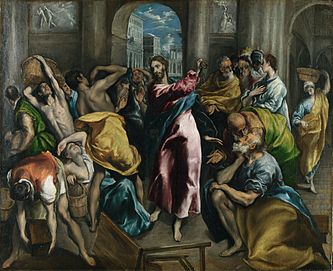
Jesus_cleansing_templeThe story of Jesus knocking over the tables in the temple and driving out the animals shakes us up but then we wonder what we should be all shook up about. Jesus’ act can be seen as the climax of repeated protests of the Hebrew prophets against the sacrificial cult in the temple. Jeremiah mocked his listeners who jabbered: “This is the temple of the Lord! The temple of the Lord! The temple of the Lord!”  (Jer. 7:4). Then there is God’s mocking question from Psalm 50 and repeated elsewhere: “Do you think I eat the meat of bulls and drink the blood of goats?” Amos proclaims God’s hatred of festivals. Most telling are the words of Hosea that Jesus quoted: “I desire steadfast love and not sacrifice, the knowledge of God rather than burnt offerings” (Hosea 6:6.) There is much debate as to whether the prophets wanted the abolition of the sacrificial cult or a reformation that would bring it in line with moral values. In driving out not only the money changers but also the animals about to be sacrificed, I think Jesus is doing a bit of guerrilla theater to prophecy the end of the temple cult, a prophecy fulfilled in 70 A.D. when the combined violence of militant Jew and the imperialistic Romans resulted in its destruction.

When asked to explain his actions, Jesus said: “Destroy this temple and in three days I will raise it up” (John 2:19) This literalist interpretation is promptly debunked by the evangelist when he says that Jesus was “speaking of the temple of his body” (John 2: 21). So much for biblical literalism. The implication that Jesus is replacing the temple with his risen body is a strong indication that he intended to abolish the sacrificial cult. What was wrong with the sacrificial cult? The quote from Psalm 69 “zeal for your house will consume me” shows us the problem if we note the context. Psalm 69 begins with “Save me O God for the waters have risen up to my neck.” The psalmist tells God that he is suffering the same reproach people level against God: “the insults of those who insult you have fallen on me.” This psalm is referred to as one of the “passion psalms” and has been interpreted as a prophecy of Christ. However, I don’t think the psalmist was gazing into a crystal ball and seeing Christ’s Passion; I think the psalmist was complaining about collective violence that was happening to him at the time. The number of persecution psalms and the fate of many prophets, suggests that the Gospels are revealing the human tendency to solve social conflicts by uniting against a victim which is precisely the outcome Jesus predicts when he explains his actions at the temple. T

he prophets consistently denounced the sacrifices made on the “high places,” pagan sacrifices to deities like Moloch who even required the sacrifice of their children. The sacrifice in the temple was more humane in that it was restricted to animals, but the practice derived from the notion that “god” was angry and would be appeased only by sacrifices. The prophets’ denunciations of the temple cult were consistently coupled with denunciations of social violence and injustice where the poor were sold for a pair of sandals as Amos complained. Although it is argued that the prophets thought the temple sacrifices were acceptable, maybe even laudable, if accompanied with righteous actions in the social sphere, but they seem to have a sneaky suspicion that the practice of sacrifice tends to encourage social injustice. The temple setup was, after all, a terrible financial burden on the poor. (I think Jesus was not edified but outraged over the widow who gave the last two coins she had to live on.) The logic of sacrifice was that some living being was always dispensable precisely as the victims of collective violence at the times of social crises were dispensable and their deaths “necessary.” Caiaphas stated the sacrificial logic baldly when he said that it was better “to have one man die for the people than to have the whole nation destroyed” (John 11:50) In modern times this sacrificial logic is expressed by the regretful term “collateral damage.” These considerations suggest that the prophets were convinced that something was fundamentally wrong with sacrificial rites.

Jesus, on the other hand, has a totally different, opposite logic; a logic that Paul says is foolishness to the rest of the world. In John 6, Jesus says that everybody the Father gives him will come to him and nobody who comes to him will be driven away. The parable of the lost sheep makes the same point that it is not the will of our Father in Heaven that even one of his “little ones” should be lost. Jesus believed this so strongly that he would accept death on the cross to make the point and, more important, return as the forgiving victim to gather all who will come to him so that none of us should be lost. The pagan deities wanted sacrifices made to them. The prophets kept trying to get it across to everybody that God pours out sacrificial love to all of us through creation and redemption and that God wants the mercy God gives us in return, not sacrifices .  Caiaphas was willing to sacrifice Jesus and anyone else who put a spoke in the wheel of the sacrificial logic. Jesus was willing to sacrifice himself rather than sacrifice any of us. That is why we do not slaughter bulls on this altar but pass around the bread and wine through which Jesus gives His very self to each one of us.