The glory of Sheer Silence

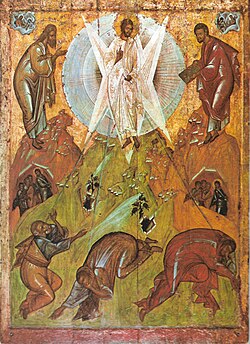
The story of the Transfiguration of Jesus on Mount Tabor is as disorienting as it is blinding. It was also disorienting and blinding for the three apostles Jesus had taken up with him. Obviously, Peter didn’t know what to say, so we shouldn’t feel bad if we don’t know what to say, either.

One of the more fascinating and powerful reflections on this story is at the heart of the theology of the 14th century Greek theologian St. Gregory Palamas. He suggested that the light of Tabor was the working of the uncreated energies of God. This energetic light, the Light of Tabor, embodies God’s self-giving to us, a giving of Godself, that is deification. Not human self-deification, but deification as a gift from God who gives us everything that God has. This concept hasn’t gained much traction in Western Christianity, partly because it doesn’t compute well with many forms of Western theology. However, for those who find traditional Western theology problematic, the Palamite notion is perhaps an attractive alternative. For what it’s worth, I think the clash between Western and Palamite notions explodes into a powerful mystery which is deeper than one set of concepts alone.

There is much more to the radiance than blinding brilliance. The Hebrew word kabod, also means glory in the sense of honor. This is also true of the Greek word doxa that translates the Hebrew. When we glorify a human being for great accomplishments, there is a sort of radiance we put around them. Saints are often painted with a nimbus when portrayed in art. However, there is a tension at the root of glorification. It almost always seems to be accompanied by derision and dishonor. In fact, the Greek word doxa means dishonor as much as it means honor. The people we honor by putting on a pedestal are knocked over in a heartbeat if they don’t meet our expectations. Artists like Igor Stravinsky and Bob Dylan have both been greatly honored, but both were denigrated when they changed their artistic visions away from projected expectations. This is what happens when fans make idols of the people they adore; they create little boxes to put them in.

What about Jesus? Jesus had received much glory and honor from his numerous followers, not least the three disciples who Jesus took up the mountain with him. But the more some praised Jesus, the more energetically others denounced him. In all three synoptic Gospels, the Transfiguration marks a turning point where Jesus heads towards Jerusalem where he will be denounced, mocked, and crucified. The honor given Jesus turns to dishonor. What about the disciples who experienced the Transfiguration? When Jesus told them what was coming, they resisted Jesus’ resolve and argued among each other as to who was the greatest. I can’t help but suspect that they were basking in the derived honor given Jesus up to that point and, rather than receiving glory from God, wanted to receive glory from the other followers of Jesus. Like modern day fans of celebrities, they were putting Jesus into boxes of their own making, turning Jesus into an idol. The disciples were blinded by their warped understanding of honor at least as much as they were blinded by the brilliance of Jesus’ shining garments.

We can gain more insight into glory by reflecting on the presence of Moses and Elijah with Jesus on the mountain. They were the two most glorified figures in Jewish history. Moses, by receiving the Law on Mount Sinai from God himself shone with the reflection of God ‘s light to the extent that he had to wear a veil. Elijah was the greatest of prophets. Both, however, also experienced dishonor. Several times the people threatened to stone Moses, and Elijah was a fugitive from royal power. Both were implicated in violence, especially Elijah in his contest with the prophets of Baal. They were in the position to know well what was going to happen to Jesus. Moses’ best moments, when he was most Christlike, was when he was interceding for the people to turn God’s wrath from them, even when the same people were directing wrath at him. Elijah, alone in a cave, heard God in the sheer silence of the wilderness. As for Jesus’ disciples, the Book of Acts shows them breaking out of the idolatrous boxes they had made and acting like their Master in self-giving, preaching, and healing, the divine energies clearly working through them.

There is reason to believe that the Transfiguration of Jesus was, at least in part, to prepare the disciples for the suffering Jesus would have to endure, and that they, too, would have to endure. At a deeper level, they were being prepared for the challenges of the Resurrection Life of Jesus that would energize them when the time came. As we prepare for Lent, perhaps we can make it our Lenten project to let the light of the transfigured Christ reveal our own warped notions of honor and dishonor so that the divine energies championed by Gregory Palamas can energize prayer on behalf of other people, especially those who dishonor God, a prayer enveloped in sheer silence.

Giving Everything and More

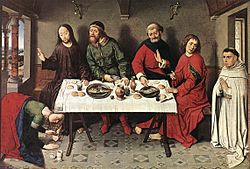
The meal at Bethany served by Martha seems to be an ordinary meal but in reality it is extraordinary. To begin with, John explicitly says that it is six days before Passover. This puts the meal in the context of the most solemn festival of the Jewish year. For another thing, Lazarus, the man Jesus raised from the dead, is present. The imminent offering of the paschal lamb and resurrection are both brought together. Even more extraordinary is the extravagant anointing of Jesus’ feet with precious perfume by Mary, the sister of Lazarus and Martha. Jesus interprets Mary’s action as a preparation for his burial, which he seems to expect is imminent, thus tying his death with the both the Passover and Resurrection. Judas’s protest over this “waste” shows that the hostility against Jesus has reached the inner circle of his disciples.

All four Gospels have a story of a woman who pours expensive ointment or perfume over Jesus, but the differences are striking. Matthew and Mark are very close parallels. Just before the Passover and Jesus’ Passion, an unnamed woman enters the house of Simon the Leper, who lives in Bethany, pours the ointment and dries Jesus’ feet with her hair. The disciples as a group protest the “waste.” This is much the same story as in John except the host is different. (Mt. 26: 6–13), Mk. 14: 3–9) Luke tells the same story except that it is placed much earlier in his Gospel and is not connected to the Passover and the Passion. (Lk. 7: 36–50) That the anonymous woman is called “a sinner” adds a sharp edge to the story. The host is Simon and he is identified as a Pharisee. He grumbles that Jesus should have known the woman was a sinner and elicits a famous parable on sin and repentance. The woman in Matthew and Mark, like the sinful woman in Luke, is so froward with Jesus that she too is considered a loose women if not a sinner. Mary of Bethany in John is more respectable and is a hostess rather than an intruder, which gives the story a very different feel from the other three, but this respectability makes the gesture all the more shocking. Respectable women don’t act this way.

It is intellectually interesting to piece together the symbolism in John and the relationships between the four versions of the story. If we let all of this seep deeply into us, it can be quite spiritually stimulating. But what really connects the women in all four versions is the extravagance of the woman which is warmly commended by Jesus. Even if we are shocked by these women (or woman), we should be even more shocked at ourselves over how little we care about Jesus. Are we like Simon the Pharisee who invited Jesus to his table but showed no affection? Are we like the apostles who complained about the waste? To this day, we tend to look down on this woman, thinking the worst of her, when Jesus would have us look up to her as an example of apostolic zeal. It is worth noting that in Luke Mary of Bethany is the one who sits at the feet of Jesus listening to this teaching while Martha (as in John) serves the meal. Here, Mary of Bethany shows her ardor but in a more contemplative way.

Isaiah proclaims God’s promise to “give water in the wilderness, rivers in the desert.” In this generosity, God is pouring Godself out as extravagantly as the women with the ointments, and surely God does need see this extravagance as“wasteful.” (Is. 43: 19–21) When Paul writes to the Philippians that he is pressing on toward the goal for the prize of the heavenly call of God in Christ Jesus,” his words gush out like ointment flowing out of control. (Phil. 3: 12–14) Bob Dylan expresses this gush in his song “Pressing on” which repeats these words over and over with greater and greater intensity that becomes overwhelming.

The women and Paul return the overflowing love of God back to God while the rest of us sit back and grumble at the unseemliness of it all. Do we not realize that the women who let their hair down and gush out their love for Jesus will also gush out that same commitment to Jesus who is present in the poor? Meanwhile, the complaining disciples, and especially Judas, don’t really mean to help the poor or anybody else. More importantly, do we not realize that on the Cross, Jesus’ blood will pour forth as did the ointment poured over him? It isn’t that all of us have to be as emotional as these women and Paul, but we do need to be as deeply committed to Jesus so as approach the deep commitment Jesus shows to us. We should take to heart Leonard Bernstein’s directions to a choir and orchestra: “Give me everything you’ve got, and then a crescendo.”

Stumbling over Living Stones

Cemetary2With the help of a Salvation Army-style trombone, Bob Dylan sings with his wry humor that “they” will stone you for “trying to be so good” or when you’re “tryin’ to go home,” for “walkin’ on the floor,” for “walkin’ out the door,” and even when you are “young and able” or sitting “at the breakfast table.” Given the way his fans turned on him time and again for not singing what they wanted, it’s no surprise that “they” will stone you “when you’re playing your guitar.” Seems like “they” will stone you no matter what you do or don’t do. Then, after stoning you, they “will say you are brave” and then “they’ll stone you when you are set down in your grave.” As if “they” haven’t stoned you enough already. In the refrain, Dylan sings that he “wouldn’t feel so all alone/Everybody must get stoned.” Usually, persecution is “they” (i.e. everybody) against a victim, such as what happened in the stoning of Stephen. But if everybody gets stoned, then everybody is a victim and there’s nobody left to be “they” who will stone you. If we all become Stephen, not only do we get stoned; we “see heaven open and the Son of Man standing at the right hand of God” (Acts 7:56). This was the moment of epiphany for Stephen that transformed him into a forgiving victim like Jesus. In his speech to the Sanhedrin that outraged his listeners, he was not exactly a model of tactful diplomacy.

In his first epistle, Peter identifies Jesus with the living stone rejected by the builders that has become the cornerstone in Psalm 118. Jesus identified himself as this cornerstone at the end of his parable of the evil workers in the vineyard who ganged up on the owner’s son and killed him. (Mt. 21:33-41) Stephen was killed by stones the builders rejected and left outside of Jerusalem when they were building the temple. Jesus was threatened with stoning several times and escaped until his time had come and he gave himself up to the cross. When Jesus says that he is the way, the truth and the life and that nobody can come to the Father except through him (Jn. 14:6), he is saying that the only way to God is by way of the stone that was rejected. Rejected by whom? If we think it is other people who have rejected this living stone, we are probably right but we fail to understand ourselves in this. Moreover, we are rejecting the people we blame for these rejections and so we stumble over them and they stumble over us. Speaking for myself, I don’t like being rejected and I don’t instinctively feel that being rejected is the way to God. I would rather be the keystone in my own scheme of things. So, actually, I reject this living stone all the time and I stumble constantly over my fantasies of being the cornerstone of my own life. Much as I like Bob Dylan, I’d rather leave him all alone rather than get stoned.

But Jesus the living stone is abundantly forgiving and he waits for us to stop stumbling around and come to him. Peter tells us that it turns out Jesus is building “a spiritual house,” “a holy priesthood” out of each one of us and he is building it out the parts of us that we reject, out of our failures, not our successes, which makes our failures our successes. Well, Dylan said “there is no success like failure and failure is no success at all.” Stones can be hard and dead, useful only for stoning people. Our hearts can be just as hard and we stumble on our stony hearts until we come to the living stone who wants to make us living stones. Living stones don’t pick up stones to throw at other people; they pick up stones to build into the spiritual house. In this spiritual house, there are many dwelling places where there is room for us to grow further into the abundant life of Jesus the living stone, enough room that we do not need to stumble over one another and yet a house where we are all together and we don’t have to be so all alone.

Hospitality Initiative

WilliamGuestsChurch1On May 3-4 I will be attending the Hospitality Initiative hosted at Oakland University in Oakland, MI. The convener is Charles Mabee, a scholar who works with the thought of René Girard. This is a multi-faith gathering where papers from a wide variety of spiritual traditions will be represented by the presentation of papers. I will be presenting a brief paper called “Mimetic Hospitality: Guests and Community in the Rule of St. Benedict.” Some of the content overlaps with my blog post Cleaning up our Unclean Acts which introduces some of the thoughts I develop in this paper. You can read my paper here.

Selling Postcards of the Cross

crucifix1“They’re selling postcards of the hanging
They’re painting the passports brown.”

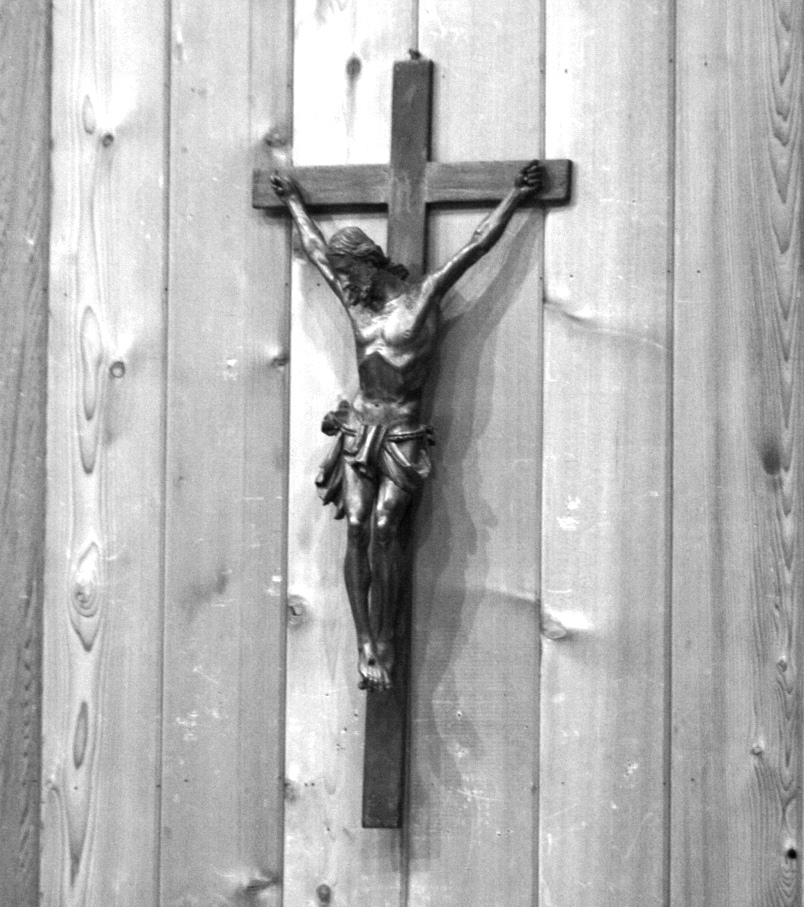
White boys like me mostly didn’t know what Bob Dylan was singing about when “Desolation Row” first came out on “Highway 61 Revisited.” James Cone’s book The Cross and the Lynching Tree tells us it was about lynching. Lynching was a public spectacle where people took pictures and made postcards out of them.

Cone goes on to argue that the lynching tree was a series of grisly re-enactments of the crucifixion of Jesus. He also demonstrates on how very difficult it has been and still is for Americans to see this truth. Reinhold Niebuhr, arguably the greatest American theologian was, in spite of his social concerns, blind to this reality. Even black people have had trouble seeing this connection, though Cone shows how some black women, especially Ida B. Wells articulated it powerfully. He contrasts Niebuhr and all white liberals with Martin Luther King, Jr. who put his life on the line.

The dynamics of lynching as analyzed by Cone provide powerful confirmation of the theory of collective violence of René Girard. (See my article Violence and the Kingdom of God.) Girard argues that perpetrators instinctively fail to see what they are going. Cone shows us this truth in a powerful manner.

Dylan goes on to sing that “the circus is in town” and then catalogs Western Civilization turned topsy-turvy, suggesting that lynching does this, thanks to the “blind commissioner.”

Cone is right about whites’ blindness to this truth, but Dylan did write “The Ballad of Emmett Tell” in 1963, telling the story in stark terms, though without any Christian reference except to complains that the human race has fallen “down so god-awful low.” Then there is Mark Twain who wrote “The United States of Lyncherdom,” calling lynching for what it was and clearly discussing the human mimesis just as Girard was to do half a century later.

Cone’s book is written calmly, even gently. There is no mincing of words, yet the words are somehow full of forgiveness. The forgiveness in Cone’s words, the forgiveness proclaimed by Jesus, should be enough to undermine our trust in ourselves and our ability to see what we are doing. We must repent not only of lynching, but of our collective hatred of enemies today.

Ignominious Glory—Glorious Ignominy: a Doxology

Since when is glory ignominious ? Probably since humans first became concerned about what others thought of them. Seeking glory from others is a sure way to get its opposite as  celebrities know all too well. In the New Testament the Greek word doxa is sometimes translated as “glory,” sometimes with “shame.” How can one word mean two opposite things. James Alison says that is because the word means “reputation.” What kind of reputation? Any kind of reputation.

The Harry Potter books give some interesting examples of the double-edged meaning of doxa. Harry arrives for his first year at Hogwarts as a celebrity, not for anything he had done but because he had survived Voldemort’s attack when his mother gave her life to save him. In his second year at Hogwarts, Harry is blamed by many for an epidemic of people turning into stone although he had done nothing to earn this ignominy than he had done to earn his celebrity status. In the fourth book, when Harry’s name is entered in the competition in a questionable way but through no fault of his own, there is bad feeling towards him from students of all three schools involved. (Spoiler alert!) His defeat of Voldemort has no external fireworks and he ends up with a quietly respectable position in the wizard world without celebrity status.

Bob Dylan has been praised as one of the greatest poets and songwriters of our time but he has also been the object of much ignominy with every turn in his career. He did not receive it for drugs or sex, but for using electric guitars instead of a simple acoustic guitar like a true folk singer. Then he got it for seeming to relax and live an ordinary life, as if living an ordinary life is a scandal! The worse ignominy was for turning to Christ and doing some Gospel albums.

Speaking of Christ, in his Gospel, John plays with both sides of the meaning of doxa in relation to Christ. Jesus seeks doxa from his Father while the people who put him to death or keep their sympathy for him a secret because  they seek doxa from other people. So it is that doxa inevitably falls into sacrificial violence if reputation is sought from people instead of from God. The raising of the cross is Jesus’ doxa. That is why God has such a bad reputation nowadays. Where do we look for our own reputations?