

Baptism: Overwhelmed by Christ’s Love (3)

lakeGray1All of the biblical types of baptism that I have reviewed in the first two posts of this series stress the social nature of this sacrament. In the Paschal Mystery, we die to one way of relating (or misrelating) with people to live to a totally new way of relating to others. The traditional triad of renunciations of the world, the flesh, and the devil confirms this social element of baptism. The three are nearly synonymous but their varying shades of meaning are illuminating.

The New Testament word kosmos (world) has mainly negative connotations, especially in John’s Gospel where it means, not the material world as created by God, but the social world organized in opposition to God. In baptism, then, we renounce organizing ourselves socially around scapegoating and persecution. It is important to remember, though, that it was this very kosmos that God loved so much that God gave his only son so that this kosmos might not perish. As Jesus was overwhelmed by the kosmos in his death, we, too, may be overcome by it if we renounce it.

Flesh does not refer to the material aspect of our existence, but rather to the tendency live our embodied lives without reference to God. When we live in the flesh, our social lives are dominated by mimetic rivalry that consumes us. The contentions that Paul denounced in his first letter to the Corinthians was cited as an example of living by the flesh. If we renounce the flesh, we renounce this contentious way of relating and we allow our embodied lives to be guided by the Holy Spirit in whom there is no rivalry or resentment.

Renouncing the devil does not mean renouncing a wicked supernatural creature with horns and a pitchfork. The New Testament word skandalon refers to no such thing. Rather this word means a stumbling block, an obstacle. When we live according to the flesh, we allow other people to be stumbling blocks to our desires and we do the same to them. That is, our rivals become the organizing principles of our life rather than God. In scripture, the Satan is also the accuser, which is what rivals do. They accuse each other endlessly as opposed to praising God endlessly.

The renunciations as formulated in the 1976 Book of Common Prayer amount to much the same thing. Renouncing “Satan and all the spiritual forces of wickedness that rebel against God” may seem to imply supernatural forces. I do not rule out such angelic beings who, themselves, put themselves into mimetic rivalry with God, but the anthropological level is what is most important to us in renouncing skandalons in this life. The opposition of such stumbling blocks can seem so strong that they seem transcendent but are really an accumulation of human desires out of control. Renouncing “the evil powers of this world which corrupt and destroy the creatures of God” acknowledges the systemic evil of the kosmos which we must renounce and “the sinful desires that draw [us] from the love of God” point to our own responsibility to do what the fourth question asks of us, to “turn to Jesus Christ and accept him as [our] savior” and “put [our] whole trust in his grace and love.”

As noted in my last post, the new beginnings promised by the deliverances from the Flood and from the Red Sea were so daunting that, in both cases, those who were delivered returned to the old way of relating with each other and the same has happened with the Church. Baptism is a once-in-a-lifetime sacrament in the sense of being an initiation, that is a beginning. A beginning is just that; it is not the middle and certainly is not the end. Baptism is a beginning that must be sustained day by day, hour by hour. St. Paul’s admonition to “take off” the old person and “put on” the new person are verbs used for taking clothing on and off. Living by the Spirit in baptism, then, is allowing Christ to clothe us rather than the rivals who are usually the ones who define us. Being renewed in Christ leads us into a quality of life that we don’t easily imagine. These new clothes seem much too big for us and we get lost in them. Can we allow Christ to stretch us to fit into the new clothes of the resurrected life?
See Baptism: Overwhelmed by the Love of Christ (1)

See Baptism: Overwhelmed by the Love of Christ (2)

Baptism: Overwhelmed by Christ’s Love (2)

lakeGray1Two dramatic events from the Hebrew Bible have been interpreted as prefiguring baptism are the Flood and the deliverance at the Red Sea. Both are deliverances from highly dysfunctional societies.

Genesis 6 portrays human society as consumed with violence. No wonder if everybody was like Lamech and inflicting seventy-seven-fold vengeance on anybody whom he thought had wronged him. In his second epistle, believed by many scholars to be a baptismal homily, Peter says that the deliverance of Noah and his family corresponds to baptism which saves us now through the Resurrection of Jesus Christ. (1 Pet. 3:21) René Girard has suggested that a flood is an apt image for a society overwhelmed with retaliatory violence. In such a scenario, a man who tried not to be a part of this violence would be an obvious choice of a victim to unite the fragmented society. The Christological interpretation in Peter’s epistle suggests by being baptized into Christ’s death, we are brought out of society consumed with violence and given the chance to begin life anew, the chance that Noah and his family had after the flood waters receded. It is worth noting that when referring to Jesus descending into hell (Sheol), Peter does not say Jesus just brought out righteous people like Abraham but that he preached to the very people who had brought humankind to the boiling point while Noah was building his ark.

St. Paul says that we all “passed through the sea and all were baptized into Moses in the cloud and the sea.” (1 Cor. 10:2) Once again we have an overwhelming flood. Moreover, we have a story of a people delivered from a violent and oppressive society. In his book Jesus: the forgiving Victim, James Alison suggests that the Jews were expelled after being blamed for the plagues scourging the country. If the Jews were expelled, why would the Egyptians runs after them to bring them back? Perhaps they realized they would implode without the victims who were deemed responsible for their turmoil. This is what seems to have happened with the Gerasenes when their demoniac was cured by Jesus. One could take the tug-of-war between Moses and Pharaoh as indicating this same tension. (See Dispossessing a Town Possessed) Being overwhelmed by the waters is, again, an apt image of a society succumbing to its own violence once the scapegoats are gone.

Unfortunately, neither new chance at a new life went well. Noah’s drunkenness and rivalry among the brothers that made Ham a scapegoat set humanity on a course where the curse laid on him was used to justify slavery and lynching. The people delivered at the Red Sea suffered from chronic social unrest, leading to Moses raising the bronze serpent in the desert to stop the plague of violence. Likewise, the church continues to fall back into the same rivalry and persecution. Most lynchers, unfortunately, were Christians. A tendency to see baptism as deliverance from personal sin surely reinforces such backsliding. Baptism is not a magical deliverance from personal sin but is a constant invitation to be reborn into the new social life of God’s kingdom centered on the forgiving victim who, like the bronze serpent, was raised up to draw all people to himself.

Baptism: Overwhelmed by Christ’s Love (3)

Baptism: Overwhelmed by Christ’s Love (1)

Baptism: Overwhelmed by Christ’s Love (1)

lakeGray1“We were buried therefore with him [Jesus] by baptism into death, so that as Christ was raised from the dead by the glory of the Father, we too might walk in newness of life.”  Rom. 6:4

If baptism is our initiation into Christ, our entry into the Paschal Mystery, then baptism is the underlying, ongoing dynamic of our lives in Christ. Dying and rising with Christ is something we need to do every day. The Greek word baptismo means to be overwhelmed, inundated. In baptism we are overwhelmed by and inundated with the Paschal Mystery. I will explore this mystery by looking at a few key scripture passages that give us variations on this one theme.

Jesus himself was baptized in the River Jordan by John the Baptist. For John, it was a baptism of repentance from the violent society of his time, to prepare for God’s winnowing fork in “the wrath to come.” But when Jesus comes, he does not bring a winnowing fork; he only brings himself and asks to be baptized. As he is baptized, the heavens open, the Spirit descends, and a voice from heaven says “This is my beloved Son with whom I am well pleased.”

These words refer to two key verses in the Hebrew Bible that tell us what baptism is all about. These words ring out in Psalm 2, addressed to the king, the Messiah, who is being singled out from the nations that are raging together and rising up against the Lord and his anointed. The inundation of baptism draws Jesus out of the inundation of the nations raging with each other. In Jesus, we too are drawn out of this inundation in the sense of being freed from raging against everybody else. We are not freed from being the target of these raging nations when they unite against the one who has been freed from their wrath. These same words also refer to Isaiah 42:1, the first line of the first song of the Servant of Yahweh. Throughout these songs, we find that the servant has been called out of a violent society and becomes the victim of that society’s violence. Unlike the psalmist who threatens the raging nations with a rod of iron, the Servant does not retaliate in any way against the violence inflicted on him. In baptism, we too are overwhelmed by the Servant’s suffering but then we are overwhelmed by the Servant’s vindication by God.

John’s Gospel does not narrate the baptism of Jesus but, as in so many other instances, John shows us the underlying story in a different key. When Nicodemus approaches Jesus by night, Jesus tells him that one cannot see the kingdom of God without being “born anew,” born “from above” by water and the Holy Spirit. Jesus seems only to compound Nicodemus’ puzzlement (and ours!) by suddenly shifting to Moses raising the bronze serpent in the wilderness. However, the bronze serpent was raised during a social crisis in the form of a plague. (Both the disease and the violence against Moses were contagious.) The phrase “lifted up” refers to Jesus being raised on the cross and then being raised from the dead. The bronze serpent, then, becomes an image of Jesus being raised on the cross to draw all people out of the society overwhelmed by violence into a new society as free of the violence as Jesus is himself.

This is the context of the famous words that follow: “For God so loved the world that he gave his only Son, that whoever believes in him should not perish but have eternal life.” If God so loves the world, then God is not bringing a winnowing fork or a rod of iron, but is bringing only himself, wounds from the cross and all, to lift all of us out of the world’s overwhelming violence to overwhelm us with his love.

See Part 2

Rising to the Life of Christ

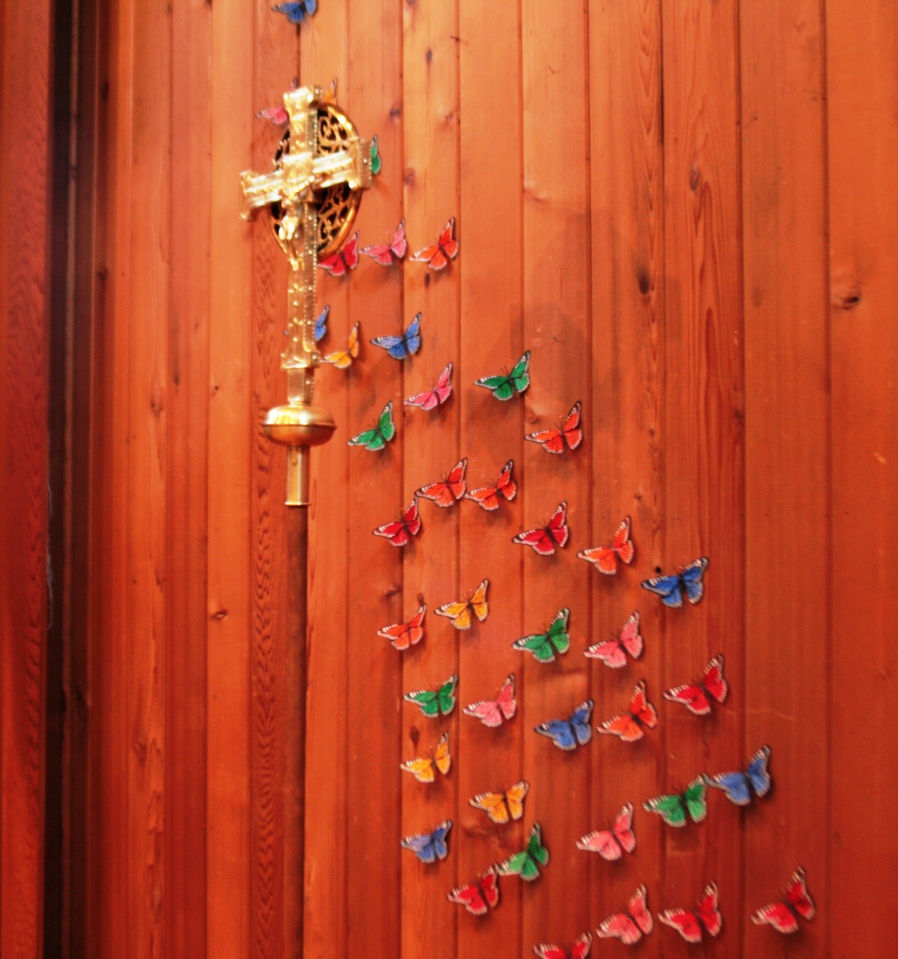
crosswButterfliesWhen St. Paul says in Romans that we are baptized into Jesus’ death, what kind of death are we baptized into? An aged person drifting off while asleep? A ritual death with no consequences? No, we are baptized into the death of Jesus. This particular death, the one we are baptized into, is a judicial death resulting from collective violence. This is the shameful death of an alleged insurrectionist at the hands of an Empire. This death was caused by the meltdown of rivalry in the society of first century Jerusalem, exacerbated by the betrayal and cowardice of Jesus’ closest followers.

Once we know what death we are baptized into, we know what life we are raised to. In his risen life, Jesus showed no resentment or vengeance to those who had gathered to put him to death or had dispersed out of cowardice.  Moreover, Jesus was not entangled in any of the rivalrous feuds that are a way of life for most humans. Imagine living without all the entanglements and resentments swirling around and inside of us. Hard to do, isn’t it? That is how radically different the risen life is from the life we live now.

If our “old self” is crucified with Jesus, then we have, like Jesus, died in the place of the victim. That means we have died to our tendency to fuel resentments and resolve these resentments through gathering against the victim, as Paul himself repented of having held the clothes of the men who stoned Stephen and openly approving of what they did.

None of this means that repenting of personal sins and faults doesn’t matter and that becoming free of them is part of the resurrected life. However, Christian teaching has a strong tendency to stress personal renewal to such an extent that horrifyingly sick participation in collective persecution goes unnoticed. That hundreds of thousands of Christians could lynch thousands of black people shows us now, now that the lynching era is over, how easily this sort of group contagion can take over in what is often called an “enlightened” and “civilized” era.

Rather than congratulating ourselves on giving up lynching after roughly a hundred years of the sport, I suggest we take careful note of the growing polarization in our country over social and religious issues. Honest disagreement is not a problem; it’s a good thing, something that keeps us honest. But polarization tends to be conflict for the sake of conflict so that conflict feeds itself and it feeds each one of us. Never mind that polarized conflict is as nourishing to humans as sawdust and glue. What is really dangerous about this polarization is that it easily collapses into collective violence as a way of resolving the tensions.

If we wish to be serious about living the risen life with Christ, we must be baptized by the love and forgiveness of the risen Christ and allow him to gently but firmly remove all the resentments we feed on so as to feed on body and blood of the Lamb of God who reaches out to everybody with vulnerable love.

Can you imagine such a thing? Can you be overwhelmed by such a thing in baptism?