
The Prodigal Father and His Sons

???????????????????????????????????????????

The famous parable traditionally known as the Parable of the Prodigal Son (Lk. 15:11–32) is the quintessential illustration of pre-emptory forgiveness, one that closes the case on Jesus’ teaching on vengeance and forgiveness. This parable is better called “The Parable of the Prodigal Father and His Two Sons.” The opening of the parable draws a triangle: “There was a man who had two sons.” We expect tension out of a triangle, and we get it right off the bat when the younger son asks for his share of the property. The father accedes to his son’s request (demand?) and the younger son goes off with the proceeds. The elder son stays at home with his share of the property, at least geographically. What kind of father would be so foolish? Why would a young man leave a father who would give him whatever he wanted? Was it to get away from his brother? The stories about paired brothers in Genesis predispose us to suspect that the two brothers are mirror images of each other.

The parable goes on to say that the younger son “squandered his property.” Literally, he “scattered his substance.” That is, the younger son, while trying to forge an individual selfhood separate from his father and brother, completely loses himself in dissolute living. Geographical distance has not freed him from continuing to be a mirror image of his older brother. Then comes a famine and the social crisis that comes with it. Chances are that the scarcity was magnified by created scarcity. In such a social crisis, there must be a victim. A foreigner is particularly vulnerable to being a victim in such a crisis. The younger son fit the bill perfectly. He was deserted by everybody, in spite of all the money he spent on his women and carousing friends. Nobody was willing to take him in. He ended up as a servant who feeds the pigs (an unclean animal for Jews) and “no one gave him anything.” In this desperate situation, the younger son recalled how well-fed his father’s servants were, and he “came to himself.” Perhaps it was embarrassment that made him want to return as a servant, but perhaps he also didn’t want to re-enter the triangle with his father and brother.

The father’s ecstatic reception of the lost son and subsequent celebration blows apart the family triangle, leaving no room for mimetic strife. In contrast to the mimetic process that organizes society around a dispensable victim, the indispensable victim who is no longer lost has been found. The elder son, however, wanted to preserve the old triangle. His sour attitude suggests that he still needs to have his younger brother live irresponsibly. The elder brother’s universe would collapse if his younger brother began to play a responsible role in family affairs. No wonder the younger son ran away from a brother like that!

When the older brother keeps his distance, the father runs out to him with the same solicitude he showed the returning younger son. The elder son’s disingenuous accusation of not being allowed to celebrate is shown up for what it is. Apparently, the elder son never thought to celebrate with his friends until his father threw a party for that son of his. What the elder son has done is put himself into competition with his younger brother, when there is no need for competition. This sort of mimetic rivalry creates a stumbling block in the way of forgiveness. It remains to be seen whether or not the younger brother will forgive the elder for his unforgiving attitude.

We are likely to judge the younger brother for his callous irresponsibility and the elder brother for his amazing insensitivity. But if we do that, we find ourselves ensnared in the mimetic struggle between the two brothers, comparing them and taking sides until our own capacity for love is obscured and our capacity for celebration fizzles. The Prodigal Father does neither. He does not upbraid the younger son for leaving; neither does he upbraid his elder son for being such an insufferable prig. He only invites both of them to the party. Most of us have a hard time even wanting to be a father like that!

The parable ends with this challenge of forgiveness and unconditional love: Do we rise to the challenge of the Prodigal Father and renounce our irresponsibility and self-righteousness?
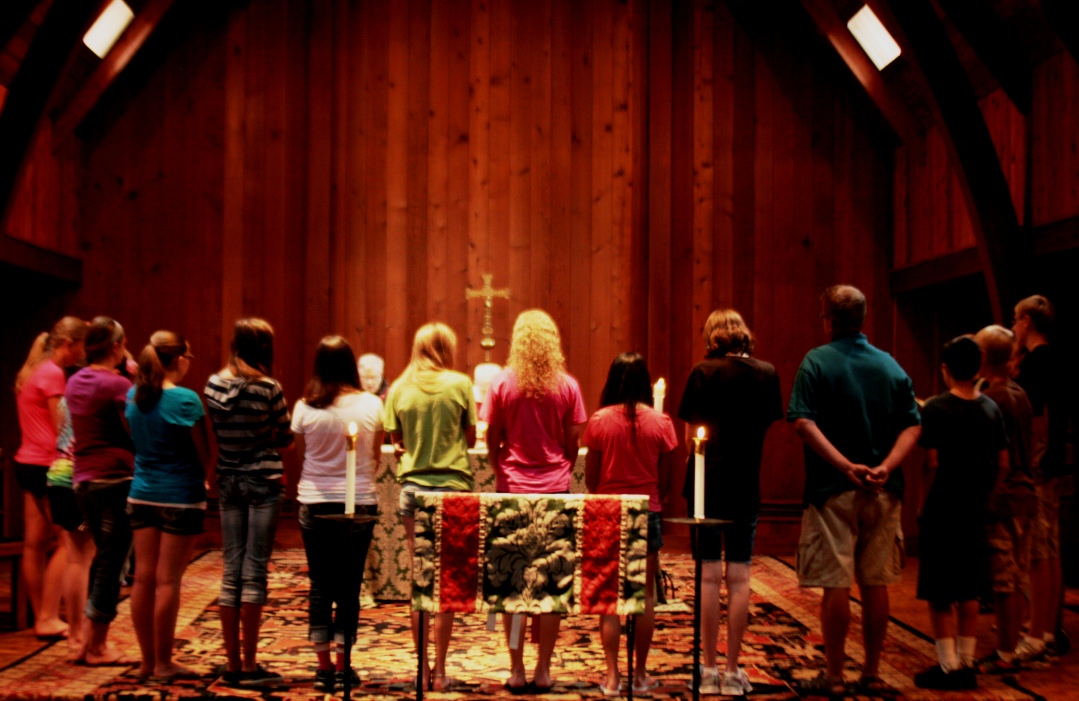
Gathering to Give Life to Victims

eucharist1Since the dawn of humanity, humans have gathered most quickly and powerfully around a victim. (See Two Ways of Gathering and Violence and the Kingdom of God.) Just think of how quickly we gravitate around whoever is currently seen to be to blame for whatever is going wrong in the world today. This gathering, however, is always at the expense of at least one person or group of people. A similar and yet very different gathering around a victim occurred when the eleven disciples saw the risen Jesus in Galilee and “worshiped him.” (Mt. 28:17) The huge, even infinite difference in this gathering is that the victim is alive and is gathering people around victims, “the least of those who are members of [his] family.” (Mt. 25:40) Ever since, Christians have gathered in worship around Jesus and his fellow victims, primarily in the Divine Office and the Eucharist.

The Divine Office is structured prayer that is uses the Psalter and other biblical canticles as the primary vehicle of prayer. Much can be said of the psalms but the thing that jumps out at anyone who prays them with any frequency is the many outcries of victims. “They surrounded me like bees; they blazed like a fire of thorns; in the name of the Lord I cut them off!  I was pushed hard, so that I was falling, but the Lord helped me.” (Ps. 118: 11-13) Verses such as these raise the question of whether we gather “like bees” around another person, or if we are entering the circle of bees in solidarity with the victim. Being a victim tempts us to anger, bitterness and violence. “Cutting off” our assailants in “the name of the Lord” is the reflex reaction, but is the opposite of what Jesus himself did in the same position. These rough verses help us renew our awareness of our own violent reactions to being victimized, even (especially!) petty matters such as being slighted by another. If we focus on Jesus when we are in the place of the victim, we find that the Lord has made the rejected stone the “chief cornerstone” that is “marvelous in our eyes.”

In the Eucharist, we gather around an altar which has been transformed into a table where, instead of laying out a sacrificial victim for slaughter, we place a piece of bread and a cup of wine to share among those present. We do this in memory of Jesus’ Last Supper, suffering, death, and Resurrection. The Greek word anamnesis does not mean a mere memory but to make present. That is, we enter the place of the victim with Jesus when we gather around the table. In so gathering, we feed on Jesus’ forgiveness of us for our own victimization are our challenged by this forgiveness to give this same life to others, both in terms of physical needs and emotional and spiritual sustenance. (See Miserable Gospel)

In his Rule, St. Benedict says that prayer should be made with “utmost humility and sincere devotion.” Entering the place of the victim with Jesus leads to both humility and devotion, attitudes that allow us to follow Benedict’s admonition that we sing the psalms (and also break bread in the Eucharist) “in such a way that our minds are in harmony with our voices.” (I develop these thoughts on the Divine Office in Tools for Peace)

New Story about a Strange Plague that Hits a Town

???????????????????????????????????????????I have just posted a new story called “The Gray Plague.” It tells the story of Jimmy Peppersap and the other people in his town where a plague strikes without any explanation. The first version of this story was written years before I was aware of René Girard’s thought but even back then it showed some intuition of the social dynamics Girard has analyzed so well. To read this story and reflect on what it has to tell us, click Here.

The Prophet Between the Fox and the Hen

turkeys1We often think of a prophet as a person who speaks the word of God such as Elijah and Isaiah do, but Jesus gives us a deeper definition of what a prophet at the climax of his diatribe against the scribes and Pharisees in Mathew: “so that upon you may come all the righteous blood shed on earth, from the blood of righteous Abel to the blood of Zechariah son of Barachiah, whom  you murdered between the sanctuary and the altar.” (Mt. 23:35) Here, the prophet is one who says not a word but speaks the Word of God nonetheless in the sense that Abel’s blood cries from the ground.

This diatribe is often cited as a proof that Jesus, at least at times, was violent. It is worth noting, however, that Jesus didn’t shoot an automatic rifle at anybody; he spoke truth to presumptive power with a two-edged sword for a tongue. More importantly, these harsh words are followed by Jesus’ wish that he could gather his “children together as a hen gathers her brood under her wings.” Here we see very clearly the Two Ways of Gathering outlined in my blog post of that title.

In Luke, the lament over Jerusalem is put in a different, but similar, context. Warned by some Pharisees that Herod wants to kill him, Jesus calls him “that fox.” (Lk. 13:32) In preaching on this Lukan text, Prior Aelred here at St. Gregory’s, drew out the comparison of the fox and the hen. In the face of a threatening fox, Aelred suggested that Jesus might have been a better protector by being a tougher animal, such as the Lion of Judah. But no, Jesus assumed the role of a vulnerable hen gathering her chicks. Aelred went on to extoll Vicki Soto and her colleagues at Sandy Hook who covered as many of their small pupils with their bodies as they could to protect them, a contemporary embodiment of Christ the vulnerable, protective hen.

A fox scatters, while a hen gathers. What if Jesus had chosen to be a lion to deal with that fox Herod? It occurs to me that a lion would scatter all foxes who might threaten the chicks. Sort of like a superhero crushing the bad guys so that good guys like us can get on with our lives. Aelred noted that Jesus the Hen is not a popular image in Christian lore as is the Lion of Judah. The problem is, if Jesus the Hen gathers, then not only is Jesus the Hen trying to gather the scribes and Pharisees,  but Herod and his court as well, thus robbing us of more favorite enemies.

How my Story “The Rainbow Butterfly” Came to Be

creatures coverThe writing of my story “The Rainbow Butterfly” has a complicated history. My first inspiration came from a short story by Nathaniel Hawthorne called “The Artist of the Beautiful.” In it, a craftsman creates a very delicate and beautiful butterfly that has a numinous quality. In Hawthorne’s grim imagination, this fragile work falls victim to insensitive people.

In my imagination, this image got hooked into an idea of a story about a town at war with another town to the extent that the war defined the town’s life at every level.  An underground group, devoted to finding an alternative to war, was engaged in a project of constructing a rainbow butterfly that would take on a transcendent life of its own. The project succeeded and the rainbow received a mixed reception depending on the dispositions of each person.

A few years later, at the time of the civil wars in the Balkan Peninsula, I got the idea of writing a story about a city in the state of civil war where occupation of the city was roughly divided between each side. The children too young for combat (starting at age twelve) spent their time getting a piecemeal education with the result they learned of a possible to stop the war, but one requiring self-sacrifice. (I used the Welsh legend of the black cauldron that turns dead bodies into zombies until a live person jumps into the cauldron voluntarily which breaks the cauldron. As you can guess, it was a pretty dark story.

Over time, I continued to feel there was a lot to like in both stories but at the same time some fundamental problems that kept either of them from working. After puzzling about this for some time, I got an inspiration to take elements of each story and create a whole new story using the same themes about war. The result was “The Rainbow Butterfly.” Basically, it combines the inter-city civil war scenario with that of an underground resistance group seeking peace. This time, there was no attempt to create the rainbow butterfly; finding a cup that had the butterfly’s life in it was enough.

I created a whole new character as the protagonist who tells the story, twelve-year-old Darren Forty-Third. His vocabulary is limited because linguistic skills are limited to the pragmatics of perpetual war. That already tells the reader a lot about what a culture is like when it is so totally focused on war.

Want to see how Darren and his friends and the Rainbow Butterfly fare? Read the story in Creatures We Dream of Knowing.

Stumbling blocks in the Desert: the Temptations of Jesus

freshBread1When Jesus went out into the desert after his baptism, he became aware of the fundamental temptations he would have to fight throughout his life. James Alison helps us understand the social nature of these temptations by pointing out that “devil” (diabolous) means “divisive obstacle.” Such an obstacle requires two or more people to stumble over it. That is temptations are unavoidably social.

The social implications of the first temptation are spelled out in John 6 where Jesus feeds the multitude in the desert. The feeding is a sign of God’s willing of abundance (see Divinely Created Abundance) but bread, like any material good, exists in a social context.  The temptation presented here is to align bread with economic and political power. The people who have been fed fall into this temptation and try to seize Jesus and make him king (the glory of all the kingdoms of the word–see Ignominous Glory). Jesus had to resist the temptation, go off alone, and then return to preach about bread from heaven, bread that is a gift from God.

In the temptations, the devil taunts Jesus as being the “son of god.” Likewise, when Jesus casts demons out of people possessed by them, the demons call Jesus “the son of god.” Thinking back to the attempt to seize Jesus and make him king, Jesus’ ordering those he has healed to tell nobody makes a lot of sense. Jesus was focused on healing those who had need. The demons tried to politicize the healings to make them part of a thrust for social power. This dimension is particularly apparent in the name of the demon possessing the man of Gadara: Legion.

When Jesus predicts his imminent suffering and death, Peter is called a “satan” when he tries to dissuade Jesus from following that course. As with “devil,” the word “satan” means a stumbling block. Lacking support from his closest followers could only have multiplied Jesus’ difficulty in holding the course laid out by his heavenly father. How much better would it be to fling himself off the roof of the temple and force his heavenly father’s hand? The devil was right to quote the verses from Psalm 92. God would bear up the son of man, but not until the son of man had truly and deeply put himself into the unforced hands of the heavenly father by allowing himself to be handed over into the hands of angry sinful humans.

Like Jesus, we must be alert to where the stumbling blocks are in our relationships with other people and with God. Like Jesus, we must learn that the stumbling blocks are too heavy for human hands to lift and toss away. Like Jesus, we must turn to our heavenly father who is always waiting for us to ask him to toss the stumbling blocks away.

Turning on Ash Wednesday

altarDistance1As we begin the season of penitence on Ash Wednesday, we do well to put penance in a context beyond our individual selves. René Girard’s concept of mimetic desire tells us that our “individual selves” are merely an illusion; our desires are unavoidably caught up in the desires of other people. (see Human See, Human Want) With that being the case, cleaning up our “own” desires simply does not do the job.  Instead, we must clean up the desires we share with others, and that means relating to others.

Early in his great poem “As Wednesday,” T.S. Eliot zeroes in on healing shared desire by following the first lines about hoping to turn his life: “Desiring this man’s gift and that man’s scope/I no longer strive to strive towards such things.” That is, the tenth commandment about coveting includes coveting the God-given gifts of others and their insights. If we turn from our entanglements with the desires of others, we will affirm and rejoice in their gifts and insights and in doing so, will awaken to the gifts and insights that we have within us to give to others.

In Matthew’s Gospel, Jesus follows his teaching on renouncing mimetic rivalry (turn the other cheek, etc.) with a solemn caution against using “good” actions such as repenting, fasting, almsgiving, and praying as occasions for competing with others so as to desire gifts and insights of others.  If we practice piety “in order to be seen by others,” then our piety is locked in our competition with others and not on God. That is why God cannot reward such piety which isn’t piety at all. The Desert Monastics also found themselves falling into the trap of competitive asceticism. On of the reasons Benedict, in his Rule, asks his monastics to tell the abbot about their Lenten disciplines is to put the practice of each into the context of building community. All this is compiling treasure on earth just as much as fattening our bank accounts.

The alternative to “praying in secret” may seem to be individualistic but it is really a matter of being an individual before God, which is a different thing. (An individualist flaunts his or her individuality over/against others—another thrust in a life of fencing.) Rather, “praying in secret” grounds each of us in God so that we can rejoice in God’s giftedness of others and ourselves. More important, it is precisely in the midst of these admonitions against flaunting our piety that Jesus teaches us the Our Father which reaches its climax with the petition that God forgive us as we forgive others.

As we turn again back to God, let us look at the turnings we must do in our relationships, realizing that unhealthiness in our relationships is not the same thing as the unhealthiness we may see in ourselves as individuals, although there is a relationship between the two. With T.S. Eliot, let us not even try to want the gifts of others but instead turn to the gifts we have to give to others.

For more about Lent in the Rule of St. Benedict in dialogue with Girard, read Tools for Peace

A Miserable Gospel

sideAltarsIcons1Victor Hugo had turned away from the Catholic Church because of its indifference to the poor when he wrote Les Miserables and the book was condemned by the Church when it was published. Yet the novel is deeply imbued with the Gospel and some Church figures are strong witnesses to it. Go figure. Better yet, go see the movie of the musical if you haven’t already.

Jean Valjean, rejected by all as an ex-con, is invited to eat and sleep in the bishop’s house, but still embittered and desperate, he runs off with a silver plate. When brought back by the police, the bishop says the plate was a gift and orders the police to release him. The bishop presents this act of mercy to JV as a challenge to make the most of his second chance at life. The self-sacrifices required of JV to live up to this challenge make it clear that the forgiven life is far from easy or soft. Meanwhile, the police officer Javert, deeply scandalized by the bishop’s forgiveness, makes a career of tracking down the criminal in the name of justice.

A successful factor owner under an assumed name, JV inadvertently fails to protect his employee Fantine from being driven out by her co-workers and corrupt foreman when it is discovered she is an unwed mother. To atone for this, he takes responsibility for Fantine’s daughter while Fantine is dying. This entails bargaining with the venal Thénardiers to take the girl Cosette away to a better life. With JV’s past exposed by Javert, JV and Cosette escape to a convent that gives them sanctuary.

During the 1832 uprising in Parish, two mimetic triangles form around the grownup Cosette when she and Marius, a rich young man turned student revolutionary, fall in love. JV fears losing his daughter and at first hopes the street violence will lead to the young man’s death. But JV quickly realized he must put his daughter’s interests first and he then sees in Marius the son he might have had.  More complex is the triangle of the two lovers with Eponine, oldest daughter of the Thenardiers. Having fallen in love with Marius only to be politely turned away, Eponine protects Cosette and JV from a police raid led by Javert and her father but encourages Marius to join his fellow students in the revolt with the hope she and Marius will be killed. When fatally wounded by a bullet intended for Marius, she repents and tells Marius where he can find Cosette. Renouncing mimetic rivalry is shown to be possible, but costly.

Meanwhile, Javert infiltrates the rebels, is exposed by the street urchin Gavroche (a castoff son of the Thenardiers), sentenced to be killed, then handed over to JV who has joined the rebels to save Marius if he can. With the chance to exact his revenge, JV frees Javert, doing for the self-righteous officer what the bishop had done for him so many years ago. When, after the tragic street battle, JV drags the wounded Marius through the sewers of Paris (a Christ-like descent into hell if there ever was one) Javert ambushes him but can’t bring himself to arrest the convict. Totally disoriented by the prodigal forgiveness offered him, the legalist representative of the law throws himself into the Seine, a tragic demonstration that forgiving love is a tough challenge.

The musical strengthens the Gospel theme considerably in comparison with the book. The streamlining of the convoluted plot of the book puts the law/grace and revenge/mercy dichotomies front and center. The vulnerability of women and children to personal (the Thenardiers) and institutionalized (Javert) violence is stressed through Fantine, Cosette, and Gauvrache. Javert sings a song that betrays his warped mirror-imaging of the Gospel: declaring JV to be “fallen from God/fallen from grace” he reveals himself as a man so fallen. Musically, the singing of JV, Marius, and Cosette (especially as a child) is very soft while Javert is loud and assertive and the Thénardiers boisterous. (Strength in weakness.)  In the finale, JV dies and is brought by Fantine and the good bishop to a heavenly barricade turned into a heavenly chorus of revolutionaries who sing, in a song filled with biblical allusions: “Somewhere beyond the barricade/is there a world you long to see?”

A miserable, offensive Gospel if there ever was one.

A Way of Meeting with Others

commonRoomOne of the more remarkable and attractive chapters in the Rule of St. Benedict is Chapter Two: “Summoning the Brothers [and Sisters] for Counsel.” Although Benedict was not so democratic as to have matters put up to a majority vote (as most modern monastic constitutions are), Benedict considered it essential that the abbot listen to all members of the community before making a decision. In my time as abbot of my community, I am profoundly grateful for the suggestions and cautions from my fellow monks on numerous occasions. Most writings on the Rule remind us that the first word is “Listen.” Much is made of the need to listen to God and to then to others, especially the superior, as a means of listening to God. Here, Benedict reminds the abbot to listen to the community. Given the toxic atmosphere of much debate in political and religious matters, I cannot stress enough to importance of listening as a first principle to healing the exchange of thoughts and opinions.

We can make it easier for others to listen to us by expressing ourselves in a way that makes it easier for them to listen. Benedict says that we will do this if we “express [our] opinions with all humility, and not presume to defend [our] own views obstinately.” If we take a moment to think about how hard it is to listen to a person who does the opposite of what Benedict enjoins here, we will see the importance of this admonition. More important, when we express our views humbly and without obstinacy, it is easier to be focused on the issue rather than our relationships with other people which, in the course of debate, tend to become more competitive than constructive. Benedict would have us discern the right thing to do, not strive to gain the most debating points.

Even more startling than the foregoing: Benedict says that the reason the whole community should be called together is because “the Lord often reveals what is better to the younger.” This is not an over-idealization of young people, but is a salutary reminder that the points of view of marginal people, which includes the young, may prove to be vital to a right discernment. Our tendency is to push those we consider marginal to the margins, usually while assuming that we are not marginal.

Issues such as gun control and immigration reform being debated right now are complicated and require careful thinking and expression that is most fruitfully done humbly with a heart that listens to ourselves, to others, and to God.

These ideas are developed at greater length in my book Tools for Peace.

Kirkus Review for From Beyond to Here

9781475934588_COVER.inddI have just received an affirming review of From Beyond to Here from Kirkus. It starts out: “Marr’s collection comprises six short stories aimed at young readers interested in aliens and ghosts (which in turn comprises just about all young readers, one would imagine).” It goes on to say that I have “done a good job depicting the troubles and traumas that preteens and teenagers face and showing how they might be able to deal with life’s challenges.” At the end, it says that I “feel for kids who suffer the death of a sibling or the abandonment of divorce or just the general confusion of trying to grow up or of being afraid to grow up. There are morals to these stories, but they don’t hit the reader over the head. Marr is that wise and often witty uncle that every young person needs.” 

I would add for those of you interesting in mimetic theory that the story “Buyer of Hearts” is filled with mimetic issues in the junior high and the town beyond.  You can read this review in its entirety on the From Beyond to Here page. You can also read “The Ghost of Swiss Castle” as a sample of my writing. I hope this review encourages more readers to give my stories a try. For some comments on ghost stories in general see Chills and Salvation.