Foreigners and Strangers

statueoflibertyI’m not going to brag about how great a country the United States of America is, but I’m not going to condemn it either. The lections assigned for this celebration tell us how to celebrate this day and that is how I’m going to do it.

In Deuteronomy (10:17-21), Yahweh claims to be the God of Gods. That is God is God of all nations, not just Israel and certainly not just of the United States. Yahweh goes on to remind the Israelites of their humble origins as escaped slaves and commands them to lend the same compassion to other foreigners. It is easy for us to forget that all of us here are descended from foreigners, even the Native Americans, although they go way back. Yahweh, who defends the poor and the fatherless, embraces the tired, the poor, the teeming masses yearning to breathe free. As descendants of tired and poor teeming masses yearning to breathe free, we should open this country to those whom Yahweh loves and not just to the energetic, rich people who breathe easily. In order for a country to practice such radical hospitality, it is necessary to practice the same hospitality to all who already live here so that others may wish to come.

When we gather in any way, whether as a family, a community, or a nation, we need to be sure that our bonding is not at the expense of others. That is, we should not need enemies to know who we are or who we think we are. In Matthew 5:43-48, Jesus tells us to love our enemies, which amounts to not considering anyone our enemies, even if they think that of us. Jesus says that pagans greet those who are of “their sort.” Jesus asks much more of us than that. If God gives rain to all, then we should give peace to all. That is, we should treat those of other countries the way we treat our own, provided we treat our own as the passage from Deuteronomy teaches us.

The author of Hebrews (11:816) reminds us that our country, any country, is not ultimate, is not our final dwelling place. Even the most supposedly settled of us were nomads once and fundamentally we still are. We all should be looking for a “better country—a heavenly one” while we live as foreigners and strangers here. If we all live as foreigners, we will not be strangers to each other and we will be surprised at how pleasant our stopping place is on the Way to the better Home.

Paul’s Collection for Jerusalem

AndrewWashingFeet - CopyWe are so used to passing the collection plate in church that we easily overlook the importance of the collection Paul writes about in 2 Corinthians 8:1-9:15 and elsewhere. The emotion and enthusiasm that gushes from Paul’s pen tells us that the collection was of the upmost importance to him. It behooves us to consider how important it was.

Many times, Paul speaks about the joy of giving, not only with money (which Paul had in short supply) but in time and energy and concern for others. It is Paul who passed on Jesus’ words: “It is more blessed to give than to receive” (Acts 20:35) while exhorting the Ephesians to help the weak through hard work. This concern for the weak in Jerusalem is one of the factors that inspired the collection. The joy Paul would have us take in giving is accentuated when we consider that Paul’s word for giving generously and joyfully is hilaritas. That is, we should give with hilarity.

Paul shamelessly spurs the Corinthians on to a bit of competitive generosity by boasting of how the Macedonians gave even beyond their means while urgently pleading “for the privilege of sharing in this service to the Lord’s people” (1 Cor. 8:5). Competition has its problems but I don’t think Paul is holding a contest for who could give the most to the collection. Rather, Paul is holding up the Macedonians as an example to follow, hoping that their enthusiasm will inspire a like enthusiasm in Corinth.  What Paul is urging is a chain reaction of generosity that will spread throughout the churches.

Paul emphasizes the importance of sharing out of abundance, or at least having enough for sustenance, with the hope that such generosity might be reciprocated if the roles were reversed. This is what Paul is getting at in advocating “equality.” In a helpful online article, Sam Marsh suggests that the reason this equality is important to Paul is because he does not want to set up anything resembling a patron-client relationship between the Gentile churches and Jerusalem. The Roman institution of patronage is one of many ways power remained entrenched with those who already had it. Paul is envisioning something very different: a matrix of mutual giving where there is need where everybody takes turns in giving and receiving.

The unity of the church also emerges as a principal motivation for the collection. When Paul met with the elders in Jerusalem, as reported in Galatians 2, Paul said he was admonished to remember their poor, which he very much wanted to do. The debate over admitting Gentiles without circumcision was decided Paul’s favor but later correspondence shows much lingering tension over the issue. If the Gentiles of Macedonia, Ephesus and Corinth should send what money they can spare to Jerusalem, it would be a powerful sign of fellowship uniting one church in Christ.  Paul’s making sure that representatives other churches accompany him to Jerusalem is another indications of mistrust of Paul in the church of Jerusalem.

Most important is the Christological dimension to the collection. Contributing with enthusiastic hilarity is modeled on Jesus who though he was rich, for our sakes became poor that we through his poverty could become rich (1 Cor. 8: 9). This verse has been enshrined in the 1979 Book of Common Prayer in one of the collects for saints who followed the religious life. We can’t help but recall the famous verse in Philippians where Christ humbled himself to enter the human condition and suffer the same vulnerabilities, including death, which humans suffer from. This is a far cry from the billionaire who writes a few tax-deductible charity donations from the comfort of his or her mansion. We can’t compete with Christ in generosity but we can at least empty ourselves of what we do have for the sake of others.

Given the eschatological overtones of Paul’s hope for union of Jew and Gentile, this collection may well have had eschatological significance for Paul, not in an otherworldly way, but as a seismic shift in human culture. The Jewish prophets exhorted the rich to give alms to the poor, but this is the first instance in human history that I can think of where a collection of money was taken up for the relief of those in need. Paul started something momentous. It is up for us to finish the job.

Mimetic Resonance

Xenia1If we desire through the desires of other people, do we have any freedom in our desires, or are our desires determined by the desires of others? And then are other people’s desires determined by ours? This starts to look like a vicious circle, similar to the vicious circle of mimetic rivalry where nobody started the fight; it seems that it had no beginning and maybe will have no end. Actually, this vicious circle of determining each other’s desires undergirds the vicious circle of mimetic rivalry. Nobody starts a cycle of desire; it was already there before it started, or so it seems. (See Human See, Human Want.)

Questions of free will and determinism are the staple of philosophy, often starting with Philosophy 101. Most of us are humiliated at any notion of not being totally free in our desires and our actions. After all, many of our ancestors fought for freedom and many of us are still fighting for it. Besides, if we are not free in our actions, we are not responsible for what we do and we can’t hold anybody accountable for anything. On the other hand, we there are well-known factors that seem to compromise freedom. Psychoanalysis often suggests we are determined by our subconscious, at least until we become more conscious of what is there. Social and environmental forces can greatly shrink options for many. St. Paul writes about how we are slaves to sin unless freed by Christ. What about mimetic desire?

Mimetic desire is often presented in small scenarios such as two people in a bookstore converging on the same book on the sale table. Were both determined by mimetic desire beyond any free will? In the broader scheme of things, many people model many desires to us to the extent that we simply cannot imitate all of them all of the time. That is, there is a lot more going on than two people converging on the sale table. Do we choose what model to follow when there are many of them? It seems likely that in such cases we do make choices, or at least we can and do make them some of the time. To the degree that mimetic desire is deterministic (if it is at all), the desire modeled by the most people will likely win out, or the desire modeled by the person with the greatest impact, such as a parent or best friend will have the strongest effect, maybe even a determinative one. If most of my friends like Mozart, chances increase that I will like Mozart. But then why do I hang out with a Mozart crowd instead of a Led Zeppelin crowd? Of course, this question only applies if both crowds are moving about in my environment.

One can speculate endlessly about such questions but I am going to cut to the chase with a suggestion that gives us a sense of direction for approaching them. The way mirror neurons seem to work is that they resonate with the visible intentions of others. (See Mirroring Desires) These intentions are fueled by desires. This resonance happens on a pre-conscious level. That is, we resonate with the desires of others before we know it is happening, and maybe we never realize it is happening. Our environments are complex and that means that we are resonating with many desires. Many of us working with Girard’s thought call this a field of desires, using an analogy with the gravitational field in Einstein’s physics. Just as moving objects exert a force on other moving objects, desires in a field move other desires in that field.   At this level, I wonder if “mimetic desire” is actually the best term for this phenomenon. Are we necessarily desiring what others are desiring at this stage? Maybe, at least in some cases. But maybe not. I suggest that we use the term “mimetic resonance” for this stage of interacting with the desires and intentions of others. This pinpoints the reality that all of these desires are exerting an influence on us while our desires are influencing them in return.

This mimetic resonance tends to be pre-conscious but it is possible to cultivate a greater awareness of this resonant mimetic field through self-discipline. Of course, the more people who model this self-discipline, the better the chances that I might. These resonances may pull us primarily in one direction or they might pull us in many, depending on how homogeneous or heterogeneous the environment. Sooner or later, usually sooner, we have to act on some of these ambient desires and that is where it is more meaningful to speak of “mimetic desire,” even if this mimesis is still not conscious. So when one person reaches for the book on the sale table that another had just looked, and the first person becomes more interested in the book than before, we are seeing mimetic desire in action, even if neither believe they area imitating the other.

So let’s consider introducing “mimetic resonance” into our vocabulary?

Her Gates Will Never Be Shut

JerusalemIn Her Gates Will Never Be Shut: Hope, Hell, and the New Jerusalem, Bradley Jersak has given us an insightful study on the destiny of humans after death. For the most part, he examines scriptural categories associated with heaven and hell to glean their most likely meanings, and this is the most helpful part of the book. His overviews theological positions in the church from the Church Fathers to contemporary evangelicals does not give much depth but it does make sure the reader is at least basically informed on the major strands of thought.

He discusses briefly several relevant New Testament words such aionos but what was really new and revelatory to me was the distinction between kolasis and timoria. They both refer to punishment but although timoria could be unrelenting, kolasis is always remedial, and that is the word Jesus always used for punishment.

The extended discussion of Gehenna is particularly valuable. It is fairly well-known that Gehenna was the massive garbage dumb just outside Jerusalem where indeed the flames were never extinguished, as Jesus said. Jersak explores the use of the image in Jeremiah, noting that Jesus often imitated Jeremiah as a suffering prophet and was influenced by his prophecies. It is Jeremiah who denounced the Valley of Hinnom for the child sacrifices committed there. It is this valley that was used for the garbage dump in later generations, making it a shadow side of Jerusalem. Jeremiah announced that Jerusalem was subject to the same destruction as the Valley of Hinnom for the sins of Israel BUT when Jeremiah proclaims the new covenant in chapter 32, he declares that God will make this unholy valley holy again. That is, God will redeem Gehenna!

Jersak also has an extended discussion of the “lake of fire” which he correlates with the Dead Sea and finds in scripture the same redemptive thrust for this place of horror as well.

By following through on the redemptive passages in Isaiah, Jeremiah, the Gospels and Revelation, Jersak makes a strong case for the eternal, irrevocable offer of salivation and healing for all comers. That is, those cast outside the city in Revelation are still invited in at the end of the book.

Trinity as Story and Song

eucharist1When we talk about the Trinity as a doctrine consisting of three Persons in one Deity, we tend to feel that we have grasped it to some degree. That is the way it is with concepts and doctrines. But the Trinity is a story much more than it is a doctrine. (See The Infinite round Dance.) As a story, the Trinity is no more graspable than the wind as Nicodemus found out. That is the nature of stories: to be ungraspable. Try to grasp anything in a story and you lose everything but the fragment you grasp. Might as well grasp at a note or two of a song and try to get a hold of the song. The story of the Trinity is the story of the Paschal Mystery, told succinctly in the famous verse, Jn :17, that God sent God’s only Son out of love for the world so that the world would not be judged but saved. In the sending, the Spirit acted out the bond of love between the Father and the Son. The Trinity also enters into the stories of each and every one of us as, through the Spirit, we cry “Abba! Father!” So it is that the Spirit makes us joint heirs with Christ. Paul tells us that as the Spirit enters our stories, we participate in Christ’s suffering and glory so that our own sufferings are shared by Christ and Christ’s glory becomes ours. After the threefold cry of “Holy!” in the temple, the Spirit sends the prophet Isaiah as the Father sends the Son and the Holy Spirit. Like Isaiah, we are sent by the Son and the Spirit to each other.

The Trinity as story shows us that a person is not a rugged individualist but is, in its very essence, a person is relationship. No relationship, no person. Our analogies with stories and music help us again here. The words of a story or a poem have very limited meaning individually but they take on much meaning in relationship to one another. The same is true with individual notes becoming a song when joined one to another. A triad is made up of three notes but it is one chord. The Persons of the Trinity hold nothing back from one another and ideally neither should we with one another. Trying to grasp our non-existent individuality is like trying to grasp a story or a song or the wind. If we are to be ourselves, we must let go as the Persons of the Trinity are always letting go so that we always go where we are sent whether it is halfway around the world or—as is most often the case—to the person next to us.

Mirror Neurons Revisited

Xenia1Although the title The Myth of Mirror Neurons make cause one to think it, this book does NOT deny the existence of mirror neurons. (See Mirroring Desires.) The myth the author talks about is a serious overrating of what mirror neurons can do in human beings. The discovery that the same neurons in the brains of macaque monkeys fire when they do an action or see the action done, such as grabbing a banana remains intact. It is the extension of the motor simulation to explaining human language and imitation that Hickock contests. Two historical points: 1) Up to the discovery of mirror neurons, the computational system of the brain was somewhat overrated; 2) the discovery of mirror neurons triggered a revival of the highly discredited motor theory of language skills in humans. Hickock explains at length how the same problems that discredited the motor theory of language remain in force, notwithstanding the difficulty of killing zombies. He discusses the evidence for high-level computational processing in the human brain in language use and in imitation. What mirror neurons do is ground the computational work in the brain in the motor areas of the brain. Hickock suggestss that mirror neurons seem to be about the same in macaques and humans but macaques do not talk and they do not imitate very much–certainly not anywhere near on a human skill. Hickock discusses autism and the theory that it is caused by a deprivation of mirror neuron activity. Hickock gives reasons why this does not work as part of a broader questioning of all deprivation theories of autism. In its place, Hickock cites evidence that autism is caused by overload in many areas. It is well-known that autistic persons are hypersensitive to sound and other sensory inputs such as certain colors. There is also growing evidence that autistic persons are hyper-sensitive to the other people; that is, they have an overload of empathy that is overwhelming rather than a lack. Where we seem to end up, for the time being anyway, is a mirror neuron system that grounds a complex computational cognitive set up apps (to use the computer analogy). For those interested in René Girard’s thought who see the discovery of mirror neurons as explaining Girard’s notions of mimetic desire: mirror neurons don’t do as much as the hype has suggested but they are very much in our bodies and they do play a role. The instinctive reaction to stimuli still seems to point to the preconscious element of mimetic desire, or at least part of it. The paradigm that Hickock is moving us toward suggests that it is not mirror neurons but the explosion of cognitive skills in the brain that takes humans out of instinct into learning by experience. Imitation, so fundamental to those exploring Girard’s thought, takes over from what instinct did in animals. Those skilled in neurology and related issues might found it useful to follow up this notion to see if it holds significant explanatory value. In any case, everyone who has been excited about mirror neurons and especially those who have cited the discovery as helpful to understanding humans should read this book to see where at least some scientists are now taking it. Hickock hasn’t just razed the barn; he has also called in the carpenters.

Will and God’s Desire Revisited

AndrewPalmSunday2

Some time in the past I published a post called “Will and God’s Desire.” I have just thoroughly revised this post so as to use it for a brief introduction to a book I am writing that will explore various ways that Girard’s insights into mimetic desire can help us understand and live the Christian life. Several other blog posts will also provide matter for this book. Since a pair of introductory pages are of crucial importance for making the rest of the book work, I am posting it here and asking for any suggestions I might consider to make it clearer and stronger. Here is the introduction as I have it currently:

Spiritual writing often place much emphasis on obeying God’s will. That is good, but I think we can deepen our relationship with God by shifting the emphasis from trying to do God’s will to sharing God’s Desire. The two seem to amount to the same thing: if God desires something, then God wills it. But the differing connotations of these two words have a big effect. The words “obey God’s will” suggest that God’s will is something we should allow God to impose God’s on us. The phrase “share God’s Desire” has a much gentler connotation. It suggests that God has a certain Desire that God wishes to share. Sharing a desire is a very different thing than giving us marching orders. God’s Desire extends an invitation to us to enter into a great mystery. I purposely use the singular form of desire for God because, although God could be said to desire many things, they all converge into one all-encompassing Desire for the well-being of all creation.
Thinking and praying in terms of God’s Desire is attractive in the sense that it opens up a collaborative relationship with God, such as what Abraham and Moses showed when they bargained with God on behalf of God’s people. But our desires are complex, stimulating, and troubling. This problematic aspect of our desires makes us want to exert our own wills against them and then ask God to take the same dictatorial approach on them as well. But if God shares God’s Desire with us instead, then trying to do to ourselves with our own will what God does not do to us is not likely to work. That Desire is something God shares with us rather than imposes on us tells us something important about desire: desire is shared.
Here we come up against the biggest problem we have with our desires. We think they originate within ourselves and so belong to us. This causes us to treat them in a proprietary manner through exerting our wills on them. The French polymath thinker René Girard has suggested that the desires within us are not exclusively our own. They do not originate within ourselves but they originate from the desires of others. That is, our desires are shared. Not only are they shared, they are contagious like an epidemic. We see this when rage flares up throughout a social network like a firestorm. Shared desire can also be as contagious as a gentle smile that floats through people like a soft breeze. Girard calls this shared desire mimetic desire. That is, desire that imitates the desires of others. Actually, as I shall show when I explore this trait in the course of this book, it is important not to think of imitation as an external copying like mimicking the actions of others. Rather, our desires our shared through a deep resonance that connects us with other people and with God. When we think of desires as our own, we are likely to treat them like weapons in battles with other people with the will acting as the general aspiring to be a war god. But the more we try to assert our desires as our own, the more they are governed by the desires of others. The more we rebel against the desires of others, the more subject we are to them. If we try to control the desires of others by trying to make them imitate us, we are still organizing our lives around their desires all the more. Meanwhile, the people who have us trapped into imitating their desires are just as trapped into imitating ours.
This phenomenon of shared desire is like a dizzying labyrinthine worm that boars to the depths of our personhood. This is why trying to control our own desires as if they were strictly our own is beating the air. (1 Cor. 9:26) On a broad social scale, this labyrinth of mimetic desire can lead to meltdowns that lead to collective violence such as the crucifixion of Jesus of Nazareth. For his part, as I will explain at length, Jesus nailed this persecutory meltdown to the cross, to quote Paul creatively (Col. 2:14).
God’s Desire enters into this dizzying matrix of human mimetic desire more deeply than the devouring worm ever could, probing far more deeply than the desires of other people so as to saves us from being overrun by these desires. The amazing thing about God’s Desire is its spaciousness, quite a contrast with the cramped nexus of human mimetic desire. In God’s Desire, there is all the room in the world. That is not surprising since God created all of the room in the world. While human mimetic desire creates scarcity through conflict, God’s Desire provides abundance such as the abundance Jesus that flowed from five barley loaves and two fishes in the wilderness. The gentleness of sharing God’s Desire might make it look like an easy option, but I find it highly challenging. Sharing God’s Desire asks of us nothing short of a total transformation of ourselves as we open our hearts to embrace the expansive Desire of God.
In bringing the shared aspect of desire to our attention, Girard and his many colleagues have opened up a powerful avenue for spiritual and social renewal. This small insight may not look like much but it has the power to help us understand how violence, especially violence connected with religion, occurs. This is especially true with the Paschal Mystery of Christ. More important, this small insight can help us learn how we can become living stones in the temple of God that explode into God’s Kingdom. In the pages that follow, I will explore these ideas as means of hearing God’s Word and making it flesh in our acts of service and prayer.

A Church of Living Stones

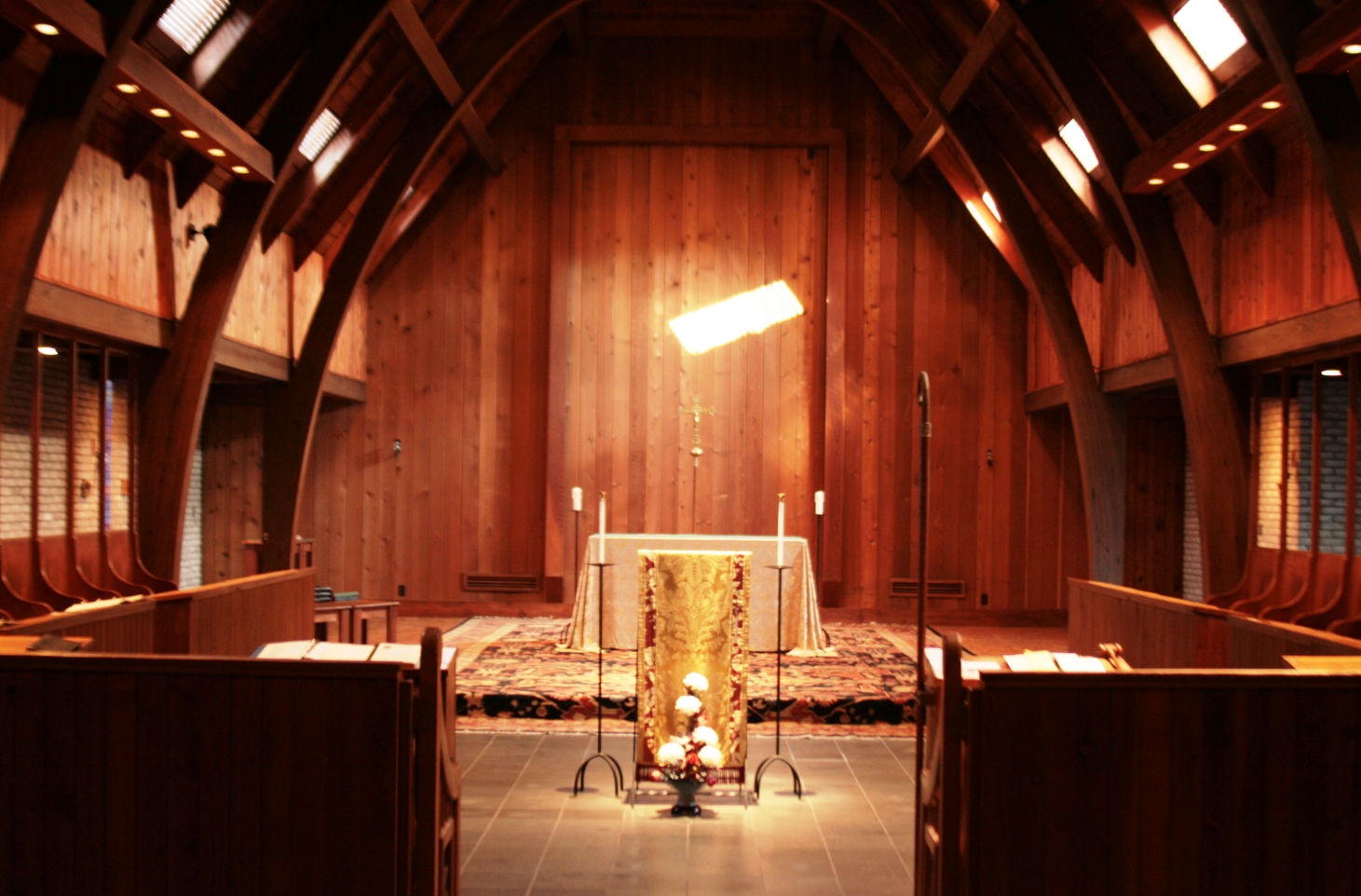
altarWhite 1When we celebrate an event like the anniversary of the consecration of the Abbey church, we are brought up short by the many negative things scripture says about temples and church buildings. Solomon humbly notes that not “even Heaven or the highest Heaven” can contain God, let alone a dinky temple in a backwater of civilization. Many of the prophets expressed discomfort or worse over the idea. David had wanted to build a temple but Nathan said God nixed it because David had fought too many battles that had made him impure for the task. A big part of the problem was that God wanted more elbow room than a temple would give. One of the more dramatic denunciations was Jeremiah’s admonition not to put any trust in stammering: “This is the temple of the Lord, the temple of the Lord, the temple of the Lord.” Fast forward to Jesus and we have him throwing the money changers and animals out of the temple.

What’s wrong with having a temple or a church building? Although Christians can and have worshiped in private houses, there are many practical reasons for having a building dedicated to worship, among them the problem of a host and hostess or their servants having to clean house before and after the service. Mircea Eliade famously pointed out humanity’s need of sacred space to draw attention to the Divine. St. Benedict affirmed the importance of the oratory in the monastery when he said that nothing else should be done there and nothing should be stored there so that there would be no mistaking this being the place for prayer and nothing but prayer. In throwing out the money changers, Jesus said that temple should not be a marketplace but a place of prayer.

There is an interesting detail in Matthew’s account of the cleansing of the temple that helps us understand Jesus’ actions in the temple. Jesus healed the blind and the lame who came to him there. We easily skip over this detail because Jesus was healing the blind and the lame all the time so yet another healing session doesn’t seem worthy of note. An obscure verse in Second Samuel sheds some light on this. When David brought his troops into Jerusalem, the Jebusites insulted David by saying that even the lame and the blind would turn him back. David reacts to the insult by heaping scorn on all lame and blind persons and barring them from the “house,” presumably once it was built. This was hardly fair to handicapped persons.

Jesus, by healing the lame and the blind was giving a strong signal that maybe he was the Messiah but if so, he was not a Davidic Messiah who would conquer by military might. More important, Jesus is giving us a positive teaching rather than simply denouncing the sacrificial cult. In short, Jesus was demonstrating, in action, the word of Hosea that God prefers mercy rather than sacrifice, a verse Jesus quoted more than once. In his first Epistle, Peter says we should rid ourselves of malice and all guile, insincerity, all slander and envy” so that we can become “living stones” “built into a spiritual house.” We are the ones who are called to be the temple of God, the Church grounded in Jesus who is the true temple. Being living stones that prefer mercy to sacrifice is how we do it. If we so allow ourselves by the grace of God to become such living stones, then having a place dedicated to precisely that is more than just fine.

Possessed by God

treeBlossoming1The First Epistle of John overflows with declarations of God’s preemptive love: “not that we loved God but that God loved us and sent his Son to be the atoning sacrifice for our sins” (1 Jn. 4: 10). This preemptive love of God is not just a vague benevolence but an action, and a sacrificial act at that. God did, and continues to act on our behalf. John goes on to describe God’s love as an abiding presence within us, what amounts to being possessed by God. Is this just an added treat in life? We can quickly see that being possessed by God is much more important than that. Many cases of possession of a different sort were recorded in the Synoptic Gospels where Jesus cast many demons out from people who were possessed by them. Without necessarily ruling out a supernatural provenance for some of these possessions, it is helpful to remember that René Girard’s theory of mimetic desire shows us how we can become possessed by other people, especially in rivalrous situations. (See Human See, Human Want.) We only need to reflect on how strongly another person we are at odds with has taken over us to realize how much another person can possess us. Crowds of people easily become possessed as the story of the Gerasene demoniac and the Passion narratives suggest. If we put John’s teaching of God’s indwelling love together with demonic possession, we are confronted with the conclusion that we are going to be possessed by somebody. It is not possible to remain aloof from the intentions and desires of other people. They will possess us whether we like it or not. The question is: By whom are we possessed? Jesus’ little parable about the evil spirit that was cast out but returned to the house “swept clean” with seven spirits “more evil than itself” (Mt. 12: 44-45) teaches us that casting out the spirit who has possessed someone is not enough. We must become possessed by the Spirit of one who is full of love, One who is not in rivalry with us or with anybody else.

Jesus’ image of the vine and the branches in John 15 gives us another take on the importance of being possessed by God’s love. Once again, we have the language of mutual abiding. The branches depend on the vine for both their lives and the vitality that gives them the power to act and bear fruit. This image reminds us of other vineyards in scripture. There is the song of the vineyard in Isaiah 5 which the owner prepared to bear good fruit, only to have it bear wild grapes. Jesus is surely referring to Isaiah’s song in his parable of the vineyard. The evil workers who killed the messengers and servants and then the owner’s son show us what a crowd possessed by rivalry looks like. Jesus’ teaching about the vine and the branches takes us much more deeply into the heart of this parable. The “wild grapes” who killed the owner’s son are branches that broke away from the vine. Having no life in them, they can only offer death to others. But if we do not break away, we are pruned of our competitive spirit so that we can bear fruit. Unlike the parable of the vineyard, the owner does not stop with laying out the groundwork; the owner continues to care for the vineyard over time, just as God sustains us so that we abide in God’s love and God’s love abides in us. This possession protects us from the possession of the persecutory crowd and frees us to bear fruit by acting on God’s preemptive love. This freedom opens our hearts and minds to discern what we can do with what resources we have to help others in need. This freedom is dangerous. It could strengthen us enough to follow Jesus into the depths of the collective evil spirit that had possessed the evil workers in the vineyard where Jesus pulled off the greatest exorcism of all time on the cross.

Longing for God’s Desire

treespath1In one way or another, human desire has always indicated that something is lacking. My stomach is empty so I desire to fill it with food. I don’t have as much money as I would like for the necessities and treats I want so I feel empty until I get enough money to get them. I lack the satisfaction of seeing my favorite baseball team win unless they win. If they do win, I am back to square one with the same emptiness and the same desire by the next day.

René Girard’s theory of mimetic desire pushes the lack that leads to desire a step further. We don’t just lack possessions or a girlfriend; we don’t know what food or what girl to desire until we see what food and what girl somebody else desires. As we learn from scientists’ study of our mirror neurons, we don’t necessarily desire what other people want because they want it or we think they want it. Rather our desires automatically resonate with the desires of others and we need to learn to navigate these resonances as part of human maturation. This prevents us from automatically copying every desire we see in others but the less conscious we are of the impact others’ desires have on us, the more likely we will be driven by others’ desires and the more empty we will be as a result.

Those desires of ours that are drawn from other people easily become conflictual. When that happens, the emptiness opened by mimetic desire deepens into an abyss. When we are wrapped up with a rival, it is never enough to have what the rival wants. As Girard points out, we need to become the other person. We believe (wrongly) that the other person has a certain fullness of being that we don’t have because they have—or seem to have—what we want but don’t have. So it is that we covet not just the ox or wife or car of another but the very being of another person. This is why we never have enough money or possessions or anything else as long as we are in rivalrous relationships. For Girard, this is not an ontological statement but an anthropological one. That is, it is about human relationships. The problem is that we can covet the being of another person until the end of the world and we’ll come up empty. Since the alleged fullness of being on the part of another is illusory, we are only “chasing after wind” (Eccl. 1:14).

Christian thinkers have consistently averred that we are instilled with a longing for God as a gift from God and that this longing means that we cannot be totally satisfied with anything else, no matter how wonderful. As the Psalmist says: our souls “thirst for the living God” (Psa. 42: 2).If we see mimetic desire as fundamental to humanity, it follows that this trait is willed by God and used by God in a fundamental way for our salvation. The certain lack of being caused by mimetic desire gives us an ongoing openness to God, an opening for God to enter into us and dwell within us as Jesus promised us in John’s Gospel. We are created to resonate with the desires of others so that we can resonate with the Desire of the other Other. The phrase “cdeep calls from deep: (Psa. 42: 7) has often been interpreted as the depths of our humanity crying out to the depths of God. This depth is our desire resonating mimetically with God’s Desire. While it is an illusion to think that a human rival has a plenitude of being, God really does have such plenitude. Moreover, God is infinitely generous with God’s plenitude of being. If we open ourselves to God’s Desire, we participate in that Desire is such a way that we can be equally generous with others.