
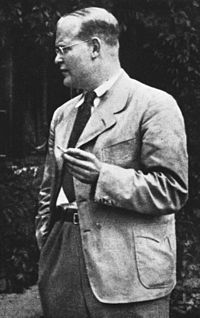
 Passiontide is an appropriate time to reflect on the life and witness of Dietrich Bonhoeffer. Charles Marsh’s book A Strange Glory is a great resource for this.
This beautifully-written book is as gripping as a novel in the way it brings the reader inside a man who was a precocious and amiable spoiled brat for much of his life, but then shunned the safety & comforts of New York to serve his stricken country and was hanged after spending roughly two years in a Gestapo prison.
This book has gained some notoriety for “exposing” Bonhoeffer’s homosexuality. The intense passion that Marsh finds in B.’s letters to Eberhard Bethge seem likely to be strengthened by sexual passion. Bethge himself shows only friendship in return. At the time when he was directing the underground seminary in Finkelwalde, at which time B. met Bethge, we can see the combination of intellectual brilliance and serious emotional immaturity on the part of B. that led to a crush on his student. Marsh is convinced that this relationship never reached sexual activity.
B. was among very few theologians who saw through the distortions of Nazism. In Marsh’s account, I see the roots of that from B.’s critical stance to his theological inheritance that co-existed with respect for his mentors such as Harnack. His very first academic thesis criticized the role of Hegelian idealism in the German theology of his time. B. was mentored by Karl Barth, who, although the greatest theologian of his generation, was shunned by the German establishment. B. did not become a Barthian either, though. B. continued to work at diagonals to the adademic establishment. A year in the US, at which time he worshiped at the Abyssinian Baptist Church in Harlem seems to have alerted B. to the dynamics of persecution in his own country. As Hitler pressured the Evangelical Church of Germany to fall in line with Nazi principles, it was an obscure professor with no paying position to speak of, who became the most significant protesting voice.
The greatest enigma about B. is how a pacifist theologian could participate in a plot to assassinate Hitler. Marsh proves the matter deeply and shows that the matter is highly ambiguous. B.’s work for the resistance consisted of diplomatic outreach to the WCC & Anglican bishops in what turned out to be a vain hope for support from the allies for the Resistance. As for the matter of assassination of Hitler, B. seems never to have resolved in his mind whether or not it was the right thing to do.
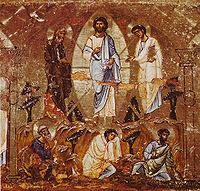 We celebrate the Transfiguration of Jesus at the end of Epiphany to prepare ourselves for Lent. This is a joyous feast where the Light of Mount Tabor should inspire us for the days of penance and then entering into the Paschal Mystery of Christ. However, there is a discordant element in the reading from St. Paul that I want to focus on. He, too, writes of the inspiring light of the Transfiguration, but he also writes about the veil over Moses’ face. This refers to the story in Exodus where Moses put a veil over his face when he came down from Mount Sinai with the tablets of the Law because his face shone too brightly for his fellow Israelites to look upon. (Ex. 34: 29–34) Paul goes on to say that the Jews remain veiled when they hear the words of the Law. In light of Holocaust, this verse causes much uneasiness, all the more so as it has been used to justify anti-Semitic attitudes and behaviors.
 Paul’s famous Hymn of Love zeroes in on what love, as agape, is all about: “Love is patient; love is kind; love is not envious or boastful or arrogant or rude. It does not insist on its own way; it is not irritable or resentful; it does not rejoice in wrongdoing, but rejoices in the truth.” (1 Cor. 13:4–6) In these qualities, we can see love as a deep renunciation of mimetic rivalry. Insisting on our own way, being resentful, rejoicing in the shortcomings of others, are all ways of putting ourselves on top of other people. Surely this short list is meant to stand for any attempt to put ourselves above other people. As long as we try to “win,” we lose at love. When we are willing to “lose,” we win at love.
 At his baptism, Jesus heard a voice from Heaven saying: “You are my Son, the Beloved; with you I am well pleased.” (Luke 3: 22) These words ring out in Psalm 2, addressed to the king, the Messiah, who is being singled out from the nations that are raging together and rising up against the Lord and his anointed. Similar words are spoken to the Servant of Yahweh in Isaiah 42:1. Throughout these songs of the Suffering Servant, he is being called out of a violent society to become instead the victim of that society’s violence. Unlike the Psalmist who threatens the raging nations with a rod of iron, the Suffering Servant does not retaliate against the violence inflicted on him. Jesus begins his mission, then, with a powerful acclaim of unconditional love from his Heavenly Father, a sense of unconditional love he will offer to all who will listen.
 “After eight days had passed, it was time to circumcise the child; and he was called Jesus, the name given by the angel before he was conceived in the womb.” (Luke 2:21)
 The angels say to the shepherds: “Do not be afraid.” (Luke 2:10) They say the same to us today. What are we afraid of? The shepherds were afraid of the glory of the Lord shining about them. That sounds like a good thing, but most of us aren’t used to glorious light filling the night sky any more than the shepherds were. Even the most devout of us would at least be startled if such a light shone around us. When Herod heard of the birth of a child destined to be a king, he was afraid. Caesar Augustus would have been as afraid if he had been told about Jesus’ birth. His successors were sufficiently afraid to persecute the followers of Jesus for three centuries. What were they afraid of?
 Many of the words in today’s Gospel are fearsome but many events in the past couple of weeks have also been fearsome so they fit right in. We are rightly anxious about Terrorism although I personally find the hateful and fearmongering rhetoric of some politicians around the world, not least in the US much scarier.

 Imaginary Visions of True Peace