
 When the angel Gabriel announced to Mary that she was to conceive and bear a son, the angel said that her son “will be great, and will be called the Son of the Most High, and the Lord God will give to him the throne of his ancestor David. He will reign over the house of Jacob forever, and of his kingdom there will be no end.” (Lk. 32–33) However, the prophet Nathan made this same promise to King David: “Your house and your kingdom shall be made sure forever before me; your throne shall be established forever.” (2 Sam. 7: 16) Likewise, Psalm 89 say that David’s “line shall continue forever, and his throne endure before me like the sun. It shall be established forever like the moon, an enduring witness in the skies.” (Ps. 89: 36–37)
But the throne of David’s house came to an abrupt end with the Babylonian conquest and exile. Right after echoing the promise to David, Psalm 89 went on to declare its falsity: “But now you have spurned and rejected him; you are full of wrath against your anointed. You have renounced the covenant with your servant; you have defiled his crown in the dust.” (Ps. 89: 38–39) According to the genealogy that opens Matthew’s Gospel, the line of David continued after the deportation to Babylon, but we know nothing about Salathiel and his descendants until we reach Joseph, the husband of Mary. Joseph was a carpenter, a worthwhile means of making a living, but carpenters are not usually considered royalty. The idea of a carpenter’s son ruling over the House of David forever was absurd. But that was hardly as absurd as God impregnating a young woman who was still a virgin.
From the moment of Jesus’ conception, then, we have the premonition that if the boy is going to grow up to become a king who rules forever, he is going to be a very different king than his ancestor David. He will be raised in a backwater of Galilee rather than in a palace. He will not have glossy magazines printing feature stories about him. His retinue will be a small group of men of humble origins, many of them fishers. The biggest and most crucial difference will be that David replaced Saul as king because he slew tens of thousands to Saul’s thousands, (1 Sam: 18: 7) but Jesus would not wield a sword. Neither did he compete for the kingship with anybody, whether within or without Israel while David competed both against the Philistines and his own king. Rather than running a military operation, he let the Roman military operation run him up against the cross. But this slain king still reigns forever. How can this be? The angel also told Mary that her son would be holy and “be called the son of God.” (Lk. 1: 35) Whereas David, descended from the house of Jesse in Bethlehem, rose up in the world, Jesus came down from heaven to a totally washed up royal house. That’s quite a come down! But after dying on the cross, Jesus was raised from the dead where he does rule forever. And yet we still fight with each other, trying to kill tens of thousands over/against the thousands killed by our competitors. We fight those in our defined out-groups while we struggle against those within our in-groups whose authority we resent. But Jesus reigns without competing and without resentment. As one who became one of us among humans, Jesus is with us, within our hearts just as much as he is at the right hand of his heavenly Abba. Are we willing to be subject to a king as low as this?
See also The Throne of David: Part Two
 There are many stories of kings who go about their kingdom in disguise, usually as a beggar. In such cases, whatever a subject of the king should do to that “beggar” would literally be done to the king himself. This may not have happened much in real life but it did happen when God became a true human being. Whatever anyone did for or to a certain itinerant preacher in Palestine was indeed done to God. It is important to note that in neither scenario did anyone consciously see the king or see God; one saw the beggar or the itinerant preacher.
 The denunciations by prophets like Micah of the rulers “who abhor justice and pervert all equity” (Mic. 3:9) and Jesus’ denunciations of Pharisees in Matthew 23 tend to curl our mouths in a snide smile as we think about how much better we are than they. But while Jesus is still warming up for his fiery words to come, he slows down and says: “Call no one your father on earth, for you have one Father—the one in heaven. Nor are you to be called instructors, for you have one instructor, the Messiah.” (Mt. 23: 9–10) When Jesus goes on with words of woe for the scribes and Pharisees, we are apt to conveniently shove these words aside, but, I think we should linger over them a bit before enjoying the scolding of “other” people.
 I have discussed the Parable of the Evil Workers in the Vineyard in my book Moving and Resting in God’s Desire where I suggest that Jesus was warning his listeners of impending collective violence. I also have used this parable as Exhibit A for René Girard’s thesis that humans have a tendency to establish culture in the midst of social crisis through rounding on a victim who is killed or expelled. This time I want to take the parable in a different direction.
 I am not going to write much on this Sunday’s Gospel. I have already done that on my blog post
  It is highly significant that Elijah did not find God in the wind, the earthquake, or the fire, but only in a “sound of sheer silence.” (1 Kg 19:12) It happens that Elijah had just run away from fire and storm when he heard this sound of silence. Since Elijah had just “won” the battle with the priests of Baal, one might have thought that God had spoken through wind and fire that time, but the result of “winning” that contest was needing to run for his life because Jezebel was out to get him. So it seems God had not spoken in the wind and fire on Mount Carmel after all. If we stop the story with the “sound of sheer silence,” we are edified, but when we read on to the words Elijah heard, we are seriously troubled. At least I am. Elijah is told to anoint Elisha to be his successor prophet. So far so good. But Elijah is also told to anoint Jehu son of Nimshi to be king of Israel. The narrative of Jehu’s cold-blooded coup d’état is chilling to say the least. (2 Kg. 9) More chilling are the words Elijah heard: “Whoever escapes from the sword of Hazael, Jehu shall kill; and whoever escapes from the sword of Jehu, Elisha shall kill.” (1 Kg. 19: 17) After the violent rivalry between Elijah and the priests of Baal, we get the crossfire of the violent rivalry between Hazael and the House of Ahab: more storm and fire. I have a hard time hearing this storm in the “sound of sheer silence.”
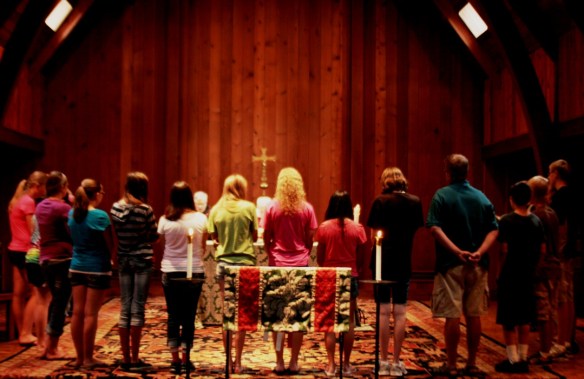 Jesus’ invitation to come to him with our burdens so that he can give us rest and take his easy yoke upon ourselves sounds like an irresistible blessing. But the troubling words skipped by the lectionary suggest that Jesus’ offer is highly resistible. Here, he bemoans the rejection of Chorazin, Bethsaida and Capernaum. Given the horrifying hardness of heart shown in the story of Sodom and Gomorrah’s destruction, it boggles the mind that Jesus thought those people might have responded better than the people of Capernaum who witnessed Jesus’ first miracles of healing.
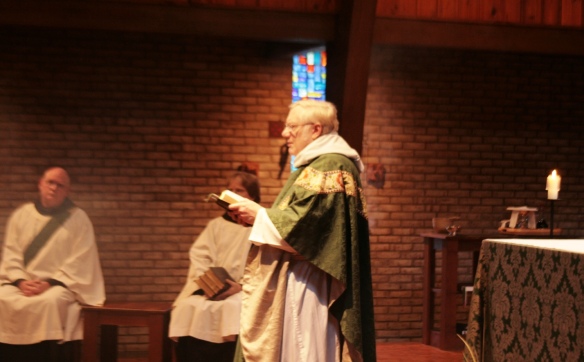 In the final chapter of John’s Gospel, Jesus asks Peter three times: “Simon son of John, do you love me?” Peter has to answer three times that he loves Jesus and then listen to Jesus tell him three times: “Feed my sheep.” (Jn. 21: 15-17) This three-fold question and response is commonly interpreted as Peter undoing his three-fold betrayal of Jesus in the court of the high priest. I agree, but with the caveat that Peter’s betrayal goes further back. At Gethsemane, when Jesus had been seized by the temple police, Peter drew a sword and cut off the right ear of one of the high priest’s servants. This may look like loyalty to most people, but not to Jesus, who said: “Put your sword back into its sheath. Am I not to drink the cup that the Father has given me?” (Jn. 18: 11) That is, Peter had betrayed what Jesus really lived for and was about to die for. As he had at Caesarea Philippi, Peter had acted as a “satan,” a stumbling block to Jesus’ commitment to non-violence, even at the cost of his life. In declaring his love for Jesus three times, Peter declared his love for what Jesus lived for and died for. It is with this love that Peter was told to feed his sheep.
 The Trinity is often presented as a puzzle: How can one be three and three be one? Mathematicians haven’t come up with any answers to that, so let’s treat the Trinity as a mystery to live, not a puzzle to solve. After all, it was through living the Mystery that the apostles preached a Triune God.
 Imaginary Visions of True Peace