
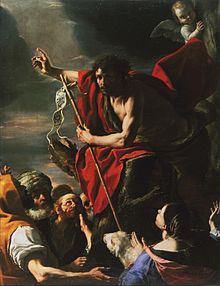
 John the Baptist is so closely associated with the beginning of Jesus’ ministry that it’s easy to see them as two of a kind. Both preached repentance. Both died the death of a martyr.
But if the two of them saw eye to eye, why would John send his disciples to ask Jesus if Jesus was “the one who is to come, or are we to wait for another?” (Mt. 11: 3) As is usually the case when asked any kind of question, Jesus gives only an indirect answer. He lists the miracles that are happening such as the blind receiving their sight and the lame walking. Then he caps it off with the cryptic and seemingly incoherent words: “And blessed is anyone who takes no offense at me.” (Mt. 11: 6) The implication is that John is taking offense at Jesus, or is in danger of doing so. If Jesus is concerned that John, his onetime mentor, might take offense at him, what about his followers? What about us?
The Greek word used here for “offense” and throughout the New Testament is skandalon. We get the English word “scandal” from it. The word means “a stumbling block” and it particularly applies to conflictual circumstances. In the thought of René Girard, two or more people in conflict are stumbling blocks to one another. In his important book The Scandal of the Gospels, David McCracken examines the concept of scandal at length. Jesus’ challenge in his reply to John’s followers is central to McCracken’s argument that faith and scandal are inextricably entangled. What this amounts to is that “only when the possibility of offense exists will the possibility of faith exist.” Being offended, scandalized by Jesus takes us half-way there. One who is not offended because of indifference has not even started. (McCracken 1994, p.82) On the other hand, someone who is stuck in being scandalized for the sake of being scandalized is not likely to move forward either. The people who were scandalized by both John and Jesus, although for opposite reasons, fit this profile. (Mt. 11: 16–19)
So why might John or we take offence at Jesus? Both Jesus and John called for repentance but John’s warnings were accompanied by images of wrath: an axe at the tree, a winnowing fork, fire. John’s preaching can be heard as a renewal of Isaiah’s prophecy of hope: creating a highway through the desert as God did to bring the Jews back from the Babylonian exile, opening the eyes of the blind and the ears of the deaf, coming with vengeance and “a terrible recompense.” (Is. 35) If we tick the boxes of Jesus’ ministry, there is a check mark for each item except for the “terrible recompense.” There are also no axes, winnowing forks, or fire in Jesus’ preaching. Perhaps John felt like an emcee announcing a dramatic act only to get a puff when he thought he’d get an explosion.
When we think of the people in our lives and public figures who affect us that we sincerely think are “a brood of vipers,” do we want the wrath they are fleeing to fall on them? Are there people we think should be chopped down and thrown into the fire? If we harbor the same vengeful feelings, we are scandalized by these people. How then do we feel about a preaching ministry where the poor and the peacemakers are blessed and we are asked to forgive those who scandalize us? Are we scandalized at the idea of renouncing vengeance against these people? If so, then we are taking offense at Jesus and we are not blessed.
The earnest moral sense and integrity of John the Baptist represents the best humanity has to offer but “the least in the kingdom of heaven is greater than he.” That is, as soon as we take even the smallest of baby steps in the way of forgiveness and not being scandalized by seriously scandalous people, we are better than the best humanity can offer. There’s nothing to be proud of here. Jesus healed the cripple when he forgave his sins. This same forgiveness heals us and gives us the strength to take these baby steps into the Kingdom of God.
 When Jesus warns of wars and insurrections fought by nation against nation and kingdom against kingdom, he is painting an image of humanity divided by violent conflicts on a grand scale. These conflicts are coupled with catastrophic natural disasters such as earthquakes, plagues, and famines. .(Lk. 21: 9–11) Jesus then goes on to warn his followers of persecutions on an equally large scale involving kings and governors, clearly suggesting a strong connection between strife and persecution. In the late twentieth century, the French thinker René Girard speculated that humanity suffered the same dangerous conflicts at the dawn of civilization and it instinctively resolved the conflicts by persecuting a victim or small group of victims. These victims were blamed for both the violence and the earthquakes and the plagues and famines. Blaming the victims entailed falsifying the reality of what had happened. Persecution and lies are inseparable. It is not difficult to see that Jesus saw clearly the truth in his time that Girard was to articulate in ours.
 The introduction to the Parable of the Unjust Judge tells us that we should keep on praying and never give up. At the end of the parable, Jesus tells us that we should keep on praying even when our prayers go unanswered for so long that we think we are praying to one who does not care and perhaps is not even just.
 Can a charming rogue be an example of how to enter the Kingship of God? Jesus’ Parable of the Dishonest Manager invites us to explore that question.
 Jesus’ healing of the woman who had been crippled for eighteen years (Lk. 13: 13–17) is one of many healing miracles where the Evangelist emphasizes its occurrence on the Sabbath. These healings were provocative to the Jewish leaders because they interpreted the Sabbath law to preclude any kind of work. Jesus clearly intended to challenge that interpretation but there is a deeper teaching about the Sabbath that he wants us to learn.
 In most churches, the Blessed Virgin Mary is either given very high honor, sometimes exuberantly so, or she is cast out of mind except at Christmas where she might be allowed in a manger scene.
 When Jesus’ disciples asked their master how they should pray, he taught them a prayer that has us learn by doing. We are taken aback by Luke’s shorter version of this prayer (Lk. 11: 2–4) since the liturgical use of Matthew’s version with an added doxology causes us to think it is the only form it has. We will find, however, that this shorter version has the main elements of the longer one.
 When called by the prophet Elijah, (1 Kings 19: 19–21) Elisha asks to kiss his mother and father first. When he is rebuked for this demurral, he slaughters his oxen, breaks the yokes and burns them, and then follows Elijah. That is, he burns his bridges in making a clean break. Elisha makes this break, however, to join a brotherhood of prophets who have set up an alternate community to the violent and idolatrous kingdom of Ahab and Jezebel. Unfortunately, this community is also compromised by violence as Elijah calls fire down on his enemies (2 Kings 1: 10–12) and one of the prophets anoints Jehu to pull of a violent coup d’état. (2 Kings 9)
 The Feast of Saints Peter and Paul celebrates the pastoral ministry of the Church initiated by two different personalities with some differences of opinion. Celebrating two formative pastors already points to pastoral ministry as one of relationships. Then there is the whole matter of shepherds, as we often call pastors, in relationship with their flocks.
 The last wishes of a dying person are traditionally considered sacred and binding on that person’s survivors. Although it is the seven recorded words on the cross that are considered the last words of Jesus, the prayer uttered by Jesus in John 17 constitute the last words of Jesus before he was handed over to be crucified. He prays that we disciples “may all be one. As you, Father, are in me and I am in you, may they also be in us, so that the world may believe that you have sent me.” (Jn. 17: 21) These words have been systematically disobeyed by those of us who are Jesus’ followers from that day until now.
 Imaginary Visions of True Peace