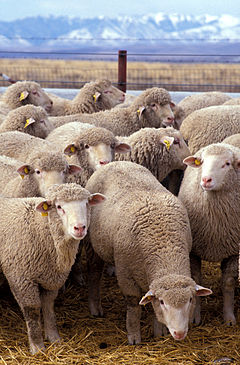
 The Good Shepherd is a reassuring image. The shepherd is in charge and the sheep follow the shepherd’s guidance. When thieves and robbers and wolves come to threaten the sheep, the shepherd deals with them in no uncertain terms. Jesus’ claim to be the gate, the way in and out of the fold, gives us another reassuring image: some of us are in and certain other people are out, just the way it should be.
But in my reflections on John 10 from a year ago, I noted that the Good Shepherd is the Lamb of God who lays down his life for the sheep. With this realization, the hierarchical picture breaks down. The Good Shepherd is not above the sheep but is one of the sheep. Whereas even the most compassionate and conscientious shepherds end up eating or sacrificing the sheep, Jesus shares the fate of the sheep by becoming the Paschal Lamb in place of the sheep.
The Lamb of God is also an odd gate. Rather than keeping the lambs inside, he leads the lambs in and out with so much movement that the idea of there being a gated sheepfold ceases to make sense. Rather than keeping the bandits and robbers away, Jesus lays down his life for the flock when the bandits attack. If Jesus is the gate, than his willingness to lay down his life is the way in to this abundant pasture for all who would join his flock.
In an essay on the Eucharistic Christ, James Alison explores these paradoxes with great insight. After taking us through stages where we fixate on the bad shepherds and feel righteous about identifying and hating them, Alison takes us to a stage where the fixations fall away:
There is no definitive inside and outside for the Good Shepherd, there are places of shelter and of feeding, different places to which the door gives access, and which presuppose movement, non-fixity, and confidence in being neither in nor out. It is assumed that the best feeding place might not be one that seems to be “in,” yet the good shepherd is able to make that place available to his sheep.
The mixup that Alison envisages reaches the point where we are all sheep and all wolves, not in a negative sense where each of us supposedly good people find the wolf within, but rather a recreation of abundant life where nobody needs to be a sheep who is devoured or sacrificed or a wolf who does the devouring and sacrificing. This is where our baptism into the death of Jesus leads us further into the abundant life of Jesus.
It is in the space of this abundant life that we hear the true voice of the Good Shepherd as the Lamb of God, which Alison suggests is the still small voice that Elijah heard in the wilderness. When we hear this still small voice, the strident voices of bandits are drowned out and our own voices can take on the same stillness that others need to hear.
 Matthew says there was an earthquake when the angel of the Lord came down, rolled away the stone of an empty tomb and sat on it. Both the earthquake and the empty tomb give us apt images for the way we experience Easter this year.
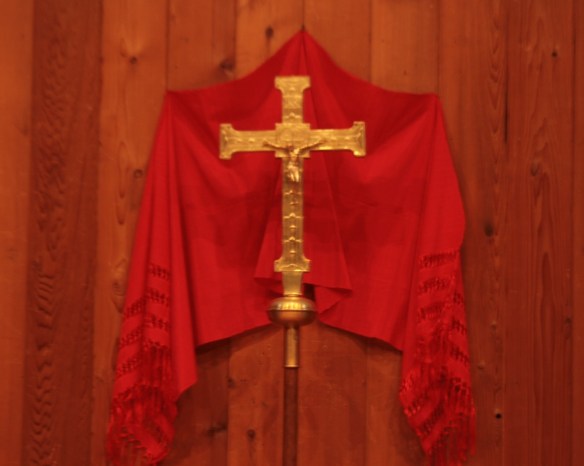 Lent is the season when we think of making sacrifices, usually small ones, like giving up a pleasure or two. This Lent, we have been called upon to make many large sacrifices because of the COVID-19 virus. The social distancing needed to slow the spread of the disease entails giving up many very good things that we take for granted. I can’t even go out and get a haircut when I need one. The disappointments through canceled events are many. For me, it’s a concert I was looking forward to and, more disappointing, a speaking engagement where I was going to present a paper I had worked on for many hours. I’m sure many others have had greater disappointments than that. It must be hard, for example for children not to be able to play freely with their friends and to be separated from grandparents. One of the greatest renunciations for committed Christians is, ironically, Church. Usually, going to Church is something one increases during Lent, but the social distancing called for right now has worshipers staying home and making do with online services. I would think this would make worship a self-emptying process as the familiar sacred space and the people one is usually with would not be there except on a computer screen.
 Recently, I read the Scythe Trilogy by Neal Shusterman. (For Girardians: Shusterman has shown much insight into mimetic desire and scapegoating in his many young adult novels.) This trilogy envisions a future where a massive computer called The Thunderhead runs the world: coordinating work, managing the healing of sick and injured people, everything except for one thing. Since people no longer die of natural causes, the population is lessened somewhat by the institution of Scythes who randomly kill people gently and without malice. This is called gleaning. The Scythes and the Thunderhead are separate and do not interact. What would a trilogy like this have to do with the Annunciation of Our Lady?
 At the end of Epiphany, we celebrate the Transfiguration of Our Lord to prepare for Lent. The vision of the glorified Christ is supposed to cheer us up for the grim days of penance and the grimmer days of following Jesus through his Passion. The Transfiguration also prepares us for Easter as it gives us a foretaste of the glorified body of the risen Lord.
 When we dip our fingers in a holy water stoup as a reminder of our baptism, how much do we really remember? Do we stop to think that the water is as explosive as the bread we receive at the Eucharist?
 The story of the Magi’s visit to the newborn Christ Child in Matthew is one of the archetypes of the Christmas season. Most popularly, the Magi are the archetypes of giving because of the gifts they brought to the Christ Child and they are often credited with being responsible for the exchanges of gifts customary during the Christmas season, even among people who otherwise have nothing to do with Christianity.
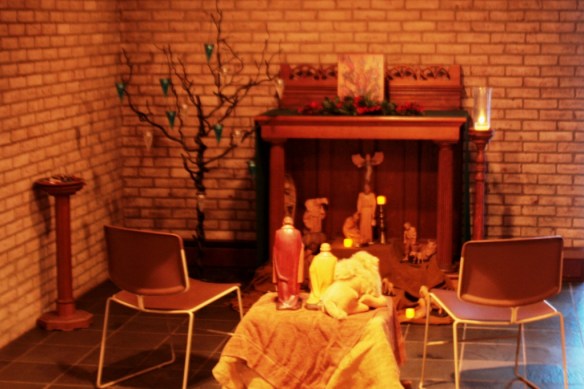 God is a mystery. That almost goes without saying since anything we can comprehend can’t be God. Humanity is also a mystery. One of the few things we truly know about ourselves is that we don’t know ourselves or our natures very well. When we celebrate the birth of Jesus, the time God entered humanity, we have the mystery of mysteries to the zillionth power.
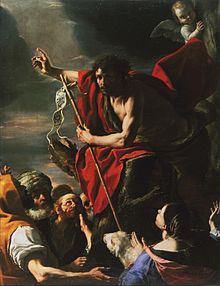 John the Baptist is so closely associated with the beginning of Jesus’ ministry that it’s easy to see them as two of a kind. Both preached repentance. Both died the death of a martyr.
 Imaginary Visions of True Peace