
 I have discussed the Parable of the Evil Workers in the Vineyard in my book Moving and Resting in God’s Desire where I suggest that Jesus was warning his listeners of impending collective violence. I also have used this parable as Exhibit A for René Girard’s thesis that humans have a tendency to establish culture in the midst of social crisis through rounding on a victim who is killed or expelled. This time I want to take the parable in a different direction.
The cue for my changed direction is the end of the Parable of the Vineyard in Isaiah 5 on which Jesus’ parable is modeled. In both parables, the owner of the vineyard has taken great trouble to set up the vineyard for maximum productivity, but things still go awry. In Isaiah’s parable, there is not the cycle of violence described in Jesus’ parable, but the well-planted grapes grow wild. The owner (Yahweh) “expected justice, but saw bloodshed; righteousness, but heard a cry!” (Is. 5: 7) Isaiah goes on make it clear that the violence he is complaining about is about those “who join house to house, who add field to field, until there is room for no one but you, and you are left to live alone in the midst of the land!” (Is. 5: 8) We could update this verse by adding those who add company to company and conglomerate to conglomerate.
Bringing this background into Jesus’ parable prods us to understand this parable, too, as referring not only to collective violence such as that threatened against Jesus but the ongoing social violence of the religious and political leaders. Properly tending the vineyard of the Lord is about properly caring for all people in society, especially the poorest and most vulnerable. Jesus was seeing quite the opposite in his time and the Risen Christ continues to see this systemic injustice continuing unabated in our time.
The stone rejected by the builders that Psalm 118 says becomes the cornerstone is rightly taken as referring to the persecuted prophets and then to Jesus who, rejected by the builders of society, has in his Resurrection become the cornerstone of the Church. But when we take into account the concluding parable in Matthew 25, it becomes clear that what is done to “the least of the members” of God’s family is done to Jesus. That is, the weak, the vulnerable, and the poor are the stones rejected by the builders of society, the same builders who put stumbling blocks before those who try to better themselves. But in the eyes of Jesus, it is those rejected by the builders who are the true building blocks of God’s kingdom.
When Jesus asks his listeners what they think the owner of the vineyard will do, they say that the owner “will put those wretches to a miserable death, and lease the vineyard to other tenants who will give him the produce at the harvest time.” (Mt. 21: 41) So it is that those committing social oppression embody an unforgiving attitude. Today, we hear many of the rich and powerful demonize the poor and vulnerable for their situation, blaming the victims of their oppression.
Yet, as Raymund Schwager points out in Jesus in the Drama of Salvation, the risen Christ did not come with vengeance against the evil workers in the vineyard. Instead, the risen Christ came in peace with forgiveness. Those experiencing oppression are often scandalized by the notion of forgiveness, but we see in the unforgiving attitude of the Jewish leaders who are the oppressors that forgiveness is even more scandalizing for them. We often overlook how easy it is to hold unforgiving grudges against those people whom we have wronged in some way. The reason that we blame our victims is because accepting forgiveness from the risen Christ implies acceptance of our own wrong doing. No matter how gentle the Lamb of God is, forgiveness is still an accusation, and accepting forgiveness can only be done in a spirit of penitence. Looked at this way, the gift of forgiveness is not necessarily easy to accept. Yet overcome this difficulty we must if we are to avoid the cycle of violence that the Parable of the Evil Workers warns us against.
[For quotes and references to Moving and Resting in God’s Desire and Raymund Schwager’s Jesus in the Drama of Salvation, see Girardian Reflections on the Lectionary Proper 22A]
[For an introduction fo René Girard see Violence and the Kingdom of God]
 I am not going to write much on this Sunday’s Gospel. I have already done that on my blog post
  Some people question the need to set aside a day to honor Mary, often out of fear that such a remembrance detracts from her son. The ready answer is that it is not possible to focus on Mary without focusing on her son. The title “Mother of God,” exalted as it sounds, does precisely that. Being a mother immediately puts her in relationship with her son and her son in relationship with her. Since Mary was a human mother, Jesus, born of Mary’s womb, was fully a human being. Since Christianity recognizes Jesus to be fully God as well, it follows that being the mother of the human child Jesus entails being the Mother of God.
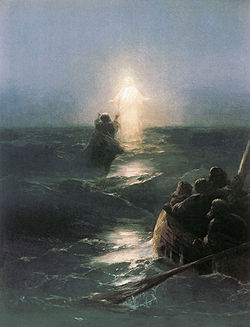 It is highly significant that Elijah did not find God in the wind, the earthquake, or the fire, but only in a “sound of sheer silence.” (1 Kg 19:12) It happens that Elijah had just run away from fire and storm when he heard this sound of silence. Since Elijah had just “won” the battle with the priests of Baal, one might have thought that God had spoken through wind and fire that time, but the result of “winning” that contest was needing to run for his life because Jezebel was out to get him. So it seems God had not spoken in the wind and fire on Mount Carmel after all. If we stop the story with the “sound of sheer silence,” we are edified, but when we read on to the words Elijah heard, we are seriously troubled. At least I am. Elijah is told to anoint Elisha to be his successor prophet. So far so good. But Elijah is also told to anoint Jehu son of Nimshi to be king of Israel. The narrative of Jehu’s cold-blooded coup d’état is chilling to say the least. (2 Kg. 9) More chilling are the words Elijah heard: “Whoever escapes from the sword of Hazael, Jehu shall kill; and whoever escapes from the sword of Jehu, Elisha shall kill.” (1 Kg. 19: 17) After the violent rivalry between Elijah and the priests of Baal, we get the crossfire of the violent rivalry between Hazael and the House of Ahab: more storm and fire. I have a hard time hearing this storm in the “sound of sheer silence.”
 Jesus’ invitation to come to him with our burdens so that he can give us rest and take his easy yoke upon ourselves sounds like an irresistible blessing. But the troubling words skipped by the lectionary suggest that Jesus’ offer is highly resistible. Here, he bemoans the rejection of Chorazin, Bethsaida and Capernaum. Given the horrifying hardness of heart shown in the story of Sodom and Gomorrah’s destruction, it boggles the mind that Jesus thought those people might have responded better than the people of Capernaum who witnessed Jesus’ first miracles of healing.
 In the final chapter of John’s Gospel, Jesus asks Peter three times: “Simon son of John, do you love me?” Peter has to answer three times that he loves Jesus and then listen to Jesus tell him three times: “Feed my sheep.” (Jn. 21: 15-17) This three-fold question and response is commonly interpreted as Peter undoing his three-fold betrayal of Jesus in the court of the high priest. I agree, but with the caveat that Peter’s betrayal goes further back. At Gethsemane, when Jesus had been seized by the temple police, Peter drew a sword and cut off the right ear of one of the high priest’s servants. This may look like loyalty to most people, but not to Jesus, who said: “Put your sword back into its sheath. Am I not to drink the cup that the Father has given me?” (Jn. 18: 11) That is, Peter had betrayed what Jesus really lived for and was about to die for. As he had at Caesarea Philippi, Peter had acted as a “satan,” a stumbling block to Jesus’ commitment to non-violence, even at the cost of his life. In declaring his love for Jesus three times, Peter declared his love for what Jesus lived for and died for. It is with this love that Peter was told to feed his sheep.
 The Trinity is often presented as a puzzle: How can one be three and three be one? Mathematicians haven’t come up with any answers to that, so let’s treat the Trinity as a mystery to live, not a puzzle to solve. After all, it was through living the Mystery that the apostles preached a Triune God.
 Imaginary Visions of True Peace