
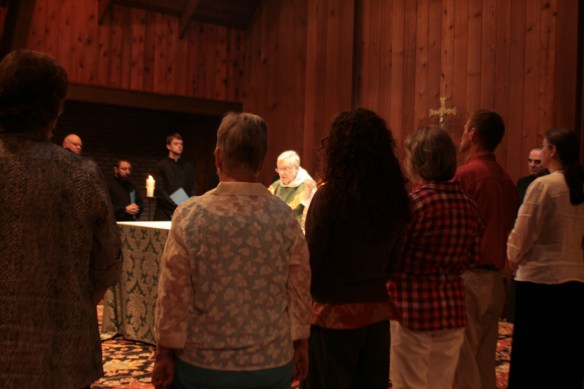
 The Passover is the formative event for Jews, the event that constitutes them as a culture. The Last Supper, the Eucharist, is as formative for Christians. Although there is debate as to whether the Last Supper was a Passover meal, the association with that feast is clear enough for Jesus’ supper to have incorporated and redefined Passover. The big question is: What is the culture that these events are intended to form?
The Passover brought freedom for the Israelites as they were lead out (or driven out) of Egypt where they had been slaves. The violence of the plagues, especially the deaths of the first born of Egypt are disturbing, particularly if God directly inflicted the vengeance. The plagues, though, are the types of events that could have happened in Egypt by natural causes. Although pharaoh resists releasing his Hebrew slaves many times, he and his fellow Egyptians don’t seem able to rid of them fast enough after blaming them for the deaths of their first born children. (Ex. 12: 29–34) The drowning in the Red Sea can easily be seen as self-inflicted violence. The Egyptians drowned not only in the water but in their own violence. In any case, Egypt is portrayed as a violent and tyrannous society, a society that the Israelites were well rid of. Their escape was an opportunity for the formation of a new culture anchored in God’s covenant with the people. Because of the covenant, Israel became the first known culture to attempt to live differently from the other nations, most notably by not making human sacrifices and not having a king who would institutionalize violence. In the end, Israel failed on both counts. Among the more telling failures was Solomon’s use of slave labor from the ten northern tribes of Israel to build the temple. (1 Kings 13–18) The prophets constantly denounced the social injustices perpetrated in Israel. The Passover itself fell into oblivion until it was revived by King Josiah. (2 Kings 23: 23)
The context of Passover tells us that the Eucharist, an event Jesus wanted his followers to repeat, is also a transition to a new culture. The greatest difference is that, while the Passover was accompanied by violence inflicted on the persecutors, in the new Passover, it is Jesus who suffers violence at the hands of violent humans. This difference is the foundation of what is perhaps best called the Renewed Covenant, since it renews and redeems the first covenant that failed. As with the first Passover, the second is a movement out of a violent culture into a whole new way of being human. This time, the rejection of violence is clear and decisive. This rejection of violence entails a rejection of the social injustices that had undermined the old covenant.
Paul’s need to remind the Corinthians of the institution of the Eucharist shows us that failure set in very soon after Jesus’ dying breath. Paul is berating the Corinthians for their insensitivity to the poorer and more vulnerable members of the congregation at the celebration of the Eucharist itself. The social inclusiveness of the renewed covenant, including economic inclusiveness, has already been forgotten. The many failures of the Church are too innumerable to name but it is important to note that countless Christians have followed Solomon’s example and enslaved other people, a practice that is still rampant today under the name of “trafficking.”
The Passover and Eucharist are calls to renounce these social vices, but they are not easily renounced by those in power, although William Wilberforce’s crusade is a rare example to the contrary. More often, it is those who are enslaved who have to reject it. This is difficult since those in power try to render their victims helpless, but it happened in the Exodus and it happened when King Rehoboam threatened to intensify the enslavement of the northern Israelites beyond what Solomon had done. (1 Kings 12: 16) Speaking of slavery, Jesus himself acted the part of a slave by washing the feet of his disciples. In the present moment, there is a peaceful rebellion against the enslavement of this country by a gun culture where the prodigal availability of powerful weapons costs many human lives, most tragically in the school shootings that have become routine. It is when we reject slavery in all its forms that we pass over from the old lives we have lived as social beings into the kingship of God.
These thoughts are explored in much more detail in my book Moving and Resting in God’s Desire
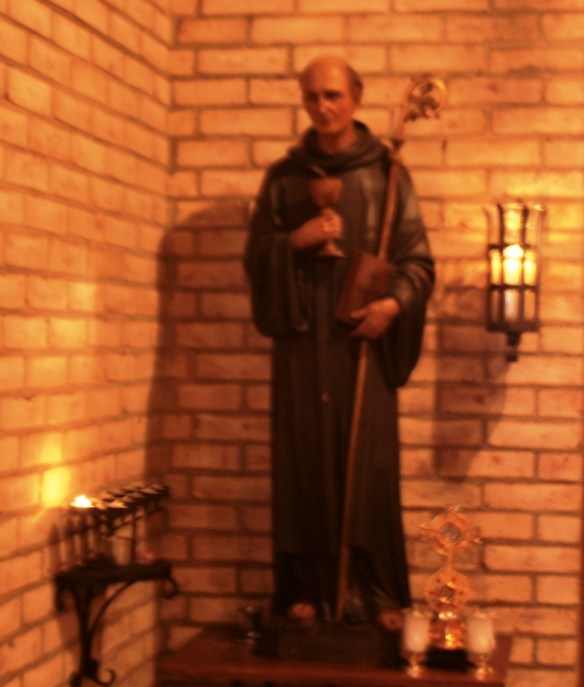 Abraham’s call to leave his country and kindred has been a monastic trope ever since there was a monastic presence in Christianity. Entering the monastic life does entail leaving behind the life one had been leading up to that time. It is also a venture into the unknown. Reading books on monasticism or even visiting monasteries do not fully prepare one for life after actually entering. The author of Hebrews said that Abraham did not know where he was going and lived “as in a foreign land.” (Heb. 11: 9) The author of Hebrews was not writing for monastics but for a Christian community under pressure. For this author, all Christians have “no lasting city. (Heb. 13: 14) Abraham did not simply turn his back on his family and his culture. God told him that he would “be a blessing” and through whom all families would be blest. (Gen. 12: 3) This would include being a blessing for the family he had left behind. Monks, for that matter remain involved with their families of origin and offer help when it is needed. Benedict himself had left the Roman culture of his time in which we was well-placed socially to enter a new life in which he became a pioneer for many sons and daughters in the millennium and a half since his life.
 As we draw near to Holy Week, the lections focus on Jesus’ anticipation of his Passion. Jesus’ famous response to the Greeks about the grain dying in the ground in order to bear fruit suggests a good deal of serenity on Jesus’ part. But one can imagine personifying a grain suddenly experiencing the pain of being ripped apart from within and panicking that it is dying before blossoming out into a new life beyond imagining. If somebody had quoted Jesus’ words to the grain before it happened, would the grain have been serene about what was to come? A brief reflection on our own nervous state about such an occurrence probably gives us the answer to that question.
 Mark tells us that immediately after his baptism, the Spirit drove Jesus out into the wilderness where he was tempted, or tested, by Satan.
 The custom of imposing ashes on our foreheads as a sign of our mortality on Ash Wednesday, the beginning of the penitential season of Lent, has the potential to encourage us to think that mortality is something we should repent of. The opposite is the case. We are not asked to repent of our mortality, we are asked to remember our mortality. Remembering our mortality is an important way to repent and to amend our lives. Since God made us mortal, mortality is not the problem. The problem, a huge problem, is the tendency to deny our mortality, to think that death should not apply to us. Clinical studies inspired by Ernest Becker show that denial of mortality leads to violent and insensitive behavior while some measure of acceptance leads to a much more humane way of relating to others, of connecting to others. I can’t help but reflect that in a great many fantasy novels, the villain tries to gain immortality which can only be achieved by stealing the life substance of others; an extreme example of how denial of mortality inevitably leads to victimization of other people. Such villains are always so deeply isolated as to be living deaths, no matter how many years they survive in this world. But if we accept our mortality, we put our trust in the crucified and Risen Lord, the true giver of life. When we accept our mortality, the time we have to repent becomes precious and we are ready to spend this precious gift wisely in the way we live so that others, too, may live.
 When Jesus opened his teaching ministry, Mark says that the people were “astounded” because he taught them“as one having authority, and not as the scribes.” (Mk. 1: 22) Oddly, Mark doesn’t include anything of what Jesus said. The Greek work exousia is much stronger than the English word that translates it. “Powerful authority” would bring us closer to the meaning. That Jesus’ teaching was not like that of the scribes doesn’t give us much more to go on as to the content, but it indicates that this authoritative teaching was distinct from those who were normally considered the teaching authorities.
 When the angel Gabriel announced to Mary that the child she was about to conceive in her womb would be the heir of the House of David, making him a second David, one might have thought that the child would be named David after his forebear. But the angel said the child should be named “Jesus” and he was given that name when he was circumcised on the eighth day.
 The celebration of the birth of Jesus is a time to put all political differences aside in glad agreement that this child is born. I wish! I have pointed out many times over the years when preaching on Luke’s nativity story that it puts political issues front and center, forcing us to confront our political realities if we are to confront the Gospel.
 When the angel Gabriel announced to Mary that she was to conceive and bear a son, the angel said that her son “will be great, and will be called the Son of the Most High, and the Lord God will give to him the throne of his ancestor David. He will reign over the house of Jacob forever, and of his kingdom there will be no end.” (Lk. 32–33) However, the prophet Nathan made this same promise to King David: “Your house and your kingdom shall be made sure forever before me; your throne shall be established forever.” (2 Sam. 7: 16) Likewise, Psalm 89 say that David’s “line shall continue forever, and his throne endure before me like the sun. It shall be established forever like the moon, an enduring witness in the skies.” (Ps. 89: 36–37)
 Imaginary Visions of True Peace