Eucharist (2): Feeding in the Desert

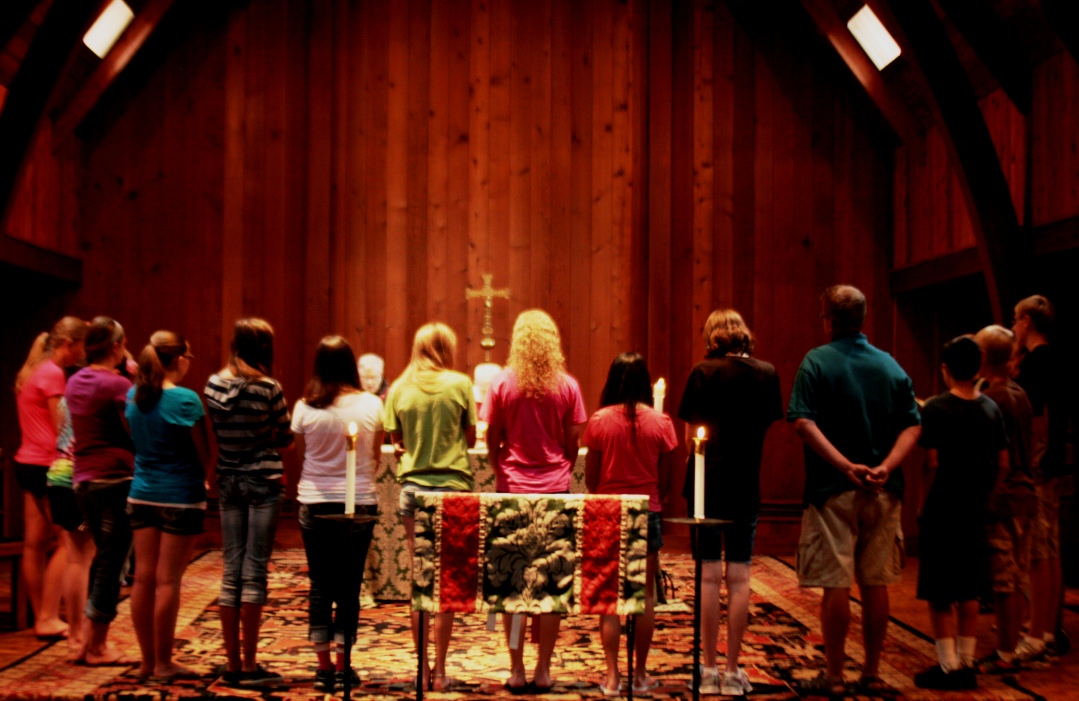
eucharist1The feedings of the multitude in the wilderness give us a vision of the new life that baptism initiates us into and which the Eucharist sustains. (See Divinely Created Abundance) The multiplication of food through both divine and human generosity is quite the opposite of the accusatory, slave-driving society of Egypt or the chaotic violence before the Flood. All six Gospel accounts remind the reader of God’s gift of manna in the desert after the escape from Egypt. It is John’s Gospel that makes this connection most explicit. Just as the manna needed to be renewed each day, we need to be renewed by the Eucharist on a daily, or at least weekly, basis.

It is also John’s Gospel which warns us of how easily we fall away from living by mutually gifting back into contention and rivalry. First, John says that after declaring Jesus the prophet who was to come, the crowd tried to seize Jesus and make him king. Jesus had not modeled a way to rule over other people. Quite the opposite. Jesus had modeled a way of self-giving without rivalry. This is the way of life that should rule us. Making Jesus a political ruler could only drag him and his followers (us) back into the violently competitive life that baptism delivers us from. Then, the people (i.e. us) murmur against Jesus when he tells us that he himself is the bread come down from heaven. We murmur a lot more when Jesus says that we must eat his body and drink his blood. Murmuring is the very same word used of the Jews who contended with Moses and God in the desert.

We could take the murmuring as referring to the bitter arguments over the Christian centuries as to whether or how Christ can be present in the bread and wine. It seems to me that we should take Jesus at his word here and accept that he feeds us with his death and resurrected life. That’s the hard point; not the metaphysics of the “real presence.” We balk at the idea that Jesus’ death and his ongoing resurrected life can feed us. It’s like Jesus body and blood are poison to the kind of life we’re accustomed to living, which they are.

It is typical of John’s slantwise means of conveying the Gospel that he puts Jesus’ discourses about eating his body and drinking his blood in a context outside of the meal in the upper room. This has the advantage of stressing the ongoing nutrition Jesus offers in the Eucharist. Curiously, this separation also seems to spiritualize the Eucharist in terms of Jesus dwelling in us to give us life, but this comes with a shocker that English translations cannot convey. The Greek word for “eat” is trogein, a very strong verb that doesn’t mean dining nicely with good manners. It means to chew, gnash, grind. Jesus comes right in our faces with our eating as a sacrificial act. We are to be painfully mindful of the sacrificial way of life we left back in Egypt but, unfortunately find ourselves carrying with us through the desert.

The sixth chapter of John ends with most of Jesus’ followers leaving because of these hard words. By being food that nourishes us by reminding ourselves of how sacrificial we tend to be, Jesus is indeed refusing to be the king who fixes everybody else’s wagons that we want him to be. We have wandered far from the community of sharing and giving that began this chapter, the place where Jesus wants us to be.

See Eucharist (1) See Eucharist (3)

Eucharist (1) Christ our Passover

eucharist1

Baptism is our initiation into the Paschal Mystery where the death and resurrected life of Christ begin to shape our lives. But how do we keep going so that we can finish what we start so that we are not like the person who started to build a tower and didn’t have the resources to complete it? This question is all the more urgent for those of us who were baptized when we were infants, before we knew what was happening to us. (I don’t dispute for a minute infant baptism for the purpose of raising a child in the shape of the Paschal Mystery.)

Clearly it is the Eucharist that feeds us on the way we have started with baptism. St. Paul’s line “Christ our Passover is sacrificed for us” that we say just before the distribution of communion says everything about the sacrament and more. What is all the more astounding is that, as Robert Daly says in Sacrifice Revealed, it’s a throwaway line said in passing while writing about something else. That indicates how fundamental a presupposition it was in the early church.

The Passover, of course, re-lives the deliverance of the Jewish slaves from Egypt. The roots of the Passover are obscure but it may have been a protective rite of shepherds that the Jews were performing at the time they were expelled from Egypt for causing the plague that killed far more Egyptian children than Hebrew children. Nowadays, there is the simple scientific explanation that the Hebrew slaves were rigidly segregated from the Egyptians so that it is reasonable that one social group could escape a plague that struck the other. (Medieval cities copied the Egyptians by blaming the Jews for plagues that struck them and expelling them when we now know that the Jews were more intelligent about matters of hygiene.) When Jesus welcomed the children whom his disciples tried to keep away, he demonstrated for all time that God is not a child-killer.

The Passover quickly moved away from its sacrificial origins and became a domestic feast as outlined in Exodus 12 that is to be repeated every year. (In Jesus’ time, the temple priests slaughtered the Passover lambs for those who had come to the Holy City for the feast. In John’s Gospel Jesus was crucified precisely at the time that the Passover lambs were slaughtered.) As the Passover became an oft-repeated practice of remembrance of God’s deliverance, the Eucharist is an oft-repeated renewal of our baptism. Just as the death and resurrection of Jesus are made present at baptism, they are again made present in the Eucharist. For those who, like me, enjoy science fiction and fantasy literature, we could note that these sacraments constitute time travel of a sort.  This time travel is not to change the past but to change the present and the future. (The Greek word anamnesis means memory in the sense of making the remembered event currently present. The fundamental change is to bring ourselves and our communities out of sacrificial, persecuting societies into forgiving societies grounded in the forgiving victim.

In Exodus 12, there is a sense of urgency with the Passover. It must be eaten “in haste.” We don’t usually feel this same sense of urgency while celebrating the Eucharist, but maybe we should. Insofar as we are governed by Pharaoh’s way of living, we really shouldn’t waste any time moving out of that way and entering more deeply into the way of the forgiving victim. The bread and wine are gifts to give us what we need to finish what we started. When we eat Christ our Passover, we need to ask ourselves: How ready and willing are to pass over from one way of living to another? How willing are we to serve one another as demonstrated by Jesus’ washing the disciples’ feet?


Eucharist (2)  Eucharist (3)  See also Baptism (1)

Baptism: Overwhelmed by Christ’s Love (3)

lakeGray1All of the biblical types of baptism that I have reviewed in the first two posts of this series stress the social nature of this sacrament. In the Paschal Mystery, we die to one way of relating (or misrelating) with people to live to a totally new way of relating to others. The traditional triad of renunciations of the world, the flesh, and the devil confirms this social element of baptism. The three are nearly synonymous but their varying shades of meaning are illuminating.

The New Testament word kosmos (world) has mainly negative connotations, especially in John’s Gospel where it means, not the material world as created by God, but the social world organized in opposition to God. In baptism, then, we renounce organizing ourselves socially around scapegoating and persecution. It is important to remember, though, that it was this very kosmos that God loved so much that God gave his only son so that this kosmos might not perish. As Jesus was overwhelmed by the kosmos in his death, we, too, may be overcome by it if we renounce it.

Flesh does not refer to the material aspect of our existence, but rather to the tendency live our embodied lives without reference to God. When we live in the flesh, our social lives are dominated by mimetic rivalry that consumes us. The contentions that Paul denounced in his first letter to the Corinthians was cited as an example of living by the flesh. If we renounce the flesh, we renounce this contentious way of relating and we allow our embodied lives to be guided by the Holy Spirit in whom there is no rivalry or resentment.

Renouncing the devil does not mean renouncing a wicked supernatural creature with horns and a pitchfork. The New Testament word skandalon refers to no such thing. Rather this word means a stumbling block, an obstacle. When we live according to the flesh, we allow other people to be stumbling blocks to our desires and we do the same to them. That is, our rivals become the organizing principles of our life rather than God. In scripture, the Satan is also the accuser, which is what rivals do. They accuse each other endlessly as opposed to praising God endlessly.

The renunciations as formulated in the 1976 Book of Common Prayer amount to much the same thing. Renouncing “Satan and all the spiritual forces of wickedness that rebel against God” may seem to imply supernatural forces. I do not rule out such angelic beings who, themselves, put themselves into mimetic rivalry with God, but the anthropological level is what is most important to us in renouncing skandalons in this life. The opposition of such stumbling blocks can seem so strong that they seem transcendent but are really an accumulation of human desires out of control. Renouncing “the evil powers of this world which corrupt and destroy the creatures of God” acknowledges the systemic evil of the kosmos which we must renounce and “the sinful desires that draw [us] from the love of God” point to our own responsibility to do what the fourth question asks of us, to “turn to Jesus Christ and accept him as [our] savior” and “put [our] whole trust in his grace and love.”

As noted in my last post, the new beginnings promised by the deliverances from the Flood and from the Red Sea were so daunting that, in both cases, those who were delivered returned to the old way of relating with each other and the same has happened with the Church. Baptism is a once-in-a-lifetime sacrament in the sense of being an initiation, that is a beginning. A beginning is just that; it is not the middle and certainly is not the end. Baptism is a beginning that must be sustained day by day, hour by hour. St. Paul’s admonition to “take off” the old person and “put on” the new person are verbs used for taking clothing on and off. Living by the Spirit in baptism, then, is allowing Christ to clothe us rather than the rivals who are usually the ones who define us. Being renewed in Christ leads us into a quality of life that we don’t easily imagine. These new clothes seem much too big for us and we get lost in them. Can we allow Christ to stretch us to fit into the new clothes of the resurrected life?

See Baptism: Overwhelmed by the Love of Christ (1)

See Baptism: Overwhelmed by the Love of Christ (2)

Baptism: Overwhelmed by Christ’s Love (2)

lakeGray1Two dramatic events from the Hebrew Bible have been interpreted as prefiguring baptism are the Flood and the deliverance at the Red Sea. Both are deliverances from highly dysfunctional societies.

Genesis 6 portrays human society as consumed with violence. No wonder if everybody was like Lamech and inflicting seventy-seven-fold vengeance on anybody whom he thought had wronged him. In his second epistle, believed by many scholars to be a baptismal homily, Peter says that the deliverance of Noah and his family corresponds to baptism which saves us now through the Resurrection of Jesus Christ. (1 Pet. 3:21) René Girard has suggested that a flood is an apt image for a society overwhelmed with retaliatory violence. In such a scenario, a man who tried not to be a part of this violence would be an obvious choice of a victim to unite the fragmented society. The Christological interpretation in Peter’s epistle suggests by being baptized into Christ’s death, we are brought out of society consumed with violence and given the chance to begin life anew, the chance that Noah and his family had after the flood waters receded. It is worth noting that when referring to Jesus descending into hell (Sheol), Peter does not say Jesus just brought out righteous people like Abraham but that he preached to the very people who had brought humankind to the boiling point while Noah was building his ark.

St. Paul says that we all “passed through the sea and all were baptized into Moses in the cloud and the sea.” (1 Cor. 10:2) Once again we have an overwhelming flood. Moreover, we have a story of a people delivered from a violent and oppressive society. In his book Jesus: the forgiving Victim, James Alison suggests that the Jews were expelled after being blamed for the plagues scourging the country. If the Jews were expelled, why would the Egyptians runs after them to bring them back? Perhaps they realized they would implode without the victims who were deemed responsible for their turmoil. This is what seems to have happened with the Gerasenes when their demoniac was cured by Jesus. One could take the tug-of-war between Moses and Pharaoh as indicating this same tension. (See Dispossessing a Town Possessed) Being overwhelmed by the waters is, again, an apt image of a society succumbing to its own violence once the scapegoats are gone.

Unfortunately, neither new chance at a new life went well. Noah’s drunkenness and rivalry among the brothers that made Ham a scapegoat set humanity on a course where the curse laid on him was used to justify slavery and lynching. The people delivered at the Red Sea suffered from chronic social unrest, leading to Moses raising the bronze serpent in the desert to stop the plague of violence. Likewise, the church continues to fall back into the same rivalry and persecution. Most lynchers, unfortunately, were Christians. A tendency to see baptism as deliverance from personal sin surely reinforces such backsliding. Baptism is not a magical deliverance from personal sin but is a constant invitation to be reborn into the new social life of God’s kingdom centered on the forgiving victim who, like the bronze serpent, was raised up to draw all people to himself.

Baptism: Overwhelmed by Christ’s Love (3)

Baptism: Overwhelmed by Christ’s Love (1)

Baptism: Overwhelmed by Christ’s Love (1)

lakeGray1“We were buried therefore with him [Jesus] by baptism into death, so that as Christ was raised from the dead by the glory of the Father, we too might walk in newness of life.”  Rom. 6:4

If baptism is our initiation into Christ, our entry into the Paschal Mystery, then baptism is the underlying, ongoing dynamic of our lives in Christ. Dying and rising with Christ is something we need to do every day. The Greek word baptismo means to be overwhelmed, inundated. In baptism we are overwhelmed by and inundated with the Paschal Mystery. I will explore this mystery by looking at a few key scripture passages that give us variations on this one theme.

Jesus himself was baptized in the River Jordan by John the Baptist. For John, it was a baptism of repentance from the violent society of his time, to prepare for God’s winnowing fork in “the wrath to come.” But when Jesus comes, he does not bring a winnowing fork; he only brings himself and asks to be baptized. As he is baptized, the heavens open, the Spirit descends, and a voice from heaven says “This is my beloved Son with whom I am well pleased.”

These words refer to two key verses in the Hebrew Bible that tell us what baptism is all about. These words ring out in Psalm 2, addressed to the king, the Messiah, who is being singled out from the nations that are raging together and rising up against the Lord and his anointed. The inundation of baptism draws Jesus out of the inundation of the nations raging with each other. In Jesus, we too are drawn out of this inundation in the sense of being freed from raging against everybody else. We are not freed from being the target of these raging nations when they unite against the one who has been freed from their wrath. These same words also refer to Isaiah 42:1, the first line of the first song of the Servant of Yahweh. Throughout these songs, we find that the servant has been called out of a violent society and becomes the victim of that society’s violence. Unlike the psalmist who threatens the raging nations with a rod of iron, the Servant does not retaliate in any way against the violence inflicted on him. In baptism, we too are overwhelmed by the Servant’s suffering but then we are overwhelmed by the Servant’s vindication by God.

John’s Gospel does not narrate the baptism of Jesus but, as in so many other instances, John shows us the underlying story in a different key. When Nicodemus approaches Jesus by night, Jesus tells him that one cannot see the kingdom of God without being “born anew,” born “from above” by water and the Holy Spirit. Jesus seems only to compound Nicodemus’ puzzlement (and ours!) by suddenly shifting to Moses raising the bronze serpent in the wilderness. However, the bronze serpent was raised during a social crisis in the form of a plague. (Both the disease and the violence against Moses were contagious.) The phrase “lifted up” refers to Jesus being raised on the cross and then being raised from the dead. The bronze serpent, then, becomes an image of Jesus being raised on the cross to draw all people out of the society overwhelmed by violence into a new society as free of the violence as Jesus is himself.

This is the context of the famous words that follow: “For God so loved the world that he gave his only Son, that whoever believes in him should not perish but have eternal life.” If God so loves the world, then God is not bringing a winnowing fork or a rod of iron, but is bringing only himself, wounds from the cross and all, to lift all of us out of the world’s overwhelming violence to overwhelm us with his love.

See Part 2

Caring for the Dead (Thoughts for All Souls Day)

cemetery1The most solemn and moving chapter in Søren Kierkegaard’s remarkable book Works of Love is “The Work of Love in Remembering One Dead.” Throughout this Book, Kierkegaard models love on God’s agape, love that is not transactional and therefore requires nothing in return. After exploring such self-giving love in live human relationships at length, Kierkegaard avers that “the work of love of remembering one who is dead is a work of the most unselfish love.” This love, according to Kierkegaard is the purest love because it is nonreciprocal; the dead “make no repayment.” This is in contrast with love for newborn children who also cannot repay as the love freely given to newborns has the potential of being repaid in the future as the child matures.

However, the dead are not as dead as Kierkegaard seems to think as the dead continue to live in us in a dynamic way that can be enriching. Caring for the dead, as does caring for any live person, tends to lower resentment if there happens to be any to start with. This often begins when a person dies. We often say we should not speak ill of the dead. The instinct behind this adage is that sympathy for the dead person, warts and all, tends to kick in automatically, making the release of resentment and forgiveness free gifts from God that we can pass on to the dead. There is something about death that helps us see that person as God sees him or her, and God sees everybody, without exception, with forgiveness and freely-given love.

Resentment makes any relationship destructively static. God is completely boxed out of the relationship. Which is a way of saying the resentment creates an idol out of the one who is resented. That is, the resented person becomes central to one’s life and God does not. The lessening of resentment allows a relationship to change. This is just as true of a relationship with a dead person as it is with that of a person still alive. This dynamic allows us to understand aspects of the person we had never understood before. Giving this dynamic free reign with a dead person frees the dead person to reciprocate in a way because the dynamic of increased sympathy and understanding is so rewarding.

Caring for the dead includes commending them to God. When we do this, we become more aware of how deeply God loves both the dead and the living and that this love spurs a desire for change until one has reached the fullest potential (teleios in Greek, a word suggesting finality). If this is what God desires, then it should be what we desire for the dead and the living, including for ourselves. Of course, it also follows that the dead desire the same. And so it is that the dead, living with God, can give us much more in return for our care than we can give them.

See also “Living with the Dead.”

Mimetic Laughter

outsideSupper1Laughter is one of the more pleasant things in life, but is it just a frill? In his book The Phantom of the Ego,” Nidesh Lawtoo discusses the importance Georges Bataille attached to laughter for the emerging consciousness of a newborn child. Laughter is one of the first things a baby learns in imitation of a mother, father, or other caregiver. So it is that laughter comprises the first bond a newborn child makes. Interactions with babies may seem silly, something to be transcended with intellectual maturity and so we don’t value laughing with babies.

At its best, laughter is spontaneous and infectious. How many times do we laugh without knowing why, just because other people are laughing? When children are laughing helplessly as part of playing, happiness spreads to everyone around them. We don’t want to be left out of the joke, even if we don’t know what it is. Just think of some of our best times when we laughed with family and friends with no other reason than we were together and we got caught up in laughter.

There is a darker side to laughter, however. Actually it is a darker side of us and our mimetic desires, rather than a darker side of laughter. Often laughter is used to wound others, to score points against others, to put others down to lift ourselves up. Almost as soon as they learn how to speak, small children use laughter in this way. School playgrounds are filled with this sort of thing. Children learn all this from their elders, of course. Just as they imitated the spontaneous laughter of those around them as infants, they imitate the cruel humor that surrounds them as they grow older. Unfortunately, children usually learn this mode of laughter through being shamed by adults who think ridicule is a good way to train children for the hard knocks of life. Laughter continues to be a bond between people, but it is a bonding at the expense of someone, a butt of jokes, a victim.

When he discourages laughter as a sign of pride, St. Benedict certainly had this darker side of laughter in mind, although it is possible that he had a blind spot for the value of spontaneous, bonding laughter. Certainly, when laughter is a put-on act to gain attention, it is the opposite of spontaneous and it is a prideful act, an act seeking to dominate by drawing attention to oneself at the expense of others. I discuss this at length in my book Tools for Peace.

We get so habituated to using laughter as a weapon instead of a bond of love that we hardly know what the latter is. One way back is to use the wit we acquire to learn to laugh at ourselves and help others laugh at themselves. At its best, a comedy does just that. In Mozart’s “The Marriage of Figaro,” discussed in an earlier post, laughter is used as a means to overcome mimetic triangles and tensions and bring reconciliation. Shakespeare does this sort of thing masterly in comedies such as “Twelfth Night” and “As You like It.” In “The Merchant of Venice,” Shakespeare sets a trap for the unwary, leading us into joining the persecution of Shylock before unmasking this derisory laughter for what it is.

Life is too serious and awesome a thing to be left to sourpusses who always want to be on top of somebody else. We all need heavy doses of spontaneous, selfless laughter shared with others.


Renouncing Resentment

buddingTree1Since resentment keeps us locked into the groups and individuals who feel have hurt us, it behooves us to let go of our resentments, as I suggested at the end of my post “Resentment: the Glue that Keeps us Stuck Together.” As everyone who has tried it knows, letting go of resentments is one of the greatest challenges in life. Concentrating on letting go of our resentments is counter-productive as this technique keeps us focused on the very thing we are trying to get rid of. It is like the childhood game: Try to get through one minute without thinking of strawberry shortcake. Obviously, all one can think of for the next minute is strawberry shortcake.

The thing to do is think of something else, and/or think of the sources of our resentments in a new way. At the end of my last post, I gave an example of the latter by bringing in St. Paul’s recurring admonition to think of others and their needs ahead of our own. We can often gain a degree of sympathy of the people we resent if we see some of the brokenness they suffer and see our own brokenness mirrored in them. (It is this mirroring effect that often makes us wish to escape this truth through projecting it on to others.) The something else that is most effective for redirecting focus is, at least for a Christian like me, Jesus the Forgiving Victim. The emphasis here is on “forgiving victim.” Far too many Christians have used the memory of Jesus’ death as a cause for resentment with tragic results.

Actually, thinking isn’t really the way to handle resentment because resentment isn’t a matter of thought; it’s a much more visceral phenomenon. It isn’t that we decide to be resentful because it’s a nice thing to do and we can decide to stop being resentful at the drop of a wish. Resentment is something that grabs us before we know it has grabbed us and resentment does not loosen its hold on us easily. It is as if resentment, like a virus infecting one’s body, has its own blind urge for survival no matter what damage it does to anything else. So, when I talk about redirecting attention to Jesus the Forgiving Victim and to the people we resent in the light of Jesus who has forgiven them as much as He has forgiven us, I mean that we have to undergo a revolution of the whole, embodied person. I didn’t say that we should initiate the revolution; I said we should undergo it. That is, we have to let go in a very deep way so that the Desire of the Forgiving Victim can become our visceral desire, a desire much deeper than the desire of resentment which is locked into the same resentful desire of other people.

Basic spiritual practices such as liturgical prayer, deep reading of scripture and meditation (contemplative prayer) are, or should be, practiced at this same deep visceral level so that they can open us up to being filled with the Desire of the Forgiving Victim. Praying with others is a means of being in a group that gains cohesion by praying without resentment rather than persecution, which breeds resentment. The more solitary practice of meditation is still made in solidarity with others, thus seeking to relate us to God and other people without resentment. In a short blog post, renouncing resentment sounds like a simple matter. Well, it is simple, but it takes years of devoted practice.

Each time we allow the Forgiving Victim to remove any resentment we harbor, we glimpse a bit more of the new Heaven and the new Earth coming down from Heaven into the midst of our lives.

[I discuss spiritual practices in reference to the Rule of St. Benedict in my book Tools for Peace]

Cast Out by the Outcasts

altarDistance1Jesus encounters the ten lepers between Samaria and Galilee. Luke often uses geography to point to a spiritual landscape and this is a particularly apt example. Jesus meets ten marginal people in a marginal space. The broader geography is that Jesus has “set his face” to Jerusalem, the center of meaning and power, where he will be crucified.

But some outcasts are cast out more than others. One of the lepers was a Samaritan who would presumably be marginalized by his marginal companions. Sort of a double whammy.  In this marginal place, Jesus tells the lepers to go to the center of power, to the very people who have declared them unclean, for validation that they are clean. I can’t help but suspect that Jesus was being sarcastic, grumbling at the lepers to find out how they really want to be “healed.” When they suddenly find themselves clean, only the marginalized Samaritan returns to Jesus, who is still standing in the marginal space. That the other nine would go straight to the priests, at the center of power, is the strongest indication of how the Samaritan was treated by them. The Samaritan was healed, not only of leprosy, but of the social and religious system that required that some people be declared unclean so that others can be “clean.” This is the healing that the other nine former-lepers miss out on.

Jesus and marginality come up so many times in the Gospels, giving us the occasion to preach about it many times, that it starts to sound like a cliché. Instead of falling asleep, we need to wake up and really listen. Surely the Gospels hammer this theme so many times because we need to be healed of being hard of hearing.

This story prompts us to reflect on what we do when we find ourselves in marginal positions, having been cast out and declared unclean in some way. Do we band together with other outcasts in a constructive way? Or do we band together in resentment at the establishment? Does our little outcast group amount to a mini-establishment with people divided between clean and unclean? Do we run back to the establishment that exiled us if we get a chance to do so?

That only the Samaritan returned to Jesus to thank him raises the question of what causes gratitude and what hinders it. I suggest that a system that divides people between clean and unclean inhibits gratitude. When we live with this kind of mindset, we inevitably feel entitled to our advantages and delude ourselves into thinking we have earned them. We also inevitably feel that lepers have “earned” their marginalization. If returning to the center of power is what we want, then gratitude is the last thing we feel if we manage to do just that.

Of course, the Samaritan had to advantage of not having the same option of going to a priest to be declared clean as his fellow lepers did. Being cleansed wasn’t enough to take him out of the margins. Remaining in the margins gave him the opportunity to give Jesus another look and let Jesus be the one who decides if he is clean or not. Giving Jesus this sort of authority is an exhilarating thing to do. It is also dangerous. Jesus just might tell us that not only is each one of us clean, everybody else is also clean and we have to live without our lepers.

Mimetic Desire and Truth (5)

???????????????????????????????????????????In my last post, I showed how the premiere place for perceiving truth, the place of the victim, has been distorted. The problem is, if a person in in the place of the victim deals with it by making victims of others, as so many abused people have done, then that person is no longer in the place of the victim and has lost “the intelligence of the victim.” Unfortunately, such people are so caught up in feeling entitled to make victims of others and with the mimetic rivalry I mentioned as to who is the greatest victim, that do not know that they do not have the victim’s “intelligence.”

The revelation of the true victim in the Gospels is very different. Jesus was not only the innocent victim; Jesus was the forgiving victim. No wishing for the limbs of his enemies to tremble or shake or that they be swept away, greenwood or dry, as the Psalmist wished for him! It is Jesus’ forgiveness which gives him a true view of humanity so that he saw the potential for Matthew and Zacchaeus and, after his Resurrection, of Paul when nobody else did. The place of the victim, then, is the place of truth when the victim is forgiving.

When the victim is forgiving, as Jesus was, is, and will be forever, then mimetic desire takes a sharp turn away from rivalry and moves again in the expansive direction of sharing. The forgiving victim does not pose as the greatest of victims; the forgiving victim only wants healing for everybody, including and, especially for the victimizers. The desire that the forgiving victim shares is a desire for the well-being of all, a desire that does not allow for rivalry as rivalry would undermine this desire of universal healing.

In a sense, we have come full circle from where I started with expansive mimetic desire that initiates young people into food and games and art and many other things that are good and desirable. This original mimetic desire, if we wish to call it that, is akin to the good of creation. We were created with mimetic desire for precisely this purpose. The universal fall into mimetic rivalry and its ensuing social crises is Original Sin. (Note the mimetic rivalry between Adam and Eve, Cain and Abel and humanity’s rivalry with God by building the Tower of Babel.) The recovery of expansive mimetic desire through Jesus the forgiving victim is restorative and redemptive. St. Paul said repeatedly the Christ’s redemption did not return us to original good creation; it brought us to a whole higher level of well-being that is grounded in forgiveness.

Since truth is grounded in creation, it follows, as Thomas Aquinas demonstrated, that the truth of things resides in the mind of God. That is, God sees what God has made and knows the depths of all that God has made in all truth. Insofar as we humans see things as God sees them, we see them truly. Our growing awareness of mimetic desire, however, shows us that seeing the truth is not a solitary endeavor; it is a corporate matter. Only through the expansive mimetic desire of sharing what is desirable can we, together, have a reasonably accurate apprehension of truth. Since truth is grounded in God, God becomes a partner in this corporate effort. Given the fallenness of humanity through rivalrous mimetic desire, it is through the forgiving victim that we can recover a vision of the world as God sees it in all its profound desirability.

See Mimetic Desire and Truth Series

See Mimetic Desire and Mimetic Rivalry for all posts on this topic