On Gathering with Those who Keep Oil in their Lamps

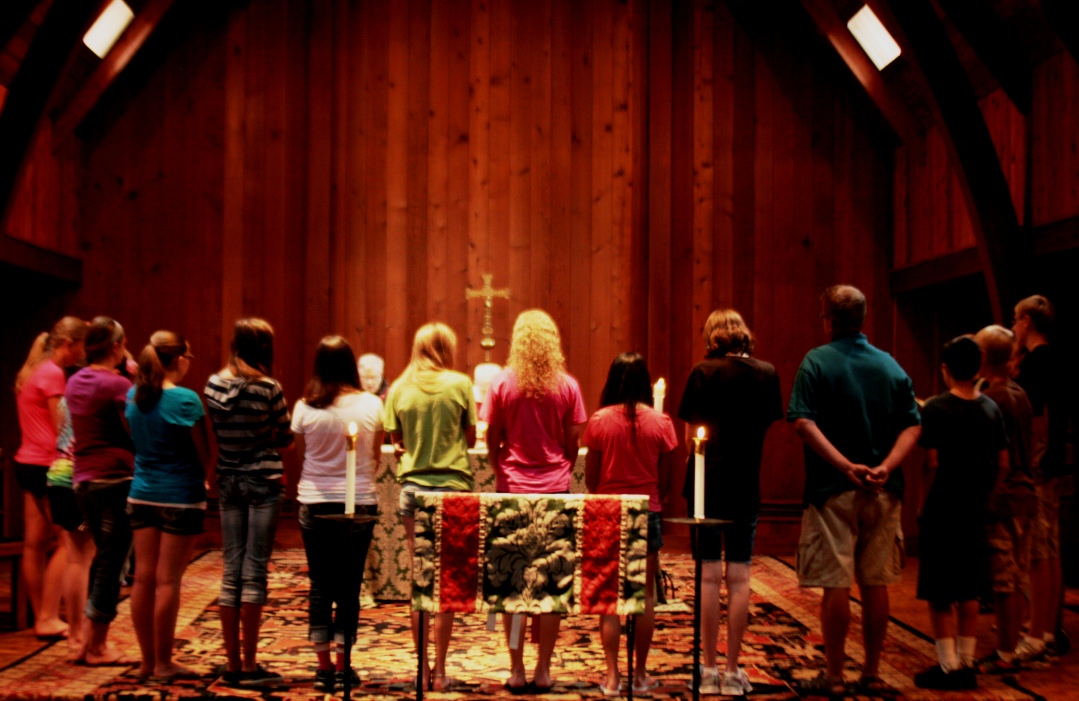
eucharist1Like many parables, the Parable of the Wise and Foolish Maidens is obvious and yet puzzling in some respects. The notion of forfeiting eternal life for failing to be prepared at a certain level is oppressive, but we can lift this degree of oppression by noting that the Kingdom of God is something we are supposed to be living NOW, in this life. This is what we are to be prepared for. If we are prepared NOW for the kingdom, entering more deeply into the Kingdom when we die will take care of itself.

It is worth noting that just before this parable, Jesus has thrown out the parable of the household where the wicked servant beats his fellow servants and gets drunk with the drunkards. Here we have an image of the violence humanity commits and suffers for not being alert to God’s Kingdom. Ironically, the wicked servant thinks the Master is delayed when the Master is already there in the servants he is beating. In contrast, the Foolish Maidens do not commit violence, but they fail to do anything that would stand up to violence such as that of the wicked servant.

I also think it significant that the parable is about two groups of maidens rather than just two maidens. As one who uses the thought of René Girard as a tool for interpreting scripture, I am inclined to interpret this parable in turns of contrasting human groups, each governed by a collective desire they share within that group. The wise maidens who have extra oil for their lamps are a community whose members encourage one another so as to keep their lamps burning. When they care about the Bridegroom and those the Bridegroom identifies with, their lamps burn yet more. I know how valuable it is to live in a community of men who all encourage me to remain ardent in prayer and kindness to those who come here, which makes it easier for me to encourage them in turn. The Foolish Maidens are quite the opposite. Here is a community, if one even wants to call it that, where the members encourage each other to remain apathetic and so strengthen apathy among themselves. Apathy is just as contagious as ardor, if not more so. When the people around us act (or fail to act) out of apathy, our own lamps are sure to burn lower and lower and eventually go out.

When the Wise Maidens say there is not enough oil to share when the Bridegroom comes, they are wrong in one respect. The strengthening of ardor among themselves could easily catch the foolish Maidens into its burning. The problem is that it is very difficult to extricate oneself from a group whose process has a strong grip on us and it is even much more difficult yet to change a whole group around all at once. Not even with the best will in the world could the Wise Maidens have enough oil burning to do that. The Foolish Maidens are like the drunkards in the previous parable who let the wicked servant beat the other servants and then drink with him. The Wise Maidens have the strength to stand up to the violence and witness to a nonviolent way of living. The Foolish Maidens may not be violent themselves, but they will be swept away by violence when it comes. We really do have to pay attention to the company we keep and how we keep it. The Wise Maidens do need to find ways to reach out to their Foolish sisters without getting caught in their apathy.

Finding themselves flatfooted when they realize the Bridegroom is here, the Foolish Maidens compound their foolishness by running off to the store in the middle of the night. With some stores open 24/7 these days, this act isn’t quite as irrational now as it was then but it is irrational enough. What they are doing is running away from the Maidens who have their lamps lit and away from the Bridegroom. They would have better off to stay with the Wise Maidens and the Bridegroom. It may have been humiliating to have empty unlit lamps but the Bridegroom is the one who lights the lamps of those who hold them out. They also would have been in a position to start catching the ardor of the Wise Maidens. By running off, they get plenty of oil but they have missed the chance to encounter the Bridegroom and those the Bridegroom identifies with. All of this is a perfect image of the kind of crowd panic in reaction to a problem that ensures that it only gets worse.The foolish maidens will almost certainly just let the oil run out all over again.

As with the wicked servant who thought the Master was delayed, the Maidens think the Bridegroom is delayed. The truth is that the Bridegroom is always already HERE. We can turn to the Bridegroom in love at any time and we can respond to the least of those the Bridegroom identifies with at any time they show up. THIS is what we have to be alert to and prepared for. There is lasting damage to being unprepared through apathy for the Bridegroom’s presence. I’m sure all of us can think of opportunities that we squandered and there is now no way to go back and make them good. The Forgiving Victim will still redeem all of us, but the diminishment and needless pain we have allowed always remains. Let these memories that we regret motivate us to stay close to the Bridegroom who lights our lamps in the company of others who will encourage us to keep our lamps lit.

Christian Community (4)

AndrewPalmSunday2I am becoming more and more convinced that we have to pay close attention to the historical fact that Christianity began in the shadow of an empire. Not just any empire but the Roman Empire, the biggest Empire in world history up to that point. This is also true of the Jews. Although they had a brief period of some independence under David and Solomon, the rest of the time, Juda was under the thumb of one empire or another at best and squashed by the boots tramped in battle at worst.

Of the Gospel writers, Luke in particular takes pains to locate the life of Jesus in history. He says that Jesus was born under the reign of the Emperor Augustus when Quirinius was governor of Syria. Some scholars have doubted the historicity of this particular census, but it is the sort of thing Empires do for the sake of social control and it sets the stage for the story. Later, Luke says that the word of God came to John son of Zechariah in the wilderness “in the fifteenth year of the reign of Emperor Tiberius, when Pontius Pilate was governor of Judea, and Herod was ruler of Galilee, and his brother Philip ruler of the region of Ituraea and Trachonitis, and Lysanias ruler of Abilene, during the high priesthood of Annas and Caiaphas.” (Luke 3: 1) Here we have a list of the very people who ordered the crucifixion of Jesus. These were the builders who rejected the cornerstone, the body of a man who is the Body of Christ.

Most people don’t like to think of cold hard politics at Christmas time, but the angels’ song to the shepherds was a political statement. Augustus Caesar claimed to be the peace broker for the Empire. Luke claims that the new-born Christ is the real peace broker. Thirty-three years later, it becomes clear that the Roman peace is kept through tactics such as crucifixion. Jesus’ parable of the Wedding Banquet in Matthew’s version helps us draw the contrast between Church and Empire.

Jesus also draws the distinction between Church and empire in his reply to the question designed to entrap him: Must we pay taxes to the emperor or not? The most important element of this little story is that Jesus asks his questioners to bring a coin because he does not have one. He has withdrawn from the economical system. This reminds us that Empire isn’t necessarily about politics; it is also about economics. Jesus’ lack of a coin suggests that the Parable of the Talents, in Luke’s version that portrays the master as violent, the servant who buried his talent might be the figure of Christ who dropped out of the economic order and was cast out. (I believe we should make the most of the talents given us by God; I’m just not so sure any more that this parable, at least in Luke’s version, teaches us that Jesus does not teach that God demands that his enemies be torn to pieces—a sacrificial act.)

What Empire is about fundamentally is power that must be sustained by sacrifice. This brings us back to the first post in this series where I discussed the contrast between Jesus’ way of gathering people and the Empire’s. Empire isn’t just about size. We all know of little fiefdoms all over the places, including (especially!) religious institutions. Since Empire is all over the place in all sizes, we need Church (not limited here to a single faith tradition) of all sizes in all places.

Being Church is not about dropping out of an imperial society. Jesus was living in the Roman Empire whether he liked it or not (and he probably didn’t) and we live in empires whether we like it or not, which I hope we don’t like. The fundamental thing to do is live and act grounded in the love and forgiveness of Jesus, the Risen Forgiving Victim. Virgil Michel, a Benedictine monk at St. John’s Collegeville during the Depression years was a strong advocate of creating parallel economic structures that would be nurturing for everybody involved. If I remember a lecture I heard about him some years ago rightly, Michel invented, or helped invent the credit union. As a leading member of the Roman Catholic Liturgical Movement, he envisioned liturgy as a springboard to social action.

Most fundamentally, Empire cannot be resisted in the Empire’s terms, which is the use of violence of any kind. This is what Jesus showed us in his silence before Pilate. If Jesus really is the wedding guest thrown out into the outer darkness and the penniless servant thrown out in the same way, then we can all join him in the outer darkness which will then lighten up with some help from the Light of the World.

See also: Stupid Galatians, Stupid Us

Go to Christian Community (5)

Christian Community (1)

guestsNarthex1The French modernist theologian Alfred Loisy famously quipped: “Jesus preached the kingdom of God and got the church.” This dictum pits the Jesus movement against the church that followed.

The Gospels attest to Jesus having many people gathering around him for healing and to listen to his teachings. Except for the twelve apostles and the women who, according to Mark, provided for him when he was in Galilee and followed him to the cross in Jerusalem, there is no indication of how stable the group of followers was. Since many of them had to eke out hard livings on the land, probably most people gathered around Jesus when he was in town and that was about it.

The teachings of non-retaliation and forgiveness in the Sermon on the Mount and in other parables were clearly on a higher plane than his listeners could have been used to. They pose such a severe challenge that many of the greatest Christian writers have relegated these teachings to the margins and re-instituted retaliation both in moral theology and dogma. Maybe monks and nuns could turn the other cheek if a fellow monk or nun insulted them, but that was about it. No wonder Alfred Loisy and many others have grumbled about the church. Did the people who listened to Jesus and tagged along at least for a while catch on to the preaching of the kingdom based on peace and forgiveness in the midst of a world just as violent as our own? The indications I can see suggest that they probably did not.

Jesus’ closest followers consistently failed to understand and absorb Jesus’ teachings. Peter’s question as to whether or not he should forgive a brother or sister as much as seven times betrays this incomprehension. The constant bickering among the disciples as to who was the greatest further exposes their incomprehension. Mark juxtaposes this inner fighting with predictions of his crucifixion three times. Three is universally the number standing in for infinity so probably this didn’t happen just three times but an uncountable number of times. Moreover, when Jesus was arrested, he had to tell Peter to put his sword away.

The man who asked Jesus to make his brother share their inheritance equitably, only to be rebuked (along with his brother) for avarice, suggests that his listeners weren’t giving up rivalry over possessions at the drop of Jesus’ words. The crowd’s seizure of Jesus right after he had fed them bread from heaven seems to be John’s retrospective image of what Jesus’ listeners understood and hoped for.

The mysterious reversals of the crowd during Jesus’ last week are especially astonishing until we reflect on what the Gospel writer teach us about crowd psychology. All of the synoptic Gospels emphasize the fear the Jewish leaders had of the crowd. They wanted to put off the arrest until after the Passover at which point the crowd would disperse. When Jesus forced their hand, they had to do their own crowd manipulation. None of that would have worked if Jesus had spoken before Pilate. I suspect that Jesus chose to be silent because any words at all, no matter what they were, could have been construed as an encouragement to start an uprising. In the wake of Jesus’ silence, the disappointed crowd who had wanted to make him king were ready to be turned against him.

It is not productive to knock these people for being stupid, obtuse, and hard of heart. The truth is that we imitate their very stupidity, obtuseness, and hardness of heart more often than not. The followers of Jesus during Jesus’ earthly life do not give us very good models for how to listen and act. All except the few faithful women and the Beloved Disciple had deserted Jesus by the time he died. The rest of Jesus’ “followers” are very accurate mirrors that continue to stare us in the face. Then something happened. Jesus met up with the women to begin the process of re-gathering a following. Will we gather with them this time around?

Go to Christian Community (2)

Receiving Forgiveness

buddingTree1As we have noted several times, granting forgiveness and receiving forgiveness go hand in hand. Although receiving forgiveness wasn’t listed in the process of forgiveness, it is receiving forgiveness that completes the new cycle and breaks the cycle of revenge. In looking at the Parable of the Unforgiving Servant, we stressed the need to grant forgiveness in order to receive forgiveness. The circle works in the other direction just the same. We have to receive forgiveness in order to grant it.

Receiving forgiveness as a free gift sounds like a good deal until we remember that receiving forgiveness necessarily entails becoming aware of what we are being forgiven for. If we are convinced we have done nothing wrong, then we do not receive forgiveness no matter how often and ardently forgiveness is given us. If somebody tells us we have been forgiven, it implies that we have done something wrong to merit punishment as well as the forgiveness that is given us instead. That is to say, receiving forgiveness only makes sense when one is penitent. This does not negate the peremptory forgiveness given by God and imitated by those who imitate God as deeply as this. God’s peremptory forgiveness reveals the truth of the wrongs we have done and this forgiveness strengthens us to live up to the challenge to amend our lives.

I noted earlier that a major component of granting forgiveness is to renounce mimetic rivalry. The desire for revenge is a desire to win a victory against the person who has “defeated” us through personal injury. It is this desire to “win” that is renounced with forgiveness. There is a similar, but not identical renunciation of mimetic rivalry in accepting forgiveness. In committing sin that requires forgiveness, mimetic rivalry in the sense of seeking to dominate other people is often involved. This quest for dominance is one of the major things that need to be repented of in receiving forgiveness. Just as one becomes a “loser” in granting forgiveness, one becomes a “loser” in receiving it. This is the difficulty that Javert had in Les Miserables. (See A Miserable Gospel.) This gendarme had placed himself in perpetual mimetic rivalry through his determination to catch out Jean Valjean and bring him back to prison. This vendetta started at the moment of his release, without giving Valjean any opportunity to prove himself worthy of his release—or not. This mimetic rivalry on the part of Javert, which was never reciprocated by Valjean, made Javert relentlessly unforgiving and it made him just as relentlessly incapable of receiving forgiveness. He could not renounce his irrational quest to “win.” And so he lost everything.

Receiving forgiveness is essential for one who grants forgiveness. The temptation in granting forgiveness is to claim the higher moral ground over the one forgiven. If we think we have no need for forgiveness ourselves when we forgive others, we put ourselves above those we forgive, which is pride and, more importantly, a short-circuiting of forgiveness. This is why the Lord’s Prayer pairs praying for forgiveness with praying to receive it.

These considerations help us understand the puzzling verse in Romans 12:20. Paul tells us feed our enemies who are hungry and give water when they are thirsty for by doing this we will heap “burning coals on their heads.” Paul is quoting Proverbs 25: 22 here, which only pushes the puzzle back to the Wisdom Sage. If we are truly forgiving one who has wronged us and have renounced the desire for revenge or for someone else (God) to avenge us, then we truly wish to restore connections to the person who wronged us and to enhance that person’s well-being. Feeding and giving water to such as these as much as we give them to our own family and friends is enhancing their well-being. But what of those who cannot or will not forgive and cannot or will not receive forgiveness? Javert is an example of one who experienced a free act of forgiveness as the heaping of burning coals on his head. Valjean’s forgiveness seared his soul. Paul, and the Wisdom Sage before him, realized that forgiveness will burn the person who does not accept it. Such is the teaching of Jesus in the Parable of the Unforgiving Servant who was not tortured by the master but by his own inability to give and therefore receive forgiveness.

Receiving any kind of gift puts us in an inferior position to the one who gives the gift. Since forgiveness is rooted in God’s Desire, receiving forgiveness as a free gift always puts every one of us in an inferior position before God. Likewise, receiving forgiveness keeps us on the same level with other people as we forgive them and receive forgiveness from them. The Satan’s kingdom, the Empire, is fueled by the cycle of revenge. God’s Kingdom is fueled by the cycle of forgiveness. Both cycles are just as infinite but the cycle of forgiveness is infinitely larger than the other.


American war Sacrifice

crossRedVeil1The escalation of militarized violence has reached bewildering levels in the USA. Kelly Denton-Borhaug gives us an important theological response centered on the theme of sacrifice.

First, Denton-Borhaug surveys the militarization of our society which will be an uncomfortable eye-opener for most of us. Recruitment is taking place in our public schools and has infiltrated our computer games which are being more and more designed to train us for real war that is no game—or shouldn’t be.

One of the most disconcerting elements of our society’s militarization is the large number of Christians who are avidly supporting our wars. Denton-Borhaug zeroes in on the rhetoric of sacrifice which she suggests is the keystone of the presidential speeches since 9/11. The sacrifice being made on our behalf by those serving in the military is noble, sanctified. How dare we oppose those who make these great sacrifices? Well, there is the matter of the countless people “over there” who are being sacrificed without having enlisted with the US military for the job. These deaths are countless because the US military does everything it can to prevent counting their deaths.

Denton-Borhaug analyzes the Christian theologies of sacrifice, especially substitutionary atonement, that makes Jesus’ death a sacrifice required by the Father, or at least the cosmos. What has been happening is that political rhetoric is syphoning off the Christian resonances of sacrifice, corralling the sacrifices required of war as if the god of war were the God of Christ. Much of this works on subliminal levels.

Those of us working with the thought of René Girard and his colleagues see ourselves in a different place regarding sacrifice, but Denton-Borhaug has problems here as well. Girard himself she mentions almost in passing, only to suggest that Girard sees it as human nature to be violent so not much can be done with it. Mark Heim’s fine book Saved from Sacrifice is examined in some depth. Although Denton-Borhaug respects Heim’s attempt to get away from a theology of sacrifice, she thinks he fails. The failure hinges on Heim’s (and Girard’s) notion that only through his sacrificial death could Jesus reveal the truth of sacred violence.

I think Heim and Girard are right about this but Denton-Borhaug has pointed to an important point. If Jesus’ death is considered “necessary” in any way whatever, then it is vulnerable to the military rhetoric that proclaims the sacrifices of war as “necessary.” Girard avoids philosophical and theological terminology and so does not consider the category of contingency. This is where theological analysis is necessary for Girard’s anthropological insights. Granted, the power of mimetic desire analyzed by Girard was highly likely to lead to the violent outcomes of collective violence leading to sacrificial rites. But to retain any sound doctrine of Original Sin, we must insist that this violent outcome at the dawn of humanity was contingent. The same applies to Heim’s analysis of the Atonement. Heim is as clear as it can be that Jesus’ death was not necessary as far as God was concerned. If it was “necessary,” it was “necessary” for humans. Given the weight of history and the situation in Judaea at the time Jesus lived, it seems highly unlikely any other outcome was possible for Jesus’ earthly ministry but we have to insist that the death of Jesus was contingent. That is, the truth of sacred violence could have been (and actually was) revealed through Jesus’ teaching. It was not “necessary” for Jesus to be killed to reveal this truth, but that is what happened. Knowing Mark Heim as I do, I am almost certain this is his position. I have taken the time to go over this section of the book in more detail to show how the challenge from Denton-Borhaug can help those of us who use Girard’s thought to sharpen our thinking in this area.

In a broader sense, Denton-Borhaug has trouble with sacrifice and for good reason, since the militarized rhetoric is such a powerful form of emotional and spiritual blackmail that really has ruined many of the brightest and best of our younger generation. One need only note the traumatized lives, high rate of homelessness and suicides of our veterans to see how thoroughly they have been made sacrificial victims. Denton-Borhaug has trouble understanding the nobility of Christian martyrdom in the early centuries, not realizing the degree to which it was nonviolent resistance to the Empire. In fact, her practical suggestions are along the lines of actively making peace, a “theology of work” she calls it which amount to much sacrifice as well as resistance to violent political structures.

A thought-provoking and important book that helps us grapple with a major ongoing crisis in our time.

For an introduction to René Girard’s thought see Violence and the Kingdom of God

The Process of Forgiveness (3): Forgiving

yellowTulips1The final step of forgiving is actually to forgive. Simple as that. Or is it that simple? Well, yes and no. It is a simple act, although in some cases it can take years to actually unfold when the hurt is very deep. The thing about forgiveness is that I really don’t think any of us really forgives another; God forgives the person through us. That is to say, forgiveness is an act of grace from God. The first three steps of telling the story, owning the hurt and letting go can be done by us and need to be done by us. Although letting go is not forgiveness in itself, it opens the way for forgiveness to happen. We open the door for the Paraclete, the Divine Advocate for the Defense, to come in.

I have to admit to feeling a bit embarrassed about writing on this important topic. That is because, so far in my life anyway, I have had quite a lot less to forgive than many people I know and know about. When I think of the enormous injuries, such as childhood abuse some have suffered and forgiven, I ask myself: Who am I to tell others how to forgive? The answer to that question is to say that I am Andrew Marr and I have had to do some forgiving. In any case, like everybody else, I have learned much from those who have forgiven monstrous hurts.

Although telling stories is helpful, I do not feel I can tell my own stories of forgiveness except abstractly since other people are involved. Two instances stand out for me. In one case, when a person penitently admitted to sustained acts of deceit, I felt forgiveness move through me on the spot. This did not eliminate the hurt over the situation but it did free me from being caught in the hurt and allowed me to move on. The second instance was a case where it took many years to become aware of how a person was hurting me, albeit without intending it or, as far as I could tell, realizing it, in spite of my frank naming the hurt to this person. At the time that I write this, I have not experienced the same forgiveness work through me as a one-shot deal, but I feel the process working gradually through me.

I find forgiveness to be more difficult when it involves the wrongs done to other people, whether people I know or people I have never seen but who are being hurt and killed through economic injustice and war. It occurs to me that a certain helplessness adds to this difficulty. If a wrong is done to another, it is hard to forgive on behalf of that person. The thing is, God forgives the wrongs done to other people all the time. At the same time, God suffers with all who are suffering these grievous wrongs and is also suffering along with the ruin of the perpetrators themselves. Forgiveness is costly in such cases and as we participate in God’s forgiveness of others who harm other people, we learn in our own hearts how costly forgiveness is.

As difficult as forgiveness is when it comes to trauma, I find forgiveness most difficult with the small things on a day-to-basis. When an emergency comes along, we respond quickly and generously, even when it takes much time and resources, but giving up small bits of time for the benefit of other people is difficult, sometimes excruciatingly so. It’s the same thing with forgiveness. When we get nickel-and-dimed by petty offenses day in and day out, we get fed up with people and lash out at them. When we suffer these little stabs, they are so immediate, compared to the long-term sufferings we endure, that they seem a lot bigger than they are. Here is where we need a habit of letting go that is rooted in humility. St. Paul said that he died daily. Part of that is losing daily, which is what letting go amounts to when these petty offenses come. It’s when we receive a barbed comment on the spot that we want to come back with a retort that gives us the satisfaction of revenge. Swallowing our words in these situations is difficult. And yet, learning to forgive in these small situations strengthens us to forgive the longstanding hurts that we suffer. Letting go is letting go, whether the matter is big or small. In God’s sight, they are all the same size.

Binding and Loosing

AndrewPreaching1How many of us listen to Jesus’ words about correcting fellow members of the church and think they are about punishing people and casting them out? (Mt. 18:15-20) Checking ourselves for such reactions is a good way of taking note how instinctive punishing and excluding are to us and how less instinctive is forgiving and including and welcoming others. It is precisely this instinct to punish that makes it difficult to have ears to hear what Jesus is saying and hear what the Spirit is saying to the churches.

If we take a step back and ask ourselves what our instinctive reaction to being wronged is, we find that the first instinct is to seek revenge. If somebody hits you, hit him back. Simple. But Jesus tells us to go to the person and tell that person what they have done to us. This action puts a serious break on the revenge mechanism and moves in the opposite direction. After all, going to the person peacefully and honestly is the first step towards reconciliation, which is the last thing a person bent on revenge wants. If speaking one to one does not resolve the matter, then the circle widens to two or three and then the whole assembly. What is easily overlooked in this process as described here is that it presupposes that each of us is expected to take responsibility for the community and for each other. This is why we should warn a person who is acting destructively, but it is also why we should be open for others to approach each of us to correct us. Of course, anyone who has ever corrected another person knows that this can result in learning about our own shortcomings. One of our favorite slogans at St. Gregory’s Abbey is” “You do it too.”

Treating an unrepentant person like “a Gentile and a tax collector” sounds straightforward enough. We kick the person out and that is that. But that is not that. For one thing, this is not an act of vengeance, or at least it’s not supposed to be. It is an act of distancing, an act that, when used rightly, shows that the reproved person has distanced him or herself from the community. It is realistic in that some people make themselves impossible and a peaceful parting is necessary. But that is far from the end of that matter. Matthew himself was a tax collector. How was he treated? Jesus called him to follow him and be a disciple. We need to keep in mind the context. Immediately preceding this list of instructions for dealing with a delinquent person is the Parable of the Lost Sheep. All this suggests that the way to treat a Gentile or a tax collector is to try to bring them into the Christian community, which entails forgiveness.

Forgiveness? But we are told that those we loose on earth are loosed in heaven and those who are bound on earth are bound in Heaven. Sounds like we have the power to bind other people for all eternity and God’s hands are tied for as long as we want them to be. How much power is that? But not so fast. Why is it that we so easily assume we are being allowed to bind on earth when we are being encouraged to loose on earth? We need to note what follows immediately after this verse: Peter’s question about how many times he must forgive an offender and Jesus’ parable of the unforgiving debtor. If we have to forgive others as God forgives us, and that without limit, as Jesus’ saying we have to forgive seventy-seven times means, then we are indeed being encouraged to loose on earth and are being warned that if we do not loose on earth, we are bound to our resentment for what others have done to us (or we think they have done to us) and we will be so bound even in Heaven since God’s hands are indeed tied for as long as we refuse to let God untie us.

See also: The Sin against the Holy Spirit

The Process of Forgiveness (1): Owning the Hurt

purpleFlower1When I suggest that forgiveness is a process, the implication is that there are several steps to the process and we take them one at a time. It isn’t as simple as that. There are steps that can be articulated to give us a sense of direction for the process, but they are all so closely interrelated that it is more like disentangling a tangle of yarn than a matter of climbing steps on a ladder or a staircase. The image of the tangled yarn, something that often feels more like a tangled rope around our necks, suggests that the process has a lot to do with loosening something that is tight, which is precisely what the Greek word aphesis, a word often translated as forgiveness, is about. Letting go that which has tied us up simply takes time.

Desmond and Mpho Tutu have written a valuable book called The Book of Forgiving that helps us understand the process of forgiveness. In my own reflections I don’t come up with precisely the same list, but it comes close and the four-step process in Tutu’s book gives us something to work with.

The first two steps listed by the Tutus are: 1) Telling the Story and 2) Naming the Hurt. These two steps are so closely related that they feel like one step to me, albeit a more complex step. I am inclined to call this first step: own the hurt. This step seems simple but it can be difficult emotionally because it means facing the pain and that is—well, very painful. It is, however, pain that is necessary for healing just as an infection has to be opened before it can be healed. Community is important as one almost always needs at least one sympathetic listener and often there is need for many more than that. The importance of telling the story is that when another has invaded us by injuring us, we are suffering on the terms of the perpetrator. The first step of suffering on our own terms is to tell the story, to face the truth of what has happened to us. We cannot forgive what we have not seen and faced for ourselves. As long as the truth of injury is repressed, it holds us in its grip. Over the years I have listened to people tell their stories, some of them about childhood sexual abuse. This listening makes it clear that the very act of telling the story changes the story from what it was before. Something moves within us when we tell our stories.

The many psalms of lament model for us this step of owning the hurt by telling the story. There is a communal element to these psalms as they seem to have had cultic use in Israel, and in fact are sometimes collective laments, and they have a long history of use in public worship in Christianity. These verses from Psalm 31 are one sample among many that could be picked out from the Psalter:

I am the scorn of all my adversaries,
a horror[c] to my neighbors,
an object of dread to my acquaintances;
those who see me in the street flee from me.
                      I have passed out of mind like one who is dead;
I have become like a broken vessel.
                   For I hear the whispering of many—
terror all around!—
as they scheme together against me,
as they plot to take my life. (Ps, 31: 11-13)

The Truth and Reconciliation Commission in South Africa that Bishop Tutu chaired is, to date, the most powerful instant of a communal telling of stories. Everybody who wished was allowed to tell the truth of the injuries they had received during Apartheid. Perpetrators were also invited to tell their stories and were granted amnesty for doing so. Telling the story also makes it clear that much more is at stake that the forgiveness by the victim. Those in South Africa who listened to the testimonials, from the bishop himself to those watching on their TVs, were challenged to forgive what had happened.

There is a danger in telling the story. Doing so does not automatically begin a healing process. It can do quite the opposite. Asking God to blot our abusers from the land of the living (Ps. 69:28) once we have told the story of waters rising up to our necks (Ps. 69:1) hardly moves us in the direction of forgiveness. Telling the story of victimization and listening to it can enrage us and lead us to seek revenge. Worship in Holy Week involves telling the story of Jesus’ sufferings that culminated on the cross. What these observances should do is deepen our compassion for the victim, leading to compassion for all victims. Instead, Jews learned over the centuries that it was dangerous to be walking about during Holy Week if there were Christians around.

This is why I include “own the hurt” as an integral part of this first step. It isn’t enough to tell the story; it is necessary to tell the story in a listening way. That is, we must listen to ourselves when we tell the story. The importance of at least one more person listening is that a good listener can help the teller listen more deeply to him or herself. The mimetic desire to hear the story between two or more people increases the listening that is happening. Since the abuse we have experienced is inscribed in our bodies, we need this deep listening to reach our guts so that the muscles tightened over what has happened can loosen. The act of loosening happens in our bodies before it happens in our heads and we can’t put our hearts into forgiving until our guts have done it. I have listened to enough people to have learned that there is a strong and clear distinction between those who listen to what they are saying and those who don’t. Those who listen well to themselves move towards healing. Those who do not listen to themselves remain stuck with their pain, trapped with no exit until they do learn to listen.

Such deep listening is owning the hurt. Owning the hurt does not make it hurt less and it certainly does not solve any problems, but it is the first step toward healing and forgiveness. Owning the hurt is the beginning of letting go, which is the second step. This shows us how closely related the steps are. We will look at this second step in the next post of this series.

Proceed to The Process of Forgiving (2)

The Sin Against the Holy Spirit

???????????????????????????????????????????The Parable of the Unforgiving Servant takes us to the heart of the question of forgiveness in Matthew’s Gospel. A dialogue between Jesus and Peter sets the stage and gives us a sense of direction for interpreting the parable. When Peter asks if he should forgive someone who offends him seven times, he seems to think he is putting a high ceiling on the matter. Forgiving somebody seven times seems an awful lot but Jesus breaks his bubble by saying that he has to forgive an offender seventy-seven times, or seventy times seven, in some manuscripts. Taking the higher number, one might think that counting up to 491 offenses legitimizes taking revenge after the magic number is passed, but that obviously misses the point. Jesus’ reply is an allusion to Lamech’s savage song where he boasts that if Cain is avenged seven times, then he is avenged seventy-seven times. The working of revenge cycles indicates that the revenge is infinite. Jesus’ counters the infinite revenge cycle by making forgiveness just as infinite.

Then Jesus launches into the parable of the unforgiving debtor. After being forgiven outright a large sum of money owed to the master, the forgiven servant refuses to forgive a much smaller sum by a fellow servant. Having just been forgiven a large debt, the servant hardly has the excuse of being desperate for money. The point of the parable is clear enough: if you don’t forgive, you won’t be forgiven. But there is a small hitch here. The “forgiving” master suddenly becomes unforgiving. The forgiving Father in Heaven is not forgiving either, at least for this offense. Not forgiving is the unforgivable sin.

Elsewhere in Matthew, Jesus says that every sin and blasphemy can be forgiven with the exception of “blasphemy against the Holy Spirit” which is the one thing that cannot be forgiven (Mt. 12:31). It seems odd that God’s hands should ever be tied in any circumstances in forgiving anybody for anything, so what gives? Saying that unforgiving people cannot be forgiven suggests that withholding forgiveness would be the sin of the Holy Spirit. In Jesus’ final discourse, he promises that when he leaves, he will send the Advocate to guide them in all truth. An Advocate is a lawyer for the defense. So the Advocate Jesus sends is the defender of all who are accused. The Advocate “will prove the world wrong about sin and righteousness and judgment” (Jn. 16:8). Of course, the world runs by the fuel of accusation and revenge. If we bring Jesus’ words about the Advocate to his words in Matthew, it appears that sinning against the Holy Spirit by not forgiving others cuts us off from our Advocate who would plead our case.

In the parable, the unforgiving servant is handed over to be tortured until he has paid his entire debt. The servant had been invited to a new way of living based on forgiveness and rejected it. Living without forgiveness, which is tantamount to living by vengeance, is torture. It isn’t God who is unforgiving; it is the servant. If refusing the way of forgiveness is the sin against the Holy Spirit, then we do not need to worry about what thing we might do wrong that brings us to eternal damnation. Forgiveness is a process and so is vengeance. Clinging to vengeance in the face of God’s forgiveness tortures us with our vengeance for as long as we are imprisoned in it. All the while, the Advocate continues to defend us, hoping that we will allow the Advocate to prove us wrong about sin and righteousness and judgment. Ultimately, Jesus and the Heavenly Father forgive us our unforgiveness in the hope that we will accept this free gift. Likewise, St. Paul says that Christ is at the right hand of God interceding for us (Rom 8:34). Just ahead of the parable, Jesus has told the Parable of the Lost Sheep for whose sake the shepherd left the ninety-nine to seek out the lost. Surely God searches out each one of who tortured by vengeasnce. Then, immediately before this the Parable of the Unforgiving Servant, Jesus has instructed his disciples about seeking reconciliation and treating delinquent members like Gentiles and tax collectors. Judging by the parable that follows that we have examined, the way to treat Gentiles and tax collectors and all other people is to forgive them. Truly accepting this free gift of forgiveness entails passing this free gift on to others. We are all thrown into the same world together. The question is whether we will be tied up in vengeance or bound by forgiveness.

Banished Messiah

crucifix1Banished Messiah: Violence and Nonviolence in Matthew’s Story of Jesus by Robert R. Beck is an intriguing and stimulating take on Matthew’s Gospel. He structures the book on the structure of the Banished –Prince-Returns-to-Claim-his-Throne story motif. He outlines this motif in animated movies such as The Lion King to make the outline clear before proceeding to Matthew with ongoing comparisons with other classics such as The Odyssey and Hamlet.

The first stage of the story motif is usurpation which Herod has done very well, although ultimately the usurper is the Roman Empire. The royal claim made through the genealogy strikes me as being as anti-imperial as Luke’s song of the angels the night Christ was born. The exiled prince then grows up in obscurity.

The second stage is the imposter. Beck discusses the ambiguous situation of an exiled prince. As with the case of Odysseus, validating the real McCoy from a Pretender is not easy. In this section Beck discusses the struggles with the Pharisees from a post-colonial perspective. The strife between them has to do with how to resist the Empire. The Pharisees tried to broaden recent techniques—making the whole people a priesthood following ritual purity. Jesus went back deeper in the Jewish tradition for the renewal. More important, the Pharisees were complicit with the Empire, as their having coins with Caesar inscribed demonstrated. Jesus’ resistance to the Empire was total, even to the point of not carrying any money issued by the Empire.

The third stage is the Mentor. John the Baptist fulfills this role. Beck discusses the tensions the mentor’s role often has. John the Baptist does seem to have oriented Jesus to his mission and he baptized him, but Jesus broke with John over the question of violence and judgment, preferring healing to divine vengeance. Athena urges Odysseus to kill the suitors and the ghost of Hamlet’s father complains that he is in a sort of purgatory until his death is avenged—a rather screwy view of Purgatory as Shakespeare surely realized.

The final stage is the return and reckoning. Normally this takes place in two stages: cleansing and revenge. Here is where Matthew breaks off from the story motif, defying our expectations. (Think of how many meek and mild literature professors berate Hamlet for not getting the job done!) The entry into Jerusalem is the return. In Matthew, Jesus immediately goes to the temple and cleanses it. This is a non-violent, symbolic act. In a real cleansing, a lot of blood would have been flowing. Instead of revenge, we get the arrest of Jesus who tells Peter to put the sword away and gives himself up to the soldiers although he could have called on ten thousand legions of angels.

Beck brings in Girard at the end but he misreads him on the crucial point, saying that Jesus was a helpless victim while Girard argues for Jesus’ intentionality here as does Beck. It is Jesus’ renunciation of revenge, breaking the revenge story motif that reveals the truth of God. The commission to the disciples at the end of the Gospel is anti-imperial, a commission to create an entirely new style of human community than the power-structure of Empire.