
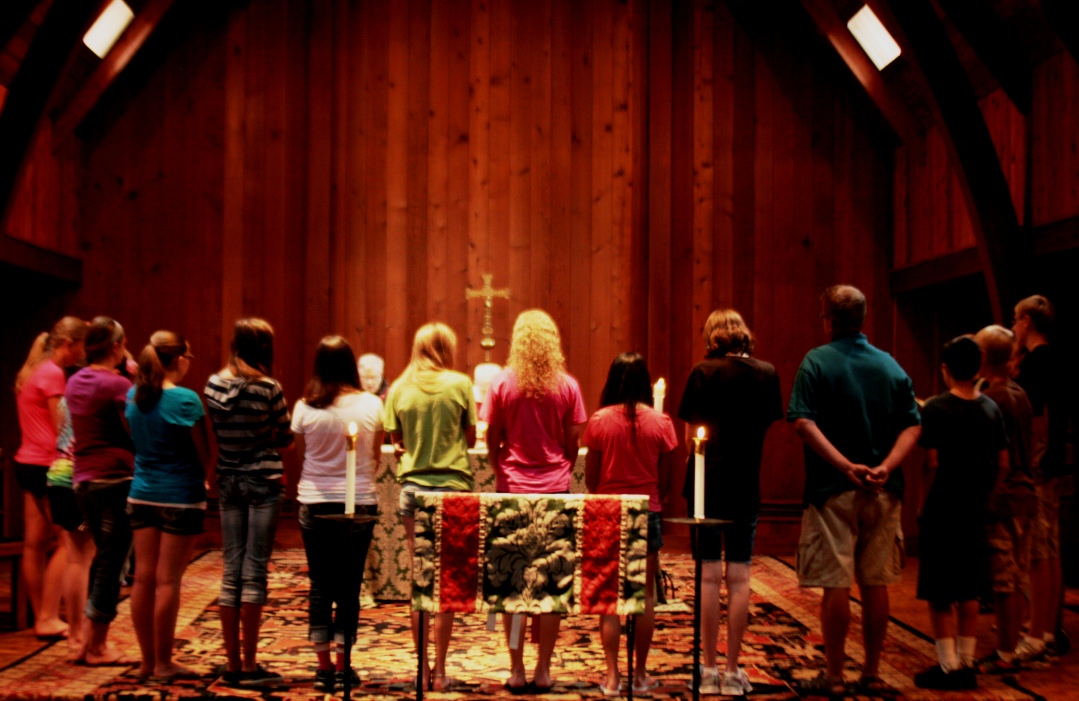
Liturgical Animals (3): Stories and Ritual

eucharist1Ever since stories started to be told it has been known that we resonate with them and with the actions of the characters at a very deep level. Aristotle famously called it catharsis where our own emotions are purified when we identify with the emotions of a character on stage. Girard’s theory of mimetic desire gives us increased awareness of the phenomenon. It is no accident that Girard discovered that the best novelists and playwrights had discovered it, not least Sophocles who had inspired Aristotle’s concept of catharsis. (See Human See, Human Want.)

The discovery of mirror neurons adds further scientific and anthropological understanding to the way we resonate with stories. (See Mirroring Desires.) Realizing that our mirror neurons are activated by the intentions of others, we now know that the actions of actors on stage or on the screen also activate our mirror neurons. This is why we are so affected by what they do and most particularly what they desire. By identifying with a thief who is the protagonist of a story, we easily find ourselves desiring the thief’s success although in real life we would normally not desire that at all. But then again, perhaps the story has revealed a hidden desire to steal successfully. Or, perhaps a desire that wasn’t there has been created by the thieving action. Or a combination of both.

This is where the debate about whether or not violence or any reprehensible actions should be allowed in movies or on the stage of even in books. Does the violence observed or read about make one more violent or does it cause a catharsis, thus acting as a safety valve that prevents violence in real life? As far as I can tell, the answer goes both ways. After the Columbine school shooting, a video game was blamed for motivating the killers to go on a shooting spree, but this accusation overlooks the huge number of boys in the same age bracket who did no such thing. What we are left with, I think, is the need for us to take some responsibility for what we watch and read and more important, for how we react to them. For some, watching cops and robbers programs are mild entertainment. For others, it is more a thrill of surrogate righteous violence. If it is the latter, is this surrogate thrill enough or does it lead to inflicting violence against the “bad” guys in real life and feeling righteous about it? Or, do we act these feelings of righteous indignation without knowing what we are doing? Which puts us in the position of those who crucified Jesus.

Which brings us back to liturgy. It is worth noting that Greek plays were performed as parts of religious festivals, making the expulsion of Oedipus, for example, a liturgical event. To this day, plays and classical concerts often have a quasi-liturgical atmosphere with dimmed houselights and norms for audience decorum similar to what is usually expected in church. The more raucous and extroverted actions at rock concerts and Pentecostal services are liturgical in their own right with different liturgical norms. The thing is, liturgies and plays and concerts all stimulate the same mirror neurons in similar ways.

In Christian worship, the liturgical action is bound up with stories about Israel and most particularly, the story of Jesus. The stories are drawn out in the readings from scripture and the central story of Jesus, the Paschal Mystery, is compressed in the Eucharist where the story is fed to us literally in the bread and wine. Listening to the Word activates the mirror neurons, hopefully making us identify with the heroes and heroines of faith and most particularly with Jesus. Even from ancient times, certain people have been held up as good examples to imitate. As for Jesus settling a good example, since he compared himself to a burglar at one point, we can feel naughty and subversive in following his example and yet also feel righteous about it (Mt. 24;43). The pitfall is that we might identify with the owner of the house, and so try to keep Jesus out so that our lives aren’t subverted and turned upside down. This is just one example of how a story can twist us around in several directions, leaving us to wonder which end is up.

In general, plays and concerts are not repetitious the way the Eucharist is, which tells the same old story time after time to make it sink more deeply into us each time. It should be noted, though, that many people like to hear the same symphonies time after time and some people have favorite movies they see more times than they can count. Children have a ritual sense with their favorite bedtime stories that they want to hear night after night at the same time each night. In the Paschal Mystery, there is disclosure of the deepest truths about the way we humans live but also how we ought to live and could live by absorbing the character of Jesus. This is a story that never ends.

mimetic scarcity (2)

outsideSupper1The loosening of family and tribal bonds was a second and much longer term strategy for diffusing violence resulting from mimetic rivalry. (See mimetic scarcity 1 for context.) Up to the present day it has been effective enough to be considered a good thing. But it has its disadvantages. It has led to what Norman Geres, a writer cited by Paul Dumouchel, calls “a contract of indifference.” This contract has released from obligations for violence, such as the vendettas that have scarred many social groups. That is good. But this contract as also released us from obligations to care for the misfortunes of other people. That is, we are no longer our brother’s keeper. As an instinctive reaction to violence, the various effects were never planned out and they are still not easily visible. Most seriously, the contract of indifference is deleterious to social conscience. We don’t easily see a connection between our individual actions and their social consequences. To take one example: polluting the environment just doesn’t seem to get on the radar of those who use technology at a level that does just that. It supports an individualist spirituality where saving one’s own soul is the main thing and broader social issues are off the radar.

It is the scarcity created by this “solution” that forms the founding dynamic of capitalism. The basic argument, as I understand it, is that the scarcity gives humans an incentive to try and overcome the scarcity by increasing production so that there will be more material goods than there were. This works in the sense that more material goods are produced that can be consumed by people. But scarcity is not overcome because the increase of production increases desires for goods and when this leads to more increased production, desires increase still more. Material goods never catch up with desire. Mimetic desire, where we desire things because other people desire them, further intensifies this frenzy because whole inventories of perfectly wearable shoes disappear if only a few designs are in fashion. This is how this “peaceful” solution to violence leads directly to the quiet, hidden, sacrifice of many people on the hidden altars of indifference. Indifference is just as contagious as mimetic violence. The ennui of modern humanity analyzed by legions of philosophers and social commentators witnesses to the extent of this contagion.

If Paul Dumouchel is right in suggesting that creating scarcity has roots in early humanity, created scarcity has become much more prominent in modern times. I will make only a brief historical detour to consider the Jewish tradition. The prophets exposed the truth of collective violence much more deeply and clearly than other cultures, thus attenuating the efficacy of sacrificial religion. (“I desire steadfast love, not sacrifice” Hos. 6:6) Did this prophetic exposure increase use of the solution of scarcity to limit violence? The countless oracles against oppression of the poor suggest that scarcity was alive and well in early Jewish society. Perhaps the surrounding cultures, still grounded in sacrificial religion, still had stronger social bonds for caring for each other’s’ needs. Maybe. An historical study of this matter would be welcome.

In pleading for the poor and oppressed, the Jewish prophets were clearly aware of the problems created by scarcity and loosening social bonds and so were trying to increase the scope of “family.” That is, far from loosening ties, we are to strengthen them and extend them. By inviting all of us into being siblings of him, Jesus also encouraged us to be brothers and sisters of one another: the whole church, all of humanity is family. Jesus is most explicit in this teaching in Matthew 25 where “the least of these” are all part of Jesus’ family and therefore ours as well. It is this sense of family that motivated St. Paul to take up a collection in his various churches so as to give famine relief to the brothers and sisters in Jerusalem.

This is a hard saying. First the Jewish prophets and then Jesus, by his death as a result of collective violence, throws a monkey wrench into the first “solution” to violence. But before he died, Jesus, along with the prophets who preceded him, threw another monkey wrench into this second solution. We are given an ascetical double whammy. We have to renounce the solidarity that leads to mimetic strife and then to collective violence, but not only must we retain these same ties, we must strengthen and extend them when it comes to providing for others. That is, the borders that made providing for family tenable have been exploded. Not only that, but if these are “solutions” to violence resulting from intensified mimetic rivalry, and both have been exploded, then we have to discipline ourselves to renounce that rivalry. In analyzing the land enclosures in England, Dumouchel noted the mimetic rivalry of the lairds that caused them to desire better productivity of their lands that brought on scarcity without reducing any material goods in their environments. Make no mistake. I am not suggesting we have to renounce capitalism. We have to exchange goods and services somehow. But renouncing mimetic strife will change the social complexion of capitalism as it changes everything else.

One of the reasons this social demand for social solidarity seems so onerous is because we tend to hear it through the filter of “the contract of indifference.” That is, we think the entire burden falls on each of us individually. We forget even before we hear it that we are invited into a family, a family that is the Body of Christ. We do not have to take responsibility for others, each on our own little lonesome. That would be rugged individualism all over again. Instead, we are encouraged to take responsibility as members of a Body. Jesus reaches out to everyone through each and every one of us. Our personal responsibilities are collective responsibilities.

Liturgical Animals (1)

monksinChoir1The reality of mimetic desire guarantees that we will engage in liturgical activity. What kind of liturgical activity and for what end leads to many possibilities. However, since we instinctively react to the desires and intentions of others, we also instinctively move and sing with each other and act together. Since we are mimetic animals, we are also liturgical animals. Much liturgy takes place in churches and temples but liturgy can be done anywhere at any time and it is indeed done all over the place. René Girard’s theory of scapegoating violence places the origins of ritual and liturgy in the spontaneous mob violence against a victim that “solves” a massive social crisis. At first thought, one would think there is nothing liturgical about collective violence; it just happens. But actually collective violence is a very predictable phenomenon that consistently works in a certain way once it gets started. We all know that once the persecutory ball gets rolling it is almost impossible to stop until blood has been spilled. The relatively few instances where the persecutory wave is stopped short of bloodshed also follow a predictable pattern. In essence, the mimetic contagion of a mob has to be redirected into another direction, one less destructive. This is what Jesus did when the Jewish elders were gathered around the woman caught in adultery. This is what Christians do to this day when celebrating the Holy Eucharist. Although I think it likely that sacrificial rituals have their origins in collective violence as Girard suggests, I think that ritual in itself is rooted more deeply in human nature. Since we humans are imitative creatures, we would instinctively coordinate our bodily movements with those of others. This sort of mirroring is instinctive to mothers especially in their interactions with their babies. It is this coordination of movement that would unify a family and then a clan and then a tribe. These coordinated movements would naturally turn into communal dancing and singing. Such coordinated action would naturally move into reenactments of primal collective violence once that occurred, but there is nothing in this instinct for coordinated movement that requires that it move in that direction. This is to say that collective violence and its continuations in sacrifice and institutionalized violence are not of the essence of humanity. There is nothing necessary about it; it’s just something that happens most of the time. What is necessary in the sense of being of the essence of humanity is coordinated movement. Our built-in mimetic desire guarantees that it will happen. There are practical reasons for this trait, among them coordinating movements during hunting expeditions, the way soldiers do military drills to facilitate coordination in battle, and the way football teams synchronize their actions, not to speak of the rituals performed by their fans. Singing together over common work such as gathering fruits and preparing meals might not be as necessary for success as the coordinated movement of hunting parties, but perhaps are as necessary at another level. Maybe nobody dies of boredom but we often feel that we can, and maybe we do in the sense that lack of interest in life isn’t conducive to living a long life. It is singing and dancing together and moving together in other ways that would have given our earliest ancestors an interest in living and it is these activities that spark our interest in life today. Many people today may think they are dismissive of liturgy because they think of stuffy church services or masonic rituals. But the ways we greet people, especially when introducing people to strangers or meeting them, are little rituals that we take so much for granted that we don’t think of them as rituals. When I was young, many people who never darkened the door of a church linked arms in the streets and sang the hymn “We Shall Overcome.” All this is to say that humans are liturgical animals. Gathering with others always has some liturgical overtones in the sense of repeating actions we are used to doing together. Drinking parties tend to follow the same patterns for those groups in the habit of gathering for that purpose. Given this human trait to gather through ritual, it is inevitable that any who wish to gather with others in memory of Jesus would gather liturgically. Liturgy is discussed at length in my book Tools for Peace.

Proceed to Liturgical Animals (2)

Christian Community (5)

guestsNarthex1Unfortunately, I can’t discuss Church without saying something about institutions called churches. I also can’t overlook the unfortunate fact that although the word “church” has six letters in it, for some it is a four-letter word.

A common distinction is made between the visible Church and the invisible Church. The former is made up of people who wear clerical collars and vestments and those who sit or stand or kneel in pews and sing hymns or songs of praise. The latter is made up of those who actually have their hearts and minds conformed to Christ regardless of whether or not they place their bodies in buildings with a cross on it. In such a distinction, the invisible Church is the real Church, although people invested in the visible church (sorry about the pun!) hope that at least some of them are in the real, invisible Church as well. Of course, this invisible church isn’t really invisible. It is perfectly visible to God and it is visible to all people who have eyes to see. In my earlier posts on the subject of Church, I have suggested that the essence of Church is to be aligned with the forgiving love of Christ that brings us to the place of the victim in opposition to the principalities and powers that feast on victims. Acting out the role of Church in this way is quite visible, just as visible the people who sing hymns and preach in buildings that we call churches. Again, we hope there is at least some overlap between the two, but we all know that the two hardly coincide.

The Church is, then, visible in acts of worship and in charitable acts such as ministering to the poor. The disconnect between these two visibilities is a cause of dismay and downright confusion. Some people who are devoted to both might find that the people they worship with and the people they work with in ministry are very different. This problem becomes particularly acute when a “church” openly allies itself with Empire. To this day, there is concern that when the Roman Empire theoretically converted to Christianity, Christianity was actually converted to the Empire. The establishment of what was called “Christendom” tended to institutionalize the violent tactics of Empire. The Inquisition was a particularly notorious example of this. In more recent history, the Nazi government of Germany ordered the Evangelical (Lutheran) Church to expel all members of Jewish descent from leadership positions. Complying with this demand was a betrayal of their own members and of Christ. The Confessing Church which seceded in protest was a remnant of the Body of Christ.

The disunity and discord among Christians is a further cause of scandal to many. That there should be many ecclesiastical bodies with long or sometimes short traditions is not a problem to me. People are different and cultures are different. It is sad, however, that most churches, were founded in protest against the ecclesiastical body they left. Many of the long-standing debates have been resolved and many ecclesiastical bodies work together charitably in matters such as world relief. Many of the divisions, however, smack of emulating the disciples who argued about who is the greatest and/or the slogans in 1 Corinthians: “I am of Apollos!” “I am of Cephas!” Many of the theological debates in the early Christian centuries over the Trinity and the Natures of Christ could have been carried on with less rancor if church leaders had not been so afraid that God would eternally torture anyone who didn’t get the formulas just right. Getting the theology right just isn’t enough when we get the Love of God wrong.

The scandal of Church for so many of us tempts us to chuck it all and try to go it alone. If Girard’s theory of mimetic desire is true, that is simply not possible. We are affected by the desires and intentions of others whether we like it or not. If we set ourselves over against everybody else in defiance, that very defiance makes us totally dependent on the people we are defying. After all, if we aren’t defying people, we aren’t doing much in the way of defying. The deeper problem is that when we make ourselves that dependent on other people, we are easily sucked into the power of persecutory mechanisms when they occur. A lone individual can’t hold out against such a thing.

So there is need to connect with others. This is a point I illustrate in some of the stories I’ve written, most particularly in Merendael’s Gift. The protagonist can’t stand up to social pressures of the kids he hangs out with until he allies himself with other children who band together to befriend this strange visitor from another planet. This group becomes an analogy for the Church as the Body of Christ. In real life, we have to be alert to the people who are sincerely and humbly entering the place of the Victim. (I say “humbly” because some people pridefully use “victimhood” to manipulate others.) We can only hope that some of these people actually are in a church in the ecclesiastical sense.

Girard’s theory of mimetic desire and the rivalry and sacrificial violence it can lead to suggests that they greatest division among Christians is along the lines of a theology and practice that is sacrificial on the one hand and one that is grounded in Jesus the Forgiving Victim on the other. Girard’s theory shows us how easily followers of Jesus’ Kingdom could easily slide back into remnants of the primitive sacred. The Body of Christ looks like the Body of Christ when it is embodied by people who stand up to the persecutory mechanism whenever it occurs. Unfortunately, any of us can easily fall into embodying instead the Satan who is the Accuser. That is to say, this schism between sacrificial and forgiving members can split right down the middle our own selves. This is why we need to strengthen ourselves with the practices of Church such as worship and interior prayer and mutual encouragement.

On Gathering with Those who Keep Oil in their Lamps

eucharist1Like many parables, the Parable of the Wise and Foolish Maidens is obvious and yet puzzling in some respects. The notion of forfeiting eternal life for failing to be prepared at a certain level is oppressive, but we can lift this degree of oppression by noting that the Kingdom of God is something we are supposed to be living NOW, in this life. This is what we are to be prepared for. If we are prepared NOW for the kingdom, entering more deeply into the Kingdom when we die will take care of itself.

It is worth noting that just before this parable, Jesus has thrown out the parable of the household where the wicked servant beats his fellow servants and gets drunk with the drunkards. Here we have an image of the violence humanity commits and suffers for not being alert to God’s Kingdom. Ironically, the wicked servant thinks the Master is delayed when the Master is already there in the servants he is beating. In contrast, the Foolish Maidens do not commit violence, but they fail to do anything that would stand up to violence such as that of the wicked servant.

I also think it significant that the parable is about two groups of maidens rather than just two maidens. As one who uses the thought of René Girard as a tool for interpreting scripture, I am inclined to interpret this parable in turns of contrasting human groups, each governed by a collective desire they share within that group. The wise maidens who have extra oil for their lamps are a community whose members encourage one another so as to keep their lamps burning. When they care about the Bridegroom and those the Bridegroom identifies with, their lamps burn yet more. I know how valuable it is to live in a community of men who all encourage me to remain ardent in prayer and kindness to those who come here, which makes it easier for me to encourage them in turn. The Foolish Maidens are quite the opposite. Here is a community, if one even wants to call it that, where the members encourage each other to remain apathetic and so strengthen apathy among themselves. Apathy is just as contagious as ardor, if not more so. When the people around us act (or fail to act) out of apathy, our own lamps are sure to burn lower and lower and eventually go out.

When the Wise Maidens say there is not enough oil to share when the Bridegroom comes, they are wrong in one respect. The strengthening of ardor among themselves could easily catch the foolish Maidens into its burning. The problem is that it is very difficult to extricate oneself from a group whose process has a strong grip on us and it is even much more difficult yet to change a whole group around all at once. Not even with the best will in the world could the Wise Maidens have enough oil burning to do that. The Foolish Maidens are like the drunkards in the previous parable who let the wicked servant beat the other servants and then drink with him. The Wise Maidens have the strength to stand up to the violence and witness to a nonviolent way of living. The Foolish Maidens may not be violent themselves, but they will be swept away by violence when it comes. We really do have to pay attention to the company we keep and how we keep it. The Wise Maidens do need to find ways to reach out to their Foolish sisters without getting caught in their apathy.

Finding themselves flatfooted when they realize the Bridegroom is here, the Foolish Maidens compound their foolishness by running off to the store in the middle of the night. With some stores open 24/7 these days, this act isn’t quite as irrational now as it was then but it is irrational enough. What they are doing is running away from the Maidens who have their lamps lit and away from the Bridegroom. They would have better off to stay with the Wise Maidens and the Bridegroom. It may have been humiliating to have empty unlit lamps but the Bridegroom is the one who lights the lamps of those who hold them out. They also would have been in a position to start catching the ardor of the Wise Maidens. By running off, they get plenty of oil but they have missed the chance to encounter the Bridegroom and those the Bridegroom identifies with. All of this is a perfect image of the kind of crowd panic in reaction to a problem that ensures that it only gets worse.The foolish maidens will almost certainly just let the oil run out all over again.

As with the wicked servant who thought the Master was delayed, the Maidens think the Bridegroom is delayed. The truth is that the Bridegroom is always already HERE. We can turn to the Bridegroom in love at any time and we can respond to the least of those the Bridegroom identifies with at any time they show up. THIS is what we have to be alert to and prepared for. There is lasting damage to being unprepared through apathy for the Bridegroom’s presence. I’m sure all of us can think of opportunities that we squandered and there is now no way to go back and make them good. The Forgiving Victim will still redeem all of us, but the diminishment and needless pain we have allowed always remains. Let these memories that we regret motivate us to stay close to the Bridegroom who lights our lamps in the company of others who will encourage us to keep our lamps lit.

American war Sacrifice

crossRedVeil1The escalation of militarized violence has reached bewildering levels in the USA. Kelly Denton-Borhaug gives us an important theological response centered on the theme of sacrifice.

First, Denton-Borhaug surveys the militarization of our society which will be an uncomfortable eye-opener for most of us. Recruitment is taking place in our public schools and has infiltrated our computer games which are being more and more designed to train us for real war that is no game—or shouldn’t be.

One of the most disconcerting elements of our society’s militarization is the large number of Christians who are avidly supporting our wars. Denton-Borhaug zeroes in on the rhetoric of sacrifice which she suggests is the keystone of the presidential speeches since 9/11. The sacrifice being made on our behalf by those serving in the military is noble, sanctified. How dare we oppose those who make these great sacrifices? Well, there is the matter of the countless people “over there” who are being sacrificed without having enlisted with the US military for the job. These deaths are countless because the US military does everything it can to prevent counting their deaths.

Denton-Borhaug analyzes the Christian theologies of sacrifice, especially substitutionary atonement, that makes Jesus’ death a sacrifice required by the Father, or at least the cosmos. What has been happening is that political rhetoric is syphoning off the Christian resonances of sacrifice, corralling the sacrifices required of war as if the god of war were the God of Christ. Much of this works on subliminal levels.

Those of us working with the thought of René Girard and his colleagues see ourselves in a different place regarding sacrifice, but Denton-Borhaug has problems here as well. Girard himself she mentions almost in passing, only to suggest that Girard sees it as human nature to be violent so not much can be done with it. Mark Heim’s fine book Saved from Sacrifice is examined in some depth. Although Denton-Borhaug respects Heim’s attempt to get away from a theology of sacrifice, she thinks he fails. The failure hinges on Heim’s (and Girard’s) notion that only through his sacrificial death could Jesus reveal the truth of sacred violence.

I think Heim and Girard are right about this but Denton-Borhaug has pointed to an important point. If Jesus’ death is considered “necessary” in any way whatever, then it is vulnerable to the military rhetoric that proclaims the sacrifices of war as “necessary.” Girard avoids philosophical and theological terminology and so does not consider the category of contingency. This is where theological analysis is necessary for Girard’s anthropological insights. Granted, the power of mimetic desire analyzed by Girard was highly likely to lead to the violent outcomes of collective violence leading to sacrificial rites. But to retain any sound doctrine of Original Sin, we must insist that this violent outcome at the dawn of humanity was contingent. The same applies to Heim’s analysis of the Atonement. Heim is as clear as it can be that Jesus’ death was not necessary as far as God was concerned. If it was “necessary,” it was “necessary” for humans. Given the weight of history and the situation in Judaea at the time Jesus lived, it seems highly unlikely any other outcome was possible for Jesus’ earthly ministry but we have to insist that the death of Jesus was contingent. That is, the truth of sacred violence could have been (and actually was) revealed through Jesus’ teaching. It was not “necessary” for Jesus to be killed to reveal this truth, but that is what happened. Knowing Mark Heim as I do, I am almost certain this is his position. I have taken the time to go over this section of the book in more detail to show how the challenge from Denton-Borhaug can help those of us who use Girard’s thought to sharpen our thinking in this area.

In a broader sense, Denton-Borhaug has trouble with sacrifice and for good reason, since the militarized rhetoric is such a powerful form of emotional and spiritual blackmail that really has ruined many of the brightest and best of our younger generation. One need only note the traumatized lives, high rate of homelessness and suicides of our veterans to see how thoroughly they have been made sacrificial victims. Denton-Borhaug has trouble understanding the nobility of Christian martyrdom in the early centuries, not realizing the degree to which it was nonviolent resistance to the Empire. In fact, her practical suggestions are along the lines of actively making peace, a “theology of work” she calls it which amount to much sacrifice as well as resistance to violent political structures.

A thought-provoking and important book that helps us grapple with a major ongoing crisis in our time.

For an introduction to René Girard’s thought see Violence and the Kingdom of God

Jerusalem, Jerusalem

Jerusalem“Jerusalem, Jerusalem´ was the outcry of Jeremiah in his Lamentations, and of Jesus when he was rejected by the leadership in in the holy city. James Carroll’s searingly excellent book of this title is an extension of this outcry with historical, theological and spiritual depth.

This book is not so much a history of Jerusalem as a history of the idea of Jerusalem, the Jerusalem of the imagination. The history of the city itself, of course is deeply affected by the ideas and imagination projected on it, almost always to its detriment. Jerusalem is an image of the ideal, the perfect city and yet this great ideal has shed more blood than could fill an ocean and at the present day the ideal threatens the survival of humanity and the planet we live on. How can this be?

Carroll finds the groundwork for an answer to this troubling question in the thought of René Girard. The anthropological insights into mimetic desire and the resulting rivalry often arising from it is most apt a framework for working through the troubled history of the city on the hill. Carroll’s introduction of Girard’s thought is concise, pointed, and highly insightful even for those familiar with Girard’s thought. (See Violence and the Kingdom of God.)

The sacrifice of Isaac, imagined to have been nearly committed on the rock where the temple was later built, is another underlying motif of the book and is a powerful illustration of how God’ revelation of peace and love gets twisted towards violence. A story that almost certainly was intended to reveal the wrongness of human sacrifice got twisted to praising the obedience of Abraham being willing to sacrifice his son which then lead humanity to be willing to sacrifice its children, not just “half the seed of Europe” but at least half the seed of the whole world, “one by one” in the words of Wilfred Owen’s powerful poem on this story. (See Abraham out on Highway 61.)

The Jerusalem of the imagination is narrated through the Jewish establishment of the city as the capital of Judah, a city that became loved when it was lost during the Babylonian exile. It is the city where Jesus ended his preaching ministry and died under the Roman authorities. It is the city the first Moslems wanted because of their share in the tradition of Abraham and the prophets. It is the city that swirled through the Christian imagination, spurring a virulent anti-Semitism that reached its climax in the Shoah. Jerusalem inspired the crusading ideal that lead millions of soldiers and civilians to their deaths. The Battle Hymn of the Republic powerfully sings this violent ideal of the crusade in its purple poetry and Hubert Parry’s noble hymn tune gives force to the ideal of conquering the holy city anew.

It is not possible to do justice to the scope and depth of this book. Anyone interested in religious studies, theology, history, human culture and almost anything else would do well to give the reading of this book a high priority and to read it slowly, carefully and thoughtfully. I do not agree with quite every detail in Carroll’s analysis. Some of his interpretations of the New Testament seem to confuse the content with its reception history, although his analyses of the reception history is fully accurate. The overall thrust is highly compelling and will give every reader, whether Jewish, Christian, Moslem, atheist, or anything else a stiff challenge to one’s thinking, imagination, and relationship to violence, most especially supposedly “noble,” “redemptive” violence.

Jesus the Rejected Cornerstone among the Weeds

field1Jesus’ parable of the wheat and the weeds inflicts on us the discomfort of being told that we have to put up with the people we don’t like but the end of the parable and the explanation of it afterwards give us the comfort of knowing that the people we don’t like will get it in the end. But does Jesus really mean to give us this “comfort?”

When we consider the workings of mimetic desire, the image of a field densely filled with plants intertwined with each other is easily seen as an image of our entanglement with the desires of other people, some of whose desires we covet, others we try to separate ourselves from. Of course, each person who wants something we want and we don’t think it can be shared, is an enemy, a weed who should be pulled out, expelled from the garden. In such a situation, each of us is prone to considering ourselves to be one of the intended, desirable plants while the others are weeds. Of course, when we are preoccupied with how “weedy” everybody else is, we are totally wrapped up with them in our hostility. It is easy, then, to understand this parable as teaching us to mind our own business and not worry about everybody else. The trouble with this interpretation is that we are all in the thick of this garden whether we like it or not and we need to find a constructive way to live with everybody else in it. A deeper interpretation that is often offered, and one I have much sympathy with, is that we should commend everybody else to God and let God deal with them. To make this work, we have to commend ourselves to God as well, or we think we are commending those bad guys to God but we are good guys who can take care of ourselves. Moreover, the word for “letting” the weeds grow is aphete, which also is used in the New Testament to mean “forgive.”

If we give this parable a Christological interpretation, everything looks different. In being the stone rejected by the builders, Jesus was a weed. That’s the way Caiaphas and Pontius Pilate and Herod saw him. Jesus identified himself with a lot of “weeds” on the way to the cross such as the woman with a bad name in town who washed his feet at Simon the Leper’s house and the tax collectors Zacchaeus and Matthew. Every planter knows that it can be difficult to tell an intended plant from a weed. This is why well-intentioned but uninformed “helpers” are the bane of gardeners. If we try to weed out the garden based on our own judgment, we are likely to weed out Jesus himself.

The explanation of the parable seems to be at cross-purposes with the parable itself. Many scholars absolve Jesus of having ever given it, relegating the explanation to a later redactor to the text finalized in Matthew, as Simon Joseph argues with such vengeful texts in The Nonviolent Messiah. Or, we can argue that Jesus was giving us a parody of what an obtuse listener who lacks ears to hear takes away from the parable, as Paul Nuechterlein suggests on his site Girardian Reflections on the Lectionary. The trouble is, self-righteousness takes us to such extremes that it is impossible to parody. Let’s take a look at where the “explanation” takes us. First, we become preoccupied with weeding out the undesirable plants. Second, we identify with the angels who weed the garden. Third we think we shine in righteousness that blinds us to our self-righteousness. That is, we play the role of God, which is idolatry. The end result is weeping and wailing and gnashing of teeth for everybody and no harvest for anybody.

If we look forward to harvesting as opposed to weeding, we get a totally different scenario that fits well with the parable itself. When it comes to harvesting, weeds just don’t matter. The only thing that does matter is picking the fruits and bringing them in so they can offer sustenance to others. When it’s all about harvesting, things start to look a lot like the heavenly banquet that all of us can share without worrying about who is wheat and who is a weed.

Humility (1)

garden1Humility tends to evoke images of groveling before potentates, as when Anna was ordered to bow before the King of Siam. Such popular images project human images on God that have nothing to do with Jesus who was more interested in finding the lost sheep of Israel than having anybody bow down to him.

The first and most fundamental step of humility for St. Benedict is that we keep “the fear of God always before [our] eyes and never forget it.” That is, before humility is anything else, humility is living in the presence of God. This is indeed something very different from groveling in the dust. This step reminds us of our constant need for God and also of God’s sustained presence in our lives. It is precisely in our desires that our need for others shows itself. We often think of needing others to fulfill our desires but it is really more a case of needing others to desire at all as René Girard has demonstrated. (See Human See, human want) We tend to deny our need for the desires of others and to claim these desires for ourselves, which is an act of serious pride. Humility involves, then, accepting the interaction of our desires with the desires of others and accepting our mutual need of each other’s desires. But as this first step of humility teaches us, we most need to be in tune with our need for God’s Desire.

We tend to forget not only God’s presence but, even more seriously, God’s Desire when we are immersed in the desires of other people. Our involvement with the desires of other people tends to become rivalrous, which draws us further from God’s Desire. The more we are grounded in God’s Desire and never forget it, the more constructive we are apt to be in the way we act in terms of the desires of others. For example, we are freer to treat others with respect and courtesy when we don’t need to “win” any human encounters because we are grounded in God’s Desire that has nothing to do with winning but has everything to do with providing for others.

The inner attitude of living in the memory of God’s presence is balanced in the twelfth and final step of humility with the external deportment that corresponds with the former. Humility should be noticeable whether one is “at the Work of God, in the oratory, the monastery or the garden, on a journey or in the field, or anywhere else.” In other words, at all times and all places. Once again we have outer action and inner attitude reinforcing one another just as they should during worship. The last thing Benedict would want would be for someone to put on an act. When we let our actions flow out from right inner attitudes, then these actions are natural with no sense of putting on airs. The more one is mindful of living in God’s presence, the more natural the deportment of humility will be. Moreover, paying attention to this outward deportment does tend to have a humbling effect that strengthens the right inner attitude.

(More about Humility can be read in Andrew Marr’s book Tools for Peace)