
 Easter is a great celebration, but it is a strange celebration. It isn’t like celebrating an election won or winning the World Series. It most certainly isn’t like celebrating victory in war. But if we have trumpets and kettle drums to augment the shouts of Alleluia!” we might forget the strangeness sometimes and get carried away by a sense of triumphant victory.
The sober but profound truth is that we are celebrating the resurrection of a loser. Jesus was not voted into office; he was handed over to the authorities who put him to death. Jesus did not win a war; he refused to fight one. His disciples were downhearted because they thought Jesus was the one who was going to restore Israel, and he obviously didn’t do it. When he rose from the dead, some of his disciples thought he might restore Israel after all, but he still didn’t. All Jesus did was have quiet meetings with his unfaithful followers who had trouble recognizing him. During those meetings, Jesus explained the scriptures to try to help us understand why he could only win by losing. We still have trouble understanding this.
Jesus did win a victory; a great victory. But it was a victory Jesus won by losing. That is, if Jesus had defeated the Roman Empire by force and restored Israel in that way, Jesus would have lost, and so would everybody else. For defeating an enemy by force is the way the world normally works, so if Jesus had won in that way, the world would not have changed and the rule of defeating one another by force would continue to rule the world as it always has. But Jesus triumphed over triumphalism, thus defeating trimphalism for all time.
The Resurrection proves that it is Jesus who rules the world and not those who defeat others by force, least of all empires. If that is the case, then Jesus rules in an odd way. For Jesus does not give marching orders and intimidate people to do what he wants. (Unfortunately, many pastors do that on Jesus’ behalf.) Jesus rules the world by gathering those who will join him into a community of vulnerability and forgiveness. Of course, the vulnerable and forgiving lose in the game of life which is ruled by force.
It is frustrating to see the powerful prey on the weak and not only not does Jesus not tear the oppressors apart but Jesus teaches us not to do that. But the victory Jesus won on the cross was the victory of losing and the victory of Jesus’ Resurrection is the continuation of Jesus’ losing ways. What is so frustrating is that there is so much forgiving to do that it is overwhelming. Many of the news stories I read about make forgiving very difficult for me. The worst thing about these news stories is that they show how unforgiving our society is. Given that, it is a blessing beyond imagining that Jesus is gathering us in a different way. If Jesus had not won by losing, we would all be losers without even knowing how deep our loss is. But Jesus has won the great victory so that He can give us his life of mercy and love for us to pass on to others. We also are relieved of the responsibility to “win;” we only need be faithful in works of mercy. This is the way to life for ourselves and for all other people. This is the restoration of Israel. This is what we celebrate when we cry out: “Alleluia! The Lord is Risen! The Lord is risen indeed!”
 We rightly meditate on the sufferings of Jesus during Holy Week. But in Matthew 25, Jesus made it clear that the sufferings of others were also his sufferings. So it is also suitable to meditate on the sufferings Jesus bears with others.
 The Feast of the Presentation of Jesus in the Temple is a belated closure to the Christmas Season. Since the excitement of Christmas and New Year’s Day is long past, we may have assumed Christmas was over, but the Presentation of Jesus is the last of the Infancy Narratives. The Christmas Cycle began with Advent, the time of expectation of God’s coming to us. In Simeon and Anna, we come full circle with two more people who were waiting for the consolation and redemption of Israel. Anna had been waiting for 57 years, with nothing to show for it until that day.
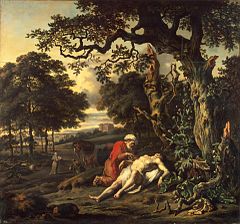 Many of us instinctively think that knowing is something we have in our heads, something we can recite, like a catechism. This is the sort of knowing that the lawyer demonstrates when he recites, correctly, the two great commandments when Jesus encourages him to answer his own question as to what he must do to inherit eternal life. (Lk. 10: 27) But then the lawyer shows a certain ignorance, a missing piece. He doesn’t know who or what his neighbor is. Jesus answers this question by telling a story that pinpoints exactly the missing piece in the lawyer’s cognition.
 There is much theology that treats the Trinity as a mathematical game, trying to work out how three can be one and one can be three. But math, important as it is for many things, is not the way of salvation.
 Luke’s version of Jesus’ Resurrection is much the gentlest among the synoptic Gospels. No earthquakes and no women running off so afraid that they can tell nobody what they had seen at the empty tomb. The women were, indeed, terrified of the two men in “dazzling clothes” who appeared to them. But by the time, but before long they have remembered, with prompting from the men in white, Jesus’ words to them.


 Imaginary Visions of True Peace