Outcasts at the Manger

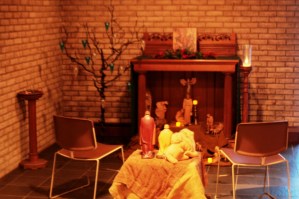
altarXmasStar1We like to be insiders and hate to be outsiders, don’t we? Well, let’s look at some insiders and outsiders in the Christmas story. The people who stayed at the inn in Bethlehem were insiders. A betrothed couple and their newborn baby were outsiders. Shepherds were outsiders, hated and distrusted by all. So why would the angel of the Lord show such bad taste in revealing the birth of the Savior to them?

The Magi were highly-placed insiders in their own country, most likely top advisors of royalty. So why would they travel to another land where they were outsiders? If the star was up there for all to see, why did these foreigners from without and outcasts from within Jewish society respond when others did not?

The Magi, used to being insiders, went straight to the top, to the ultimate insider, King Herod, to inquire about which newborn child the star was indicating. Ironically, Herod was an Idumean, not a full-blooded Jew. He had power, but he was an outsider. Herod’s reaction to the Magi’s inquiry showed Herod to be an outsider to humanitarian feelings once he thought his power was threatened. Mixed racial background aside, being rich and powerful pushes one to the margins of society as much as the poverty of the despised shepherds.

These days, we easily see Herod as an outsider, an intrusive foreign element entering the story only to stir up trouble and grief. The shepherds and the Magi are insiders, like us. How did that happen?

There is a certain sleight of hand that turns us and certain chosen others into insiders when it suits us. Not only do we not wish to be outsiders, we don’t like to be challenged by outsiders. If we realize that the shepherds and Magi and the Holy Family themselves are outsiders, our identities are shaken at a deep level. If it is outsiders who appreciated the richness of the Christ Child, maybe the same thing happens today. After all, some nonbelievers care more about the poor than rich Christians and a Hindu early in the twentieth century believed in the Sermon on the Mount more than the Christians of his time.

The greatest irony is that Christ was born to save all people, to make insiders of all of us. The problem is, we don’t want to be insiders with those who are outsiders and we certainly don’t want outsiders to join us. After all, what would we do if there were no outsiders?

The Word Became Vulnerable Flesh

creche1When St. John says that the Word became flesh and dwelt among us, he is sharing a mystery so deep that we don’t know what to say. The mystery only deepens when we recall that the Word was with God “in the beginning” and without the Word, nothing was made. What is more, the Word was God. Which is to say, the Word is God for all time.

So why would the Word enter into the Creation that the Word shaped? Isn’t that a case of ultimate downward mobility? Later in his Gospel, John says that God so loved the world that He gave his only begotten Son who died on the cross. Suddenly, the Word who in the beginning was with God and was God is much more concrete and understandable. Except why would God and the Word love us so much that they would do that? Looking around at ourselves, there seems to be no accounting for taste.

What is so amazing is that God, who we might think is the ultimate in invulnerability, chooses to be vulnerable. God’s vulnerability is attested by the prophets who spoke of God’s distress over human waywardness and infidelity. But even then, “the boots tramped in battle” in Isaiah didn’t trample the Word who was with God and was God. But once the Word was born in the flesh of a human mother and laid in a manger, the Word had become just as vulnerable to trampling boots and automatic rifles as the children at Sandy Hook School in Newtown, Connecticut and the children slaughtered in Bethlehem by order of King Herod.

Here is where the mystery deepens so profoundly as to escape comprehension. It goes against what we think are our deepest instincts. We do everything to make ourselves less vulnerable from putting on plated armor, to hardening our feelings to buying weapons to defend us for the “slings and arrows of outrageous fortune,” to quote Hamlet. If the Word without whom nothing was made that was made is willing to be so defenseless, than perhaps it isn’t really our deepest instinct to defend ourselves so aggressively after all.

Perhaps if we, like Mary, would treasure these things and ponder them deeply in our hearts, we will find within ourselves a Love created by God that loves so abundantly that it melts all our defenses and we no longer worry about accounting for God’s taste in so loving the world.

Celebrating the Prince of Peace

snowKatrinaCrossBW1This year’s rejoicing over the birth of the Christ Child is darkened by the recent murders at Sandy Hook School in Newton, CT. Lest I be accused of being a killjoy by keeping these two events together, let me remind you that Saint Matthew is just as much of a killjoy when he tells the story of the Holy Innocents who were killed in Bethlehem. Christmas has been darkened by human violence from the start.

When a tragedy like this strikes, it is only responsible to find ways to prevent it happen again, or at least lower the chances of it. The problem with prevention is our tendency to fall into a blame game. Some of it is absurd, such as blaming homosexuals or the banning of prayer from public schools, never mind the countless attacks on schoolchildren that predated that Supreme Court decision. Then there is the NRA. There is unquestionably a long overdue need to re-examine the ubiquity of firearms in our country but we have to dig deeper.

Which gets me to what we need to learn from the baby laid in a manger on a cold winter night. When this child grew up, he became the victim of collective violence in a tense city, the one blamed for that tension. And yet God raised this victim to prove his innocence. When Jesus encountered human problems, he did not blame people, he healed them. Even when he spoke strongly, as he did to the Pharisees, he was trying to heal them. When threatened with violence, Jesus told the disciple who drew a sword to put it back in its scabbard and stay there.

The killing of the children at Sandy Hook was violent, but the casting of blame is also violent. Hacking the Internet pages of the Westboro Baptist Church, egregious though its actions are, is only a further escalation of violence. The problem with the blame game, even when there is some truth to the charges, is that it always distracts us from other factors that are at least as important.  We all need to look at the logs in our own eyes, at the resentments within ourselves that fuel the violent tensions in our society.

The angels appearing to the shepherds sang of peace for all people. Not peace orchestrated by a violent empire, but peace emanating from the human heart that wants to protect not only Jesus from Herod, but all children from all who would hurt them, most of all, ourselves. By taking responsibility for ourselves, we make ourselves responsible to all. Then we can really celebrate Jesus as the Prince of Peace.

See also Two Ways of Gathering

The Need for New Hearts: an Advent Meditation

wreckedTrees1The traditional apocalyptic Advent themes of Death/Judgment/Heaven/Hell fuse in the recent mass shootings, especially the one at Sandy Hook School in Connecticut. A traumatic event like this at this time of year gives us occasion to wonder about the end of the world.

In a memorable poem, Robert Frost mused over whether the world will end in fire or ice. His first thought is that from what he has “tasted of desire,” he holds with “those who favor fire.” The violence of shooting deaths and terrorist attacks is filled with gunfire, suggesting that we should favor fire. René Girard has warned us that with the breakdown of the scapegoating mechanism as a way to hold a violent society together, we run the risk of apocalyptic violence spinning out of control. (See Violence and the Kingdom of God and Human See, Human Want.)

But Shakespeare’s Julius Caesar questions how fiery this violence really is. The opening rebuke of the people: “You blocks, you stones, you worse than senseless things” applies to all of the characters in the play. The ominous oracle of the beast without a heart provides the play’s central image. The heartless violence that drives the plot from civil war to assassination to civil war is all as cold as blocks and stones as well as senseless.

The violence of mass killings and terrorist attacks is frigid.  Frost says he thinks he knows enough of hate to know “that for destruction ice/Is also great/And would suffice.” The powerful understatement is all the more chilling.

There is another way the world could end in ice than cold, heartless violence. Jean-Pierre Dupuy, warns us that our modern economy creates victims through indifference. We literally do not know what we are doing. The final story in my book From Beyond to Here, “Buyer of Hearts,” explores an apocalyptic of ice and indifference. Danny Melton, a boy already bummed out because his father has left the family, suddenly begins to see ghosts floating around the school. He becomes all the more creeped out when he discovers that the people are still alive in the flesh, although “living and partly living,” in the words of T.S. Eliot, is more like Danny discovers that many of his classmates and teachers have sold their hearts for large sums of money. The selling and buying of heart gains more and more momentum as more and more people become hopelessly depressed over what is happening to their families and friends. My story, Dupuy’s warning, and Frost’s poem show us that God gives us humans the responsibility let God create new hearts within us to keep the world from ending “not with a bang, but a whimper.”

A leaky Basket: Judging Judgmentalism

guesthouse1A desert monastic said that contempt and reproaching another person in thought will prevent us from seeing the divine light. The monastic pioneers of the fourth and fifth centuries were constantly admonishing each other to stop judging each other judgmentally. This admonition sounds good until we realize that we always have good reasons for our own judgmental attitudes toward people we know or know about.

In one of my favorite stories about the desert monastics, one of their number had committed an unspecified sin and the other monastics gathered to pass judgment on him. The wisest and most respected elder was slow to come and when he arrived, he carried a leaky basket full of sand. The puzzled monastics asked him what he was doing and the elder replied: “My sins are falling out behind me where I cannot see them, and you would have me judge this brother.” End of trial.

This story warns us that judging another person entails losing awareness of our own sins. The other person’s sins distract us from our own. René Girard’s mimetic theory helps us zero in on an even deeper problem. Reflecting on the shortcomings of others hooks us into a rivalrous relationship with them. Our judgmentalism hooks us into the desires that lead the other to that sin. Perhaps this is why we are often warned that we judge most harshly those people who do what we secretly want to do or maybe actually secretly do them. As with every rivalrous relationship, judging another makes that person an obstacle to self-understanding and, as the elder quoted above warns us, also creates an obstacle between us and God.

It isn’t enough to just look the other way as the desert monastics often did. What is needed is an involvement with the other that is not judgmental but loving. In another story, an elder is called to join other monastics in raiding the cell of a monastic who was harboring a woman. When the elder entered the cell, he saw a hamper and sat on it while the others searched the cell without finding the woman. After the elder sent the other monastics away, he stood up, opened the hamper where the woman was hiding and said to his brother and the woman: “Take care for your soul.”

The convoluted chapters about punishment in Benedict’s Rule (analyzed in Tools for Peace) hint at mimetic traps in dealing with delinquent monastics. Finally, he throws up his hands and says that prayer is the greatest remedy of all. In prayer, we make ourselves the equal of whomever we are inclined to judge and we open ourselves up to God.

Prepare a Way for the Lord: an Advent Meditation

field1John the Baptist calls out to us with Isaiah’s words: “Prepare the way of the Lord, make his paths straight.”  Isaiah here was referring to the return of God’s people to their rightful home from which they had been uprooted by the Babylonians. Even today, we live in exile, not living our lives in God as we ought. The call to repentance (metanoia) in John’s baptism means, literally, to turn our minds. This does mean just filling or minds with new books; it means turning our whole embodied selves in a new direction to see and live in a different way.

Isaiah prophecies a leveling process where the valleys are filled in, the mountains are brought low, and the crooked ways are straightened. That is, the obstacles within ourselves and within our culture that prevent God from coming to us must be removed. The image of leveling seems to suggest a social upheaval where the mighty are brought low and the lowly are raised up so that all are on the same level. This would be to overlook the real obstacle to God: our tendency to compare ourselves with one another without reference to God, preoccupied with being better than others or fretting that others are better than us. This preoccupation and the resentments they foster maintain the isolating barriers of valleys and mountains and block the way to God.

The repentance that Isaiah calls for is the renunciation of our rivalrous entanglement with others and allow for God’s leveling process that holds everybody in the same regard without exalting some or lowering others. Unfortunately, while God is smoothing out the way for us, we prefer to maintain the barriers that we think protect us. Opening a highway for God makes us vulnerable, not only to God but to all of God’s people. Take out the valleys and mountains and anybody could come deeply into our lives! Isaiah gives us fair warning by declaring that “all flesh shall see the salvation of God.”

Like all analogies, the analogy of smoothing out the landscape has its liabilities. Flat ground makes for boring scenery. Valleys and mountains make for beautiful scenery. God doesn’t destroy the landscapes God has made. That means, if we turn our embodied minds, we see that God’s leveling process is to rejoice in the valleys and mountains and twists of the road without rivalry or resentment.

Ignominious Glory—Glorious Ignominy: a Doxology

Since when is glory ignominious ? Probably since humans first became concerned about what others thought of them. Seeking glory from others is a sure way to get its opposite as  celebrities know all too well. In the New Testament the Greek word doxa is sometimes translated as “glory,” sometimes with “shame.” How can one word mean two opposite things. James Alison says that is because the word means “reputation.” What kind of reputation? Any kind of reputation.

The Harry Potter books give some interesting examples of the double-edged meaning of doxa. Harry arrives for his first year at Hogwarts as a celebrity, not for anything he had done but because he had survived Voldemort’s attack when his mother gave her life to save him. In his second year at Hogwarts, Harry is blamed by many for an epidemic of people turning into stone although he had done nothing to earn this ignominy than he had done to earn his celebrity status. In the fourth book, when Harry’s name is entered in the competition in a questionable way but through no fault of his own, there is bad feeling towards him from students of all three schools involved. (Spoiler alert!) His defeat of Voldemort has no external fireworks and he ends up with a quietly respectable position in the wizard world without celebrity status.

Bob Dylan has been praised as one of the greatest poets and songwriters of our time but he has also been the object of much ignominy with every turn in his career. He did not receive it for drugs or sex, but for using electric guitars instead of a simple acoustic guitar like a true folk singer. Then he got it for seeming to relax and live an ordinary life, as if living an ordinary life is a scandal! The worse ignominy was for turning to Christ and doing some Gospel albums.

Speaking of Christ, in his Gospel, John plays with both sides of the meaning of doxa in relation to Christ. Jesus seeks doxa from his Father while the people who put him to death or keep their sympathy for him a secret because  they seek doxa from other people. So it is that doxa inevitably falls into sacrificial violence if reputation is sought from people instead of from God. The raising of the cross is Jesus’ doxa. That is why God has such a bad reputation nowadays. Where do we look for our own reputations?

Divinely Created Abundance

Here is a little thought experiment in spirituality. Imagine being a child who is carrying five barley loaves and two fishes. A crowd has gathered to listen to a man speak. You stop to listen. Maybe you are intrigued; maybe it goes over your head. After a while, you realize that many people are hungry. You are hungry too but you don’t need all the food you are carrying just then. Maybe it occurs to you that you could make a lot of money by selling a fish and three or four of the loaves to the highest bidder. Before you have a chance to act on this idea, one of the men surrounding the speaker asks you to come meet the speaker. Maybe you are nervous about this, but you want to know why such a man should want to talk to you. To your shock and surprise, the man tells you that the people all around are hungry and would you be willing to let him give the bread and fish to the crowd. Before you can reply, one of the men says “But what is this among so many?” You are asking yourself the same thing, but the speaker shrugs off the question. What do you do?

As we know from John 6, the lad with the loaves and fishes gave them to Jesus and Jesus fed the crowd with an exponential amount of food scraps left over. One fairly well-known theory is that the boy shamed everybody else into sharing their food when he handed over what he had. Maybe that is what happened. That would be a good example of a mimetic process creating abundance instead of scarcity (see Humanly Created Scarcity.) The references to God’s feeding the Israelites in the desert and the amazement in the narrative suggest that Jesus was re-enacting God’s act of creation in the wilderness. The miracle takes on all the more powerful when we realize that Jesus did not create food out of nothing which presumably he could have done, but he created out of a human act of giving. This miracle, recorded six times in the four Gospels show us that God desires abundance in the sense of everybody having enough. (The manna in the desert spoiled if anybody tried to take too much.) But God provides through multiplying our human generosity to others as the boy gave up the five loaves and two fishes to Jesus in the wilderness. Can we imitate this boy as this boy imitated Jesus?

For more see Violence and the Kingdom of God and Tools for Peace

Humanly Created Scarcity

Scarcity is often believed to be part of the natural order, but is it? It is true that material goods in the world are finite and in times of famine they are more finite than usual. But let us revisit the story in Human See, Human Want. In a house filled with balloons, all of the children suddenly started fighting over one balloon when one child made claim to it and that balloon alone. Suddenly, where there was abundance, there was scarcity. It is as if a magician had waved a magic wand to make all the other balloons in the house disappear. The image of a magician is not so far-fetched. Mimetic desire, the tendency to copy the desires of other people is an enchantment as Shakespeare’s Midsummer Night’s Dream demonstrates. The four besotted and confused young people were enchanted before Puck engaged in his pranks. When two or more people fight over one lover, then lovers suddenly disappear.

This is to say: rivalrous mimetic desire creates scarcity where there was abundance and increases scarcity in times of famine. Our desires are not linked directly to objects of need and intrinsic desire, but are linked to our rivals. It seems so natural to want to keep up the same standard of living as our peers or, better yet, surpass them. When rivalry rules the day, there will always be victims.

Now that the political campaigns are over, at least for a few days, maybe we can see how the rivalry involved creates scarcity that other people cannot afford. The amount of money donated to the political campaigns was massive. As soon as one side got more money it was imperative for supporters of the other side to give at least as much money. All so that more ads tearing down the opponents could pollute the air waves. Just think of all the infrastructure and educational aid and health care could have been bought for all that money! Not to mention having money for the victims of Hurricane Sandy. It’s interesting that health care has come to be seen as a rare commodity to fight over.

The alternative to mimetic rivalry can be stated quite simply: Pay more attention to what you really need and care for and wish for other people to have what they need and really care for. Why is this so hard? As the example of the children and the balloons shows us, mimetic rivalry seems to be natural. The creation of world narrated in Genesis Chapter One says otherwise. What is natural is God’s abundance and care for all creation. Why is it so hard for all of us to desire that?

Marriage of Figaro

I watched Mozart’s Marriage of Figaro while in New York this week, and was impressed with the deep insights into mimetic desire this opera offers. (cf. Human See, Human Want) The opera centers on Count Almaviva’s desire for his servant Susanna who is betrothed to the count’s servant Figaro. For all of his roaming for women, the Count seems not to have desired Susanna until Figaro desired her and wished to marry her.

Meanwhile, Marcellina, a servant of Dr. Bartolo, wishes to marry Figaro and Dr. Bartolo, wishing revenge for Figaro’s helping the count marry Rosina when he himself had desired her, supports his servant’s claim based on Figaro’s unpayable debt to her. This triangle becomes farcical when it turns out that Figaro is Marcellina’s son begotten by Dr. Bartolo himself, who had done with his servant what the count wants to do with Suzanna.

The adolescent servant Cherubino provides a comical mirror image of the count in that he also desires all women, especially the countess, the only woman the count does not desire. This infatuation does not make him a serious rival to the count, but he becomes entangled with Rosina and Susanna’s plot against the count.

The count only shows any desire for his wife when he believes (mistakenly) that she is desired by another. In Act 2, he believes Cherubino was flirting with his wife and was hiding in the closet (which he was until Susanna helped him escape). When it is Susanna who emerges from the closet, an uneasy forgiveness ensemble ensues that foreshadows the opera’s finale, but then unravels when the gardener complains about somebody (Cherubino) jumping into the flower garden.

The abortive plans of Act 2 to trick the count come to fruition in the last two acts where Rosina and Susanna disguise themselves as the other and so entrap him so that the count has no choice but to drop to his knees and ask his wife’s forgiveness, which se freely gives.

The disguises and mistaken identities throughout the opera dissolve the characters into the indifferentiation of mimetic desire. At a deeper level, Mozart’s music weaves a unity out of the passions of all these characters so as to unite them in the mimetic desires, a unity transcending the class differences of the characters and creating a vision more subversive than the play by Pierre Beaumarchais used by the librettist Lorenzo Da Ponte.

The noble forgiveness scene is as fragile as it is beautiful; a fragile fleeting vision that can be blown away by the next breath of mimetic desire.