Proving Shylock Right—Or Wrong

ShylockThe first thing that usually pops into anybody’s mind when Shakespeare’s The Merchant of Venice comes up is the cardboard stereotyped Jew Shylock. After Auschwitz, we cannot slip into enjoying this caricature the way earlier audiences might have if so inclined. On the contrary, we are apt to dismiss the play now that we realize how lethal such stereotyping can be. The second thing about the play that usually comes to mind is Portia’s set of three boxes where it is not the gold or silver covers that lead to her riches, but the unattractive lead cover. Appearances can be misleading and so perhaps it will be worth looking for what is beneath the ugly stereotyping.

It’s hard to find any gold under the ugly exterior of Shylock’s behavior, but it is equally hard to find any gold under the apparently more attractive exterior of Antonio’s behavior. Antonio is noble in that he is willing to give surety to a loan for his friend Bassanio, thus accepting the risk, but the way he treats Shylock is shameful. In one respect, Shylock is offering to do good to an enemy, but in another, he is hoping that the interest-free loan will lead to Antonio’s downfall by the extraction of a pound of flesh. It is important to realize that both men are mimetic doubles, rivals in the quest for increasing wealth for the sake of wealth.

In Shylock’s famous speech, when he is taken to task for his vengeful terms, he insists he is exactly the same kind of man as any of his Gentile rivals:  “If you prick us, do we not bleed?” Which is what would happen to Antonio if a pound of flesh is cut out of him. “If you wrong us, shall we not revenge? If we are like you in the rest, we will resemble you in that.” Shylock’s detractors are trying to distinguish themselves from Shylock because they are merciful, but mercy is conspicuously lacking in their treatment of Shylock.

Meanwhile, Bassanio is often thought to have proven himself wise by choosing the lead casket, which wins him the hand of Portia in marriage. The speech he makes before making the choice, however, shows that he is not wise by cunning and calculating in his own desire for wealth. “Thus ornament is but the guiled shore/To a most dangerous sea.” Bassanio is so used to disseminating that dissemination is what he expects of Portia. And he is right.

The famous trial scene features Portia’s famous praise of mercy: “The quality of mercy is not strain’d,/It droppeth as the gentle rain from heaven.” This is as golden a speech as any in Shakespeare. But—mercy is—again!—lacking in dealing with Shylock. By the end of the trial, he has lost his wealth, his livelihood and his religion. Portia’s words seem to echo Ecclesiasticus 35:20: “Mercy is seasonable in the time of affliction as clouds of rain in the time of drought.”  But her actions belie the beautiful words, thus proving Shylock right when he says that when wronged, Christians revenge—just like Shylock. Unfortunately, we have a golden casket with nothing rich inside. The words, however, really are golden and invite any of us who rejoice in Shylock’s downfall to open our hearts to accept this gift from heaven.

Ignatiusly Reading

Ignatius_of_Loyola_(militant)[This is a companion post to Quixotic Reading]

Reading in a life-giving way is not primarily a matter of reading but of living; of how we read our lives. Don Quixote idolized Amadis of Gaul, Emma Bovary idolized her lovers and Werther idolized Lotte. The primary reason for the Werther effect is that readers of Goethe’s novel committed the same idolatry through mimetic desire as did Werther. If we are too embroiled in our mimetic desires to have eyes to see what Cervantes and Flaubert see, then we will only see what Goethe seems to have been able to see when he wrote Werther: the despair of desiring a woman desired by another who has made that woman unattainable. That is, the way the readers of Werther were living their lives affected their reading and their reading reinforced the way they were living their lives.

In his incisive study of Don Quixote (The Humble Story of Don Quixote; Reflections on the Birth of the Modern Novel) Cesario Bandera leads us to the heart of the Don’s problem and ours: “God-like Amadis is not God. God transcends empirical reality but does not ignore it or make it irrelevant.” The more we look at the world around us and interact respectfully with it, the less apt we are to be swept away by the fantasies of mimetic desire. God “demands an absolute act of faith beyond empirical reality, but such an act of faith does not obliterate the inherent rationality of the world ‘out there.’ The act of faith is essential only to prevent empirical reality from becoming a god unto itself, an idol.” (p.155) Bandera is alerting us to the problem of allowing our models to distort the world around us, making models like Amadis or Albert (Lotte’s husband) the lens through which we interact with the world instead of God.

Ignatius of Loyola provides an instructive contrast to Don Quixote. According to his Autobiography, Ignatius liked to read the same sorts of chivalrous romances the Don Quixote did and, while he was recovering from his battle injuries, he asked for this sort of literature, but only a life of Christ and a book of the lives of the saints was available, so he read those instead. These books changed not only what Ignatius read, but how he read. Not only did he stop to think about the things he was reading, he also stopped to think “about the things of the world that he used to think of before.” That is, Ignatius was using what he read to connect him to real life, the life God had created rather than what life looks like through the lens of an idol like Amadis. During this time of struggle and repentance, Ignatius then confesses his infatuation with the idea (not reality) of going into the service of a “certain lady,” oblivious to “how impossible it would be.”

But then Ignatius started to think about what it would be like to imitate Saint Francis or Saint Dominic who had imitated Christ? Such thoughts gave him consolation that thoughts of soldiering and chivalry did not give him. Here were models that were challenging but not impossible. Ignatius was spurred on to develop a spirituality based on the imitation of Christ, not an imitation of external actions only but, more important, of cultivating the inner disposition of Christ’s charity for others that was to become the backbone of his Spiritual Exercises. Bandera draws the contrast for us when he says that “unlike Christ, Amadis cannot give his follower what he wants without ceasing to be Amadis.” (P.157) That is, Amadis, if real, would be what Girard calls a model-obstacle whom Quixote would need to best in combat, which would change Amadis for the worse if Amadis was vanquished. Christ, on the other hand is a model without rivalry, who wishes to be imitated without rivalry. Ignatius discovered that Christ creates an abundance of charity that can only become more abundant through imitating him. The idea of imitating Jesus led to a real pilgrimage to Jerusalem and then to a real spiritual pilgrimage of imitating Christ for the rest of his life.

Quixotic Reading

Don_Quijote_and_Sancho_PanzaIt is both interesting and significant that the mimetic desire revealed in two of the novels discussed by René Girard in Deceit, Desire & the Novel are derived, not from other people, but from characters in literature.

Don Quixote famously went mad with a desire to imitate Amadis of Gaul in the medieval romances of this knight errant, while Madame Bovary’s desires were fueled by the sentimental novels she read. The literature consumed by both characters gives them distorted visions of reality. Don Quixote mistakes windmills for evil giants and a barber’s basin for a knight’s helmet. Madame Bovary sees the lovers of her life through the lens of the romance novels and fails to see them as they really are until it is too late.

Of the two, Don Quixote is much more removed from “reality” than Madame Bovary. Yet, although the novels Madame Bovary has read seem to mirror “real life” and are thus “realistic,” it is she who seems to be even more confused about “reality” than Don Quixote, to the point of being smothered by fantasy so that what self she has disappears. C.S. Lewis offers us a key insight here when he says : “Children are not deceived by fairy tales; they are often and gravely confused by school stories. Adults are not deceived by science fiction; they can be deceived by the stories in the women’s magazines.” Lewis seems a bit sexist here but the underlying point is clear enough. “Realistic” stories present models and stir up desires that seem realistic but are traps that catch the unwary reader.

Curiously, Don Quixote’s fantasies have a contagion of their own. An unnamed man accuses Don Quixote of having a “talent for making anyone who has anything to do with you mad and senseless.” It is curious that Don Quixote is blamed for the insanity of others, as the other people are arguably making themselves insane by staying on Quixote’s case to the point of obsession. In the second part of the novel, a duke and duchess spend huge amounts of time and expense to mirror Don Quixote’s desires in theatrical fakery. They themselves seem to be caught up in Quixote’s madness as much as their victim.

In both cases, there is something of a collective violence around a victim. In the case of Don Quixote, his singularity provokes a spontaneous, improvised conspiracy to bring him to his senses. In the case of Madame Bovary, the social system of mimetic desire is fully developed to the extent that both Madame Bovary and her irresponsible husband and lovers all act like puppets of the ambient fantasy fueled by the novels and the culture industry.

Novelists such as Cervantes and Flaubert are faced with the enormous challenge of revealing the truth of mimetic desire in a medium that is normally used to reflect and fuel mimetic desire. After all, it is the latter tendency that makes huge profits for the producers of this and other media. In the second part of Don Quixote Cervantes does not disguise his indignation over copycat offshoots of his work and other ersatz imitators. Perhaps the main thrust of the second part was to mirror the misunderstandings of his readers in the Duke and the Duchess.

It isn’t enough to write novels revealing mimetic desire. Also needed are readers who can truly see what these novels reveal. If Cervantes was exasperated by the readers of his time, imagine his apoplexy over a musical featuring an inspirational song about following impossible dreams. For Cervantes was showing us in his novels that successfully imitating fictional characters is truly impossible. Don Quixote could not live Amadis of Gaul’s life any more than Emma Bovary could live the lives of heroines in the novels she read. They could only live their own lives, which they failed to do.

Werther is another fictional person who was widely imitated for a time. Heartsick and overwhelmed by his mimetic desire for a woman already promised to another man, Werther kills himself. The publication of Goethe’s novella was followed by an epidemic of suicides throughout Europe. This phenomenon is still called the Werther effect. Drowning in the mimetic desire of fictional characters can be deadly.

So how do we read in a way that is life giving? The short answer is to seek life where it can be found, where Don Quixote found it at the end, in repentance. I will give a slightly longer answer in my next blog post.

Respecting All Things that God has Made

buddingTree1The Book of Common Prayer gives us an important focus for Lent by starting the collect for the Ash Wednesday Eucharist with “Almighty and everlasting God, you hate nothing you have made and forgive the sins of those who are penitent.” So often, we blame the material world for our sins and then hate what God has made which God also loves. In a sense, the material world becomes a scapegoat for our own disordered desires. If we eat too much, it isn’t really the fault of the food, though we quickly blame it for our own lack of self-control. Women, of course, have been blamed for being “tempting” as if it is their responsibility to control the desires of men while men need take no responsibility for themselves.

To complicate the picture, René Girard has demonstrated many times in his books that our desires are intertwined with the desires of others in a dense network of mutual imitation. If we become ensnared in desires for certain things or certain people because others desire them, we are in a frustrating situation and, again, it becomes convenient to blame the other people and other things for the pickle we are in.

We need to remember that God is our model for perfect love for all that God has made. That means that, unlike Zeus and many other mythological deities, God does not lust after humans but loves all humans with perfect respect. The more we respect other people and all things in the world, the more restraint we have in relation to them. So it is that when we repent and turn to God, we also turn to all things and to all people that God has made with new respect and love.

Twin Killings

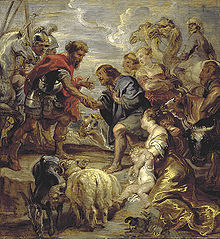
220px-Rubens_Reconciliation_of_Jacob_and_EsauIn baseball a twin killing is a double play: two outs on one batted ball. “Two for the price of one,” as the great Detroit Tigers great sportscaster Ernie Harwell called it. Double plays are a legitimate part of baseball. But there is another kind of twin killing that has been a part of humanity until close to the present day that is not legitimate: the killing of twins.

Why was one, and sometimes, both twins been killed in early societies? René Girard suggests that it was the fear of what he called “mimetic doubles,” two people united through conflict. After the social chaos was resolved by collective violence, societies created structures to prevent the repeat of the chaos as much as possible. Twins, especially identical twins, were too much of an image of the indifferentiation that lead to conflict. They could not be allowed to live. During the time of chaos, indifferentiation was precisely the problem as differences between people melted in the heat of conflict. It is obvious to us now that these babies were innocent victims of society’s fear of mimetic doubles, but in today’s society where social differences are dissolving, perhaps we should fear, not twin babies, but mimetic doubles.

The authors of Genesis had no illusions about the danger of mimetic doubles. Brothers paired off against each other are the driving force of the book, culminating in Joseph’s brothers ganging up on him. Jacob and Esau were twins. The conflict that kept them apart for many years finally resolved in an uneasy reconciliation as Esau turned out to be more forgiving for the wrongs done him than Jacob ever believed possible.

Lois Lowry’s chilling dystopia The Giver also has a twin killing. The society is shown to be peaceful but colorless. (Literally so, as we learn when the protagonist, Matthew, begins to see colors.) It becomes apparent that everything is designed to prevent conflict. There is no courtship or sex; medication stifles the latter and babies are grown in test tubes, implanted in adolescent girls, and distributed to couples, each of whom gets one boy and one girl. Not surprisingly, the cost of this “peaceful” society is high. When Matthew is apprenticed to the Giver, he learns that it is his job to keep track of everything that is happening via TV monitors but to do nothing unless asked, as the job is consultative only. A day or two before Matthew makes his escape, he watches his own father “release” one of two twin babies with a lethal injection, the normal way of releasing somebody. (The elderly are so released at a certain age after a celebration of their lives.)

Much else is shown to be wrong with this society but the killing of a twin shows clearly enough that preserving the peace by squelching mimetic doubles inevitably institutionalizes violence, even if, as in Lowry’s society, it is kept invisible. René Girard would argue that one of many effects of the Cross and Resurrection is that we don’t kill twins and we have the freedom to build God’s kingdom where we actualize the freedom shown by Esau to forgive and then later by Joseph to his brothers. It is no longer possible for social structures to contain the potential violence of mimetic doubles in conflict. It is possible, and in our times, necessary to renounce conflict, even if it means forgiving the theft of a blessing. This renunciation leads to its own blessings. After all, Esau had done pretty well for himself while Jacob was away.

Principalities and Powers

WilliamGuestsChurch1Jesus was not crucified by just one person; he was crucified by a social system. The Gospels and the apostolic preaching in Acts show clearly how hostile social systems in Jerusalem came together to create a larger social system that was united solely by the agreement to put Jesus to death. By quoting from the persecution psalms, these sources suggest that persecutory social systems have always been a part of humanity. René Girard has demonstrated how mythology covers up and yet still points to this same persecutory mechanism. It is such social systems that Paul calls the “principalities and powers” of the world. These principalities get their power from the collective cohesiveness of persecution. This collective power is overwhelming to the individual within this system. Hence the transcendent power they have for Paul. However, Paul also says that the principalities and powers have been dismantled and nailed to the cross by Jesus. The forgiving victim is gathering a radically different social system that not only does not require the sacrifice of the victim but totally precludes such a thing. Paul says that if the principalities and powers had known, they would not have crucified the Lord of Glory. Because they did, we have some ability, by the grace of God, for seeing the fundamental signs of a society that is still run, at least in part, by the principalities and powers and for seeing what are the signs of the Kingdom that the Risen and Forgiving Victim has opened up for us.

A society run by the principalities and powers is punitive. Some people may think that is a good thing, but in  a punitive society, somebody must be to blame whenever anything goes wrong or even seems to go wrong. That is, somebody must be punished. When a society needs to have somebody punished, then this need takes precedence over justice. It is better for an innocent person to suffer than for the corporate rage of the society to suffer for lack of an object of that rage.  It follows that the Law of Tit for Tat reigns. There is no room for mercy. Every offense must be met in equal measure. As long as this Law reigns, there is no end in sight to the spiral of retaliation. In Jesus’ Kingdom, restoration of relationships is the corporate desire when things go wrong. The pain of this restoration might feel like punishment for some, but the pain is remedial, moving toward reconciliation.

In the society of the Principalities and Powers, somebody is always expendable. Caiaphas’ dictum that it is better that one person die than that the whole nation should perish is “gospel.” Collateral damage is an acceptable price to pay for objectives deemed good to those who are running the show. Jesus’ parable of the lost sheep that the shepherd seeks until he finds it and brings it back to the fold shows that in Jesus’ Kingdom, nobody is expendable.

The society of the Principalities and Powers is dualistic.  There has to be an “in” group and an “out” group. The society’s identity is based on what is wrong with those people, the enemy.  If we are to love our enemies, as Jesus teaches, then enemies do not define us in any way.

Most devastating of all, the society of the Principalities and Powers is mendacious. The need to cover up the truth of collective violence in primitive societies carries over to the most sophisticated of modern societies. Part of this mendacity is to blame the victim. The blame that many US politicians cast on women who are raped is a particularly grisly example. Victims of lynching, too, were blamed for what happened to them.

Here is the choice. Where is our treasure? Where is our heart?

Blueprint of the Kingdom

buddingTree1The blueprints for a building are a lot less exciting and interesting than the building itself. However, blueprints are useful for showing the fundamental shape and structure of the building at a glance. The readings for Epiphany 3A are more like a blueprint for the Kingdom of God than a tour of the Kingdom in its fleshed-out form.

In Mt. 4:17, Jesus says:  “Repent, for the kingdom of heaven has come near.” Repenting does not mean to make a laundry list of our little sins and try to stop doing them. Repenting means to turn around, to switch our minds and our hearts, to see life in a new way. This is the fundamental thrust of the Kingdom. But what specs can we get from the blueprint?

The quote from Isaiah, especially the part about Zebulun and Naphtali may not seem exciting but they show some important shapes in the blueprint. These places in Galilee are Gentile territory, lands of the enemies of Israel, lands that were occupied by the Assyrians in their invasion of Israel. The darkness has to do with the power and might of military occupation and enmity between peoples. Isaiah’s saying that God broke the rod of the oppressor as on the day of Midian suggests that God’s Kingdom will free us from military force that inevitably creates darkness. Reconciliation with the Gentiles involves forgiveness for past wrongs, even past atrocities such as those committed by the Assyrians and then the Romans in Jesus’ day. Matthew notes that Jesus moved to this area of Galilee after Herod’s arrest of John the Baptist, another instance of Roman oppression. One might feel this is not applicable to most of us because most of us are not high government officials or military leaders. However, all of us live either in a country bursting with military might or in a country that is in some way, perhaps economically, occupied by another. That means we need to turn away from anything that contributes to the enmity this situation creates and start breaking the yokes we impose on each other.

In First Corinthians, Paul gives us another example of darkness that is very close to everyday life for all of us. The church is in conflict with its members using slogans such as: “I belong to Apollos!” “I belong to Cephas!” One could say that this is war on a small scale but the darkness is the same as that created by the Assyrians and the Romans. Paul suggests that the light of the kingdom which Jesus is bringing near is to be “united in the same mind and the same purpose,” which for Paul is the mind of Christ, whose cross is foolishness for those who are perishing in the darkness of violence but is the power of God for those being saved.

The “power of God” doesn’t look much like power as we usually understand it. It isn’t exactly a large-scale military invasion like D-Day. In fact, it is quite the opposite. But the cross is power in the sense of shedding light in the darkness which John says the darkness cannot overcome. The light reveals the darkness of the military might of the Assyrians, the Romans and all else who imitate them. The light also reveals the hatred of victims for their oppressors, however understandable, for what it is: a wall of enmity that perpetuates divisions between people. As I struggle with my almost constant anger at many politicians in this country for their misuse of power and the public trust, I have to repent of this anger minute by minute.

Where does this darkness come from? Isaiah and Matthew are not portraying darkness as part of the created order in the sense that night time is natural. This is not darkness that God made, or in fact had anything to do with. This is darkness as a human creation. It is human beings who organize armies to oppress people or who tear congregations apart with petty party politics. This sort of behavior is highly contagious. The more people build walls or fight, the more people feel the need to build walls and fight.

What does the Kingdom of God, founded on the foolishness of the cross look like? The blueprint we have in these readings doesn’t look like much, but then a crucified criminal in Roman times doesn’t look like much either. When we read just a bit further in Matthew, we enter the real-life rooms of the Kingdom outlined in the blueprint. We find many rooms, many mansions, all of which offer contagious possibilities such as being blessed for being poor or for being a peacemaker, or turning the other cheek or walking the extra mile, and then finding in these weaknesses the rock that supports the house of faith we are building against the storm of Rome and Assyria and the power brokers of our time.

I Me Me Mine

abyssEach of us knows what my own self is, right? Yeah, my self is right here, right inside of me, running my life. My self is who I am. What could be more obvious? “Everyone’s weaving it, coming on strong all the time!” Hmm. Who is doing the driving, who the weaving. “I-me-me-mine” is doing it according to George Harrison put it? So where is my self in all this?

If René Girard is right, then the human self is not in the midst of our desires, I-me-me-mine, where we tend to locate it. Rather, we derive our desires from the desires of other people and they from us. (See Mimetic Desire and Mimetic Rivalry) Well, we don’t want other people driving our desires or snatching ours away, so we fight back, insisting that I-me-me-mine is the one who wants whatever it is and others are copying I-me-me-mine. The problem is, the whatever-it-is falls away as a desire defining the self and the entire self of I-me-me-mine is embroiled with this rival. Some autonomy. So, I-me-me-mine will try refusing to desire what anybody else desires. This is resentment. Of course, resentment I-me-me-mine me into the enemy’s desire since opposition to a desire is as strong a driving motor as combat over the desire. (See Resentment)

This spiral of desire tilts I-me-me-mine to the abyss that shows this desiring self to be an illusion, a void. While reflecting on Chuang Tzu’s Taoist writings, Thomas Merton suggested that “it is the void that is our personality, and not our individuality that seems to be concrete and defined by present and past, etc.” This “not-I” is seen by Chuang Tzu and Thomas Merton as a source of freedom, but “we are completely enslaved by the illusory.” (Merton & the Tao)

In New Seeds of Contemplation Merton warns us that “every one of us is shadowed by an illusory person: a false self. This is the man I want myself to be who cannot exist, who cannot exist because God cannot know anything about him.” The false self a.k.a. I-me-me-mine, is constantly in rivalry with other false selves who have the same alias. “All through the night, all through the day, everyone’s saying it, flowing more freely than wine.” Like Merton, George Harrison warns us that an epidemic of desire threatens to flood the whole world.

We aren’t lost in this abyss of “not-I.” If we let go of the matrix of desires that I-me-me-mine clings to, than we find ourselves called by name. This calling voice asks us why we are persecuting him? Persecuting? We weren’t doing nuthin’. I-me-me-mine’s desire machine blinds us to what we are doing to other people, all of whom Christ identifies with.

When we answer with our names to the voice in the abyss, the self is still not-I, but that does not matter because the Persons of the Trinity are filling this void with their forgiving love that clarifies what all this forgiveness is about.

Well, Jesus did say something about dying in order to live.

Eucharist (3): Discerning the Body

eucharist1St. Paul solemnizes his recounting of Jesus’ breaking bread and passing the cup of wine by saying that he is passing on to the Corinthians what he had received from the Lord. The words Paul uses here are specialized terms for receiving and passing on a sacred tradition. The only other time Paul uses these terms is to testify to Jesus’ Resurrection appearances. Resurrection and eating and drinking to “proclaim the Lord’s death until he comes” go together. After all, does not the Lord come every time we eat the bread and drink the wine?

These solemn words are an island of peace and tranquility in the middle of a storm of human passions amounting to farce. Preceding them is Paul’s denunciation of the insensitive and chaotic eating habits where some people bring opulent meals to church and eat in front of poorer members who have little or nothing to eat. The deterioration of the sharing in the wilderness that began in John’s Gospel has only gotten worse. After holding up Jesus’ shared meal as a model, Paul warns against eating and drinking judgment by “not discerning the body.” Paul may be warning us not to fail to discern Christ’s body in the bread, but he is not thinking in individualistic terms. Christ’s body surely refers to the church and, given the context, Paul is concerned with failure to recognize this corporate body in the way we share, or fail to share what we have with the community. In his fit of tempter, Paul seems to suggest that the Body and Blood of Christ make people sick cause some to die. But considering how strongly Paul insists on God’s freed Gift of grace, Christ Body and Blood can only be more free grace and forgiveness. However, when we fail to see the Body and Blood in Christ in others, sickness, hunger and many more social ills will abound.

With a church in shambles, is the miracle of the Feeding in the Wilderness a distant memory? I noted in the first article in this series that memory is not just recalling something in our heads. Memory is making present. When we eat the death of Jesus, we enter into our own discord that tears the Body apart with cries such as “I am of Cephas!” “I am of Apollos!”  When we eat the Resurrection of Jesus, we eat the forgiveness with which Jesus greeted is disciples to gather them back together. We also eat the feeding in the wilderness and Jesus’ Desire to heal the people brought to him.

We are not left as orphans who have to try to stuff some ideal of human relating into our heads. We are invited to act with others the human drama of entering into God’s Desire for ourselves and all others. Most important, we are fed with the substance of God’s desire to quicken us on the way.

 Eucharist (1): Christ our Passover

Eucharist (2): Feeding in the Desert

Eucharist (1) Christ our Passover

eucharist1

Baptism is our initiation into the Paschal Mystery where the death and resurrected life of Christ begin to shape our lives. But how do we keep going so that we can finish what we start so that we are not like the person who started to build a tower and didn’t have the resources to complete it? This question is all the more urgent for those of us who were baptized when we were infants, before we knew what was happening to us. (I don’t dispute for a minute infant baptism for the purpose of raising a child in the shape of the Paschal Mystery.)

Clearly it is the Eucharist that feeds us on the way we have started with baptism. St. Paul’s line “Christ our Passover is sacrificed for us” that we say just before the distribution of communion says everything about the sacrament and more. What is all the more astounding is that, as Robert Daly says in Sacrifice Revealed, it’s a throwaway line said in passing while writing about something else. That indicates how fundamental a presupposition it was in the early church.

The Passover, of course, re-lives the deliverance of the Jewish slaves from Egypt. The roots of the Passover are obscure but it may have been a protective rite of shepherds that the Jews were performing at the time they were expelled from Egypt for causing the plague that killed far more Egyptian children than Hebrew children. Nowadays, there is the simple scientific explanation that the Hebrew slaves were rigidly segregated from the Egyptians so that it is reasonable that one social group could escape a plague that struck the other. (Medieval cities copied the Egyptians by blaming the Jews for plagues that struck them and expelling them when we now know that the Jews were more intelligent about matters of hygiene.) When Jesus welcomed the children whom his disciples tried to keep away, he demonstrated for all time that God is not a child-killer.

The Passover quickly moved away from its sacrificial origins and became a domestic feast as outlined in Exodus 12 that is to be repeated every year. (In Jesus’ time, the temple priests slaughtered the Passover lambs for those who had come to the Holy City for the feast. In John’s Gospel Jesus was crucified precisely at the time that the Passover lambs were slaughtered.) As the Passover became an oft-repeated practice of remembrance of God’s deliverance, the Eucharist is an oft-repeated renewal of our baptism. Just as the death and resurrection of Jesus are made present at baptism, they are again made present in the Eucharist. For those who, like me, enjoy science fiction and fantasy literature, we could note that these sacraments constitute time travel of a sort.  This time travel is not to change the past but to change the present and the future. (The Greek word anamnesis means memory in the sense of making the remembered event currently present. The fundamental change is to bring ourselves and our communities out of sacrificial, persecuting societies into forgiving societies grounded in the forgiving victim.

In Exodus 12, there is a sense of urgency with the Passover. It must be eaten “in haste.” We don’t usually feel this same sense of urgency while celebrating the Eucharist, but maybe we should. Insofar as we are governed by Pharaoh’s way of living, we really shouldn’t waste any time moving out of that way and entering more deeply into the way of the forgiving victim. The bread and wine are gifts to give us what we need to finish what we started. When we eat Christ our Passover, we need to ask ourselves: How ready and willing are to pass over from one way of living to another? How willing are we to serve one another as demonstrated by Jesus’ washing the disciples’ feet?


Eucharist (2)  Eucharist (3)  See also Baptism (1)