
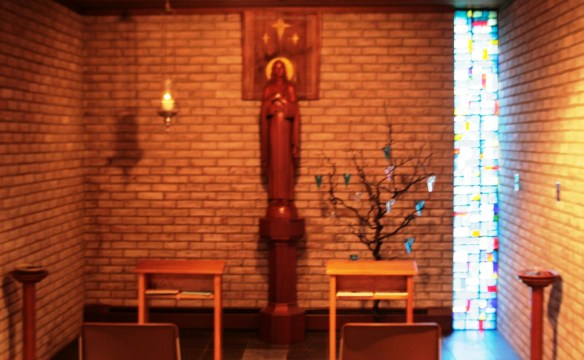
The Throne of David – Part One

MaryWhen the angel Gabriel announced to Mary that she was to conceive and bear a son, the angel said that her son “will be great, and will be called the Son of the Most High, and the Lord God will give to him the throne of his ancestor David. He will reign over the house of Jacob forever, and of his kingdom there will be no end.” (Lk. 32–33) However, the prophet Nathan made this same promise to King David: “Your house and your kingdom shall be made sure forever before me; your throne shall be established forever.” (2 Sam. 7: 16) Likewise, Psalm 89 say that David’s “line shall continue forever, and his throne endure before me like the sun. It shall be established forever like the moon, an enduring witness in the skies.” (Ps. 89: 36–37)

But the throne of David’s house came to an abrupt end with the Babylonian conquest and exile. Right after echoing the promise to David, Psalm 89 went on to declare its falsity: “But now you have spurned and rejected him; you are full of wrath against your anointed. You have renounced the covenant with your servant; you have defiled his crown in the dust.” (Ps. 89: 38–39) According to the genealogy that opens Matthew’s Gospel, the line of David continued after the deportation to Babylon, but we know nothing about Salathiel and his descendants until we reach Joseph, the husband of Mary. Joseph was a carpenter, a worthwhile means of making a living, but carpenters are not usually considered royalty. The idea of a carpenter’s son ruling over the House of David forever was absurd. But that was hardly as absurd as God impregnating a young woman who was still a virgin.

From the moment of Jesus’ conception, then, we have the premonition that if the boy is going to grow up to become a king who rules forever, he is going to be a very different king than his ancestor David. He will be raised in a backwater of Galilee rather than in a palace. He will not have glossy magazines printing feature stories about him. His retinue will be a small group of men of humble origins, many of them fishers. The biggest and most crucial difference will be that David replaced Saul as king because he slew tens of thousands to Saul’s thousands, (1 Sam: 18: 7) but Jesus would not wield a sword. Neither did he compete for the kingship with anybody, whether within or without Israel while David competed both against the Philistines and his own king. Rather than running a military operation, he let the Roman military operation run him up against the cross. But this slain king still reigns forever. How can this be? The angel also told Mary that her son would be holy and “be called the son of God.” (Lk. 1: 35) Whereas David, descended from the house of Jesse in Bethlehem, rose up in the world, Jesus came down from heaven to a totally washed up royal house. That’s quite a come down! But after dying on the cross, Jesus was raised from the dead where he does rule forever. And yet we still fight with each other, trying to kill tens of thousands over/against the thousands killed by our competitors. We fight those in our defined out-groups while we struggle against those within our in-groups whose authority we resent. But Jesus reigns without competing and without resentment. As one who became one of us among humans, Jesus is with us, within our hearts just as much as he is at the right hand of his heavenly Abba. Are we willing to be subject to a king as low as this?


See also The Throne of David: Part Two
On Hearing God’s Silence in the Storm

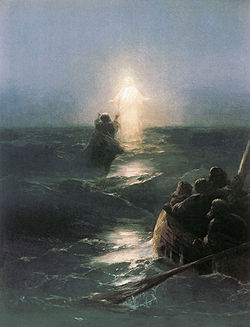
Jesus walking on waterIt is highly significant that Elijah did not find God in the wind, the earthquake, or the fire, but only in a “sound of sheer silence.” (1 Kg 19:12) It happens that Elijah had just run away from fire and storm when he heard this sound of silence. Since Elijah had just “won” the battle with the priests of Baal, one might have thought that God had spoken through wind and fire that time, but the result of “winning” that contest was needing to run for his life because Jezebel was out to get him. So it seems God had not spoken in the wind and fire on Mount Carmel after all. If we stop the story with the “sound of sheer silence,” we are edified, but when we read on to the words Elijah heard, we are seriously troubled. At least I am. Elijah is told to anoint Elisha to be his successor prophet. So far so good. But Elijah is also told to anoint Jehu son of Nimshi to be king of Israel. The narrative of Jehu’s cold-blooded coup d’état is chilling to say the least. (2 Kg. 9) More chilling are the words Elijah heard: “Whoever escapes from the sword of Hazael, Jehu shall kill; and whoever escapes from the sword of Jehu, Elisha shall kill.” (1 Kg. 19: 17) After the violent rivalry between Elijah and the priests of Baal, we get the crossfire of the violent rivalry between Hazael and the House of Ahab: more storm and fire. I have a hard time hearing this storm in the “sound of sheer silence.”

We have more storms in the story of Jesus’ disciples taking a boat across the lake. As almost always with Jesus, there were some human storms. Jesus had just learned of the ignominious death of John the Baptist as a result of a sophisticated mob violence at court. Afterwards, Jesus fed a mob of people who were hungry both for food and God’s Word. Matthew doesn’t mention this mob’s attempt to take Jesus by force to make him king but one can’t help but think that Jesus went off alone to pray because he needed to center himself again on his heavenly Abba after what had just happened. I’m inclined to see in the storm at sea not only a natural phenomena but an interpersonal phenomena as well. I wrote in my book Moving and Resting in God’s Desire: “The story of Peter walking on water — or trying to — also illustrates this aiming [to be centered on God]. (Mt. 14:28-33) The wind and the choppy waves represent our being overwhelmed by the mimetic movements that tend toward rage and persecution. When Peter looked at the waves instead of at Jesus, he started to sink. By himself, he would have sunk and drowned. By looking again at Jesus, Peter was pulled into the boat and the sea grew calm.”

[Tom and Laura Truby develop these thoughts with excellence in their sermon The Raging Storm of Our Own Making.”]

Both of these scripture readings make it dramatically clear that being truly focused on God and God’s peace beyond human understanding is very difficult. Elijah shows how it is very possible to hear the “sheer silence” and yet also “hear” the violence unfolding in his generation. That Elijah was persecuted by Jezebel, Ahab’s wife, makes it understandable that Elijah would hear, even in the “sheer silence,” his own anger and fear towards Ahab’s royal house. Likewise, the disciples in the boat on the stormy sea are so caught up both in the natural storm and the storm of their own disputatiousness that even Jesus himself appears as an object of horror rather than peace. We should take this as a warning of how our prayer in trying times can be distorted by our own anger and anxiety.

There is no simple solution I can offer for this difficulty we all face. In principle, it seems simple to say that we should turn to Jesus and stay turned to him. The problem is that this “simple” solution is difficult minute by minute, second by second. We look at the chaotic waves of the water and sink back into our fears, resentment, and rage. It is a huge help if we remain aware of this weakness and don’t mistake the storms inside ourselves for the word of God. When we fall into our rage, the storm continues, for Jesus calms the waters; he does not stir them up. It takes time and discipline to keep even enough focus on the “sheer silence” to help us see the rage we keep hearing for what it is. Imitating Peter by crying for mercy is essential as this is a cry of repentance of our violence that is the first step to living in the peace of Christ.

On Being Living Stones

altarWhite 1

Sermon for the Anniversary of the Dedication of the Abbey Church, May 9

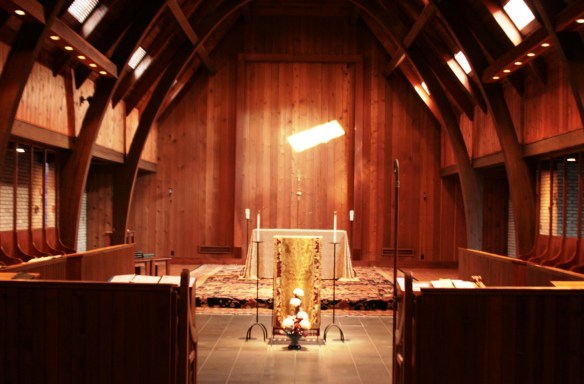
The abbey church has been a profound delight for me to pray in since I first visited here to discern if I had a monastic vocation. I’m still here, so maybe I do. I missed out on the Anglo-Catholic setup we once had which I am sure was also beautiful, but I deeply appreciate the simplicity of our worship space that has nurtured me and many others for many years. Our church is something to celebrate.

Much as I love this building and its space, I think the best way to celebrate it is to reflect on how we can be the Church with the help of this Church building. Solomon admitted that the temple could not contain God since not even the heavens can contain God. Moreover, we hope we don’t need Jesus’ ministry of throwing money changers out of our church. Peter gives us a powerful image for how we can be the church: “like living stones, let yourselves be built into a spiritual house.” (1 Pet. 2: 5) In being living stones, we imitate Jesus who was the stone rejected by the builders. This reference to Psalm 118 is used many times in the New Testament, often by Jesus himself. It means that the life and teaching of Jesus that was rejected by nailing Jesus to the cross has become the basis of a whole new culture and way of life in Jesus. We are called to be living stones built by the Holy Spirit into a new temple supported by Jesus, the cornerstone.

Stones are solid and surely we are to be solid in our commitment to Christ and to each other. It is the solidity of stones that makes them strong enough to support each other. We need to be as strong  as that if we are going to support one another. Stones, however, can be rigid and rigidity makes them hard and cold. Such stones are dead. But Living stones are vibrant so that they resonate deeply with each other. Unlike dead, rigid, stones, living stones are permeable to each other and most importantly to Christ.

Although our abbey church isn’t built with actual stones, but is mostly built of wood and brick, may this church that we celebrate today open us to each other and to Christ so as to transform us into living stones receiving life from the rejected cornerstone.

Setting Our Hearts on God’s Treasure

purpleFlower1Jesus’ teachings on the right and wrong ways of fasting are true and important but I would rather talk about treasure and our hearts. Treasure is a much brighter and exciting thing to think about then renunciation and fasting. What child doesn’t like a treasure hunt? Why else is Treasure Island such an archetypal novel?

What is the treasure we should seek? A treasure is whatever we set are hearts on. If we desire diamonds, then diamonds are our treasure. But even if we find a diamond mine in our back yards, we won’t have the treasure Jesus is talking about. Jesus’ admonition to “store up treasures in heaven” sounds like we store them for an after-life. But let us remember that this verse comes roughly in the middle of the Sermon on the Mount which outlines the real treasure we should seek: “Do not resist an evil doer” (Mt. 6: 39) and “Love your enemies.” (Mt. 5: 44)

We call these treasures? If we set our hearts on these teachings, they do indeed become treasures, treasures we have in the here-and-now, treasures that “neither moth nor rust consumes.” (Mt. 6: 20) These are treasures that remain safe as long as we set our hearts upon them. How about that as a challenge for Lent and on into Eternity?

Transfiguration on to Way to the Cross

crossRedVeil1The transfigured light that radiated from Jesus has inspired many as an image of our potential for holiness. Some Eastern Orthodox spiritual writers such as Gregory Palamas and St. Seraphim of Sarov believed that they saw the light of Mount Tabor within.

Jesus’ self-designation “the Son of Man” is also rich in possibilities for humanity. Walter Wink famously suggested that the phrase “Son of Man” refers to a newly created humanity in Christ. This fits well with St. Paul’s use of the phrase “New Humanity” in Romans 5. For the likes of the disciples and us entry into the new humanity in Christ is not smooth sailing into transfigured light. The disciples quickly return to arguing about who is the greatest. We all know the anger and other discordant feelings that overtake us quickly every time we sense any hint of the transfigured light in our lives. Even Moses and Elijah were both compromised with violence which they had to overcome in the same way we have to overcome our own violent impulses, petty as they often are.

Jesus’ transfiguration is linked to the journey he is about to make to Jerusalem and we know what happened to him there. Jesus was transfigured, then, because he was willing to die in Jerusalem if that turned out to be necessary for opening the way to a new humanity. Jesus tells his disciples as much when he admonishes them not to tell anyone what they have seen until “the Son of Man has been raised from the dead.” (Mt. 17: 9) At that time, Jesus opened the way for a new humanity that would not require human bonding through the death of one for the sake of the people as Caiaphas would have it, but a new humanity that would join in seeking for even one lost sheep, strenuous and dangerous as such seeking could be, and then rejoicing when that sheep was found. (Lk. 15: 3–7)

That the Transfiguration takes place on a mountain recalls Mount Sinai, where God began the renewal of humanity. The first Commandment that “you shall have no other gods before me” and the last one “you shall not covet” cover our relationships with God and neighbor and create a sandwich with the eight other commandments. More recently there is the Mount where Jesus preached his sermon to renew humanity through non-retaliation and forgiveness, precisely the human qualities Jesus himself showed as the risen forgiving victim. This is the transfigured light that shines in the darkness so that the darkness cannot overcome it. (Jn. 1:3)


See also: How is the Gospel Veiled?  and The Transfigured Glory of God’s Children

On Expecting Patiently in God

simeonThe Feast of the Presentation of Jesus in the Temple is a belated closure to the Christmas Season. Since the excitement of Christmas and New Year’s Day is long past, we may have assumed Christmas was over, but the Presentation of Jesus is the last of the Infancy Narratives. The Christmas Cycle began with Advent, the time of expectation of God’s coming to us. In Simeon and Anna, we come full circle with two more people who were waiting for the consolation and redemption of Israel. Anna had been waiting for 57 years, with nothing to show for it until that day.

To wait in expectation as Anna did takes much patience. For most of us, expectation is coupled with impatience. If we expect something, we expect it now. There should be no delay when it comes to what I expect. God’s time is shown here to be different than ours. The many centuries during which Israel had been expecting consolation and redemption were a lot more years than Anna had spent coming to the temple fasting and praying.

Expectation can lead to rivalry and even violence. This is all the more likely when expectation is coupled with impatience. The more impatient we are, the more likely we are to act precipitously to bring about the consolation and redemption of our own people. This is what happened in Israel. Few, perhaps nobody at all, had the patience of Simeon and Anna and were violently hastening the redemption and consolation of Israel. This haste resulted in the destruction of the Temple in 70 A.D.

Expectation is, however, quite different when we give ourselves over to it in patience and in God. The patience and presence of God wear away the trap of violent rivalry. Patience in God also made Anna and Simeon responsive to the Holy Spirit so that they came to the Temple at the right time to see the Christ Child.

More important, patience in God broadened the expectation of Anna and Simeon. Although Simeon had been waiting for the “consolation of Israel,” when he held the child in his arms, he said that he had seen the salvation “prepared in the presence of all peoples.” Not only was this child the glory of God’s people Israel, he was “a light for the revelation to the Gentiles,” the very people from whom they were expectantly waiting for deliverance.

Patience in God also deepened the expectation so that Simeon realized that Jesus would be a “sign that is opposed,” one who would reveal the “inner thoughts of many.” This child, then, was not destined to be a consolation and redemption of Israel in a comfortable or cosy way, but would console and redeem Israel and the Gentiles (i.e. everybody else) by revealing the truth of how we build human culture on collective violence and then offering us redemption through embracing this truth.

We also see patience on the part of Joseph and Mary who offered a pair of turtledoves or two young pigeons as required of the Law for those who were poor. Many years later, Jesus would again make the offering of a poor person who had been opposed and so “reveal the inner thoughts of many” as they “look on the one whom they have pierced.” (Zech 12: 10)

Sharing God’s Riches

creche1-copyLike every culture, the Jews had to face fundamental decisions as to how open or closed they would be to others. The default mechanism tends to be flight or fight. In discussing remaining social groups living close to the level of what he calls “traditional” societies, Jared Diamond observed this phenomenon. A stranger wandering into the territory of a different tribe had better come up with a common ancestor or the encounter could prove fatal.
The type of encounters with other nations has an effect on such decisions. In the case of the Jews, most encounters were bad. Slavery in Egypt was followed by both cultural and military threats from the Canaanites who tempted the Jews to forsake the God who had delivered them from Egypt. Encounters with the Assyrians and Babylonians were catastrophic. But then the Persians destroyed the Babylonian Empire and invited the Jews to return to their homeland and revive their cultural and religious traditions. It is surely no accident that the return from Babylonian exile and resettlement back in their homeland coincided with the first expressions of openness to other cultures on the part of the Jews such as we have when Isaiah proclaims: “Nations shall come to your light, and kings to the brightness of your dawn.” (Is. 60:3) With Isaiah, we have the breakthrough insight that the God who brought them out of Egypt and then delivered them from Babylon was the God for all people and not just them. Although Adam Smith took the title of his famous book The Wealth of Nations from Isaiah 60:5: “the wealth of the nations shall come to you,” the prophet encourages a much more profound exchange than that of capital: an exchange of the riches of the Jews’ religious tradition for the riches other nations can bring to that same tradition. Unfortunately, retrenchment followed, climaxed by the expulsion of all foreign wives at about the time of the building of the second temple.

At the time of Jesus’ birth, the relationship between the Jews and the Gentiles, the other nations, was complex and tense. Their religious traditions were mostly tolerated but at times menaced by the Romans. Although some individual Gentiles became God-fearers, practicers of Jewish piety such as the Centurion who built the synagogue at Capernaum, (Lk. 7: 4-5) there were few friendly relations between Jews and Gentiles. And yet in the face of this tension, Matthew sees in the visit of the Magi to the infant Jesus a fulfillment of Isaiah’s prophecy of the exchange of wealth between the two peoples.

It was for St. Paul to return the gifts to the Magi. After his dramatic conversion, he was called to preach the Good News of Jesus, a Jew, to the Gentiles. To the surprise of many Jews who followed Jesus, “the Gentiles have become fellow heirs, members of the same body, and sharers in the promise in Christ Jesus through the gospel.” (Eph. 3: 6) That is, Jesus dissolved the fundamental division between Jew and Gentile when he was crucified by a collaboration between the two peoples who had suddenly come together for that brief moment. But when Jesus was raised from the dead as the forgiving victim, he bridged the gap between nations with one comprehensive act of forgiveness.

Ever since Paul’s commission, the Church has been tempted to retrench herself as the Jews did after building the second temple. This is to fall back into the default hostility to the stranger that Jared Diamond saw as part of “traditional” humanity. What the feast of Epiphany celebrates is the generosity of God who shares God’s riches with all so that all people can share this same richness with all others, not least with strangers who can then soon cease to be strangers.

God-Is-With-Us: A Christmas Eve Meditation

creche1-copyTonight, we celebrate the birth of a child. Usually, there is rejoicing when a child is born. One of my family stories is that my grandmother was so excited about my birth that she burned two pots of beans.

When we celebrate a birth, we celebrate the fact that a baby is. The simple act of coming to be is a cause of wonder and joy. So it is that we celebrate Jesus before he did anything at all except come out of his mother’s womb and maybe cry a bit and suckle some milk. As a friend of mine said once about newborn babies: “They don’t do much at that age.” We also celebrate our hopes for the future and for the future of that child. We know that in the case of Jesus, the future wasn’t all rosy. That Jesus was born in a stable because there was no room for him and his family and that Herod would be out to get him as soon as he found out about him shows that there was cause for anxiety from the very start. Unfortunately, many babies being born right now are born into much the same sort of anxiety that is mingled with hopes for the child. So not every birth leads to unequivocal rejoicing. Such anxiety is exacerbated by our tendency to focus on those who stir up fear in us, goading us on to adding further fuel to the violence growing all around us. We can see in news reports, Twitter, and Facebook that we are locked in violent systems of condemnation that stoke our fears exponentially.

Although we celebrate tonight the very being of Jesus, that Jesus is, when Jesus was apparently not doing much, God was and is already doing a great thing, an unprecedented thing: God had entered humanity. God chose to share, in frail human flesh, the very threats and anxieties that we all share. God has not left us to the human powers over which we have little or no control, powers we doubt we can trust with our well-being. Moreover, God shares the vulnerability other humans suffer from us on account of our fears and our own violence that we cannot see. In this way, God, in Jesus, lives up to the name: Emmanuel, which means “God is with us.”

God’s presence among us means many things. Tonight I will touch on one of them. By entering humanity, God has opened our human nature to God’s nature. We are no longer as trapped in our own human fear and violence as we often think we are. Later in life, Jesus spoke about God coming “like a thief in the night” but at the time of Jesus’ birth, God had already broken into the household of our humanity and started to sneak around, taking away bits of fear and violence and leaving bits of love behind.

This Christmas, let us celebrate the sneaky child who is already crawling around in the dark places of our lives, taking away the things we need to lose and giving us the gifts we need the most.

On Welcoming a Thief in the Night

crucifix1A thief is not usually thought of as a good type of person and a thief in the night is worse. And yet Jesus characterizes himself as a thief when he says: “if the owner of the house had known in what part of the night the thief was coming, he would have stayed awake and would not have let his house be broken into.” (Mt. 24: 43) The expression that God will come like “a thief in the night” also comes up in 1 Thessalonians 5:2 and 2 Peter 3:10. Since Jesus commends the dishonest steward who defrauds the master who is firing him and the unjust judge who gives the widow a fair hearing just to stop her from pestering him, it seems that Jesus has a soft spot in his heart for rogues. Maybe he was a bit of a trickster rogue himself.
But surely it isn’t good to be a thief is it? A thief is someone who takes what belongs to somebody else for personal gain at the expense of the thief’s victim. That is not good. However, before we get too self-righteous about other people who are thieves, we should pause to take note that one can steal the reputations of other people through misrepresentation and downright lying. Worse, we can steal the dignity of other people by treating them with disrespect. With these considerations, we begin to see that thieves aren’t just other people.

The context of this verse in Matthew strengthens this uncomfortable realization. Jesus refers to the Flood of Noah’s time, noting that people were going about their business as if nothing was wrong. But Genesis says that the whole society had become a flood of violence that was sweeping everybody away. The implication is that the society of Jesus’ time was likewise being swept away in a flood of violence while most people thought things were just going along normally. And what about our own time? We go about our business while reputations and human dignity are being stolen right and left by both right and left. All of us have become thieves and we will never get out of this social flood until we realize this truth.

So, is Jesus a good thief while the rest of us are bad thieves? Let’s take a look at how Jesus acts like a thief in the night. Does Jesus steal our things for personal gain? Jesus does steal everything we have but he does not steal our things for his personal gain but for our personal gain. More important, Jesus steals everything in us and about us that destroys our relationships with other people and God. That is, Jesus steals our thieving ways that we are so attached to. How else can we feel good about ourselves if we can’t steal the reputations and dignity of other people? But while a human thief leaves nothing for the thief’s victim, Jesus gives us the full richness of God, the richness bestowed on humankind at the dawn of creation.

How can we be ready for a thief like this? St. Paul tells us to “live honorably as in the day” by giving up “quarreling and jealousy.” Then, “put on the Lord Jesus Christ.” (Rom. 13: 13–14) Then, as Isaiah teaches us: beat our “swords into plowshares” and our “spears into pruning hooks.” (Is. 2: 4) Then we won’t have so much thievery and violence for Jesus to take away from us when he sneaks into our lives.

Luke tells us of a thief who became good because he repented and, in so repenting, realized that Jesus had been unjustly swept away by society’s violence. Will we choose to repent and become good thieves?

Zacchaeus and his City

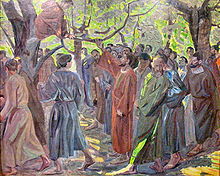
zacchaeusThe French thinker René Girard has argued that since the dawn of humanity, we have tended to solve social tensions through persecuting a victim who absorbs these tensions and suffers for them. Girard has also argued that the Gospels unveil the truth of this scapegoating mechanism in their narratives of Jesus’ death and Resurrection where Jesus opens up new possibilities for humanity to gather through the forgiveness of the Risen Victim. It happens that the Gospels show Jesus unveiling these very same dynamics in his earthly ministry. I analyzed our such stories in my book Moving and Resting in God’s Desire. Here is what I have to say about Zacchaeus:
When Jesus came to Jericho, he was famous, or notorious enough, that something of a hubbub arose as a result of his passing through the town. People gathered and crowded one another to gawk at the man and his followers. Why the stir? The mayor wasn’t exactly giving him the key to the city. Throughout Jesus’ journey to Jerusalem, Jesus was set upon by Pharisees and scribes and questioned in front of the crowd. Such questioning, of course, was made with the intention of publicly discrediting the freelance itinerant preacher who was becoming famous for his clever retorts. The result was bound to be entertaining. The scribes and Pharisees were surely on the prowl in a town that large. Zacchaeus’s act of climbing a tree to get a look at Jesus need not be taken as an indication that he was inclined to have his life changed by this stranger. His eagerness to see and hear the duel is enough to account for his action. And yet the anticipated debate does not occur. Why? Because Jesus saw Zacchaeus up in the tree. The signs that Zacchaeus was a rich man hated by everybody in town were there to be seen by a person with eyes to see.
That Jesus had discerned the social matrix of Jericho rightly was immediately manifest when Jesus called out to the tax collector and invited himself to that man’s house. St. Luke says that “all who saw it began to grumble and said, ‘He has gone to be the guest of one who is a sinner.’” (Lk. 19:7) Here is another example of Luke’s astute anthropological insight. It isn’t just the Pharisees and scribes who grumble about Zacchaeus. Everybody grumbles about him. Like Simon when confronted with the Woman Who Was a Sinner, (Lk. 7:36–50) the people of Jericho were thinking that if this man were a prophet, he would have known who and what kind of man this was who was sitting up in a tree—that he was a sinner. One doesn’t have to be a demonically possessed man or a sinful woman to be a communal scapegoat. A rich man who is a traitor to his people can hold the same position. And deserve it. After all, he was treading down the downtrodden. For scapegoating others, he deserved to be scapegoated. As it happened, Jesus did know what kind of man Zacchaeus was. It is through showing us that anybody can be the scapegoat and anybody can be a persecutor that Luke shows the communal scapegoating phenomenon for what it is. Given the fact that Jesus was on the way to Jerusalem with a pretty clear idea of what was going to happen to him there, it behooved Jesus to give his followers every opportunity to see how collective hostility against one person works, in the hope that they would learn to recognize the process when it happens in the Holy City, and that is what he has done here.

As with the Gerasene demoniac, Jesus performs an exorcism of the communal scapegoat, a quiet one this time, but just as effective. The result is that the homeostasis sustained by the scapegoating process is destabilized. There is some ambiguity as to whether or not Zacchaeus is actually converted by his encounter with Jesus or if he had repented earlier but nobody believed it. Bible scholars disagree as to whether the verbs used by Zacchaeus are in the present tense or the future. That is, Zacchaeus may be saying that he will give half of his possessions to the poor and pay back four times anybody he has defrauded, but he could be saying that he is already doing these things. If Zacchaeus is using the future tense, then he is announcing a change of heart. If Zacchaeus is speaking in the present tense, then he is claiming that he is better, or less terrible, than he has been made out to be. I think our best bet is to look at the implications of either interpretation of the verb tenses.

If Zacchaeus has been converted on the spot by Jesus, and we assume that Jesus did not zap people with a magic wand to override their free will, then we may ask ourselves how this conversion happened. The information in Luke suggests two possibilities. As the communal scapegoat, Zacchaeus had “the intelligence of the victim” and perhaps that intelligence led him to understand what it meant to other people to be the victim of his tax collecting. The other possibility is that an undeserved commendation from Jesus freed Zacchaeus from the necessity of acting in such a way as to justify his designation as communal scapegoat. It is more than likely that both factors played their part here. On the other hand, if Zacchaeus was speaking in the present tense, the implication is that the collective attitude of the townspeople was unjust, which would underline the arbitrary aspect of scapegoating. Generous actions on the part of a rich person who has drawn the collective resentment of the community often do not diminish resentment against him or her. It is also possible, of course, that Zacchaeus is trying to make himself look better than he really is. That is, he is boasting of his good deeds while overlooking the unjust means used for gaining the wealth that he uses for his acts of largesse. If I am right in taking this story as being primarily concerned with communal scapegoating, then the ambiguity enriches the story and there is no need to solve the grammatical problem once and for all.

The challenge of this story, however, is not limited to the possible conversion of one person. It extends to the possible conversion of the whole community. Whether or not Zacchaeus needed to be converted and, if so, whether or not he did change his life, is immaterial for the greater challenge. Either way, by singling out Zacchaeus and inviting himself to that man’s house, Jesus has already robbed Jericho of its scapegoat. The unanimity has been irretrievably broken. That everybody turns to grumbling at Jesus for going to the house of a man who is a sinner suggests that Jesus is well on the way to becoming a unanimous object of hatred. Since Jesus is on the way to Jerusalem, where he would, once again, become the object of hatred, it is no surprise that it should happen in Jericho, while he was on the way to the Holy City. This development does not bode well for Jericho becoming a social climate of healing.