Binding and Loosing

AndrewPreaching1How many of us listen to Jesus’ words about correcting fellow members of the church and think they are about punishing people and casting them out? (Mt. 18:15-20) Checking ourselves for such reactions is a good way of taking note how instinctive punishing and excluding are to us and how less instinctive is forgiving and including and welcoming others. It is precisely this instinct to punish that makes it difficult to have ears to hear what Jesus is saying and hear what the Spirit is saying to the churches.

If we take a step back and ask ourselves what our instinctive reaction to being wronged is, we find that the first instinct is to seek revenge. If somebody hits you, hit him back. Simple. But Jesus tells us to go to the person and tell that person what they have done to us. This action puts a serious break on the revenge mechanism and moves in the opposite direction. After all, going to the person peacefully and honestly is the first step towards reconciliation, which is the last thing a person bent on revenge wants. If speaking one to one does not resolve the matter, then the circle widens to two or three and then the whole assembly. What is easily overlooked in this process as described here is that it presupposes that each of us is expected to take responsibility for the community and for each other. This is why we should warn a person who is acting destructively, but it is also why we should be open for others to approach each of us to correct us. Of course, anyone who has ever corrected another person knows that this can result in learning about our own shortcomings. One of our favorite slogans at St. Gregory’s Abbey is” “You do it too.”

Treating an unrepentant person like “a Gentile and a tax collector” sounds straightforward enough. We kick the person out and that is that. But that is not that. For one thing, this is not an act of vengeance, or at least it’s not supposed to be. It is an act of distancing, an act that, when used rightly, shows that the reproved person has distanced him or herself from the community. It is realistic in that some people make themselves impossible and a peaceful parting is necessary. But that is far from the end of that matter. Matthew himself was a tax collector. How was he treated? Jesus called him to follow him and be a disciple. We need to keep in mind the context. Immediately preceding this list of instructions for dealing with a delinquent person is the Parable of the Lost Sheep. All this suggests that the way to treat a Gentile or a tax collector is to try to bring them into the Christian community, which entails forgiveness.

Forgiveness? But we are told that those we loose on earth are loosed in heaven and those who are bound on earth are bound in Heaven. Sounds like we have the power to bind other people for all eternity and God’s hands are tied for as long as we want them to be. How much power is that? But not so fast. Why is it that we so easily assume we are being allowed to bind on earth when we are being encouraged to loose on earth? We need to note what follows immediately after this verse: Peter’s question about how many times he must forgive an offender and Jesus’ parable of the unforgiving debtor. If we have to forgive others as God forgives us, and that without limit, as Jesus’ saying we have to forgive seventy-seven times means, then we are indeed being encouraged to loose on earth and are being warned that if we do not loose on earth, we are bound to our resentment for what others have done to us (or we think they have done to us) and we will be so bound even in Heaven since God’s hands are indeed tied for as long as we refuse to let God untie us.

See also: The Sin against the Holy Spirit

Baptism: Overwhelmed by Christ’s Love (2)

lakeGray1Two dramatic events from the Hebrew Bible have been interpreted as prefiguring baptism are the Flood and the deliverance at the Red Sea. Both are deliverances from highly dysfunctional societies.

Genesis 6 portrays human society as consumed with violence. No wonder if everybody was like Lamech and inflicting seventy-seven-fold vengeance on anybody whom he thought had wronged him. In his second epistle, believed by many scholars to be a baptismal homily, Peter says that the deliverance of Noah and his family corresponds to baptism which saves us now through the Resurrection of Jesus Christ. (1 Pet. 3:21) René Girard has suggested that a flood is an apt image for a society overwhelmed with retaliatory violence. In such a scenario, a man who tried not to be a part of this violence would be an obvious choice of a victim to unite the fragmented society. The Christological interpretation in Peter’s epistle suggests by being baptized into Christ’s death, we are brought out of society consumed with violence and given the chance to begin life anew, the chance that Noah and his family had after the flood waters receded. It is worth noting that when referring to Jesus descending into hell (Sheol), Peter does not say Jesus just brought out righteous people like Abraham but that he preached to the very people who had brought humankind to the boiling point while Noah was building his ark.

St. Paul says that we all “passed through the sea and all were baptized into Moses in the cloud and the sea.” (1 Cor. 10:2) Once again we have an overwhelming flood. Moreover, we have a story of a people delivered from a violent and oppressive society. In his book Jesus: the forgiving Victim, James Alison suggests that the Jews were expelled after being blamed for the plagues scourging the country. If the Jews were expelled, why would the Egyptians runs after them to bring them back? Perhaps they realized they would implode without the victims who were deemed responsible for their turmoil. This is what seems to have happened with the Gerasenes when their demoniac was cured by Jesus. One could take the tug-of-war between Moses and Pharaoh as indicating this same tension. (See Dispossessing a Town Possessed) Being overwhelmed by the waters is, again, an apt image of a society succumbing to its own violence once the scapegoats are gone.

Unfortunately, neither new chance at a new life went well. Noah’s drunkenness and rivalry among the brothers that made Ham a scapegoat set humanity on a course where the curse laid on him was used to justify slavery and lynching. The people delivered at the Red Sea suffered from chronic social unrest, leading to Moses raising the bronze serpent in the desert to stop the plague of violence. Likewise, the church continues to fall back into the same rivalry and persecution. Most lynchers, unfortunately, were Christians. A tendency to see baptism as deliverance from personal sin surely reinforces such backsliding. Baptism is not a magical deliverance from personal sin but is a constant invitation to be reborn into the new social life of God’s kingdom centered on the forgiving victim who, like the bronze serpent, was raised up to draw all people to himself.

Baptism: Overwhelmed by Christ’s Love (3)

Baptism: Overwhelmed by Christ’s Love (1)

The Good Shepherd in the Desert

goodShepherdIf Jesus is the “living interpretive principle of scriptures, as James Alison says, then the Parable of the Good Shepherd who leaves the ninety-nine to search out the one lost sheep should be a powerful and accurate interpretive lens for other passages in scripture.

In the RoCa lectionary, this Gospel is coupled with a tense episode in Exodus 32. As he comes down the mountain with the tablets of the Ten Commandments, he finds that Aaron has set up a golden calf for the Israelites to worship. God tells Moses to get out of the way so that his wrath can “burn hot against them.” Doesn’t sound like a good shepherd.  Instead, it is Moses who acts out the part of the good shepherd by interceding with God, as Abraham did earlier to avert the divine wrath from the people. At the end of this same chapter, there is another narration of Moses coming down the mountain. This time, he is so furious he breaks the tablets and then rallies the Levites to his side to slay thee thousand people who were worshipping the golden calf. Although Moses claims to be doing God’s work, what we have is a narrative of human rather than divine violence. Moses doesn’t look like a good shepherd this time, but the morning after this monstrous slaughter, Moses intercedes with God to forgive the people although it is a bit late for the three thousand who were slain. This strange doubling of narrations seems to point to a debate in the Jewish tradition moving in the direction of unveiling God’s love for God’s people.

In 1 Corinthians 10, St. Paul refers to this incident by saying “we must not indulge in immorality as some of them did, and twenty-three thousand fell in a single day.” (He ups the death toll.) In isolation, this is about the chilliest verse in the Pauline epistles but in its sacramental context, it is much more in keeping with Jesus the Good Shepherd. Leading into this verse, Paul says that “we were baptized into Moses in the cloud and in the sea, and all ate the same supernatural food and all drank the same supernatural drink.” This, in turn, recalls the reinterpretation of the Flood in 1 Peter where the water corresponds to the baptism that delivered Noah and his family and delivers us now. The Genesis story clearly indicates a social meltdown with a few, probably the intended victims, escaping. The Exodus story refers to the social meltdown in Egypt that lead to the expulsion of the Israelites. In the desert, the Israelites had their own social meltdown centered around rivalry between Moses and Aaron. (Arnold Schönberg’s opera Moses and Aron portrays this rivalry with great insight.) For both Peter and Paul, baptism is the deliverance from the surrounding sacrificial society into the Kingdom centered on the Eucharist, the new way of gathering without need of victims and certainly not needed the slaughter of three thousand. Paul is not, then, warning his readers against a wrathful deity but against a wrathful society that will engulf them if they return to its sacrificial ways, just as a relapse into the wrathful society of Egypt lead to a meltdown in the camp and the deaths of thousands.

Jesus the Good Shepherd does not strike dead those who re-enter a sacrificial society that today manifests hardness of heart to the extent of trying to prevent fundamental ministries such as feeding the hungry. Instead, Jesus enters into the heart of the society to bring back all who are lost. Rather than starting a bloodbath, we should intercede for all such people as Moses did and follow Jesus in searching for the lost.

See also: The Communal Good Shepherd

PETER AND PAUL: The Church’s Quest for Mimetic Unity

Sts_Peter_and_PaulThe presence of two strong personalities roughly the same sphere of influence is a perfect recipe for mimetic rivalry that can tear the social fabric apart until it is resolved either through implosion or collective violence against a victim. There is evidence that precisely these sorts of tensions played out between Saints Peter and Paul but there is also evidence of attempts at reconciliation between the two and further reconciliation on their behalf in the early Church to provide a very different model for the relationship between two strong outstanding personalities.

In the Acts of the Apostles Luke seems to have taken great pains to balance the impact of the missionary work of these two apostles under the guidance of the Holy Spirit. That Peter drops out of the narrative half way through the book and the seemingly abrupt ending with Paul awaiting trial in Rome diminishes the importance of even these great saints and emphasizes their subordination to the Holy Spirit. At the momentous Council of Jerusalem where the two apostles meet, at the heart of the book, the situation is ripe for conflict, but Luke presents the Council as an amicable solution to their conflict. Luke heightens the reconciliation by having Peter speak up Paul him in with words that sound a lot like a speech Paul could have made himself. That is, Peter imitates Paul to support his position at a time when he could have become a mimetic double in conflict with him. Peter’s earlier struggle over the appropriateness of preaching to of the Gentiles resolved by his vision of a sheet coming down from Heaven with both clean and unclean animals on it sets up this reconciliation. James plays the role of the mediator who states the amicable solution that allocates a separate sphere for Jews and Gentiles so that the two groups need not compete but are given space to follow the guidance of the Spirit. Paul’s letter to the Galatians tells a different story full of tension. Although Peter and gave Paul received “the right hand of fellowship” in Jerusalem, he later found it necessary oppose Peter “to his face” for rejecting table fellowship with Gentiles. Perhaps Peter had suffered a relapse of his own tendency to be swayed by the wrong mimetic crowd, such as happened to him in the courtyard of the high priest when he was surrounded by fellow Jews were against that fellowship. We never learned if this quarrel was ever healed between them in this life before it was healed posthumously in the hagiography and liturgy of the Church but there are hints that it probably was.

In writing to the Corinthians, Paul took pains to quell rivalry that had triangulated him with Peter by taking them severely to task for using such slogans as: “I am for Paul,” “I am for Cephas.” Far from fanning the flames of conflict, Paul distances himself from it in no uncertain terms and renounces any possible gain he might get from the “Paul” Party in Corinth. Although Peter is not believed to be the author of the Second Epistle bearing his name, it is significant that he refers to “our brother Paul, who is so dear to us.” At the very least, these words attest to the Church’s corporate effort to maintain a peaceful relationship between the two apostles. Peter says that Paul wrote “with the wisdom that is his special gift,” but then he cautions his readers that some points in Paul’s letters are hard to understand and are “easily distorted by uneducated and unbalanced people.” Tension and reconciliation between the two great apostles are themselves held in close tension here. A generation later, St. Clement of Rome writes the Corinthians to rage over an “abominable and unholy schism” in the community fueled by jealousy and envy. As a counter-example, Clement describes the deaths of Peter and Paul, stressing the harmony between the two great apostles. A century or so later, St. Ireneaus called the Church of Rome “the greatest and most ancient Church, founded by the two glorious apostles, Peter and Paul.” Archaeological investigations along the Appian Way have unearthed rooms with inscriptions honoring both saints together and a bronze medal dating from the first half of the second century pictures the heads of the two saints on the same side of the medal.

The Golden Legend, a 13th century compilation of saints’ lives by Jacob of Voragine is not the book one goes to for the most accurate history of the early church or anything else, but it is one of the best books for studying the way saints have been presented as models to the faithful. In his entry on Paul, Jacob explicitly curbs the alleged rivalry with St. Peter when he says: “We find that at different times Paul is portrayed as Peter’s inferior, as greater than Peter or as Peter’s equal, but the fact is that he was inferior in dignity, greater in preaching, and equal in holiness.” Jacob seals this unity by affirming the early Church’s legend that they were martyred under Nero on the same day. Before they were parted for their executions, Jacob records that Peter and Paul exchanged benedictions of each other.

This reconciliation between these two apostles is effected by their sharing the same feast day on June 29 when the other apostles get a day each for themselves. The Magnificat antiphon for First Vespers of this feast says: “Peter and Paul were at one in their love of the Lord: neither in life nor death were they divided.” The second half of this text comes from David’s lament for Saul and Jonathan (2 Sam. 1:23), so that a verse referring to the protracted mimetic struggle between David and Saul is applied to another problematic relationship to heal whatever division there may have been in real life and offer the Church a model of mimetic amity.

Cleaning Up Our Unclean Acts

eucharist1Peter was surprised when he had a vision of a sheet carrying all the animals listed in the Law as unclean accompanied by a voice telling him that God had made them clean. Peter was even more surprised when he was told to go to the house of an unclean Gentile named Cornelius and preach the Gospel to him. That is, God had made all humans clean.

We all have a hard time living without the comfort of knowing that some people, some things, are unclean. This fear that sustains us is the fear of what is Other. All we have to do is get to know “unclean” strangers and we will be happy and no longer afraid.

René Girard, however, would give us pause. Girard is often invoked when there is need to scold people for creating “out” groups to make them feel good about their “in” groups. Actually, Girard alerts us to our problems within our “in” groups. Prior to our fear of the Other is our fear of what is the same. Rivalry and the violence rivalry lead to does not originate in battles with strangers but with those closest to us. In Genesis, almost all of the strife is between brothers.

Girard suggests that this fratricidal strife tends either to the death of a brother or a reconciliation through killing somebody else. At the dawn of humanity, a tribe first struggled with rivalry within its own ranks and either imploded through its violence or came together through killing one of its members, who then was designated at Other, the monster who caused the commotion. Then the tribe held itself together on an ongoing basis by warring on other tribes who were designated as Other. In this regard we are not one wit wiser than the most “primitive” of people. A fundamental practice of statecraft today is to deal with rivalry and tensions within a nation by designating an enemy that the whole nation must fight.

Anthropologists such as Mary Douglas have demonstrated the human tendency to divide foods between those deemed clean and those considered unclean. Eating is the central activity of a community. We eat with those who are closest to us. However, as noted above, we also fight most with these same people who are closest to us. By dividing the food we eat between clean and unclean, we create a barrier between us and other people, between us as the “in” group and those in the “out” group. That is, we relieve our communal tensions by banding against those who eat “unclean” foods.

Here we come to the importance of Jesus’ admonition to his disciples, while at table, that they (we) love one another. Some scripture scholars have poured cold water on idealistic readers by saying that John was concerned only with love within the community. But Jesus’ saying that others will know we are Jesus’ disciples by our love makes it clear that this loves does extend beyond the immediate community. These reflections on “clean” and “unclean” further suggest that fostering non-rivalrous love within the community allows the community to reach out to others. This love will make everything and everybody clean and bring us all to one great table in the Heavenly Banquet.

How Are We Saved?

yellowTulips1The New Testament and two thousand years of Christian preaching has consistently proclaimed that the death and resurrection of Jesus Christ has opened the way of salvation for all humanity. Precisely how this mysterious, earthshaking event has done that   has raised more questions than answers. It is understandable that the focus would tend to be on the death of Jesus since the event is so dramatic and creates intense emotional effects in Jesus’ followers. However, understandings of the atonement of Jesus through this route have raised long-standing problems that cry out for a fresh approach. The growing realization that the killing of Jesus was just plain wrong on the part of many Christians, and not just those influenced by the thought of René Girard,  opens a way for a re-thinking of atonement theology that can support a deep spirituality grounded in God’s unconditional love for all people. As article I wrote for the Abbey Letter Saved By the Life of Jesus contributes to this re-thinking that actually reclaims the Gospel for us. It is included in the collection of articles in Come Let Us Adore. You can read it here.

A Risen Life Full of Forgiveness and Love

crosswButterfliesHere is my favorite thought experiment: Imagine that everybody around you ganged up on you, leveled incredible accusations against you, and rained savage blows on your body. Your friends either joined in the persecution or slunk away, too afraid to defend you. Your attackers pressed on until they had put you to a most painful death. Imagine further that, miraculously, you found yourself alive three days later. Having already died, you could hardly die again. You have become invincible. What would you do to the people who had mistreated you? How would you approach your cowardly friends?

Perhaps this thought experiment can give us an inkling of how amazing it is that, when this very miracle happened to Jesus, he did not retaliate, but instead, invited everybody to a big whooping party that will never end. After rising from the dead, Jesus continued to do what he was doing before he was killed: gather God’s people in peace by peaceful means only. That is, after his Resurrection, Jesus practiced what he preached in the Sermon on the Mount: return evil with good, hatred with love. The fullness of Jesus ‘forgiving love can be as earth-shattering as an earthquake or as gentle as stepping through a wall.

If Jesus were dead and there was a body in the tomb for the women to anoint, chances are that Jesus’ disciples would either have remained in hiding or they would have reacted to the violent act of the crucifixion with violence. But in Luke the young men in white asked the women: “Why seek the living among the dead?” That is, God did not will the death of Jesus, God willed life for Jesus because that is what God wills for each one of us. As long as we stop at Jesus’ death, we also stop at the grief and anger and that leads to violence. If we move on to the life of Jesus, than there isn’t the same room for grief and anger because Jesus is alive and wants us to be alive in Him.

In short order, Peter passes on the same absence of revenge of Jesus’ persecutors and fullness of forgiving love for them when he tells the people in Jerusalem precisely what they had done, sticking to the bare facts and not adding irrelevant insults the way we usually do in such situations. When Peter’s listeners were “cut to the heart” and asked: “What should we do?” Peter extended the invitation that he and the disciples had received from the Risen Lord: “Repent and be baptized every one of you in the name of Jesus Christ so that your sins may be forgiven; and you will receive the gift of the Holy Spirit.” This is a far cry from the response we get from most followers of a slain leader. Peter had heard the cock crow, repented and accepted Christ’s forgiveness and love. Peter was a weak human being like the rest of us. If Peter is like us, we can be like him.

See also Two Ways of Gathering and Violence and the Kingdom of God.

Crying out with Palm Branches in our Hands

AndrewPalmSunday1Jesus entered Jerusalem to the acclaim of crowds strewing branches before him and proclaiming him the king. A few days later, the same crowd gathered before Pilate to cry out for Jesus’ crucifixion. What happened?

Before answering this question, it is helpful to recall another crowd that went out into the desert to see John the Baptist. “What did you come out to see?” John asked them. “A reed blowing in the wind?” John suspects that people have come out in droves because people were coming out in droves. That is, it was the “in” thing to do. Fast forward a few months and we have a crowd at Herod’s palace supporting Salome’s request for John’s head on a dish. What did they come to see?

The post Ignominious Glory—Glorious Ignominy: a Doxology goes a long way in explaining this phenomenon. One can’t help but suspect that people are crying out because everybody else is crying out, no matter what the outcry is about. Advertising usually does not advertise the product but its alleged popularity. Political campaigns do the same thing. What would happen if people stopped to listen to what people were actually saying instead of crying out what they think everybody else is crying out?

It so happens that the Gospels do precisely this. The suggestion that the Gospels are Passion narratives with long introductions gives short shrift to what the Gospels are about. What these “long introductions” do is tell us at great length what Jesus actually said and what he taught. They also tell us what Jesus did before he was nailed to the cross, i.e. he healed people and cast out demons and he unilaterally forgave sins. These “long introductions” also tell us why the power brokers in Judea and Jerusalem wanted Jesus dead. By reading these “long introductions” to the Passion narrative, we are drawn away from crying out what everybody else is crying out and waving signs that only proclaim what the current fashion is believed to be. Instead, we are drawn into a very different social mimetic process, a process that builds up mutual respect between people, seeing people as they really are and as they really can become when they receive the unilateral forgiveness that Jesus gives them, a social process of not retaliating for wrongs done, a socially mimetic process of forgiving debts, of sharing what we can, of offering healing to others.

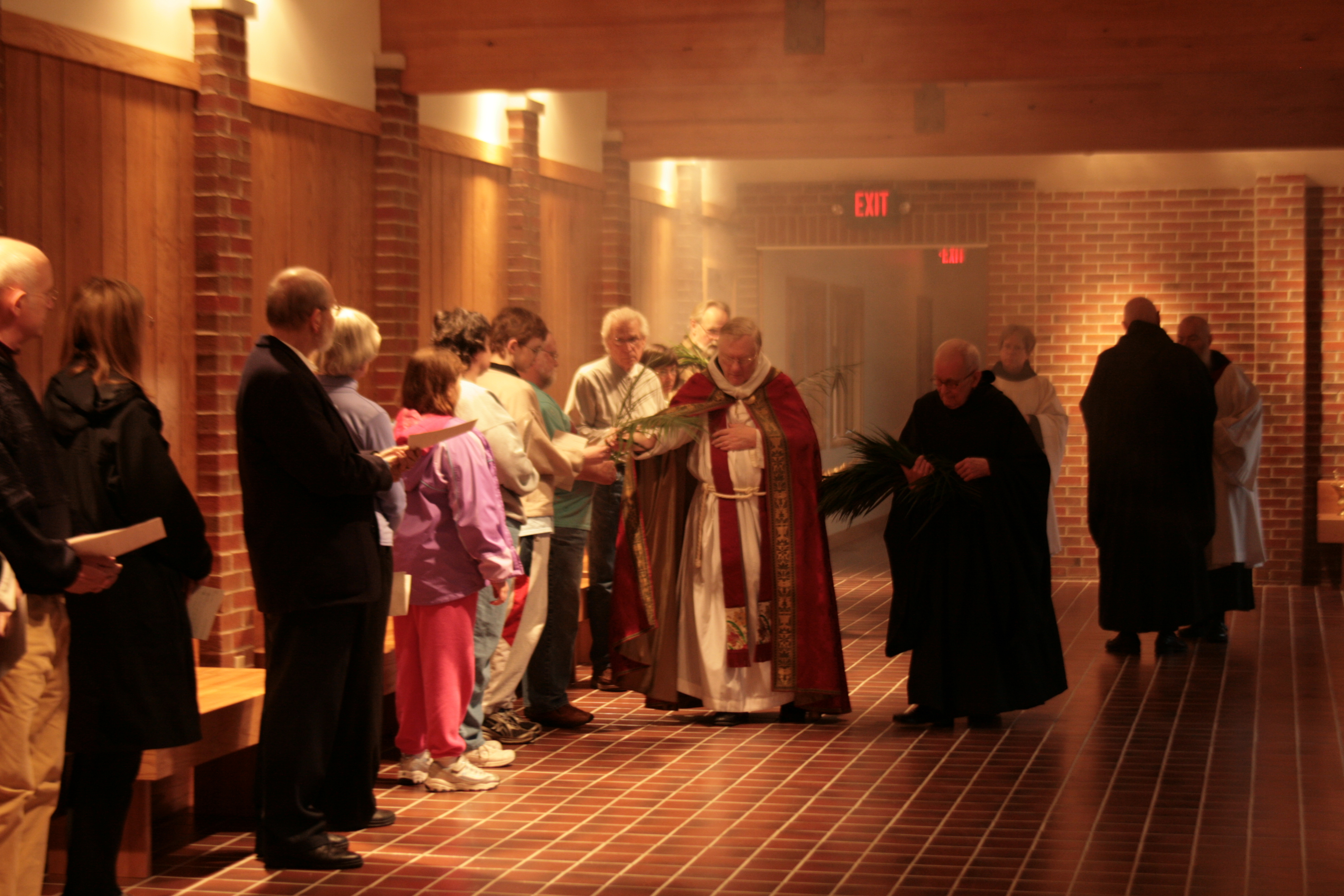
It is instructive that the Palm Sunday liturgy begins with everybody playing the part of the crowd welcoming Jesus with palms and then, a bit later, we hold these palms while acting the part of the crowd in crying out for Jesus’ death during the reading or chanting of the Passion. What we need to do afterward is return to the “long introductions” to see what the fuss was about and hopefully, hear the cock crow as did Peter.

I develop these ideas in my book Tools for Peace.

Stumbling blocks in the Desert: the Temptations of Jesus

freshBread1When Jesus went out into the desert after his baptism, he became aware of the fundamental temptations he would have to fight throughout his life. James Alison helps us understand the social nature of these temptations by pointing out that “devil” (diabolous) means “divisive obstacle.” Such an obstacle requires two or more people to stumble over it. That is temptations are unavoidably social.

The social implications of the first temptation are spelled out in John 6 where Jesus feeds the multitude in the desert. The feeding is a sign of God’s willing of abundance (see Divinely Created Abundance) but bread, like any material good, exists in a social context.  The temptation presented here is to align bread with economic and political power. The people who have been fed fall into this temptation and try to seize Jesus and make him king (the glory of all the kingdoms of the word–see Ignominous Glory). Jesus had to resist the temptation, go off alone, and then return to preach about bread from heaven, bread that is a gift from God.

In the temptations, the devil taunts Jesus as being the “son of god.” Likewise, when Jesus casts demons out of people possessed by them, the demons call Jesus “the son of god.” Thinking back to the attempt to seize Jesus and make him king, Jesus’ ordering those he has healed to tell nobody makes a lot of sense. Jesus was focused on healing those who had need. The demons tried to politicize the healings to make them part of a thrust for social power. This dimension is particularly apparent in the name of the demon possessing the man of Gadara: Legion.

When Jesus predicts his imminent suffering and death, Peter is called a “satan” when he tries to dissuade Jesus from following that course. As with “devil,” the word “satan” means a stumbling block. Lacking support from his closest followers could only have multiplied Jesus’ difficulty in holding the course laid out by his heavenly father. How much better would it be to fling himself off the roof of the temple and force his heavenly father’s hand? The devil was right to quote the verses from Psalm 92. God would bear up the son of man, but not until the son of man had truly and deeply put himself into the unforced hands of the heavenly father by allowing himself to be handed over into the hands of angry sinful humans.

Like Jesus, we must be alert to where the stumbling blocks are in our relationships with other people and with God. Like Jesus, we must learn that the stumbling blocks are too heavy for human hands to lift and toss away. Like Jesus, we must turn to our heavenly father who is always waiting for us to ask him to toss the stumbling blocks away.