

Baptism: Overwhelmed by Christ’s Love (2)

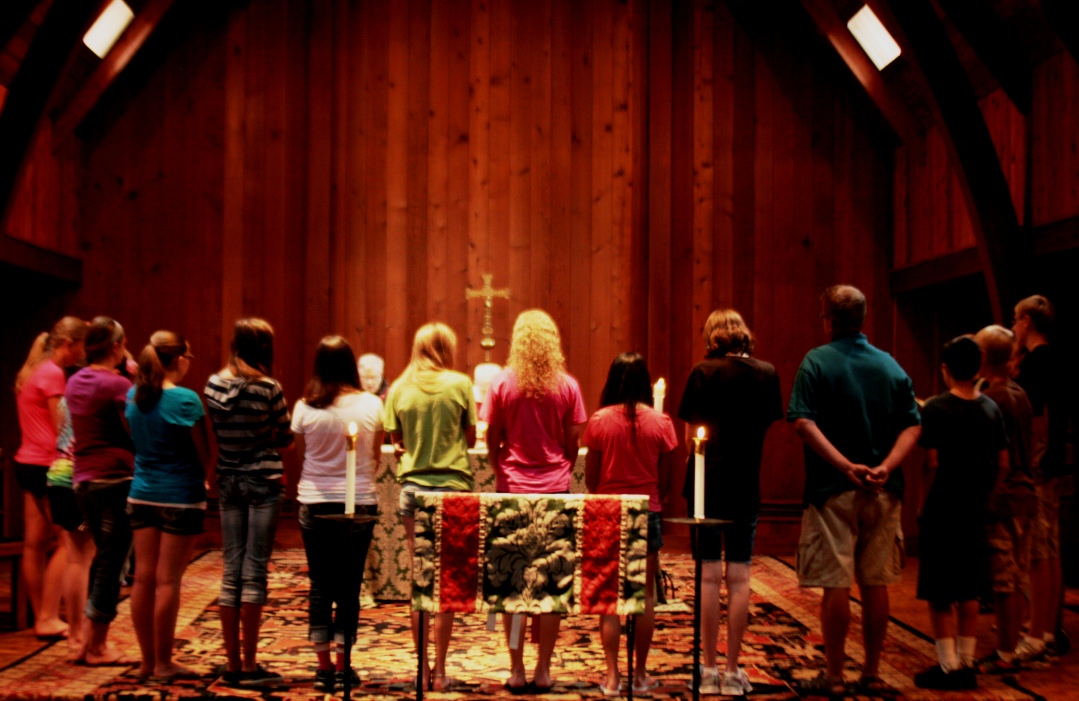
lakeGray1Two dramatic events from the Hebrew Bible have been interpreted as prefiguring baptism are the Flood and the deliverance at the Red Sea. Both are deliverances from highly dysfunctional societies.

Genesis 6 portrays human society as consumed with violence. No wonder if everybody was like Lamech and inflicting seventy-seven-fold vengeance on anybody whom he thought had wronged him. In his second epistle, believed by many scholars to be a baptismal homily, Peter says that the deliverance of Noah and his family corresponds to baptism which saves us now through the Resurrection of Jesus Christ. (1 Pet. 3:21) René Girard has suggested that a flood is an apt image for a society overwhelmed with retaliatory violence. In such a scenario, a man who tried not to be a part of this violence would be an obvious choice of a victim to unite the fragmented society. The Christological interpretation in Peter’s epistle suggests by being baptized into Christ’s death, we are brought out of society consumed with violence and given the chance to begin life anew, the chance that Noah and his family had after the flood waters receded. It is worth noting that when referring to Jesus descending into hell (Sheol), Peter does not say Jesus just brought out righteous people like Abraham but that he preached to the very people who had brought humankind to the boiling point while Noah was building his ark.

St. Paul says that we all “passed through the sea and all were baptized into Moses in the cloud and the sea.” (1 Cor. 10:2) Once again we have an overwhelming flood. Moreover, we have a story of a people delivered from a violent and oppressive society. In his book Jesus: the forgiving Victim, James Alison suggests that the Jews were expelled after being blamed for the plagues scourging the country. If the Jews were expelled, why would the Egyptians runs after them to bring them back? Perhaps they realized they would implode without the victims who were deemed responsible for their turmoil. This is what seems to have happened with the Gerasenes when their demoniac was cured by Jesus. One could take the tug-of-war between Moses and Pharaoh as indicating this same tension. (See Dispossessing a Town Possessed) Being overwhelmed by the waters is, again, an apt image of a society succumbing to its own violence once the scapegoats are gone.

Unfortunately, neither new chance at a new life went well. Noah’s drunkenness and rivalry among the brothers that made Ham a scapegoat set humanity on a course where the curse laid on him was used to justify slavery and lynching. The people delivered at the Red Sea suffered from chronic social unrest, leading to Moses raising the bronze serpent in the desert to stop the plague of violence. Likewise, the church continues to fall back into the same rivalry and persecution. Most lynchers, unfortunately, were Christians. A tendency to see baptism as deliverance from personal sin surely reinforces such backsliding. Baptism is not a magical deliverance from personal sin but is a constant invitation to be reborn into the new social life of God’s kingdom centered on the forgiving victim who, like the bronze serpent, was raised up to draw all people to himself.

Baptism: Overwhelmed by Christ’s Love (3)

Baptism: Overwhelmed by Christ’s Love (1)

Cleaning Up Our Unclean Acts

eucharist1Peter was surprised when he had a vision of a sheet carrying all the animals listed in the Law as unclean accompanied by a voice telling him that God had made them clean. Peter was even more surprised when he was told to go to the house of an unclean Gentile named Cornelius and preach the Gospel to him. That is, God had made all humans clean.

We all have a hard time living without the comfort of knowing that some people, some things, are unclean. This fear that sustains us is the fear of what is Other. All we have to do is get to know “unclean” strangers and we will be happy and no longer afraid.

René Girard, however, would give us pause. Girard is often invoked when there is need to scold people for creating “out” groups to make them feel good about their “in” groups. Actually, Girard alerts us to our problems within our “in” groups. Prior to our fear of the Other is our fear of what is the same. Rivalry and the violence rivalry lead to does not originate in battles with strangers but with those closest to us. In Genesis, almost all of the strife is between brothers.

Girard suggests that this fratricidal strife tends either to the death of a brother or a reconciliation through killing somebody else. At the dawn of humanity, a tribe first struggled with rivalry within its own ranks and either imploded through its violence or came together through killing one of its members, who then was designated at Other, the monster who caused the commotion. Then the tribe held itself together on an ongoing basis by warring on other tribes who were designated as Other. In this regard we are not one wit wiser than the most “primitive” of people. A fundamental practice of statecraft today is to deal with rivalry and tensions within a nation by designating an enemy that the whole nation must fight.

Anthropologists such as Mary Douglas have demonstrated the human tendency to divide foods between those deemed clean and those considered unclean. Eating is the central activity of a community. We eat with those who are closest to us. However, as noted above, we also fight most with these same people who are closest to us. By dividing the food we eat between clean and unclean, we create a barrier between us and other people, between us as the “in” group and those in the “out” group. That is, we relieve our communal tensions by banding against those who eat “unclean” foods.

Here we come to the importance of Jesus’ admonition to his disciples, while at table, that they (we) love one another. Some scripture scholars have poured cold water on idealistic readers by saying that John was concerned only with love within the community. But Jesus’ saying that others will know we are Jesus’ disciples by our love makes it clear that this loves does extend beyond the immediate community. These reflections on “clean” and “unclean” further suggest that fostering non-rivalrous love within the community allows the community to reach out to others. This love will make everything and everybody clean and bring us all to one great table in the Heavenly Banquet.

Celebrating the Prince of Peace

snowKatrinaCrossBW1This year’s rejoicing over the birth of the Christ Child is darkened by the recent murders at Sandy Hook School in Newton, CT. Lest I be accused of being a killjoy by keeping these two events together, let me remind you that Saint Matthew is just as much of a killjoy when he tells the story of the Holy Innocents who were killed in Bethlehem. Christmas has been darkened by human violence from the start.

When a tragedy like this strikes, it is only responsible to find ways to prevent it happen again, or at least lower the chances of it. The problem with prevention is our tendency to fall into a blame game. Some of it is absurd, such as blaming homosexuals or the banning of prayer from public schools, never mind the countless attacks on schoolchildren that predated that Supreme Court decision. Then there is the NRA. There is unquestionably a long overdue need to re-examine the ubiquity of firearms in our country but we have to dig deeper.

Which gets me to what we need to learn from the baby laid in a manger on a cold winter night. When this child grew up, he became the victim of collective violence in a tense city, the one blamed for that tension. And yet God raised this victim to prove his innocence. When Jesus encountered human problems, he did not blame people, he healed them. Even when he spoke strongly, as he did to the Pharisees, he was trying to heal them. When threatened with violence, Jesus told the disciple who drew a sword to put it back in its scabbard and stay there.

The killing of the children at Sandy Hook was violent, but the casting of blame is also violent. Hacking the Internet pages of the Westboro Baptist Church, egregious though its actions are, is only a further escalation of violence. The problem with the blame game, even when there is some truth to the charges, is that it always distracts us from other factors that are at least as important.  We all need to look at the logs in our own eyes, at the resentments within ourselves that fuel the violent tensions in our society.

The angels appearing to the shepherds sang of peace for all people. Not peace orchestrated by a violent empire, but peace emanating from the human heart that wants to protect not only Jesus from Herod, but all children from all who would hurt them, most of all, ourselves. By taking responsibility for ourselves, we make ourselves responsible to all. Then we can really celebrate Jesus as the Prince of Peace.

See also Two Ways of Gathering