
A Cup of Cold Water

Jesus’ words about cutting off hands and feet and plucking out eyes in order to avoid unquenchable fire are pretty grim and can leave us feeling traumatized. (Mk. 9: 43–48) It is enough to make a preacher look for ways to make everybody feel better. For starters, I think I can safely say that this business of cutting off hands and feet and plucking out eyes is hyperbole and Jesus doesn’t expect or want us to do any such things. Even so, even if we take these words metaphorically, they are clearly metaphorical about giving up something that feels like a part of us, so we aren’t in for a free ride by any means.

Why the talk about stumbling blocks that lead to sin and the drastic solution of dismemberment? The French thinker René Girard is helpful for understanding what a stumbling-block is all about. The Greek word is skandalon. It refers to offense, scandalizing other people by our conduct or our words. In the preceding verses read as last Sunday’s Gospel, the disciples had argued about who was the greatest. Jesus then put a child among them and told them to become like this little child. (Mk. 9: 33–37) At the beginning of today’s reading, the disciples are complaining about somebody casting out demons in Jesus’ name, another example of arguing about who is the greatest, as they see this exorcist as a competitor while Jesus sees him as somebody else doing what needs to be done. (Mk. 9: 38–40) Girard suggested that when people become rivals, they become stumbling blocks to one another. They become entangled with one another, tripping and falling over each other. Children, such as the child Jesus placed among the contentious disciples, are very vulnerable to such a competitive environment in many ways. If they feel they have to compete to get attention in order to have their needs met, they copy the behavior that is modeled to them. More tragically, children are often “collateral damage” in the conflicts waged by their elders, whether it is in the family or large-scale warfare. A society permeated by people arguing and fighting about who is the greatest is hellish. It is a fire that never goes out. So we don’t have to think in terms of an afterlife, but it is worth mentioning that there can be no such rivalry in heaven so we do have to give it up if we are going to find heaven heavenly. Besides, the word translated as “hell” is Gehenna. Far from referring to the afterlife, Gehenna refers to a valley outside Jerusalem that Jeremiah and other prophets said was used for child sacrifice. (Jer. 19: 2–5) This image is most apt for the vulnerability of the “little ones” or “the least of these.” This term does not necessarily refer to children, although because Jesus had recently placed a child among the disciples, it is easy to think that. There is no question, however, that Jesus is referring to all vulnerable people, which certainly includes children.

These considerations would suggest that we need to cut off our rivalrous desires and throw them away so as to avoid the hell of rivalrous contention. The trouble is, we can’t really cut off our desires and throw them away. We are still human if we have one hand or one foot or one eye, but we aren’t human if we don’t have desires. And it isn’t that we have some bad desires we can throw away and some good desires that are keepers. We have desire. Period. So it isn’t a case of cutting off desire but directing it and, when necessary, redirecting it. Such redirection can feel like an amputation for those of us who are addicted to fighting over whether we are the greatest. We have a simple but powerful example of redirecting desire away from rivalry towards charity in the words sandwiched by the apostles’ complaint about the “unauthorized” exorcist and the exhortations to cut off hands and feet if they cause us to stumble. Here Jesus urges us to give a cup of cold water to anyone who bears the name of Christ. (Mk. 9: 41) Such redirection leaves us vulnerable to those who continue to play the hellish game, but Jesus has told us that the kingdom is about being among the least of all people, the most vulnerable. The more we are in touch with our own vulnerability, the more sympathy we have for the vulnerability of others, including the vulnerability of those who try to hide their vulnerability through rivalry. We need these cups of cold water to put out the fires.

John’s Offended Puzzlement

Mattia_Preti_-_San_Giovanni_Battista_PredicazioneJohn the Baptist is so closely associated with the beginning of Jesus’ ministry that it’s easy to see them as two of a kind. Both preached repentance. Both died the death of a martyr.
But if the two of them saw eye to eye, why would John send his disciples to ask Jesus if Jesus was “the one who is to come, or are we to wait for another?” (Mt. 11: 3) As is usually the case when asked any kind of question, Jesus gives only an indirect answer. He lists the miracles that are happening such as the blind receiving their sight and the lame walking. Then he caps it off with the cryptic and seemingly incoherent words: “And blessed is anyone who takes no offense at me.” (Mt. 11: 6) The implication is that John is taking offense at Jesus, or is in danger of doing so. If Jesus is concerned that John, his onetime mentor, might take offense at him, what about his followers? What about us?

The Greek word used here for “offense” and throughout the New Testament is skandalon. We get the English word “scandal” from it. The word means “a stumbling block” and it particularly applies to conflictual circumstances. In the thought of René Girard, two or more people in conflict are stumbling blocks to one another. In his important book The Scandal of the Gospels, David McCracken examines the concept of scandal at length. Jesus’ challenge in his reply to John’s followers is central to McCracken’s argument that faith and scandal are inextricably entangled. What this amounts to is that “only when the possibility of offense exists will the possibility of faith exist.” Being offended, scandalized by Jesus takes us half-way there. One who is not offended because of indifference has not even started. (McCracken 1994, p.82) On the other hand, someone who is stuck in being scandalized for the sake of being scandalized is not likely to move forward either. The people who were scandalized by both John and Jesus, although for opposite reasons, fit this profile. (Mt. 11: 16–19)

So why might John or we take offence at Jesus? Both Jesus and John called for repentance but John’s warnings were accompanied by images of wrath: an axe at the tree, a winnowing fork, fire. John’s preaching can be heard as a renewal of Isaiah’s prophecy of hope: creating a highway through the desert as God did to bring the Jews back from the Babylonian exile, opening the eyes of the blind and the ears of the deaf, coming with vengeance and “a terrible recompense.” (Is. 35) If we tick the boxes of Jesus’ ministry, there is a check mark for each item except for the “terrible recompense.” There are also no axes, winnowing forks, or fire in Jesus’ preaching. Perhaps John felt like an emcee announcing a dramatic act only to get a puff when he thought he’d get an explosion.

When we think of the people in our lives and public figures who affect us that we sincerely think are “a brood of vipers,” do we want the wrath they are fleeing to fall on them? Are there people we think should be chopped down and thrown into the fire? If we harbor the same vengeful feelings, we are scandalized by these people. How then do we feel about a preaching ministry where the poor and the peacemakers are blessed and we are asked to forgive those who scandalize us? Are we scandalized at the idea of renouncing vengeance against these people? If so, then we are taking offense at Jesus and we are not blessed.

The earnest moral sense and integrity of John the Baptist represents the best humanity has to offer but “the least in the kingdom of heaven is greater than he.” That is, as soon as we take even the smallest of baby steps in the way of forgiveness and not being scandalized by seriously scandalous people, we are better than the best humanity can offer. There’s nothing to be proud of here. Jesus healed the cripple when he forgave his sins. This same forgiveness heals us and gives us the strength to take these baby steps into the Kingdom of God.

Increasing Faith in Forgiveness

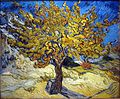
mulberry_tree_by_vincent_van_goghThe disciples’ demand (not a request) that Jesus increase their faith, (Lk. 17: 5) with a hint of desperation that such a demand entails, seems to come out of nowhere when it begins the Gospel reading. So let us look at the preceding paragraph for some context.

That paragraph begins with Jesus’ ominous warning against being occasions of stumbling (scandals) for any of Jesus’ “little ones.” Unlike the parallels in the other synoptic Gospels, however, this warning is quickly followed by an admonition to rebuke those who cause stumbling but then to forgive them if they are penitent, even if it is seven times a day, which is a lot of forgiving.

So, the disciples aren’t having a problem believing in the Nicene Creed. They are having a problem accepting this demand to be forgiving on such an incredible scale. After all, if one repents seven times a day, how serious is the repentance? Forgiving like that often requires the patience of a saint and not even many of the saints I know anything about are as patient as that. The “faith” at issue here, then, seems best understood in the usual meaning in Jesus’ time which would stress fidelity to Jesus’ teachings and trust in his sanity in the face of such impossible demands. In the same fashion, we can understand “faith” as used in Habakkuk 2:4 as referring to remaining steadfast to Yahweh in the face of the human violence of social injustice in Israel and the violence of the Babylonian invaders. That is, in the face of people who cause much stumbling and need forgiveness almost nonstop.

Unlike the parallels in Matthew and Mark, faith the size of a mustard seed is enough to move this mountain, perhaps the Temple Mount and its sacrificial system, from here to there. But mulberry trees have nothing to do with sacrifice. So why a mulberry tree in this version? A mulberry tree can be nice to have around but it an be a nuisance in some circumstances. When I was growing up, we had a mulberry tree on the edge of our property. The berries were a nice treat but they also stained the driveway a deep purple. Mulberry trees also have complex root systems that spread out a large distance just under the surface and they also send sinker roots deep into the soil. This may be one of the reasons my father used a tree removal service rather than faith to move the tree off from the property.

We an see the mulberry tree as an image of the intractability of the occasions for stumbling that we encounter on a daily basis. The image also stands for the tangle of our anger and frustration over being asked to forgive those who keep making us stumble over and over again. The close coupling of Jesus’ admonitions here suggests that all of us cause others to stumble about as much as we have occasion to forgive others for making us stumble. Faith the size of a mustard seed is enough to pull us out this tangle of scandal and stumbling and yet we have trouble having as much faith as that!

A brief parable follows. We are apt to think the master treating his slaves so harshly stands for God, but Jesus is asking: Whom among you would say to his slave to come sit down for dinner after a hard days’s work? The implication is that we are the ones who would like to have the power to order people about like that. But is that faithfulness to Christ? Looks more like a cause of stumbling to me. Jesus then shifts to the perspective of the slave who must not presume to be worthy of any reward, just as slaves were so considered in his time. In a similar parable in Luke 12, Jesus says that the master is the one who will wait on those slaves who eagerly await his return. In daily life, we often feel that we are slaves of those who cause trouble and so demand much attention and energy on our part and yet are the last to express any gratitude for what we do for them. We tend to resent such slavery and take refuge in vengeful anger and maybe some grudging forgiveness that makes us feel superior. But Jesus places himself in the position of the slave to those who stumble and makes others stumble, so that is where we will find Jesus if we have the faith the size of a mustard seed.

Respect (2)

WilliamGuestsChurch1

[A continuation of Respect (1)]

The importance of respect can be easily seen when we think of routine encounters. Love is too freighted a term for the way we interact with, say, the person at the checkout counter of a store. It is obvious that courtesy and respect are called for but not love as it rests (and twists and turns) in the popular imagination. We all know how much we appreciate doing business with people who are respectful and how much we avoid doing business with those who aren’t. In such cases, respect isn’t much of a feeling but it is a set of actions and a manner of speaking. Although receiving respectful treatment gives us a low grade sense of well-being, disrespectful treatment tends to make us instantly angry and all sense of respect flies out the window or through the wall. Disrespect makes the smallest exchanges seem big and highly significant while we don’t think of much of respectful encounters. The thing is, both respect and disrespect are highly contagious but the latter is especially so. We tend to think we are owed respect just for being people and feel violated if we are not treated respectfully. Yet we are apt to think other people should earn our respect. This looks like a double standard but I can sympathize. This sort of attitude comes naturally to me. However, if God’s unconditional love for us is taken as a model for human relationships, it follows that we should give unconditional respect, which is harder. We can fool ourselves into thinking we only hate the sin but love the sinner, but how about respecting the sinner while hating the sin?

The chapter on the Cellarer of the monastery in the Rule of St. Benedict (Chapter 31) is the most concise and articulate view of respect and courtesy that I know. The cellarer is the monk responsible for providing for the community and guests. To do that, he needs to respect the tools and all other material goods to the extent of treating them as if they were “sacred vessels of the altar.” Here is an indication of the continuum from respect to God in prayer to respect for material reality in one’s work. The cellarer should provide “the allotted amount of food without any pride or delay lest they be led astray.” That is, the cellarer should be respectful of the needs of others and should not take advantage of his position to play petty power games with people the way some bureaucrats will with their tiny turfs. The Latin for “leading them astray” is scandalizaverit which means scandalize, place a stumbling block before the other. “Scandal” is a word imported from the Greek New Testament and is the word Jesus used when he warned against causing his “little ones” to stumble, a verse Benedict goes on to quote. Jesus and Benedict are alerting us to a human tendency that René Girard has more recently pointed to: the human tendency to make oneself a stumbling block for another by making a simple encounter a contest of wills. This is precisely what Benedict wants the cellarer to avoid. (I discuss scandal in Girard and Benedict in my book Tools for Peace.)

On the contrary, if the cellarer does not have a requested item, he should “offer a king word in reply.” When I was guestmaster for the monastery, there were times when I did not have room to accept any more guests and I kept this admonition in mind and tried to speak kindly and give encouragement for coming at another time. If the cellarer should be the one who suffers discourtesy, he should “reasonably and humbly deny the improper request.” The onus is on the cellarer to stem an escalation of disrespect by treating even a disrespectful person with respect.

Continued in Respect (3)