
The last time I preached, Jesus announced the Jubilee of God. I suggested that we will likely find the rest of the Gospel filling out what such a Jubilee entails. If that is so, the blessings and woes at the beginning of the Sermon on the Plain (Lk. 6: 20–26) seem to be an odd way to have a jubilee. Usually we think that being rich and being well fed at meals filled with laughter and receiving lots of compliments is precisely how to have a jubilee. On the other hand, being poor and hungry while weeping and being reviled are all downers, but Jesus seems to suggest that these downers are what the jubilee is all about. As for Jesus himself, after he announced the Jubilee, he was spoken well of for about a minute and then it all tanked and he was driven out of the synagogue. So Jesus was already practicing his jubilee in terms of the Sermon on the Plain from the start of his ministry.
Obviously we need all the help we can get for understanding these troubling and puzzling words, so let’s see what we can glean from the first two readings. Jeremiah also talks about blessings and curses. Does he mean that God curses people God doesn’t like? The people that Jeremiah says are cursed “trust in mere mortals and make mere flesh their strength.” (Jer. 17: 5) Sounds like these people are cursing themselves by rejecting God. The contrast of a tree planted by the water and a tree planted in salt land suggest that blessings and curses are simply natural outcomes of being grounded in God or not being so grounded. Jesus, then, picking up on Jeremiah, would be suggesting that the poor and hungry are grounded in God and the rich and sated aren’t. If that is true, then maybe being rich is overrated and is not such a great cause for jubilee. It is worth noting that the Rich Young Man went away sad because he had many possessions.
The words of St. Paul from the end of his First Epistle to the Corinthians (1 Cor. 15: 12–20) with his anxious defense of the Resurrection suggest the possibility that the reversal takes place in the afterlife. Jesus does hint at that for the reviled and defamed. Maybe a better afterlife can also be some consolation for the poor and starving, but that does not otherwise help us cope with being poor and starving and slandered right now. And Jesus is saying that the poor are blessed now, not just later. The anxiety on Paul’s part is the denial of the resurrection on the part of some supposed followers. What’s the problem? If applying Jeremiah’s words to the Sermon on the Plain leads us to depend on God, we must depend on a living God, not a dead one. Only if Jesus is truly raised from the dead as the apostolic witness avers can Jesus be depended on right now.
So, the big take from Jeremiah and Paul is that we are blessed if we are grounded in God and we are unfortunate if we are not. That much is certainly true and has the advantage of being a pretty big loophole where there didn’t seem to be one: we don’t have to worry about having some economic resources and being well-fed as long as we are grounded in God. But maybe this loophole threatens to be a trap. Surely Jesus is warning us that the more we have, the less likely we are to depend on God.
At this point. I get the feeling I’m fretting that if I have one penny too many, I lose my blessing and become unfortunate. Same if I take one bite of food too many, laugh too much or get one compliment past my quota. There is no end to this spiral unless I stop and turn around. After all, these thoughts are all centered on self. There is no jubilee in such fretting and there is no depending on God either. But what if we think more about other people having something to eat and something to laugh about? What if we stop reviling other people and build them up by letting them know we appreciate them? Doesn’t this start to look a little more like the Jubilee announced by Jesus? If we take this approach, we start to see how we hinder these things and how our social system hinders them. This gives us cause to weep, but if weeping leads to making these things better, then we have turned tears into laughter. But the deeper mystery remains. Sometimes we don’t see the silver lining of being poor and starving, crying and being reviled and these things often happen as a result of doing the things listed above. Jesus is encouraging us by promising that the silver lining we cannot see is really there in the love we pour out for others. He should know, having gone through Gethsemane and the Cross. This is why we are blessed even in such times if we are grounded in the crucified and Risen Christ.
 Matthew says there was an earthquake when the angel of the Lord came down, rolled away the stone of an empty tomb and sat on it. Both the earthquake and the empty tomb give us apt images for the way we experience Easter this year.
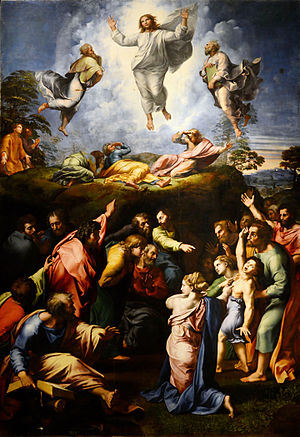 At the end of Epiphany, we celebrate the Transfiguration of Our Lord to prepare for Lent. The vision of the glorified Christ is supposed to cheer us up for the grim days of penance and the grimmer days of following Jesus through his Passion. The Transfiguration also prepares us for Easter as it gives us a foretaste of the glorified body of the risen Lord.
 Jesus’ healing of the woman who had been crippled for eighteen years (Lk. 13: 13–17) is one of many healing miracles where the Evangelist emphasizes its occurrence on the Sabbath. These healings were provocative to the Jewish leaders because they interpreted the Sabbath law to preclude any kind of work. Jesus clearly intended to challenge that interpretation but there is a deeper teaching about the Sabbath that he wants us to learn.
 Easter is an occasion of great rejoicing with bells, boisterous singing, and feasting. But do we really know what we are celebrating? The Gospel reading, doesn’t exactly ring out with Christmas joy of angels filling the skies with songs of God’s glory. Instead, we get “two men in dazzling clothes” who tell the women who came to the grave to anoint Jesus’ body that Jesus was not there but had risen. They had come to the wrong place.
 St. Paul proclaims the Resurrection of Jesus as a radical game changer. It is a passage from death to ourselves to a new life in Christ. This proclamation is often understood as an individual conversion. It is that but it is much more. During his life, Jesus proclaimed the kingship of God. A kingship, of course is social, not individual, much as we like to fancy ourselves kings and queens of our little castles. The kingship of God looked like a lost cause when Jesus died, but after being raised from the dead, Jesus leads us into the kingship that we rejected when we crucified him. It is important to note that Paul was not writing to an individual but to a community, indeed, the community that at the time represented all humanity as Paul knew it. St. Paul proclaims the Resurrection of Jesus as a radical game changer. It is a passage from death to ourselves to a new life in Christ. This proclamation is often understood as an individual conversion. It is that but it is much more. During his life, Jesus proclaimed the kingship of God. A kingship, of course is social, not individual, much as we like to fancy ourselves kings and queens of our little castles. The kingship of God looked like a lost cause when Jesus died, but after being raised from the dead, Jesus leads us into the kingship that we rejected when we crucified him. It is important to note that Paul was not writing to an individual but to a community, indeed, the community that at the time represented all humanity as Paul knew it.
 Easter is a great celebration, but it is a strange celebration. It isn’t like celebrating an election won or winning the World Series. It most certainly isn’t like celebrating victory in war. But if we have trumpets and kettle drums to augment the shouts of Alleluia!” we might forget the strangeness sometimes and get carried away by a sense of triumphant victory.
 An early Easter throws many things awry, not least the saints’ calendar. St. Benedict’s day is normally celebrated on March 21, but this year, it was transferred to Monday after Easter Week. Thinking about St. Benedict in terms of Easter reminds me of what he said about Lent in Chapter 49 of his Rule.
 Imaginary Visions of True Peace