The Burglar Who Serves

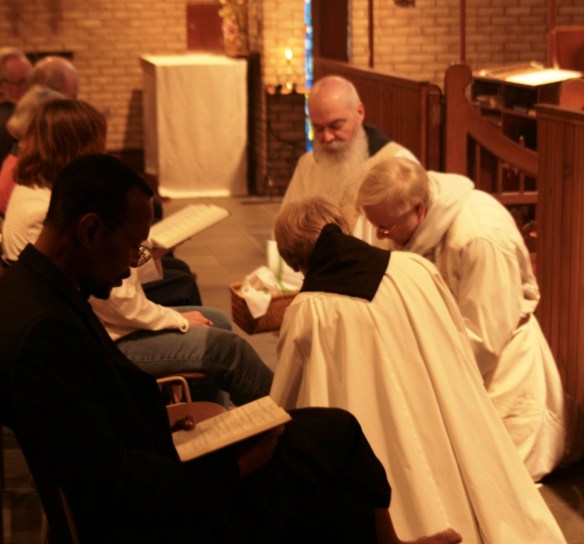
AndrewWashingFeet - CopyThe first verses of today’s Gospel (Lk. 12: 32–34) pick up from where we left off last week. That reading ended with Jesus’ little parable about the rich fool who tore down his barns to build bigger barns (Lk. 12: 12–21) only to find that his life was being demanded of him. This reading begins with Jesus’ soothing admonition to “sell our possessions and give alms” and “make purses for yourselves that do not wear out, an unfailing treasure in heaven, where no thief comes near and no moth destroys.” (Lk. 12: 32-33) This is quite a contrast to two brothers fighting over an inheritance or a rich person gloating over fabulous amounts of wealth. Lest we think Jesus is asking us to make ourselves miserable, Jesus assures us that it is our heavenly Abba’s pleasure to give us a treasure that is the kingdom. If this treasure, the kingdom, is the Abba’s pleasure, then it is our pleasure as well.

It is important to see that Jesus is not telling us to give up desires. The heavenly Abba has a profound Desire for a deep union of love with each of us, a union God would have us share with each other. If God is comprised of God’s Desire, than it follows that we creatures are created with desires. What Jesus is doing here is redirecting our desires from the desires of rivalrous avarice towards God’s Desire that is without rivalry. Isn’t every fight, ultimately, over what we think we are entitled to as our inheritance? Yet aren’t we all offered the whole world to be an inheritance rather than a bone for contention? Since these rivalrous desires embroil us with our rivals, the material inheritance we are fighting for is destroyed as if by moths. Of course, each rival blames the other for being the thief that has stolen the treasure.

Jesus then shifts to an admonition to be ready for the Master’s “return from the wedding banquet.” (Lk. 12: 36) If we servants are alert and ready to greet the master, the master will wait on us as Jesus waited on his disciples at the Last Supper. This little feast shared by master and servants is an image of the treasure our hearts should be set on. The progression of vignettes and admonitions throughout this chapter suggests that the best way to be prepared for God’s coming is to set our hearts on treasure that moths cannot consume and thieves cannot steal. Fundamentally, being alert for the “master” consists of serving one another in the same way that the master serves us when he comes.

The following little parable is comical and a bit threatening. The master who serves those who wait for him is transformed into a thief breaking into a house in the middle of the night. (Lk. 12: 39–40) If our hearts are not set on the treasure of serving one another, but instead we fight over our inheritance and try to gather it into bigger barns, then the God who serves us will be quite alien to us and will be perceived as a thief, a burglar. If our rivalry deepens as it does in the still more threatening parable that follows, so that our rivalry causes us to “beat the other slaves, men and women, and to eat and drink and get drunk,” (Lk. 12: 45), then the gracious master will indeed rob us of our victims.

God is both a burglar and a gracious master who serves. God only breaks in to take away all that draws our hearts away from God and from each other. What this burglar leaves in return is a treasure well worth setting our hearts on.

On Being a Bad Samaritan And a Good Person

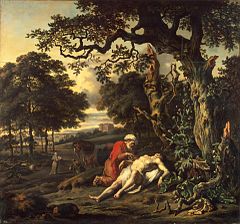
Good_SamaritanMany of us instinctively think that knowing is something we have in our heads, something we can recite, like a catechism. This is the sort of knowing that the lawyer demonstrates when he recites, correctly, the two great commandments when Jesus encourages him to answer his own question as to what he must do to inherit eternal life. (Lk. 10: 27) But then the lawyer shows a certain ignorance, a missing piece. He doesn’t know who or what his neighbor is. Jesus answers this question by telling a story that pinpoints exactly the missing piece in the lawyer’s cognition.

The key phrase in this familiar story that shows what the lawyer lacks is that the Samaritan was “moved with pity.” The Greek word is one that twists the mouth all out of shape: splagchnizomai (pronounced splangkhnizomai). Literally, this word means his entrails were stirred up at the sight. Here is a visceral response that didn’t need the benefit of the catechetical verse from scripture to be activated.

The response of the Samaritan, then, was instinctive, a bonding with the victim who had been severely injured. We are naturally wired for this sort of solidarity, but René Girard has demonstrated that this natural solidarity often takes the form of bonding with other people at the expense of those who are excluded from this bond. Paul Dumouchel, in his analysis of this process in The Ambivalence of Scarcity, argues that the social bonds in early humanity required not only self-sacrificial nurturing of others in the group, but also the obligation to kill all those outside the group, who were considered enemies. The natural response to a person in trouble is hedged in with limitations. One’s entrails are not stirred by the plight of just anybody, but only the plights of those who are within the group.

It is this bonding based on exclusion that Jesus thrusts into the face of his listeners by telling us that a priest and a Levite both passed the victim by but then a Samaritan came to his aid. Since the victim might have been dead, both the priest and Levite would have been rendered ritually unclean by touching a corpse. Ritual purity, like all kinds of purity, requires exclusion. One is pure only if something or someone is defined as “impure” so that the “impurity” can be purged from the social fabric. This kind of bonding by exclusion becomes so instinctive that it trumps bonding through sympathy with someone outside the group. The lawyer’s question came naturally to him because it was natural for him to place boundaries around who was a neighbor and who wasn’t.

The ethnicity of the victim in the parable is not given but Jesus’ listeners would have assumed that he was a Jew like them, most likely a Galilean. Samaria came between Judea and Galilee. This was a problem because all Jews hated all Samaritans and vice versa. When Jesus went through Samaria with his disciples, they were refused hospitality at a village they came to. The reason this Jew from Galilee would have been on the notoriously dangerous road from Jerusalem to Jericho, was because he would have traveled along the Jordon River to avoid going through Samaria on his way to Jerusalem. So, the traveler, in trying to avoid Samaritans, ended up encountering a Samaritan who helped him and undoubtedly saved his life!

What Jesus is doing in this parable, then, is shock us out of our tendency to bond through exclusion and bring us back in touch with the deeper natural bonding through compassion for whichever victim we pass by. For a Jew of the time to help a Samaritan in similar circumstances would have been unthinkable. Such a person would have been a bad Jew—like Jesus. Likewise, the “Good Samaritan” was actually a bad Samaritan in the eyes of other Samaritans and all Samaritans were bad in the eyes of the Jews. In his novel A Boy’s Life, Michael McCammon presents us with a similar situation that brings this parable home for many white Americans. A violently racist white man in a small town in Alabama tried to blow up a museum of Black culture but ended up in a life-threatening situation, caught in his own trap. This racist was then rescued by a black man. The cognitive dissonance experienced by the man who had hated blacks so viscerally all his life was highly dramatic. In the broader context of the novel, the eleven-year-old protagonist Corey, a white boy, consistently showed a visceral sympathy for victims that extended to saving a black boy from drowning during a flood.

Jesus knew better than most liberals like me that we don’t overcome prejudice by trying to be more logical about the problem. Our bonding through exclusion short-circuits rational thinking as the lawyer, the priest and the Levite demonstrate in much the same way as priests, ministers and social workers demonstrate today. What is needed is knowledge through our deepest natural bonds of sympathy with the other that has no boundaries. Then, we need not ask: Who is our neighbor? because, as Kierkegaard tells us in Works of Love, the person nearest us, no matter who he or she is, is our neighbor.

In Memorium: René Girard 1923-2015

GirardIt has been a couple of bittersweet days of memories since getting the news of René Girard’s death. I have the feeling that many of us are cybernetically sitting around the fire sharing memories. Here are some of mine.

For many years, pretty much ever since I became a Benedictine monk (Episcopalian, not Roman Catholic) in 1972, I fretted about the close proximity of religion and violence. Given the teachings of Buddha, Jesus, Lao Tze and others, it didn’t make sense. Thomas Merton’s polemics against violence written from his hermitage at Gethsemane Abbey in Kentucky inspired me and assured me I was fretting about something worth fretting about. This concern eventually led me to René Girard. It took a few years and the help of others such as James Williams to realize that Girard provides the most cogent hermeneutic for understanding scripture as the unveiling of a loving, nonviolent God. More important, his anthropological insights impressed me with their explanatory power as to why religion had been connected with violence from the start and why it still happens. As a sidelight, during the 80’s, I was searching for a sense of direction as to how I was to evaluate postmodern thought, especially deconstruction as a Benedictine. I talked to the abbot of St. John’s Collegeville about visiting to meet with some of the Benedictine professors in the college, but I dropped that when I grasped Girard enough to realize that he gave me the sense of direction I was looking for and that many companions on the way were at hand. A couple of times, I heard Girard put that sense of direction in a nutshell when he told deconstructionist type thinkers that the solid reality under the deconstructive flux is the reality of the victim.

I first met René close to the turn of the millennium in San Francisco at a meeting of the AAR/SBL when he read what has turned out to be one of his most important papers: “Are the Gospels Mythical?” I was in the process of writing a lead review essay on Girard for the Anglican Theological Review and I was hoping to meet René and ask him some questions. (See Violence and the Kingdom of God.) I got more than I expected. I was introduced to René after the lecture by James Williams, who had helped me with logistics for getting to the meeting, and I was invited to lunch along with several other people. I was placed across the table from René so that could discuss his ideas and get the clarifications I was looking for. When a question was outside his areas of expertise, he referred me to others who could help me. Over the years, as I managed to attend several meetings of COV&R while René was still at large, I had stimulating conversations with him, some short, some longer. There was a lot of friendly competition to get bits of time with René but he was amazingly approachable for a person who had become an intellectual leader for so many and one could talk to him in a relaxed way because that is how he talked.

Inspired by Girard and my Benedictine tradition, I wrote a book called Tools for Peace: The Spiritual Craft of St. Benedict and René Girard. I sent an advanced draft in manuscript to him for comments. When I received a letter a month later, I thought it was an amazingly prompt response. Yet René apologized for the delay, explaining that he had just gotten home from Avignon and he read the MS. first thing. His comments were generous and helpful.

I came to see, not surprisingly, that there was nothing unique in the way he treated me; it’s the way I’ve seen him treat everybody. I have seen him encourage everybody who works with his ideas whether or not he is personally sympathetic to their direction. I get the feeling that he knew his theory was much greater than him and it wasn’t anything he “owned” by a long shot. Along the way, I realized that Girard does not have followers; he has colleagues. That’s how he treated people. And not only colleagues, but friends.

Saints as Models: We Can Be One Too

vocationersAtTable1On the Feast of All Saints we are often encouraged to look up to the saints as models. Usually we point to St. Benedict or St. Francis and say: Follow his example. However, this feast is actually about us, the ordinary saints who didn’t make the cut for canonization in the Catholic Church or the Anglican calendar.

That is to say that this feast draws our attention to what we model to each other and what we do with what is modeled to us by others. René Girard has given us much insight into this matter. He is well aware, of course, of the importance of setting good examples in our actions but his concept of mimetic desire takes us much deeper into what modelling is really about. We do not just copy each other’s’ actions, we copy each other’s desires. We tend to desire what we see other people desiring. In this way, other people are constantly acting as models for us, usually without realizing it. Likewise, we are models to other people through what we desire. Putting it this way raises the question of who models to whom. This is actually a chicken and egg kind of question, especially since this whole process is usually unconscious. We are usually more conscious of what we desire then what we pick up from another person’s desire. The result is that we each thing we desire what we desire and we claim ownership of that desire.

Girard has demonstrated how this copying of each other’s desires, what he calls mimetic desire, can easily lead to rivalrous situations. This is especially true with things that cannot be shared. But once mimetic desire has become mimetic rivalry, it seems that nothing can be shared. So it is that Cain and Abel and Isaac and Jacob fought over blessings, thinking that blessings couldn’t be shared, and this after God had made Abraham a blessing for everybody. In scenarios of mimetic rivalry, each person is the model for the other, but a model who also has become an obstacle. This is a tight situation where at least one person loses. Actually, many lose in the crossfire of this kind of rivalry.

There is a different kind of modelling and that is what this feast calls our attention to. Jesus modeled behavior that was never rivalrous but was always expansive and generous. In this, Jesus was modelling his heavenly Father’s Desire which also is expansive and generous. To be a saint is to imitate Jesus but it isn’t primarily a matter of external imitation. To model ourselves on Jesus means to model ourselves on Jesus’ desires. If we want what Jesus wants, we find ourselves wanting the good of other people. To begin with, we realize there are plenty of blessings to go around and we want to be blessings to other people the way Abraham was made a blessing for everybody by God.

There is an element of choice in whom we choose as our models. The disciples, for example had Jesus modelling non-rivalrous desire right before their eyes but they still modeled to each other rivalrous desires as to who was the greatest. We all know how easy it is to be caught up in rivalry so that we are tied up in knots over it with no escape unless someone else comes along to untie the knots. Untying the knots for other people is one way to model Christ. Such people have to be pretty good at not getting tied up in knots themselves to be good at it. This is one of the qualities of saints such as Benedict and Francis who provide models in generous desiring. Those of us who follow them, when at our best, or at least not our worst, are individual variants of their personalities.

René Girard said that when he first met Raymund Schwager, a theologian who worked fruitfully with Girard’s ideas for many decades, he said that Raymund made him doubt his theory because Raymund had no mimetic rivalry in him. That was my experience with him as well. The professors at Innsbruck who studied under him show the same qualities. Not only do they imitate Schwager’s thinking but they also imitate his desires for the good of other people. This is how we can be saints in ordinary ways in our ordinary lives.

The Affirmative Way

churchDistanceBlossoms - CopyIn Christian theology and much more so in mysticism the negative or apophatic way and the affirmative way are posited as a fundamental contrast but actually they are two sides of the same coin. We can’t get anywhere if we can’t say anything about God and yet everything we say about God has to be wrong. God isn’t a rock on somebody’s front lawn any more than God is Pure Being. The dark cloud on Mount Sinai, the Cloud of Unknowing and the Dark Night all indicate negation and yet dark clouds and dark nights are still images that have to be denied. With that said (or unsaid) I will focus on the affirmative way even as I have to negate it at every turn and I will relate the affirmative way to mimetic theory.

Many see God in nature.  Even unbelievers tend to feel some reverence when they see mountains and trees and squirrels scurrying about.  The stars in the sky and stones and lakes and growing things all resonate with God’s Desire. God has profound respect for even the smallest pebble and hazel nut because God willed them to be. The more we participate in God’s Desire, the more we also will respect what is in nature and, although we must use nature, we will use nature in a sharing way rather than dominate it. Nature does not grasp at anything. It just is. This is why nature can teach us to desire in a non-rivalrous way.

The affirmative way is often experienced in human relationships. We see Christ in other people even though they do not always (or often) act like him. While the lilies of the field do not strive for the things of tomorrow, people do. In marriage, at least when it works reasonably well, one’s spouse is the primary image of God to the other. There is nothing romantic here as each partner knows very well the foibles and vices of the other. In community life, such as in a monastery, there is not, of course, the focused spousal relationship (except with God) but we have daily opportunities to see Christ through the struggles and kindnesses of others in the community. The image of Christ in the Gospels helps us straighten out the distortions that other people create even as Christ plunges us deeply into his presence within them. Learning to resonate constructively with the desires of other people is part and parcel of learning to resonate with God’s Desire.

rouault clown

One way we participate in God’s image is by creating art. No Lilly pad looks like a painting by Claude Monet but the dissolving images of lily pads on his canvases cause us to resonate with the inner life of these lily pads and to see them in real life in ways we never would otherwise.  The flowers in Georgia O’Keefe’s painting are atomic explosions. Thanks to J.R.R. Tolkien and his Ents we know how God feels in the rumbling roots of trees. Our sense of the sorrows of others is never the same after seeing any of the mournful clowns in the paintings of Georges Rouault, not to speak of the overwhelming agony in his paintings of Christ. We resonate with a certain deep level of Christ’s love through Rembrandt’s famous painting of the Prodigal Son.

???????????????????????????????????????????

Probably no person experienced Divine Love through a human being as the fictional Dante did with Beatrice in The New Life and the Divine Comedy. In real life Dante seems to have had no more contact with Beatrice beyond being waved at while passing in the street. But in Dante’s imagination the ever deepening smile of Beatrice as she leads Dante to the heights of Paradise transfigure the smiles of those we love on earth.

Music is quite apophatic in that, in itself, it has nothing to do with images and refers to nothing beyond itself. Although music might be set to words, it resists being explained in words. There is a sense of mystery caught in the motets of Thomas Tallis that is not caught in any other way. The constantly shifting keys and moods in the Schubert piano sonatas defy explanation. Music is, however, highly sensuous and it resonates deeply with our mirror neurons. Simple hymns are magnified throughout our bodies when sung in congregations.

Scripture, and not least the Gospels, are filled with images that must both be posited and negated. We know God is not a fretful woman who loses her money and people are not small round metal objects. But the Parable of the Lost Coin teaches us how solicitous God is for us and how precious we are in God’s sight. In John, Jesus says he is the bread from Heaven but resists being taken as only a distributor of bread.  In the Eucharist, we know Jesus is not bread and wine and yet we taste Jesus in the bread and wine and are fed by him so that Jesus penetrates into deep layers inside us that we will never know of except through a glass darkly.

Care for the Small Child

HolyFamilybyGutierrezIt is well-known that humans can be competitive, sometimes just for the sake of being competitive. Competition tends to draw rivals close together, even if, and perhaps especially if they really hate each other. People who are close to each other to start with are often competitive just because they are close to each other. Sibling rivalry is an old story as the story of Cain and Abel tells us. René Girard attributes this phenomenon to mimetic desire. The reason for the rivals’ competition is because they want the same thing. This does not happen by chance. The desire of one person inspires the desire of another. Often the mutual desire is instantaneous, or at least seems so. In any case, when two or more people fight over who is the greatest, each person thinks it is the others who are copying him or her and never the other way around. Girard further suggests that when this kind of rivalry spreads through society, it leads to a social meltdown that is usually resolved by the mimetic desire focusing on one person who is blamed for the crisis and who becomes a victim of collective violence. We see all these elements in a nutshell in today’s reading from Mark. Jesus tells his disciples that he will be betrayed “into human hands” and put to death. And then the disciples fight about who is the greatest, the very thing that has been happening on a broader scale in first century Palestine and so has made Jesus the designated victim of the social tensions around him.

All of this suggests that mimetic desire is a bad thing but that is not so. Mimetic desire is built into humanity by our Creator and therefore, in itself, it is good. It is good because it is the basis of deep connections between people. It is through mimetic desire that our parents and other caregivers initiate us into the world by sharing their desires for certain foods and learning to share desires for the well-being of other people. This is the significance of what Jesus does when confronted with the tense silence that greets his question: “What were you arguing about on the way?” Jesus places a child in their midst and tells them: “Whoever welcomes one such child in my name welcomes me, and whoever welcomes me welcomes not me but the one who sent me.” Jesus doesn’t reprimand his disciples as we think he should and as most of us would in his sandals. What Jesus does is very simple. Caring for a small child is the deepest manifestation of positive mimetic desire. Jesus subtly breaks up the closeness among the disciples that is brewing through their discord and instead unites them in their desire to care for the small child. This story puts before all of us the choice of how we will connect with the desires of other people: Will it be in rivalry or in nurturing others?

Love as Ultimate Respect

???????????????????????????????????????????We saw that the substance of faith and hope consists of actions on the part of God. (See Faith as Faithfulness and Hope as Inheritance.) The substance of faith is the Paschal Mystery of Jesus’ fidelity to the Heavenly Father and all humanity in dying on the cross and rising from the dead. The substance of hope moves further back in time, to the beginning of time, in that hope is grounded in God’s adopting all people as adopted sons and daughters to inherit the vineyard God laid out at the dawn of creation. Love goes further back past the beginning of time to Eternity. It is God’s love that was poured out at the Creation of the world. In God’s eyes, the “vast expanse of interstellar space,” as Eucharist Canon C in the Book of Common Prayer has it, is small in God’s eyes, “a little thing, the size of a hazel nut” as Julian of Norwich images it. But God loves that little thing and “in this way everything hath its being by the love of God.” Julian goes on to explain, based on her visions, that God loves “that little thing” so much that when that little thing in the form of a servant goes on a mission and falls into a ditch, God sends a second servant to get the fallen one back out of the ditch, an act that causes all of the dirt and grime of the pit to stain the clothes of the saving servant. So it is that Julian is convinced that it was love and pity that motivated the Father to send the servant to suffer for the fallen one and that there was no trace of wrath whatever in the process.

God’s love precedes and quickens God’s deeds. God’s love transcends time and will never end and will certainly never change, but the effects of God’s love in time can change. We see this with the actions of embracing the cross on Jesus’ part and in the process of inheritance. It is this abiding act of love that we are invited to participate in as the means of being clothed in God’s Desire.

Rebecca Adams, a feminist colleague of Girard, offers us a compelling articulation of what God’s love is all about. In an act of authorial generosity (more love in action) Vern Redekop created space in his fine book From Violence to Blessing for Adams to articulate her understanding of love at some length. It was Adams who, noting how Girard tends to stress the negative side of mimetic desire, prodded him in an interview to admit that there was such a thing as “positive mimesis” where mimetic desire works among humans for constructive and humane purposes.

Interestingly, Adams gained her inspiration from a Star Trek episode where the pivotal character is a metamorph from another planet. A metamorph is all mimetic desire to the extent that such a person is incapable of any subjectivity so as to be nothing but a perfect mirror of the other’s desires. Such a culture is mimetic desire gone mad. We can see that however mimetic desire works, it is not intended by God to be the destruction of the core of another’s personhood. This metamorph, a woman, is a pawn in an interplanetary marriage arrangement where she will be married to a callous corrupt official. Captain Picard of the Star Trek crew wants to save her from this fate but she can’t even imagine wanting any other alternative, let alone fight for it. Picard solves the problem by desiring that the metamorph have a subjectivity of her own. Because of her susceptibility, she is so engulfed in Picard’s desire that she does begin to desire a subjectivity for herself and thus achieves the beginning of independence. This is sort of like being the “tiny little thing” becoming a hazel nut with the potential to grow into something large (like the mustard seed becoming a large tree). Picard proves to be a fine model of willing the subjectivity of another person, something he must have been doing habitually with the people in his life all along.

Adams sees this Star Trek episode as providing a third alternative to attempting to be autonomous or having a subjectivity completely derived from another. This relational willing of the subjectivity between persons gives each “the capacity to participate fully in a loving dynamic of giving and receiving in relation to others.” This willing of the subjectivity of another is something that will spread so that if two people “start desiring not only their own and each other’s subjectivity,” they will also “desire the subjectivity of others as well.” p. 267) As opposed to the closed system of mimetic rivalry, we have an “open system of intersubjectivity with its own creative, generative dynamic which potentially could expand to include everyone and everything.” God, of course, already and always wills the subjectivity of all. This helps to explain why I insist that respect is the essential prerequisite to love. (See Respect.) Adams’ vision is a model of love is ultimate respect for the other, a respect that gives the other a self as a gift as we all receive a self from God as gift. When respect reaches this level, we can say that it has become love grounded in God’s Desire. It is also what Paul admonishes us to in Romans 12: 12: “love one another with mutual affection; outdo one another in showing honor.”

There is one thought that gives me pause. What if the subjectivity of another person is evil. Adams can’t possibly mean to embrace such an evil subjectivity. For one thing, the mutuality is lost because an abuser tries to destroy the subjectivity of another rather than will it to flourish. Besides, Adams says that she has suffered such abuse so clearly she does not affirm this kind of subjectivity. On the contrary, this experience has taught her the importance of respecting the other’s subjectivity as a mutual process. However, the question that poses itself is: does an abusive person have a subjectivity, or much of one? If all of us can truly be a self when that self is received as gift, then anyone who tries to take away the self of another inevitably takes away one’s own self at the same time. This mutual losing of selves is what happens in the dissolution of advanced mimetic rivalry.

The great author of fantasy, J.R.R. Tolkien can help us here. In The Lord of the Rings he powerfully portrays the emptiness of evil in the ringwraiths and Sauron whom they serve. The ringwraiths have enough substance to be covered with black cloaks, ride black horses, and try to seek out the ring bearer who happens to be the hobbit Frodo. But there is otherwise no substance to the ringwraiths just as there is no substance to Sauron who wishes to repossess the ring of ultimate power and bind everyone and everything to his own empty desire. We see the same destruction of hobbithood in Gollum who is just as consumed with desire for the ring as Sauron.

Can one possibly will the subjectivity of a ringwraith or Sauron or Gollum? Frodo does respect the subjectivity of Gollum to the extent that he feels enough pity that he will not kill the creature no matter how painful Gollum’s constant nagging presence is. It is this pity and not Frodo’s strength to destroy the ring, which in the end he does not have, that saves the day, for it is when Gollum grabs the ring from Frodo and falls into the volcano that the ring is destroyed. Gollum is pitiable, but can we try to will subjectivity for Sauron? I would answer “yes” with much trepidation for I can hardly imagine going up to a ringwraith to offer him a dose of subjectivity let alone Sauron. Even Captain Picard would be challenged to be this brave. But God does will that a person empty of a self receive a self as a gift so as to be a self. When God so offer the likes of Sauron a self, we can tiptoe into God’s offer to share in it in our own small ways. At this point, love as ultimate respect is forgiveness, another gift of God grounded in God’s love. Let us not speculate on whether or not Sauron ever consents to receive a self from God. Let us ask ourselves if we are willing to receive this ultimate respect ourselves from God and offer it to others.

Faith as Faithfulness

altarDistance1Faith is often presented as conformity to a set of doctrines like those laid out in the Nicene Creed. I believe in what the Nicene Creed says but believing it isn’t faith. If we turn to St. Paul we find something different. It is often believed that Paul says throughout his epistles that we are saved by faith in Jesus Christ, suggesting that if we believe that Jesus died and rose from the dead, we will be saved. That is, we substitute a more primitive Creed for the Nicene. But this is not what Paul said. In his exhaustive and exhausting book The Deliverance of God: an Apocalyptic Reading of Justification in Paul, Douglas Campbell argues that Paul’s phrase should not be translated faith in Christ, but the faith of Christ. This doesn’t seem to make much sense because Jesus couldn’t have believed in any kind of doctrine. Paul must be talking about faith in some other sense. That is what Campbell thinks when he suggests that a better translation of the word Greek word pistis would be “faithfulness.” That is, Jesus’ faithfulness to his heavenly Father by enduring the mockery of humans and the cross and then being raised from the dead saves us. That is, the faithful acts of Christ save us. We are not saved by our faith; we are saved by Jesus’ faithfulness. This also fits the understanding of “faith” in the Hebrew prophets. When Habakkuk said that “the righteous live by their faith,” (Hab. 2: 4) he was saying that the righteousness live by acting in faithfulness to Yahweh. When James said that faith without works is dead, he was really saying that if there are no works there is no faith because works, the acts of faithfulness, is an integral part of faith.

We can see this point more clearly when we reflect that for Paul Abraham is the father of faith because of what he did when God called him by name. Abraham was told to leave the only life he had known and move to a land God would show him. This is precisely what we are called to do in baptism. We are to leave the life we have known, the life that has formed us and clothed us in what Paul calls “the old person” and move to a life we have never known, a life that will form us and clothe us in “the new person.” This may seem laughable to those of us who were baptized as infants but the baptismal vows of renouncing the world, the flesh and the devil, even if made on our behalf, are still our responsibility as we come of age. We find ourselves formed by the social matrix around us which René Girard argues is run primarily by mimetic rivalry and sacrificial mechanisms and we are called out of these social matrixes into a way of life grounded in the Forgiving Victim.

What makes Abraham’s journey so remarkable is that he was travelling into uncharted territory. He moved out of a culture based on sacrificial violence without a New Testament in his hip pocket to tell him what kind of story he was entering. In this way he was a pioneer of faith about as much as Jesus. Both put their lives on the line, though in different ways. Abraham only had a promise that his descendants would be as numerous as the stars in the sky, although he had born no children up to that time. Jesus hoped to receive from his heavenly Fathers descendants just as numerous (Jn. 17: 10) although it looked hopeless when even his disciples deserted him at the end. Abraham’s wife Sarai went with Abraham on this journey, making her also a great pioneer of faith. I doubt that either of them could have done it alone. It is because this pioneering move is so fundamental to Abraham’s faithfulness that Paul denies that being circumcised constitutes the faith that was reasoned as righteousness. (Rom. 4: 9-12) That is, Abraham was circumcised after he had set out for a new land.

Abraham’s geographical move was not enough, of course. Indeed, if faith has to do with migrating from a sacrificial culture, it is the spiritual geography that matters. After all, Canaan was as in the thrall of sacrificial culture as Ur of the Chaldeans. The real act of faithfulness was bringing Isaac back from Moriah. In a culture that demanded sacrifice so powerfully that even Abraham thought he had to participate in it, he listened to the voice from outside the system that told him not to lay a hand on the lad. On his way to Calvary, Jesus as a pioneer of faith (Heb. 12:2) had to believe that he had been sent from outside the sacrificial system and would return to a place outside that system after having cracked the structure for all time.

[For more on the near-sacrifice of Isaac, see Abraham out on Highway 61]

Proceed to Hope as Inheritance

Early Rejections of Sacrifice

Antigone_5369-MichelidesOne of the chief tenets of René Girard’s theory about sacred violence is that humanity was not capable of seeing the truth about what it was doing until Jesus revealed the truth in his passion and resurrection. (See Violence and the Kingdom of God) This is quite a sweeping judgment but outside of the Hebrew Bible there is close to nothing that comes to mind to refute this generalization. Girard’s theory would predict this to be the case and Paul’s assertions that humanity is enslaved by sin too deeply to escape it without the help of Divine grace would also corroborate this position. One would have to have read everything written or recorded from history up to the time of Jesus’ death and resurrection to have a basis for presenting an airtight case.  However, considering that we are all created by God with mimetic desire with its potential for good, one might think that some people may have caught at least to some extent.

An interesting phenomenon that occurred between the eighth and third centuries BC that is customarily called the Axial Age points to a collective awakening in humanity. In several cultures, there was a questioning of and withdrawal from sacrifice. It was the Hebrew prophets who were by far the most articulate on the subject and coupled their concerns with the revealing collective violence behind it. In India, the Brhamanas edged away from sacrifice as Girard pointed out and Brian Collins collaborated at greater length in The Head beneath the Altar. The Upanishadic tradition turned to intense inward meditation as did Jainism and Buddhism.  They all seem to have seen a smoking gun in sacrificial rituals. It is instructive that these new movements in India rejected the Vedic caste system although Jainism created a caste system of its own which was less hierarchal, at least relatively speaking.  In China, Lao Tzu and Chuang Tzu preached withdrawal from conflictive societies to seek union with the Tao. Confucius remained involved with society but developed an ethic seeking to limit mimetic rivalry. It occurs to me that the ancestral rites in honor of ancestors were an extension of filial respect in this life that could limit conflict between generations. Many examples of insights into the problem of mimetic violence could be noted. I will confine myself to two powerful examples.

One of the most memorable teachings attributed to the Buddha is the Parable of the Burning House in the third chapter of the Lotus Sutra. A dilapidated house catches fire while the children are playing inside. They are so absorbed in their games that they do not want to come out of the burning house, no matter how urgently their father calls them. In the end, he has to make extravagant promises of the rarest and greatest of toy chariots and oxen to entice them to come out. Once the children are outside the house and are safe, they wonder where the toys are. Their father, being very rich, gives them carriages of great size and beauty, way beyond their wildest, childish dreams. For one steeped in mimetic realism, it is not difficult to see the burning of a dilapidated house as an image of a society engulfed in mimetic violence that threatens  to destroy the society, much as the Flood in Noah’s time threatens to destroy humanity. Once taken outside the house, something done through deep meditation in Buddha’s teaching, all is calm. Given the phenomenon of scarcity caused by mimetic rivalry, it is instructive that once the children are outside the burning house, there is mind-boggling abundance such as the abundance Jesus created in the wilderness for the four and five thousand people. (See Mimetic Scarcity)

The other example is the Theban plays of Sophocles. Oedipus the King has been studied at length by Girard and Sandor Goodhart for the mimetic tensions and the scapegoating of Oedipus who is blamed for the plague, another image of a society in mimetic crisis. Goodhart argues in Sacrificing Commentary that Sophocles seems to believe that Oedipus is innocent and covertly gives clues for the reader or watcher of a performance to see this, but he is carefully subtle about it. After all, plays in Athens were performed at the Festival of Dionysius, a highly sacrificial god who was torn into pieces and whose devotees tore people into pieces during their frenzies. In Intimate Domain, Martha Reineke demonstrates that in Antigone, Sophocles takes his insights much deeper. Antigone shows a deep self-sacrificing love by burying her brother’s body against orders from Creon to desist. Since Antigone cannot actually dig a grave, she buries her brother by scattering ashes over his body, an image revealing the truth about death. She dies a sacrificial death for her defiance, but she dies not as a sacrificial victim but on her own terms, as Jesus died on his own terms and not those of Pontius Pilate or Caiaphas. Since Antigone dies outside of the city, she has died outside of the system of the persecutory polis. In this way, Reinecke suggests that she has become a figure of Christ.

Mimetic Resonance

Xenia1If we desire through the desires of other people, do we have any freedom in our desires, or are our desires determined by the desires of others? And then are other people’s desires determined by ours? This starts to look like a vicious circle, similar to the vicious circle of mimetic rivalry where nobody started the fight; it seems that it had no beginning and maybe will have no end. Actually, this vicious circle of determining each other’s desires undergirds the vicious circle of mimetic rivalry. Nobody starts a cycle of desire; it was already there before it started, or so it seems. (See Human See, Human Want.)

Questions of free will and determinism are the staple of philosophy, often starting with Philosophy 101. Most of us are humiliated at any notion of not being totally free in our desires and our actions. After all, many of our ancestors fought for freedom and many of us are still fighting for it. Besides, if we are not free in our actions, we are not responsible for what we do and we can’t hold anybody accountable for anything. On the other hand, we there are well-known factors that seem to compromise freedom. Psychoanalysis often suggests we are determined by our subconscious, at least until we become more conscious of what is there. Social and environmental forces can greatly shrink options for many. St. Paul writes about how we are slaves to sin unless freed by Christ. What about mimetic desire?

Mimetic desire is often presented in small scenarios such as two people in a bookstore converging on the same book on the sale table. Were both determined by mimetic desire beyond any free will? In the broader scheme of things, many people model many desires to us to the extent that we simply cannot imitate all of them all of the time. That is, there is a lot more going on than two people converging on the sale table. Do we choose what model to follow when there are many of them? It seems likely that in such cases we do make choices, or at least we can and do make them some of the time. To the degree that mimetic desire is deterministic (if it is at all), the desire modeled by the most people will likely win out, or the desire modeled by the person with the greatest impact, such as a parent or best friend will have the strongest effect, maybe even a determinative one. If most of my friends like Mozart, chances increase that I will like Mozart. But then why do I hang out with a Mozart crowd instead of a Led Zeppelin crowd? Of course, this question only applies if both crowds are moving about in my environment.

One can speculate endlessly about such questions but I am going to cut to the chase with a suggestion that gives us a sense of direction for approaching them. The way mirror neurons seem to work is that they resonate with the visible intentions of others. (See Mirroring Desires) These intentions are fueled by desires. This resonance happens on a pre-conscious level. That is, we resonate with the desires of others before we know it is happening, and maybe we never realize it is happening. Our environments are complex and that means that we are resonating with many desires. Many of us working with Girard’s thought call this a field of desires, using an analogy with the gravitational field in Einstein’s physics. Just as moving objects exert a force on other moving objects, desires in a field move other desires in that field.   At this level, I wonder if “mimetic desire” is actually the best term for this phenomenon. Are we necessarily desiring what others are desiring at this stage? Maybe, at least in some cases. But maybe not. I suggest that we use the term “mimetic resonance” for this stage of interacting with the desires and intentions of others. This pinpoints the reality that all of these desires are exerting an influence on us while our desires are influencing them in return.

This mimetic resonance tends to be pre-conscious but it is possible to cultivate a greater awareness of this resonant mimetic field through self-discipline. Of course, the more people who model this self-discipline, the better the chances that I might. These resonances may pull us primarily in one direction or they might pull us in many, depending on how homogeneous or heterogeneous the environment. Sooner or later, usually sooner, we have to act on some of these ambient desires and that is where it is more meaningful to speak of “mimetic desire,” even if this mimesis is still not conscious. So when one person reaches for the book on the sale table that another had just looked, and the first person becomes more interested in the book than before, we are seeing mimetic desire in action, even if neither believe they area imitating the other.

So let’s consider introducing “mimetic resonance” into our vocabulary?