

It is a source of insight that the word “glamor” normally refers to a pleasing quality, one that makes the rich and famous rich and famous, but it can also mean a spell that exerts power over other people. When we think of a Hollywood actress as glamorous, we think that is a good thing, but such an actress does tend to put a spell on those devoted to her. Such careers are considered glorious, also a good thing. The word “glory” has a rich ambiguity in biblical studies. When we read the word “glory” in scripture, especially as an attribute of God, we think it means something wonderful, and sometimes it does. But the Greek word doxa can mean the opposite: disgrace. As James Alison said in one of his writings, doxa actually means “reputation.” A reputation can be good or bad. When applied to humans, glory, doxa, is associated with human glory that tends to be violent, for example a victor in war. That was the kind of glory that Roman emperors strove for and often got. If we find life dull or downright oppressive, then we crave for some glamor and glory. We want to be bespelled by someone glamorous. The glory of a victory parade for a victorious football team makes life exciting and well, glorious. For the winners anyway. Not so much for the losers.
I have come to see that these concepts of glamor and glory were instilled in me before I had any way of knowing it was happening. They were two of many filters that informed my reactions to life and still do as reflex reactions. It is unavoidable that such a thing should happen to me and everybody else. Humans are cultural animals and that means we get cultured. Becoming aware of how we are cultured and then trying to change the culture when that is desirable, is a an important challenge. René Girard, gave us much insight into this phenomenon when he wrote about the natural way humans share desires. We don’t live with our own desires, as we think; rather, we live in a sea of desires of others all around us. The desires for glamor and glory are among the desires shared among all of us.
This inculturation had an affect on how I first reacted to the story of the Transfiguration of Jesus on Mount Tabor. One could say that the image of a resplendent Jesus cast something of a glamor on me, especially with the help of Raphael’s great painting. There was much that was theologically sound in this reaction. I took it as a vision of the potential transfiguration of all creation, as Gerard Manley Hopkins said: “the world is charged with the grandeur of God.” Many gloriously beautiful works of music also transfigure the world. The Transfiguration made Jesus look like a winner, what with hanging out with two heavyweight bigwigs from the Hebrew scriptures, and in a sense that was true, but Jesus was not the kind of winner who gets ticker tape parades down Fifth Avenue.
Countering this inculturation of glamor and glory was the awareness that Jesus was about to begin the trip to Jerusalem where he was going to die on the cross. Adding a celebration of the Transfiguration at the final Sunday of Epiphany, the last Sunday before Lent, did a lot to shift attention in that direction, but there was still a tendency to think of the Transfiguration as an encouragement to the disciples—and to us—before the grimness of Lent sets in and we follow the Way of the Cross. The reactions of the disciples—the closest disciples of Jesus—fits the same inculturation of glamor and glory that I grew up with two thousand years later.
What I have come to see–and I have to give credit to thinkers like René Girard and James Alison for this—is that the disgrace of crucifixion is the glamor and glory, not the transfigured light. That is, Jesus wins glory by losing. It is because Jesus became the victim of the religious and secular powers that Jesus showed his radiance as the transfigured human. This kind of transfiguration is ugly when we take the gold plate and jewels off so many crosses gilded by them and focus on the ugly death on the cross. But this ugliness shows us the truth of the violence we inflict on each other in our search for glamor and glory. In Mark, Jesus calls himself “The Son of Man.” Much ink has been spilled on defining the phrase, but the most convincing interpretation is that it means roughly the true human being. In order to be true, Jesus had to undergo an ugly death of suffering precisely because so many other people had suffered death and mutilation and humiliation before Jesus and continue to do so, up to the present day. Much of this inflicted suffering has resulted in glory and glamor for the winners but Jesus has shown us the truth of that glory and glamor, and it isn’t pretty.
Should we toss out all bejeweled crosses? I think not. The thing to do is discern the truth in the glitter. In the great hymn Crux fidelis, the cross is “richly jeweled” but it is consecrated by the Lamb’s blood when Jesus was “nailed and mocked and parched.” We can appreciate the glamor of movie stars and electrifying pianists, but we need to watch for victims when glory has rolled over them in its wake. To quote Paul: ‘For God, who said, “Let light shine out of darkness,’ made his light shine in our hearts to give us the light of the knowledge of God’s glory displayed in the face of Christ.” (2 Cor. 4: 6) The face of Christ is a crucified face. Paul confirms this when he says: “We always carry around in our body the death of Jesus, so that the life of Jesus may also be revealed in our body” (2 Cor. 4: 10) Yes, the Transfiguration does point to the Resurrection and Ascension, but the only route is through the cross. The ugly death of Jesus is the source, the stream of living water flowing by the tree of life whose leaves offer healing for all nations. (Rev. 22: 2)
For more about René Girard see: Living Stones in the House of the Forgiving Victim and Living Together with our Shared Desires
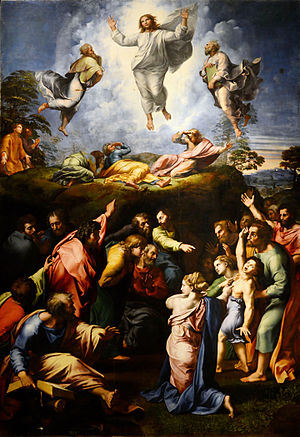 I was introduced to the Transfiguration of Our Lord when Raphael’s great painting of the event hit me between the eyes during my student travels in Rome. With the Feast of the Transfiguration coming during my church’s summer slump (and it wouldn’t have celebrated the feast anyway) I knew nothing about it. In many ways, I didn’t have to. The painting opened up a vision of a transfiguration of humanity beyond what I had thought possible. At the time, what faith I had wasn’t centered around any particular religious viewpoint but I was majoring in religion because I thought the subject dealt with the most important things in life. Seeing the painting was more of a religious awakening than I knew. I was, of course, impressed by the sublimity of the upper half of the canvas where Jesus is floating in the air with Moses and Elijah. But I was even more impressed by the inroads the transfigured light made into the lower half which is often interpreted as indicating sinful and benighted humanity. It has taken me years to see further into the significance of this chiaroscuro effect.
 Imaginary Visions of True Peace