
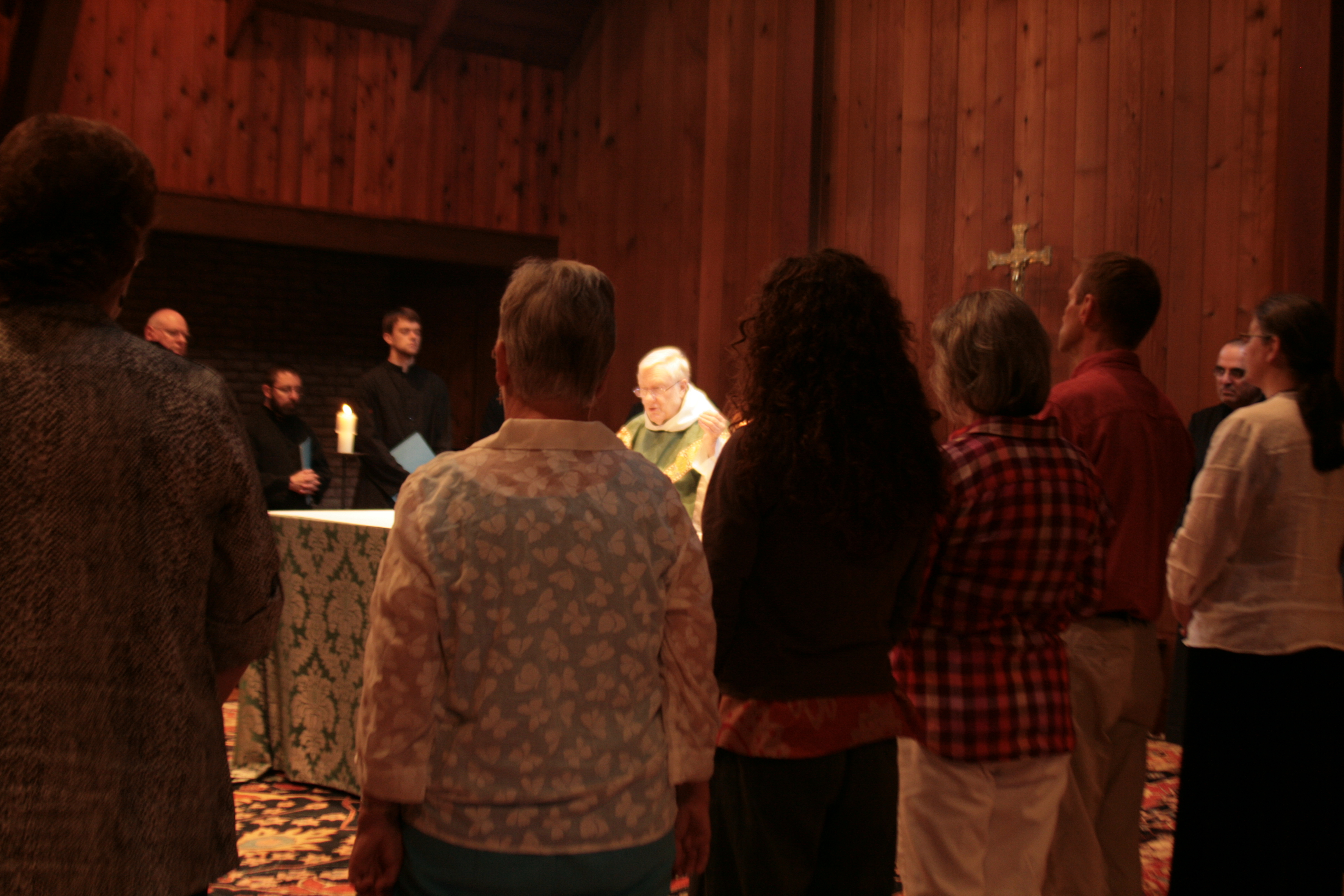
The Passion in the Eucharist

The Eucharist makes present the death and Resurrection of Jesus at each celebration, regardless of the occasion. So it is that we don’t even celebrate the birth of Jesus without celebrating his death as well. But in commemorating the Last Supper of Jesus, the Eucharist on Maundy Thursday is particularly close to the Passion, being the meal during which Jesus was suffering the anxiety he was soon to express at Gethsemane.

While reflecting on this matter, I came across a few lines on this very theme by Gerard Manley Hopkins, one of my favorite poets. They made up an epigraph of a chapter in Brian Zahnd’s new book The Wood Between the Worlds,” a powerful meditation on the Cross, Not only was I moved by the lines, but I was surprised to come across some lines by Hopkins that I didn’t recognize since I thought I had studied all of his poems multiple times. That little mystery was solved when I found out that it is an early work, one written while still a student at Oriel College in Oxford, and still an Anglican. So it is only included in the most complete collections of his works. I might have read it before without it registering, but the few lines singled out in Zahnd’s book really caught my attention, as I’ve said.

The poem is called “Barnfloor and Winepress” and it pulls together the Passion of Jesus and the Eucharist into an inextricable knot, making it most appropriate for Maundy Thursday. With wrenching, sometimes violent imagery embodied in hard sounds that put Hopkins, even in this early work, decades ahead of his time, the poem provides a powerful example of how the ugliness of Jesus’ crucifixion permanently affected the aesthetic possibilities in all of the fine arts as the ugliness is sublated in the moral beauty of Jesus’ self-sacrifice and his vindication in the Resurrection. The first stanza includes these lines that use the Eucharistic imagery of the making of bread:

Thou that on sin’s wages starvest,
Behold we have the joy in harvest:
For us was gather’d the first fruits,
For us was lifted from the roots,
Sheaved in cruel bands, bruised sore,
Scourged upon the threshing-floor;
Where the upper mill-stone roof’d His head,
At morn we found the heavenly Bread,
And, on a thousand altars laid,
Christ our Sacrifice is made!

And in the second stanza, lines using grape and wine imagery to the same effect:

Thou whose dry plot for moisture gapes,
We shout with them that tread the grapes:
For us the Vine was fenced with thorn,
Five ways the precious branches torn;
Terrible fruit was on the tree
In the acre of Gethsemane;
For us by Calvary’s distress
The wine was racked from the press;
Now in our altar-vessels stored
Is the sweet Vintage of our Lord.

We have in these powerful stanzas a kind of transubstantiation, not only of the Eucharistic elements that Hopkins was clearly believing in as a high-church Anglican, but a transubstantiation of the suffering of Christ into the Eucharistic elements. The violent human sacrifices throughout human history, both before Christ and after Christ up to the present day, are transmuted into the bloodless sacrifice on the altar. (The phrase “terrible fruit” reminds me of Billy Holiday’s “Strange Fruit.”) No wonder Brian Zahnd refers to this poem in a chapter that argues that the crucifixion of Jesus is the ultimate center of human history. Even while humans continue to commit the same old same old violence as we see most painfully in Ukraine and Gaza right now, God has transformed all of it for all time. Hopkins expresses this insight in poetry:

In Joseph’s garden they threw by
The riv’n Vine, leafless, lifeless, dry:
On Easter morn the Tree was forth,
In forty days reach’d heaven from earth;
Soon the whole world is overspread;
Ye weary, come into the shade.

And then the profoundest transubstantiation of all: the transubstantiation of us into partricipation in the divine nature, one not untouched by the sufferings of Christ supporting our own:

The field where He has planted us
Shall shake her fruit as Libanus,
When He has sheaved us in His sheaf,
When He has made us bear his leaf. –
We scarcely call that banquet food,
But even our Saviour’s and our blood,
We are so grafted on His wood.
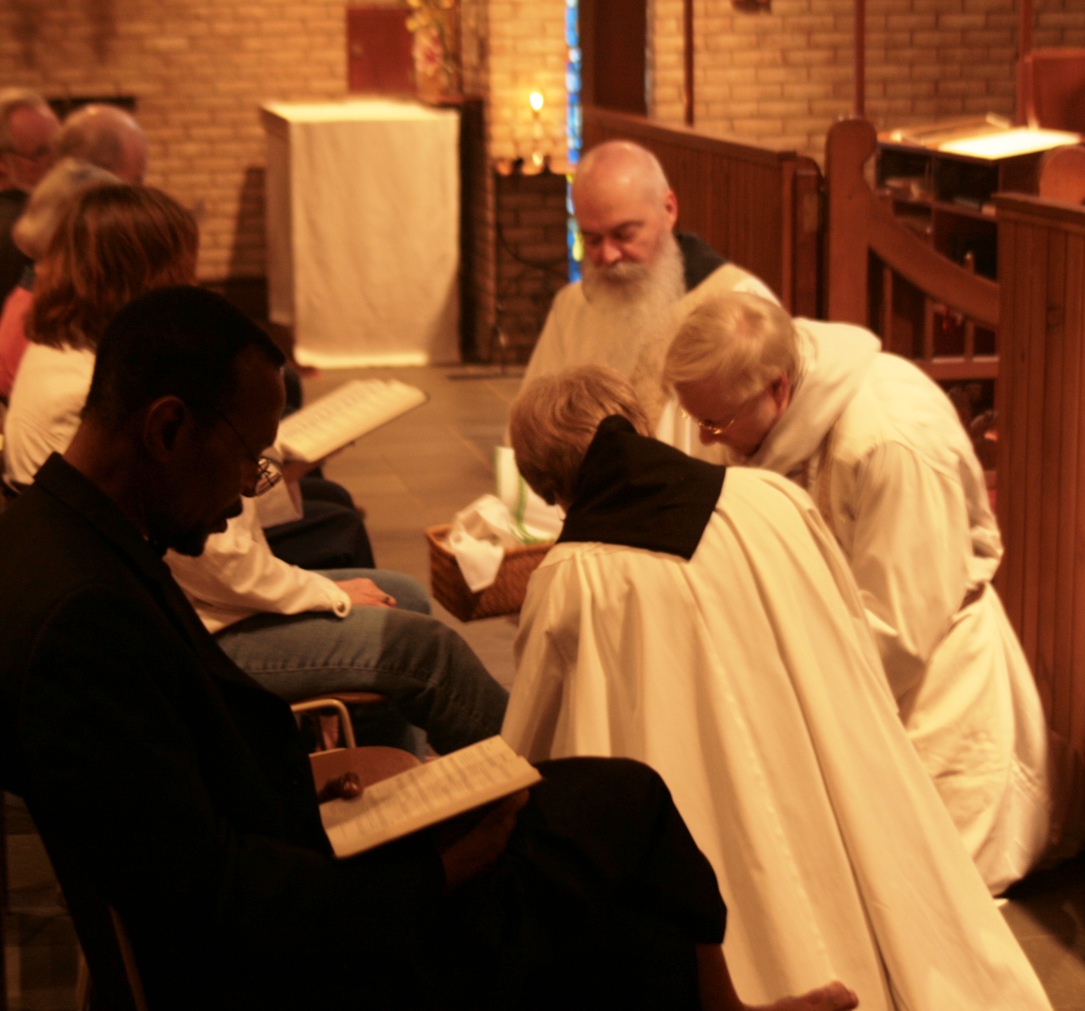
And It Was Night

AndrewWashingFeet - CopyProbably nothing is more painful than betrayal. My own personal experiences of feeling betrayed are, so far, much smaller than what I know others have suffered, but even the smallest doses of betrayal are unspeakably painful. The pain of betrayal is a pounding discord in the Gospel narratives of Jesus’ Last Supper and Paul’s own short narrative of it. This discord is particularly prominent to the point of being unbearable in John’s Gospel where it overshadows Jesus’ loving act of washing the disciples’s feet. Right after leading into the story with these sublime words: “Having loved his own who were in the world, he loved them to the end,” (Jn. 13: 1) John says: “The devil had already put it into the heart of Judas son of Simon Iscariot to betray him.” (Jn. 13: 2) When Judas leaves the supper, John says “And it was night,” (Jn. 13: 30), meaning “night” in all of its most ominous meanings. Right after Judas’s departure, Jesus gives his disciples his great “new” commandment: “Love one another. Just as I have loved you, you also should love one another.” (Jn. 13: 34)

Does this new commandment cancel the night into which Judas has just walked? Or does the night cancel the light of the commandment? Hatred for Judas has echoed through the centuries with betrayers often called a “Judas.” So commonly is this epithet used that it can be hurled at a person for playing an electric guitar instead of an acoustic one, as Bob Dylan found out. The raging pain of Judas’s betrayal occasions several outbursts in the responses of the Tenebrae services of Holy Week. Most chilling is the “Judas mercator:” “Judas, the worst possible merchant, asked to kiss the Lord.” In the powerful setting by Tomas Victoria, the pain is unbearably searing. Where is the love we are supposed to have for one another? Even in the glory-filled High Priestly prayer of John 17, Jesus says he has guarded the ones entrusted to him “except the one destined to be lost.” (Jn. 17: 12) I feel those words as a shadow in the prayer of glory. The author of 1 John reaffirms this great commandment and insists that God is light with no darkness at all, (1 Jn. 1: 5) but then rages with the hurt received from several “antichrists”who have betrayed the community by going out from them. (1 Jn. 2: 19–20)

There have been attempts to vindicate Judas. One of the more thought-provoking attempts comes in Kazantzakis’s Last Temptation of Christ where Jesus entreats Judas to betray him because it is necessary that he be crucified. Kazantzakis appeals to the reader’s sympathy for the two millennia of opprobrium Judas has suffered for doing what his best friend asked him to do. I fear, though, that the paradoxes of John’s Gospel do not give us this out. We have to face the pain of the betrayal. This pain is all the greater and hits closest to home when we realize that all of Jesus’ disciples betrayed him except “the Beloved Disciple” in John’s account. This suggests that, like Judas, we are all betrayers of Jesus. This doesn’t make Judas right; it makes us as wrong as Judas. Would it have been better if none of us had been born? Our hatred of Judas distracts us from the truth of ourselves. Accusations of betraying Jesus fly between Christians, each convinced that it is other people who have betrayed Jesus while each of us is as faithful as the Beloved Disciple. I have my own list of traitors of Jesus that tempts me to dwell on them more than on myself.

John takes us into the “night” into which Judas walked because this is the night into which Jesus himself walked when he carried the cross to Golgotha and was crucified there because he had been handed over multiple times by the time he reached that destination. Does Jesus’ commandment to love one another as he has loved us extend to everybody who handed Jesus over to the next step towards the cross? Does it apply to each of us when we betray Jesus by disobeying this commandment? Does it apply to Judas? After Jesus’ Ascension, Peter announced that the gap left by Judas had to be filled and Matthias was chosen by lot to make the disciples twelve once more. (Acts 1: 21–26) Does Mathias rub Judas out, or does Mathias redeem Judas in a mysterious way by taking his place so that the Twelve Apostles can be the twelve tribes of a New Israel that embraces everybody? Does the Light shine in the darkness so powerfully that the darkness cannot overcome it, (Jn. 1: 5) not even the darkness into which Judas walked?

On Being Lifted up for Us

crosswButterfliesAs we draw near to Holy Week, the lections focus on Jesus’ anticipation of his Passion. Jesus’ famous response to the Greeks about the grain dying in the ground in order to bear fruit suggests a good deal of serenity on Jesus’ part. But one can imagine personifying a grain suddenly experiencing the pain of being ripped apart from within and panicking that it is dying before blossoming out into a new life beyond imagining. If somebody had quoted Jesus’ words to the grain before it happened, would the grain have been serene about what was to come? A brief reflection on our own nervous state about such an occurrence probably gives us the answer to that question.

Jesus seems less serene when he says that his soul is troubled and raises the question if he should ask his Father to save him from this hour. But Jesus’ resolution returns in the very next verse: “No, it is for this reason that I have come to this hour. “ (Jn. 12: 27) The clear echo of Jesus’ anguished prayer at Gethsemane in the synoptic Gospels comes to mind here. Luke is particularly dramatic with the drops of blood dropping to the ground. The Epistle to the Hebrews stresses Jesus’ anxiety more than the Gospels: “Jesus offered up prayers and supplications, with loud cries and tears, to the one who was able to save him from death, and he was heard because of his reverent submission.” (Heb. 5: 7) It is significant that, although Jesus was not saved from death, his prayer was heard. Or was Jesus saved from death?

After his Gethsemane-like words in John, Jesus says: “I, when I am lifted up from the earth, will draw all people to myself.” John goes on to say: “He said this to indicate the kind of death he was to die. (Jn. 12: 32-33) I agree with the many scholars who take this verse and similar ones in John as conflating the cross and resurrection. John abounds in word plays and here John gives us a double meaning to “lifted up.” Jesus was lifted up on the cross and he was lifted up in the resurrection. This conflation has the danger of minimizing the reality of Jesus’ death, making it a quick and easy passage to the resurrected life. However, I see a strong tension in the way that John makes the expression “lifted up” do double duty. After being lifted up on the cross, the crucifixion remains an enduring reality even after Jesus is lifted in the resurrection. That is, it is not only the Resurrection but the crucifixion that draws people to Jesus. John gives a powerful stress on the victimization of Jesus as the focal point when Jesus says: “Now is the judgment of this world; now the ruler of this world will be driven out.” (Jn. 12: 31) The crucifixion judges the persecutors and the resurrection drives out the persecutory mechanism that has ruled the world. It is because, as the author of Hebrews said, Jesus ‘learned obedience through what he suffered,” (Heb. 5: 8) that he has the power to draw us to him. That is the say, the conflation can work both ways. It seems to dilute the experience of Jesus’ death but it also retains the painful death in the glory of the resurrection. This conflation shows how vital both elements are. Jesus was raised up on the cross as a victim of grave social injustice. God raised Jesus to vindicate Jesus and to demonstrate that the crucifixion, a disgrace in the eyes of the persecutors, was in truth the glory of God. (The Greek word doxa is another double entendre as it means both disgrace and honor.)

We can speculate on how Jesus himself actually experienced his approaching death but can arrive at no definitive answers. Even the New Testament writers who dealt with it give us varying portrayals. It stands to reason that Jesus’ own emotions were at least as complex as the sum of depictions in the New Testament. But, as the author of Hebrews said many times, Jesus is the forerunner into persecution and death to give us the courage to face both ourselves.

Accepting the Cross

crossRedVeil1Jesus’ words that “whoeverdoes not take up the cross and follow me is not worthy of me” (Mt. 10:37) are disturbing on two counts. We don’t like the idea of taking up the cross and we don’t like the idea of being rejected by God for not doing it.

It is worth pausing to note the question of whether or not Jesus could have said these words since they seem to read Jesus’ future back into this point in his life. As with the predictions of his suffering and death on the cross, I think it highly plausible that Jesus knew what was going to happen to him if he continued to teach and minster as he did if most people, especially those in power, persisted in rejecting his teaching and ministry. After all, Jesus had the example of Jeremiah and the other prophets to warn him. He did not need a crystal ball nor did he need to tap into his divine omniscience to foresee his destiny.

When Jesus said that “a disciple is not above the teacher,” he implied that we should expect the same results of imitating Jesus that Jesus himself had. This is a hard choice, one that entails renouncing worldly power and embracing the helplessness of the victim, but the alternative is to side with the oppressors either by actively joining them or silently allowing them to oppress others without challenging them.

The harsh words in Matthew suggest that God will definitively reject any of us who ever fall beneath this standard but the way Jesus treated Peter who failed miserably in this regard, not to speak of Paul who actively persecuted Jesus’ followers, suggests quite the opposite. There is a strong element of self-selection and self-judgment in rejecting the way of the cross. It is as when we speak badly of somebody or deny somebody, it tells a whole lot more about us than it does about the one we are speaking badly about. As the examples of Peter and Paul make clear, such states are not necessarily permanent unless we persevere in our rejection. It is simply the case that Jesus has a certain way of living that eschews violence and power in favor of weakness and the place of the victim. If we do not accept this way of Jesus, then we are simply not on Jesus’ way. Blaming Jesus for rejecting those who deny him is like blaming Jesus for the division his teaching and life brings about when such division is not Jesus’ intent but human decisions. (See Human Swords, God’s Peace.)

Jesus knows how hard it is to choose the way of the cross from his own experience and his sensitivity to any who might follow him. This is why he reassures us by saying that every sparrow that falls to the ground is known by the Father and that every hair on our heads is counted. Maybe the notion of sparrows falling to the ground is not so comforting but Jesus, in saying that we humans are worth more than sparrows, is assuring us that even when we fall to the ground, we are counted. This is what Jesus is getting at when he says that by trying to save our lives by denying the cross, we lose our lives and that by losing our lives we gain them when God catches us, just as Jesus catches every sparrow that falls to the ground. It is out of love for us that Jesus embraces the cross and it is our love for Jesus that leads us to do the same. Maybe we are worth more than sparrows, but sparrows are worth an awful lot as well.

Myth Become Fact

crosswButterfliesOne of the more memorable phrases culled from C.S. Lewis is Christ is “myth made fact.” The notion kind of sneaked up on Lewis during the process that lead to his conversion to Christianity.  An offhand remark by his friend T.D. Weldon, a fellow Oxford don and, like Lewis at the time an avowed atheist, made a deep impression on him over the years: “Rum thing, that stuff of Frazer’s about the Dying God. It almost looks as if it really happened once.” Of course, that is precisely the claim of the Gospels.

Lewis’ insight is worth comparing with René Girard’s view of Jesus in relation to mythology. Girard, of course, also studied Frazer’s writings about deities, mainly vegetative deities, dying and rising. Frazer, seems to have absorbed Jesus into the other myths, blurring the distinction between them. Girard, on the other hand, believes that both the myths and the Gospel accounts refer to real events. Here, he also differs from Lewis who seems to have thought of myths as something like cosmic poetry, dealing with timeless truths, such as the vegetative cycle in temperate climates where nature, like Persephone, dies and then rises again. For Girard, all myths, in their origins, are made fact.

Girard’s thesis of sacred violence asserts that social tensions in early societies were resolved, if they were resolved at all, by collective violence that was very real. Mythology then became something of a cover up of this event while still alluding to it. The rising from the dead in such mythology would be the deification of the victim who, in retrospect, was seen as the solution for the problem for which the victim was earlier blamed. Tying such mythology into the vegetative cycle raises suspicions for me that this development, if it did not originate in agricultural societies, was greatly furthered within them. After all, the claiming of land by a tribe would easily inspire other people to desire that land. In such a setting, social tensions leading to the victimage mechanism would happen much quicker than in hunter/gatherer societies. Girard’s thesis also suggests that the real cycle is not in nature but in human activity. That is, an act of collective violence holds a society together for only so long before it needs to happen again. The mythological cycle, then, is a vicious cycle.

For Girard, then, the Gospel narrative of Jesus dying and rising is not the historicization of a timeless truth, but an instantiation of a scenario that had been happening in reality, in time, since the dawn of humanity. What’s new about the Gospels is that the story is told straight out and the victim is claimed to be innocent and was unjustly murdered. For Girard, it isn’t so much a case of myth become fact as the truth behind myth revealed.

As a Christian, Lewis retained sympathy for the myths of dying and rising deities, regarding them as great poetry. Girard, of course, is not so affirming of mythology, as he sees it as obscuring the truth. However, Girard’s point of view does not necessarily mean that myths are bad poetry. Moral goodness and ascetic goodness are not equivalent, after all.

There is a deeper reason though for being open to Lewis’ sympathy. It was the pathos of a deity like Balder who was killed through collective violence that moved Lewis, and it was the same sensitivity that should make the passion of Jesus deeply moving as well. (Interestingly, Lewis went through a period where the dying pagan deities moved him more than the story of Christ; perhaps a residue of his resistance to conversion.) Although a myth such as that of Tiamat, who was blamed for Babylon’s primordial chaos and torn to pieces, does not try to inspire sympathy for a victim the way the Psalms of Lament do, we can see a woman victimized by the people who made a strenuous effort to avoid seeing what they were doing.

There is a deeper reason for sympathy for myth. Deplorable as the countless acts of collective violence were and continue to be, Girard’s thesis also demonstrates how profoundly people were caught up in this mechanism so that they could not escape without intervention from God. It is precisely this intervention from God to free humans in bondage that Paul celebrates time and again in his epistles. If we need this intervention from God in Christ, then we are hardly in a position to be judgmental against the first humans that fell into the same traps we do.