
The glory of Sheer Silence

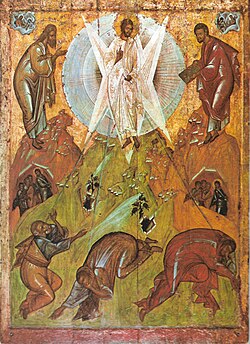
The story of the Transfiguration of Jesus on Mount Tabor is as disorienting as it is blinding. It was also disorienting and blinding for the three apostles Jesus had taken up with him. Obviously, Peter didn’t know what to say, so we shouldn’t feel bad if we don’t know what to say, either.

One of the more fascinating and powerful reflections on this story is at the heart of the theology of the 14th century Greek theologian St. Gregory Palamas. He suggested that the light of Tabor was the working of the uncreated energies of God. This energetic light, the Light of Tabor, embodies God’s self-giving to us, a giving of Godself, that is deification. Not human self-deification, but deification as a gift from God who gives us everything that God has. This concept hasn’t gained much traction in Western Christianity, partly because it doesn’t compute well with many forms of Western theology. However, for those who find traditional Western theology problematic, the Palamite notion is perhaps an attractive alternative. For what it’s worth, I think the clash between Western and Palamite notions explodes into a powerful mystery which is deeper than one set of concepts alone.

There is much more to the radiance than blinding brilliance. The Hebrew word kabod, also means glory in the sense of honor. This is also true of the Greek word doxa that translates the Hebrew. When we glorify a human being for great accomplishments, there is a sort of radiance we put around them. Saints are often painted with a nimbus when portrayed in art. However, there is a tension at the root of glorification. It almost always seems to be accompanied by derision and dishonor. In fact, the Greek word doxa means dishonor as much as it means honor. The people we honor by putting on a pedestal are knocked over in a heartbeat if they don’t meet our expectations. Artists like Igor Stravinsky and Bob Dylan have both been greatly honored, but both were denigrated when they changed their artistic visions away from projected expectations. This is what happens when fans make idols of the people they adore; they create little boxes to put them in.

What about Jesus? Jesus had received much glory and honor from his numerous followers, not least the three disciples who Jesus took up the mountain with him. But the more some praised Jesus, the more energetically others denounced him. In all three synoptic Gospels, the Transfiguration marks a turning point where Jesus heads towards Jerusalem where he will be denounced, mocked, and crucified. The honor given Jesus turns to dishonor. What about the disciples who experienced the Transfiguration? When Jesus told them what was coming, they resisted Jesus’ resolve and argued among each other as to who was the greatest. I can’t help but suspect that they were basking in the derived honor given Jesus up to that point and, rather than receiving glory from God, wanted to receive glory from the other followers of Jesus. Like modern day fans of celebrities, they were putting Jesus into boxes of their own making, turning Jesus into an idol. The disciples were blinded by their warped understanding of honor at least as much as they were blinded by the brilliance of Jesus’ shining garments.

We can gain more insight into glory by reflecting on the presence of Moses and Elijah with Jesus on the mountain. They were the two most glorified figures in Jewish history. Moses, by receiving the Law on Mount Sinai from God himself shone with the reflection of God ‘s light to the extent that he had to wear a veil. Elijah was the greatest of prophets. Both, however, also experienced dishonor. Several times the people threatened to stone Moses, and Elijah was a fugitive from royal power. Both were implicated in violence, especially Elijah in his contest with the prophets of Baal. They were in the position to know well what was going to happen to Jesus. Moses’ best moments, when he was most Christlike, was when he was interceding for the people to turn God’s wrath from them, even when the same people were directing wrath at him. Elijah, alone in a cave, heard God in the sheer silence of the wilderness. As for Jesus’ disciples, the Book of Acts shows them breaking out of the idolatrous boxes they had made and acting like their Master in self-giving, preaching, and healing, the divine energies clearly working through them.

There is reason to believe that the Transfiguration of Jesus was, at least in part, to prepare the disciples for the suffering Jesus would have to endure, and that they, too, would have to endure. At a deeper level, they were being prepared for the challenges of the Resurrection Life of Jesus that would energize them when the time came. As we prepare for Lent, perhaps we can make it our Lenten project to let the light of the transfigured Christ reveal our own warped notions of honor and dishonor so that the divine energies championed by Gregory Palamas can energize prayer on behalf of other people, especially those who dishonor God, a prayer enveloped in sheer silence.

True Greatness

It is natural and good to have an affection for the place where one was raised and where one lives. Caring for one’s family, one’s community, one’s city, one’s country is all good. Such affection is the basis for caring for other people. Caring for other people. That is the key. Do we indeed make local affections the basis for caring for people of other cities, of other countries?

In Deuteronomy, Moses grounds his love for his people in God’s love for his people. It is God who has delivered the people from Egypt and is leading them to a new land for them to settle in. Therefore one should fear God for what God has done. (Deut. 10: 21) Moses then expands God’s love for God’s own people by saying that they are commanded to love the stranger. Why love the stranger? Because the Israelites were strangers in Egypt. They should remember their own vulnerability as strangers and care for the vulnerability of other strangers. America is a continent of immigrants, which is to say, strangers. This even goes for those we call Native Americans. For that matter, we find histories of migration for just about any group of people that we know anything about. All of us are vulnerable strangers and all of us should care for vulnerable strangers.

In the Sermon on the Mount, Jesus presupposes the legitimate and right love one has for one’s own people, then, in the tradition of Moses and going beyond it, stretches this love for the stranger to one’s enemies. (Mt. 5: 44) That is to say, God raises the sun, not only on one’s own people, but on all people. After all, caring for one’s own people is the least we can and should do. Isn’t it caring for the stranger that makes a country great? Isn’t it caring for one’s enemy that makes a country greater still?

There is much talk about making America great again. The anniversary of the founding of our country is a good time to reflect on what made America great, or if it actually needs to be made great in the first place. Since penitence is central to the Christian life, repenting of the ways we fall short of greatness is part of the celebration of our country. Noting failures to care for the stranger, the widow and the orphan, let alone loving our enemies, can lead us to greater efforts. If we can do these things, America will indeed be great.

The author of Hebrews takes up the theme of migration with an added depth. Abraham demonstrates his faith by setting forth to a place that he is to receive as an inheritance, (Heb. 11: 8) but actually Abraham and his descendants were seeking “a better country, that is, a heavenly one.” (Heb. 11: 16) We are all migrants seeking a better country that is grounded in God’s love for all people. One’s own land, one’s country, is important, but it is not of ultimate importance. God is of ultimate importance and God has prepared a better homeland for all of us, one that nobody will have to fight over.

Transfiguring Darkness

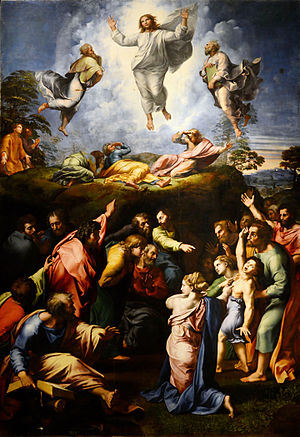
Transfigurazione_(Raffaello)_September_2015-1aI was introduced to the Transfiguration of Our Lord when Raphael’s great painting of the event hit me between the eyes during my student travels in Rome. With the Feast of the Transfiguration coming during my church’s summer slump (and it wouldn’t have celebrated the feast anyway) I knew nothing about it. In many ways, I didn’t have to. The painting opened up a vision of a transfiguration of humanity beyond what I had thought possible. At the time, what faith I had wasn’t centered around any particular religious viewpoint but I was majoring in religion because I thought the subject dealt with the most important things in life. Seeing the painting was more of a religious awakening than I knew. I was, of course, impressed by the sublimity of the upper half of the canvas where Jesus is floating in the air with Moses and Elijah. But I was even more impressed by the inroads the transfigured light made into the lower half which is often interpreted as indicating sinful and benighted humanity. It has taken me years to see further into the significance of this chiaroscuro effect.

Now that I have preached on the Transfiguration more times than I can count, I have had many occasions to study and reflect on it. I remain inspired by Raphael’s vision of the transfiguring light and fascinated by the Eastern Orthodox doctrine that holy persons can be filled with the uncreated energies that emanated from Mount Tabor. But under the influence of René Girard’s thinking about the scapegoat mechanism, I am most impressed by the proximity of Jesus’ death and resurrection to the transfiguring light.

The narrative begins: “Now about eight days after these sayings.” (Lk. (9: 28) These sayings were about Jesus announcing that he was going to be rejected by the chief priests and scribes and be killed after great suffering, followed by Jesus’ famous words about carrying one’s cross daily. After the return from the mountain and delivering a demon-possessed boy, Jesus said : “The Son of Man is going to be betrayed into human hands.” (Lk. 9: 44) So it is that predictions of Jesus’ passion envelope the transfiguration. Moreover, on the mountain, Moses and Elijah speak to Jesus about “his departure, which he was about to accomplish at Jerusalem.” (Lk. 9: 31) So Jesus and his two great predecessors weren’t exactly whooping it up and playing games with primordial light. Both Moses and Elijah knew a lot more about persecution than they really wanted to know and Jesus knew what the scriptures said about them.

There is much talk about the transfiguring light being an encouragement to Jesus and his disciples in preparation for the suffering ahead. There is truth to that and I have said as much in previous sermons. But the deeper truth I am seeing is that the suffering and death of Jesus is the transfiguration. The primordial uncreated energies have penetrated into the depths of human suffering, not only that of Christ but of all other people. This is the significance of the light reaching the people in darkness at the foot of the mountain in Raphael’s painting. A particularly bright spot of light lands on the chest of the boy Jesus delivers of a demon as soon as he comes down. What is the uncreated glory of God? It is that God would come to us in our darkness and suffer with us the sufferings that we inflict upon one another with the rage that makes us foam at the mouth and persecute one another. We can’t stay on the mountaintop, even if we should ever get there, but we can bring the mountaintop to others if we are willing to take up our crosses and follow Jesus down to the bottom where foul spirits rage and foam. What makes the glory of God glorious is that, as St. Peter says, the light shines in the darkness “until the day dawns and the morning star rises in your hearts.” (2 Pet. 1: 19)

Baptism: Overwhelmed by Christ’s Love (2)

lakeGray1Two dramatic events from the Hebrew Bible have been interpreted as prefiguring baptism are the Flood and the deliverance at the Red Sea. Both are deliverances from highly dysfunctional societies.

Genesis 6 portrays human society as consumed with violence. No wonder if everybody was like Lamech and inflicting seventy-seven-fold vengeance on anybody whom he thought had wronged him. In his second epistle, believed by many scholars to be a baptismal homily, Peter says that the deliverance of Noah and his family corresponds to baptism which saves us now through the Resurrection of Jesus Christ. (1 Pet. 3:21) René Girard has suggested that a flood is an apt image for a society overwhelmed with retaliatory violence. In such a scenario, a man who tried not to be a part of this violence would be an obvious choice of a victim to unite the fragmented society. The Christological interpretation in Peter’s epistle suggests by being baptized into Christ’s death, we are brought out of society consumed with violence and given the chance to begin life anew, the chance that Noah and his family had after the flood waters receded. It is worth noting that when referring to Jesus descending into hell (Sheol), Peter does not say Jesus just brought out righteous people like Abraham but that he preached to the very people who had brought humankind to the boiling point while Noah was building his ark.

St. Paul says that we all “passed through the sea and all were baptized into Moses in the cloud and the sea.” (1 Cor. 10:2) Once again we have an overwhelming flood. Moreover, we have a story of a people delivered from a violent and oppressive society. In his book Jesus: the forgiving Victim, James Alison suggests that the Jews were expelled after being blamed for the plagues scourging the country. If the Jews were expelled, why would the Egyptians runs after them to bring them back? Perhaps they realized they would implode without the victims who were deemed responsible for their turmoil. This is what seems to have happened with the Gerasenes when their demoniac was cured by Jesus. One could take the tug-of-war between Moses and Pharaoh as indicating this same tension. (See Dispossessing a Town Possessed) Being overwhelmed by the waters is, again, an apt image of a society succumbing to its own violence once the scapegoats are gone.

Unfortunately, neither new chance at a new life went well. Noah’s drunkenness and rivalry among the brothers that made Ham a scapegoat set humanity on a course where the curse laid on him was used to justify slavery and lynching. The people delivered at the Red Sea suffered from chronic social unrest, leading to Moses raising the bronze serpent in the desert to stop the plague of violence. Likewise, the church continues to fall back into the same rivalry and persecution. Most lynchers, unfortunately, were Christians. A tendency to see baptism as deliverance from personal sin surely reinforces such backsliding. Baptism is not a magical deliverance from personal sin but is a constant invitation to be reborn into the new social life of God’s kingdom centered on the forgiving victim who, like the bronze serpent, was raised up to draw all people to himself.

Baptism: Overwhelmed by Christ’s Love (3)

Baptism: Overwhelmed by Christ’s Love (1)

The Good Shepherd in the Desert

goodShepherdIf Jesus is the “living interpretive principle of scriptures, as James Alison says, then the Parable of the Good Shepherd who leaves the ninety-nine to search out the one lost sheep should be a powerful and accurate interpretive lens for other passages in scripture.

In the RoCa lectionary, this Gospel is coupled with a tense episode in Exodus 32. As he comes down the mountain with the tablets of the Ten Commandments, he finds that Aaron has set up a golden calf for the Israelites to worship. God tells Moses to get out of the way so that his wrath can “burn hot against them.” Doesn’t sound like a good shepherd.  Instead, it is Moses who acts out the part of the good shepherd by interceding with God, as Abraham did earlier to avert the divine wrath from the people. At the end of this same chapter, there is another narration of Moses coming down the mountain. This time, he is so furious he breaks the tablets and then rallies the Levites to his side to slay thee thousand people who were worshipping the golden calf. Although Moses claims to be doing God’s work, what we have is a narrative of human rather than divine violence. Moses doesn’t look like a good shepherd this time, but the morning after this monstrous slaughter, Moses intercedes with God to forgive the people although it is a bit late for the three thousand who were slain. This strange doubling of narrations seems to point to a debate in the Jewish tradition moving in the direction of unveiling God’s love for God’s people.

In 1 Corinthians 10, St. Paul refers to this incident by saying “we must not indulge in immorality as some of them did, and twenty-three thousand fell in a single day.” (He ups the death toll.) In isolation, this is about the chilliest verse in the Pauline epistles but in its sacramental context, it is much more in keeping with Jesus the Good Shepherd. Leading into this verse, Paul says that “we were baptized into Moses in the cloud and in the sea, and all ate the same supernatural food and all drank the same supernatural drink.” This, in turn, recalls the reinterpretation of the Flood in 1 Peter where the water corresponds to the baptism that delivered Noah and his family and delivers us now. The Genesis story clearly indicates a social meltdown with a few, probably the intended victims, escaping. The Exodus story refers to the social meltdown in Egypt that lead to the expulsion of the Israelites. In the desert, the Israelites had their own social meltdown centered around rivalry between Moses and Aaron. (Arnold Schönberg’s opera Moses and Aron portrays this rivalry with great insight.) For both Peter and Paul, baptism is the deliverance from the surrounding sacrificial society into the Kingdom centered on the Eucharist, the new way of gathering without need of victims and certainly not needed the slaughter of three thousand. Paul is not, then, warning his readers against a wrathful deity but against a wrathful society that will engulf them if they return to its sacrificial ways, just as a relapse into the wrathful society of Egypt lead to a meltdown in the camp and the deaths of thousands.

Jesus the Good Shepherd does not strike dead those who re-enter a sacrificial society that today manifests hardness of heart to the extent of trying to prevent fundamental ministries such as feeding the hungry. Instead, Jesus enters into the heart of the society to bring back all who are lost. Rather than starting a bloodbath, we should intercede for all such people as Moses did and follow Jesus in searching for the lost.

See also: The Communal Good Shepherd