
Possessed by God

treeBlossoming1The First Epistle of John overflows with declarations of God’s preemptive love: “not that we loved God but that God loved us and sent his Son to be the atoning sacrifice for our sins” (1 Jn. 4: 10). This preemptive love of God is not just a vague benevolence but an action, and a sacrificial act at that. God did, and continues to act on our behalf. John goes on to describe God’s love as an abiding presence within us, what amounts to being possessed by God. Is this just an added treat in life? We can quickly see that being possessed by God is much more important than that. Many cases of possession of a different sort were recorded in the Synoptic Gospels where Jesus cast many demons out from people who were possessed by them. Without necessarily ruling out a supernatural provenance for some of these possessions, it is helpful to remember that René Girard’s theory of mimetic desire shows us how we can become possessed by other people, especially in rivalrous situations. (See Human See, Human Want.) We only need to reflect on how strongly another person we are at odds with has taken over us to realize how much another person can possess us. Crowds of people easily become possessed as the story of the Gerasene demoniac and the Passion narratives suggest. If we put John’s teaching of God’s indwelling love together with demonic possession, we are confronted with the conclusion that we are going to be possessed by somebody. It is not possible to remain aloof from the intentions and desires of other people. They will possess us whether we like it or not. The question is: By whom are we possessed? Jesus’ little parable about the evil spirit that was cast out but returned to the house “swept clean” with seven spirits “more evil than itself” (Mt. 12: 44-45) teaches us that casting out the spirit who has possessed someone is not enough. We must become possessed by the Spirit of one who is full of love, One who is not in rivalry with us or with anybody else.

Jesus’ image of the vine and the branches in John 15 gives us another take on the importance of being possessed by God’s love. Once again, we have the language of mutual abiding. The branches depend on the vine for both their lives and the vitality that gives them the power to act and bear fruit. This image reminds us of other vineyards in scripture. There is the song of the vineyard in Isaiah 5 which the owner prepared to bear good fruit, only to have it bear wild grapes. Jesus is surely referring to Isaiah’s song in his parable of the vineyard. The evil workers who killed the messengers and servants and then the owner’s son show us what a crowd possessed by rivalry looks like. Jesus’ teaching about the vine and the branches takes us much more deeply into the heart of this parable. The “wild grapes” who killed the owner’s son are branches that broke away from the vine. Having no life in them, they can only offer death to others. But if we do not break away, we are pruned of our competitive spirit so that we can bear fruit. Unlike the parable of the vineyard, the owner does not stop with laying out the groundwork; the owner continues to care for the vineyard over time, just as God sustains us so that we abide in God’s love and God’s love abides in us. This possession protects us from the possession of the persecutory crowd and frees us to bear fruit by acting on God’s preemptive love. This freedom opens our hearts and minds to discern what we can do with what resources we have to help others in need. This freedom is dangerous. It could strengthen us enough to follow Jesus into the depths of the collective evil spirit that had possessed the evil workers in the vineyard where Jesus pulled off the greatest exorcism of all time on the cross.

Longing for God’s Desire

treespath1In one way or another, human desire has always indicated that something is lacking. My stomach is empty so I desire to fill it with food. I don’t have as much money as I would like for the necessities and treats I want so I feel empty until I get enough money to get them. I lack the satisfaction of seeing my favorite baseball team win unless they win. If they do win, I am back to square one with the same emptiness and the same desire by the next day.

René Girard’s theory of mimetic desire pushes the lack that leads to desire a step further. We don’t just lack possessions or a girlfriend; we don’t know what food or what girl to desire until we see what food and what girl somebody else desires. As we learn from scientists’ study of our mirror neurons, we don’t necessarily desire what other people want because they want it or we think they want it. Rather our desires automatically resonate with the desires of others and we need to learn to navigate these resonances as part of human maturation. This prevents us from automatically copying every desire we see in others but the less conscious we are of the impact others’ desires have on us, the more likely we will be driven by others’ desires and the more empty we will be as a result.

Those desires of ours that are drawn from other people easily become conflictual. When that happens, the emptiness opened by mimetic desire deepens into an abyss. When we are wrapped up with a rival, it is never enough to have what the rival wants. As Girard points out, we need to become the other person. We believe (wrongly) that the other person has a certain fullness of being that we don’t have because they have—or seem to have—what we want but don’t have. So it is that we covet not just the ox or wife or car of another but the very being of another person. This is why we never have enough money or possessions or anything else as long as we are in rivalrous relationships. For Girard, this is not an ontological statement but an anthropological one. That is, it is about human relationships. The problem is that we can covet the being of another person until the end of the world and we’ll come up empty. Since the alleged fullness of being on the part of another is illusory, we are only “chasing after wind” (Eccl. 1:14).

Christian thinkers have consistently averred that we are instilled with a longing for God as a gift from God and that this longing means that we cannot be totally satisfied with anything else, no matter how wonderful. As the Psalmist says: our souls “thirst for the living God” (Psa. 42: 2).If we see mimetic desire as fundamental to humanity, it follows that this trait is willed by God and used by God in a fundamental way for our salvation. The certain lack of being caused by mimetic desire gives us an ongoing openness to God, an opening for God to enter into us and dwell within us as Jesus promised us in John’s Gospel. We are created to resonate with the desires of others so that we can resonate with the Desire of the other Other. The phrase “cdeep calls from deep: (Psa. 42: 7) has often been interpreted as the depths of our humanity crying out to the depths of God. This depth is our desire resonating mimetically with God’s Desire. While it is an illusion to think that a human rival has a plenitude of being, God really does have such plenitude. Moreover, God is infinitely generous with God’s plenitude of being. If we open ourselves to God’s Desire, we participate in that Desire is such a way that we can be equally generous with others.

Eating the Being of Jesus

AndrewWashingFeet - CopyThe Holy Eucharist has been accused of being a cannibalistic rite. René Girard would accept the accusation. In a snippet from an unpublished interview, he suggests that the Eucharist recapitulates the entire history of sacrifice and its violence and that history includes cannibalism. When I took a college course on African and Oceanic religions, one of the essay questions I was confronted with on the final exam was to discuss a few anthropological eyewitness accounts of cannibalistic practice. This was the first time I had encountered anything like it. What struck me about the accounts was how these people were intentionally absorbing, through ingestion, the being of the person, sometimes in mockery but more often in respect. (My take on these documents was affirmed by my professor with a top grade.) This is also Girard’s take. He ties this data into his analysis of the dynamics of mimetic rivalry where a rival moves beyond envying the possessions of another to envying the very being of the other. Interestingly, Jesus himself seems to agree with Girard and the anthropologists on this matter. In John 6, he uses strong language when he tells us that we must eat his body and drink his blood, words that suggest cannibalism and seem to have been interpreted as such by his grossed out hearers who, for the most part, went away so as not to hear anything more about it.

Cannibalistic language is often used figuratively in human speech and that is true of Holy Scripture as well. The psalmist affirms God’s deliverance from people who assail and devour his or her flesh (Psalm 27:2). St. Paul warns the Galatians that if they “bite and devour another,” they should take care that they “are not consumed by one another” (Gal. 5: 15). These examples refer to situations of serious mimetic rivalry and even if the psalmist’s enemies and the people of Galatia are “civilized” enough to rescind from literal cannibalism, they are indulging in the essence of that practice.

In what I have called the First Supper, Jesus reverses the cannibalism of devouring another person by freely offering himself, body and blood, in the bread and wine so that we may receive the being of Jesus as a free gift rather than as the spoils of a violent victory. This implies that his death on the cross is a Gift he gives to humanity and is not booty taken away from him against his will as is the booty taken by a conqueror.

What kind of personal being are we receiving when we receive the being of Jesus? In the early human centuries, people were absorbing the bravery and fighting skills of a worthy enemy who was defeated. With Jesus, what we get is something very different. This something very different is demonstrated in Jesus’ act of washing the feet of his disciples as a sign that we should serve one another in all ways. The personal being we receive in the Eucharist is one who, far from wishing to devour another person figuratively, would wish to build up another person in actuality. When we receive the being of Jesus, we receive personal courage beyond imagining, but it is not the courage of one who fights and wins battles against violent foes, but the courage of one brave enough to serve others, even to death on the cross.

A Highway to Seeing the Glory of the Lord

treespath1After her humiliating defeat by Babylon, Israel was broken. The movers and shakers who had kept the society going were taken to Babylon where they couldn’t move or shake any more. Then, fifty years later, the prophet known as Second Isaiah proclaimed comfort to Jerusalem: the exiles will return, travelling through the desert on “a highway for our God.” Jerusalem will be made whole once again! This return of the exiles is a new thing, at least as great a new thing as God’s delivery of the Jews out of Egypt. Not only that, but, like the earlier new thing, this deliverance is a re-creation of the world by the God who is now proclaimed to be the sole creator of the world out of nothing.

René Girard suggested that the levelling of mountains and valleys stood for the levelling of society that precipitates a sacrificial crisis. I have a counter Girardian suggestion: the levelling of the desert landscape is God’s removing of the obstacles that prevent us from seeing God. The obstacles here are the social tensions created through mimetic rivalry that tear a society apart. For Isaiah, this levelling is God’s work and removing obstacles is what God does. God does not create social crises; humans do that. Isaiah said that, with the highway smoothed out, “all flesh” will see the glory of the Lord.” Not only that, but if a Gentile king had made this return possible, how much greater would the outreach be from Jerusalem to all Gentiles once the Jewish nation was reunited?

But such was not to be. The Jewish nation broke again and this time it was the Jews who broke it, not the Babylonians. Denunciations of social injustice protested by the Isaianic prophets before the Exile were repeated by Isaiah’s successors after the exile. The movers and shakers who had returned from exile also returned to moving and shaking at the expense of their weaker Jews. An anonymous victim, known as the “Suffering Servant” paid the price for the nation’s brokenness. The mountains and valleys had been recreated and the glory of the Lord was hidden once again.

“The Beginning of the Good News of Jesus Christ” is the opening of Mark’s Gospel. The Greek word “arche” also refers to the ultimate beginning of creation and the two attempted re-creations in Jewish history. Mark quotes the words of Isaiah to announce that once again (or still) God is creating a highway for God. So it is that the subsequent appearance of Jesus and his baptism by John is yet a new beginning for humanity. Once again God is removing the obstacles and just as quickly, humans are putting the obstacles back in place, with the result that Jesus was left hanging on a cross.

By coming round every year, the Season of Advent proclaims God’s removing of obstacles so that all of us, together, can see the Glory of the Lord. Will we join God, at least a little, in the work of removing obstacles so that we can glimpse the glory the obstacles hide?

Rivalry over Pure Music

angel trumpetMark Evan Bonds’ book Absolute Music: the History of an Idea deals with the most fundamental question in musicology. There are many music lovers for whom the subject is meaningless but some music lovers, including me, like to reflect on these matters. These days, music appreciation courses routinely teach the distinction between absolute music and program music. The latter paints a picture (say, a lake) in tones or tells a story (such as in Dukas’ “The Sorcerer’s Apprentice.”) The former doesn’t refer to anything beyond itself. The basic question, though, is whether or not music is its own isolated world, manipulating tones with no reference to anything else at all, or is related to the world in some way. This latter possibility could suggest that, say Schubert piano sonatas express emotions even if they are hard to define in words.

The title might lead a potential reader to think that Bonds is defending absolute music. That is not the case. Bonds is studying the history of this idea and along the way leaves us with an argument that a commonsense position that music is its own world but connects with phenomena elsewhere in the world. Central to this study is Edward Hanslick whose book Von Musikalischer-Schöne is pivotal to the debates it touched off, although Hansklick was neither the first by a long shot nor the last to make the argument he made (which Bonds examines at length.) (Sorry, the German title is hard to translate; it means something like “the musically beautiful.) Hanslick’s book did have the merit of being lucidly written in a field of thought that produced turgid and obscure tomes. Hanslick’s arch-enemy was Richard Wagner who lampooned Hanslick in the character of Beckmesser in Die Meistersinger.

Bonds’ own writing is very lucid and a great pleasure to read. One does not need to have technical knowledge of music to read this book. The key terms are clearly defined to help the reader understand the debate. There is also much about the characters of the principal debaters of what became the most intense musical debate in Europe for several decades in the 19th century. What the personal element shows is that the heat of debate distorts clear thinking and leads to exaggerated positions that get derailed from common sense and the evidence. More important, the debaters simply failed to understand accurately what their opponents were saying. Bonds traces the debate to the point where some reconciliation (for the time anyway) took place and even shows evidence of softening on the parts of Hanslick and Wagner. And yet neither could get over their personal animosities enough to admit publicly the changes in their positions, let alone reconcile with a hated adversary.

The personal elements in this debate interest me as my study of the thinking of René Girard and his colleagues has given me a keen interest in the phenomenon of what Girard calls “mimetic rivalry.” In light of Girard’s thinking, another personal element stands out for me. Hanslick began writing his book in the wake of the revolutions of 1848-9. This turmoil, climaxed for him by witnessing crowd violence that killed a hapless victim, motivated Hanslick (in Bond’s judgment as well as mine) to find in music a pure refuge from such human turmoil. This shows up in Hanslick’s insistence on the purity (reinlichkeit) of music. This same thing happened in the twentieth century. During and after World War I, there was a strong movement to absolutize music, to isolate it from human affairs. Igor Stravinsky was a ringleader here. That is ironic. His ballet The Rite of Spring (premiered in 1913) can be seen a prophecy of the sacrificial bloodshed about to tear Europe apart. After the war, Stravinsky insisted that it was an abstract symphonic poem. This same kind of thing happened after World War II with another wave of insistent manifestos that tried to tuck music into isolated boxes.

As for me, a Schubert piano sonata is a world with its own beautiful musical argument that spills out into the worlds of real human hearts. Maybe this is a bit fanciful, but there are times when I think Schubert was subtly undermining the Austrian Empire in his dramatic shifts of keys and the uncertainty of which end was sometimes up.

Jerusalem, Jerusalem

Jerusalem“Jerusalem, Jerusalem´ was the outcry of Jeremiah in his Lamentations, and of Jesus when he was rejected by the leadership in in the holy city. James Carroll’s searingly excellent book of this title is an extension of this outcry with historical, theological and spiritual depth.

This book is not so much a history of Jerusalem as a history of the idea of Jerusalem, the Jerusalem of the imagination. The history of the city itself, of course is deeply affected by the ideas and imagination projected on it, almost always to its detriment. Jerusalem is an image of the ideal, the perfect city and yet this great ideal has shed more blood than could fill an ocean and at the present day the ideal threatens the survival of humanity and the planet we live on. How can this be?

Carroll finds the groundwork for an answer to this troubling question in the thought of René Girard. The anthropological insights into mimetic desire and the resulting rivalry often arising from it is most apt a framework for working through the troubled history of the city on the hill. Carroll’s introduction of Girard’s thought is concise, pointed, and highly insightful even for those familiar with Girard’s thought. (See Violence and the Kingdom of God.)

The sacrifice of Isaac, imagined to have been nearly committed on the rock where the temple was later built, is another underlying motif of the book and is a powerful illustration of how God’ revelation of peace and love gets twisted towards violence. A story that almost certainly was intended to reveal the wrongness of human sacrifice got twisted to praising the obedience of Abraham being willing to sacrifice his son which then lead humanity to be willing to sacrifice its children, not just “half the seed of Europe” but at least half the seed of the whole world, “one by one” in the words of Wilfred Owen’s powerful poem on this story. (See Abraham out on Highway 61.)

The Jerusalem of the imagination is narrated through the Jewish establishment of the city as the capital of Judah, a city that became loved when it was lost during the Babylonian exile. It is the city where Jesus ended his preaching ministry and died under the Roman authorities. It is the city the first Moslems wanted because of their share in the tradition of Abraham and the prophets. It is the city that swirled through the Christian imagination, spurring a virulent anti-Semitism that reached its climax in the Shoah. Jerusalem inspired the crusading ideal that lead millions of soldiers and civilians to their deaths. The Battle Hymn of the Republic powerfully sings this violent ideal of the crusade in its purple poetry and Hubert Parry’s noble hymn tune gives force to the ideal of conquering the holy city anew.

It is not possible to do justice to the scope and depth of this book. Anyone interested in religious studies, theology, history, human culture and almost anything else would do well to give the reading of this book a high priority and to read it slowly, carefully and thoughtfully. I do not agree with quite every detail in Carroll’s analysis. Some of his interpretations of the New Testament seem to confuse the content with its reception history, although his analyses of the reception history is fully accurate. The overall thrust is highly compelling and will give every reader, whether Jewish, Christian, Moslem, atheist, or anything else a stiff challenge to one’s thinking, imagination, and relationship to violence, most especially supposedly “noble,” “redemptive” violence.

Jesus the Rejected Cornerstone among the Weeds

field1Jesus’ parable of the wheat and the weeds inflicts on us the discomfort of being told that we have to put up with the people we don’t like but the end of the parable and the explanation of it afterwards give us the comfort of knowing that the people we don’t like will get it in the end. But does Jesus really mean to give us this “comfort?”

When we consider the workings of mimetic desire, the image of a field densely filled with plants intertwined with each other is easily seen as an image of our entanglement with the desires of other people, some of whose desires we covet, others we try to separate ourselves from. Of course, each person who wants something we want and we don’t think it can be shared, is an enemy, a weed who should be pulled out, expelled from the garden. In such a situation, each of us is prone to considering ourselves to be one of the intended, desirable plants while the others are weeds. Of course, when we are preoccupied with how “weedy” everybody else is, we are totally wrapped up with them in our hostility. It is easy, then, to understand this parable as teaching us to mind our own business and not worry about everybody else. The trouble with this interpretation is that we are all in the thick of this garden whether we like it or not and we need to find a constructive way to live with everybody else in it. A deeper interpretation that is often offered, and one I have much sympathy with, is that we should commend everybody else to God and let God deal with them. To make this work, we have to commend ourselves to God as well, or we think we are commending those bad guys to God but we are good guys who can take care of ourselves. Moreover, the word for “letting” the weeds grow is aphete, which also is used in the New Testament to mean “forgive.”

If we give this parable a Christological interpretation, everything looks different. In being the stone rejected by the builders, Jesus was a weed. That’s the way Caiaphas and Pontius Pilate and Herod saw him. Jesus identified himself with a lot of “weeds” on the way to the cross such as the woman with a bad name in town who washed his feet at Simon the Leper’s house and the tax collectors Zacchaeus and Matthew. Every planter knows that it can be difficult to tell an intended plant from a weed. This is why well-intentioned but uninformed “helpers” are the bane of gardeners. If we try to weed out the garden based on our own judgment, we are likely to weed out Jesus himself.

The explanation of the parable seems to be at cross-purposes with the parable itself. Many scholars absolve Jesus of having ever given it, relegating the explanation to a later redactor to the text finalized in Matthew, as Simon Joseph argues with such vengeful texts in The Nonviolent Messiah. Or, we can argue that Jesus was giving us a parody of what an obtuse listener who lacks ears to hear takes away from the parable, as Paul Nuechterlein suggests on his site Girardian Reflections on the Lectionary. The trouble is, self-righteousness takes us to such extremes that it is impossible to parody. Let’s take a look at where the “explanation” takes us. First, we become preoccupied with weeding out the undesirable plants. Second, we identify with the angels who weed the garden. Third we think we shine in righteousness that blinds us to our self-righteousness. That is, we play the role of God, which is idolatry. The end result is weeping and wailing and gnashing of teeth for everybody and no harvest for anybody.

If we look forward to harvesting as opposed to weeding, we get a totally different scenario that fits well with the parable itself. When it comes to harvesting, weeds just don’t matter. The only thing that does matter is picking the fruits and bringing them in so they can offer sustenance to others. When it’s all about harvesting, things start to look a lot like the heavenly banquet that all of us can share without worrying about who is wheat and who is a weed.

Mimetic Blessing through Abraham (1): Cain and Abel

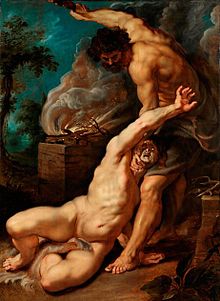
Cain_slaying_Abel,_1608-1609Fratricide is a running thread throughout Genesis. The rivalry portrayed in its stories do not involve romantic triangles as in novels and plays, but rather, the disputes are over blessings, the other running thread throughout Genesis.

In Creation God blesses humanity with all that God has created, but humanity rejects that blessing for the sake of one tree that then shrank to a barren landscape. To begin the process of re-gathering a scattered humanity after the Tower of Babel, God calls Abraham to leave his father’s house, i.e. the scattered, rivalrous civilization he was born in, and move to a land God will show him. When Abraham leaves the entanglements of mimetic rivalry behind, whole new vistas of possibilities suddenly present themselves.

God then tells Abraham:  “I will make of you a great nation, and I will bless you, and make your name great, so that you will be a blessing” and by him “all the families of the earth shall be blessed.” (Gen. 12: 1-3) We are so habituated to getting (or taking) blessings that we often fail to notice that God said Abraham would be a blessing and a blessing not just for him and his household but for all households. The intervening verse that God will curse those who curse Abraham is discordant. If God really is in the business of blessings, then God is not in the business of cursing. After all, Jesus did not curse those who cursed him and worse. However, we could say that when we curse someone who is a blessing, and through Abraham everybody is a blessing, then we are consumed by our own cursing.

We see all this already at play in the story of Cain and Abel who fight over a blessing and the supposed lack thereof. Genesis does not tell us why God accepted Abel’s sacrifice and not Cain’s. Girard’s theory of collective violence founding culture leads me to suggest that tilling the ground was a factor. There could have been mimetic rivalry among nomadic herders of sheep but tilling the ground like Cain was all the more conducive to rivalry over particular plots of land, such as Ahab’s coveting Naboth’s vineyard. The proliferation of vegetative dying and rising deities in mythology suggests that landed economy lead to mimetic crises and their resolution through collective violence. On the other hand, when we note the alleged zero sum blessings in the fratricidal strife that follows, maybe Cain jumped to the conclusion that when Abel was blessed, there could be no blessing for him.

What is decisive is that when Cain’s offering was rejected, or he thought it was, he embroiled himself with Abel, which was also to exile God. God called out to Cain, something God continues to do with violent humans to the end of time, but Cain would not let go of his preoccupation with his brother until he had killed him.

Afterwards, Abel’s blood cried from the ground. This is a marked contrast with the fratricidal myth of the founding of Rome where the blood of Remus was silent. Like Romulus, though, Cain was a founder of culture while Abel was the first prophet as defined by Jesus in Mt. 23:35, that is, a prophet is a victim. Abel’s blood seems to have cried for vengeance. The author of Hebrews, however, says that the blood of Jesus “speaks a better word than the blood of Abel.” More proof that God is in the business of blessing and not cursing.

I Me Me Mine

abyssEach of us knows what my own self is, right? Yeah, my self is right here, right inside of me, running my life. My self is who I am. What could be more obvious? “Everyone’s weaving it, coming on strong all the time!” Hmm. Who is doing the driving, who the weaving. “I-me-me-mine” is doing it according to George Harrison put it? So where is my self in all this?

If René Girard is right, then the human self is not in the midst of our desires, I-me-me-mine, where we tend to locate it. Rather, we derive our desires from the desires of other people and they from us. (See Mimetic Desire and Mimetic Rivalry) Well, we don’t want other people driving our desires or snatching ours away, so we fight back, insisting that I-me-me-mine is the one who wants whatever it is and others are copying I-me-me-mine. The problem is, the whatever-it-is falls away as a desire defining the self and the entire self of I-me-me-mine is embroiled with this rival. Some autonomy. So, I-me-me-mine will try refusing to desire what anybody else desires. This is resentment. Of course, resentment I-me-me-mine me into the enemy’s desire since opposition to a desire is as strong a driving motor as combat over the desire. (See Resentment)

This spiral of desire tilts I-me-me-mine to the abyss that shows this desiring self to be an illusion, a void. While reflecting on Chuang Tzu’s Taoist writings, Thomas Merton suggested that “it is the void that is our personality, and not our individuality that seems to be concrete and defined by present and past, etc.” This “not-I” is seen by Chuang Tzu and Thomas Merton as a source of freedom, but “we are completely enslaved by the illusory.” (Merton & the Tao)

In New Seeds of Contemplation Merton warns us that “every one of us is shadowed by an illusory person: a false self. This is the man I want myself to be who cannot exist, who cannot exist because God cannot know anything about him.” The false self a.k.a. I-me-me-mine, is constantly in rivalry with other false selves who have the same alias. “All through the night, all through the day, everyone’s saying it, flowing more freely than wine.” Like Merton, George Harrison warns us that an epidemic of desire threatens to flood the whole world.

We aren’t lost in this abyss of “not-I.” If we let go of the matrix of desires that I-me-me-mine clings to, than we find ourselves called by name. This calling voice asks us why we are persecuting him? Persecuting? We weren’t doing nuthin’. I-me-me-mine’s desire machine blinds us to what we are doing to other people, all of whom Christ identifies with.

When we answer with our names to the voice in the abyss, the self is still not-I, but that does not matter because the Persons of the Trinity are filling this void with their forgiving love that clarifies what all this forgiveness is about.

Well, Jesus did say something about dying in order to live.

Mimetic Desire and Truth (3)

Xenia1In my last post in this series, I noted the example of Polixenes in The Winter’s Tale who showed a reasonably accurate view of reality by praising the qualities of Hermione, but that the jealous rage of her husband Leontes distorted the reality deeply. It is the same distortion that happens in the nursery when children fight over one toy as if it were the only one when the reality is that there are many toys to play with. Mimetic rivalry over romantic partners will likewise distort the human reality in a school or other social setting. In a non-rivalrous situation, girls can imitate each other in finding various boys desirable and, like Polixenes, can admire the choices their friends make. But if two or more girls are in rivalry with each other, perhaps over something such as the position of captain on the girls’ field hockey team, then they will cease to see the qualities of the boys more or less for what they are. It is often said that love, especially infatuations, is blind, but conflicted mimetic desire is much more blind than that.

It is important to distinguish honest disagreement from rivalry. In both cases, there is mimetic desire but in the former case, it is a shared desire to arrive at truth or discernment of right action. In the latter case, the two people are trying to outdo each other for the sake of outdoing each other. The shared mimetic desire is a victory over the other and truth and right action fall by the wayside.

The movie “Doubt” is an excellent illustration of this kind of situation. With Father Flynn and Sister Aloysius are permanently locked in mimetic rivalry, it is not possible that the truth of whether or not the priest has abused Donald Miller, the Afro-American boy in the parish school, can be known and that is why the movie never resolves the question. Donald Miler, of course, is clearly a victim of this strife regardless of what has or has not really happened.

There is a qualitative difference between honest disagreement and rivalry but it is also a fine line between them.  We can easily start with honest disagreement and fall into rivalry if we allow ourselves to become more obsessed with the person we disagree with than with trying to see what is true and what should be done. This matter calls for constant self-examination where we continually ask ourselves as honestly as we can: What side of this line am I on? How far on that side am I? We also have to keep alert to whether we are actually listening to what the other is saying or if we are only thinking about what we want to say. If we neglect this self-examination, we are pretty certain to fall over into the wrong side of this divide and become lost in mimetic entanglements.

A shared mimetic desire for truth does not guarantee that truth will be reached since our viewpoints cannot encompass all relevant realty but it is a sine qua non for reaching some semblance of the truth. On the other hand, when we are locked in mimetic rivalry with others, it is not just some abstract principle of what is true that is a casualty, but real human beings will suffer as victims, like Donald Miller in “Doubt.”

Continue on to Mimetic Desire and Truth (4)

See Mimetic Desire and Truth Series

See Mimetic Desire and Mimetic Rivalry