
 The narratives of the call of Isaiah, Paul, and Simon Peter bring to mind my own experiences of God’s call. In my case, it wasn’t quite like being attacked by a Cherubim in church, getting knocked down on the Road to Damascus or being told to throw out the fishing nets one more time and being overwhelmed by the catch.
I did quite a lot of fishing as a child for the simple reason that my father loved it and my family spent most summer vacations at a fishing lodge. I lost interest in fishing by the time I was a teenager but the contemplative aspect of fishing stayed with me as I became a monk. While praying the Divine Office and praying silently in the Abbey Church, I constantly sense God calling me out of my self-preoccupations and self-indulgence to the wider concerns of God.
I had the call of Isaiah memorized when I was a choirboy because I sang an overwrought anthem to that text, ending with the prophet’s quiet volunteering to be sent by God. Even then, I had intimations that I might be called to the ministry although I was put off by how much kneeling I would have to do. Even so, one Sunday when our whole family was too sick to go to church, I led the four of us in the Office of Morning Prayer. As for kneeling, liturgical renewal dealt with that.
During my late high school and college years, I was a self-styled religious rebel who didn’t like the way God ran the universe. Like Paul, I was quite vocal about saying what I thought to anyone who would listen and to others who would rather not. By hindsight, I realize that I was being called all that time until I listened sufficiently to get on the track that led me to St. Gregory’s Abbey. By then I had come to realize that God doesn’t try to run the universe but God has pointed out ways we can run it better than we’re doing it if only we would listen.
It is tempting to think that one is special if one senses a call from God, as if God would surely call a superior person such as myself. But Isaiah, Paul, and Simon Peter all felt differently when approached by God. In each case, the call convicted them and pulled them out of the way they were living to a radical change of attitude and activity. In my case, I had to realize that a seminary I went to after graduating from college was the wrong choice for me, one fueled by my rebellious attitude. Only then could I hear the call to a seminary much better suited for me.
In God’s mission charge to Isaiah, God tells him to tell the people: “Keep listening, but do not comprehend; keep looking, but do not understand.” (Is. 6: 9) Jesus uses these same words to characterize the response he got from his own preaching. Some way to be “ catching people.” (Lk. 5: 10) There are many ways one can understand what it means to be a person of unclean lips living “among a people of unclean lips.” (Is. 6: 5) René Girard writes of the human tendency to share desires so intensely that they become rivalrous. When that happens, we may have ears but we will not hear what other people are saying and we will not hear what God is saying to us. In my case, I had cast myself so deeply into rivalry with God that I drowned out the direction of my call for many years. Since the most vulnerable people in a society bear the brunt of the rivalry of the powerful, deafness to the cries of the poor go unheard with only prophets like Isaiah to defend them.
Paul received his call from the resurrected Christ who asked Paul why he was persecuting him in the act of persecuting his people. John’s Gospel has a variant of the story of the overwhelming catch of fish placed after the Resurrection which raises the intriguing question of whether or not Luke placed a resurrection narrative in an early chapter of his narrative. In any case, after deserting Jesus, the disciples did need to be called a second time by the resurrected Christ. Jesus was raised from the dead because first he was killed in an act of collective violence, the sort of persecution Girard argues is the result of a society allowing itself to be swamped in rivalry where we have ears but fail to hear.
Since God’s call to each of us entails preaching the Word and, much more important, witnessing to it in our ways of living, we are fundamentally spreading our repentance to others to open their ears as well. The hazard is that a sense of rivalry can enter through the back door if we treat our ministry of witnessing as a contest in which we try to “defeat” the other and win a “victory.” What we need to do is listen to ourselves in God, and listen to others as God listens to them, and use our listening skills, based on repentance, to help other people learn to listen.
For an introduction to the thought of René Girard, see Violence and the Kingdom of God and Living Stones in the House of the Forgiving Victim.
 Jesus’ words about the lilies of the field (Mt. 6: 25–33) are among the most quoted of his teachings for their poetic beauty but among the most disregarded for their obvious inapplicability to human life as we know it. This teaching seems to be as inapplicable as Jesus’ invitation to the rich man to give away everything he had and follow him. (Mk. 10: 21) If it is impossible to give everything we have for the Kingdom of God, then it is just as impossible to trust God to feed us like the birds of the air and clothe us like the lilies of the field. However, in reference to the rich man, Jesus said that all things are possible with God, so let us, on this day of thanksgiving, reflect further on the birds of the air.
 The denunciations by prophets like Micah of the rulers “who abhor justice and pervert all equity” (Mic. 3:9) and Jesus’ denunciations of Pharisees in Matthew 23 tend to curl our mouths in a snide smile as we think about how much better we are than they. But while Jesus is still warming up for his fiery words to come, he slows down and says: “Call no one your father on earth, for you have one Father—the one in heaven. Nor are you to be called instructors, for you have one instructor, the Messiah.” (Mt. 23: 9–10) When Jesus goes on with words of woe for the scribes and Pharisees, we are apt to conveniently shove these words aside, but, I think we should linger over them a bit before enjoying the scolding of “other” people.
 Jesus’ famous words in John: “I am the way and the truth and the life” (Jn. 14: 6) have inspired many Christians, including me, but they tend to cause some consternation in an age where many seek to be inclusive and affirming of diversity. Now that René Girard has greatly increased our awareness of mimetic rivalry, the worry grows that we might understand a verse such as this as meaning “my god is better than your god.” Such a reading projects our own rivalry onto Jesus so as to make Jesus a rival against other “gods.” Which is to turn Jesus into an idol of our own making.
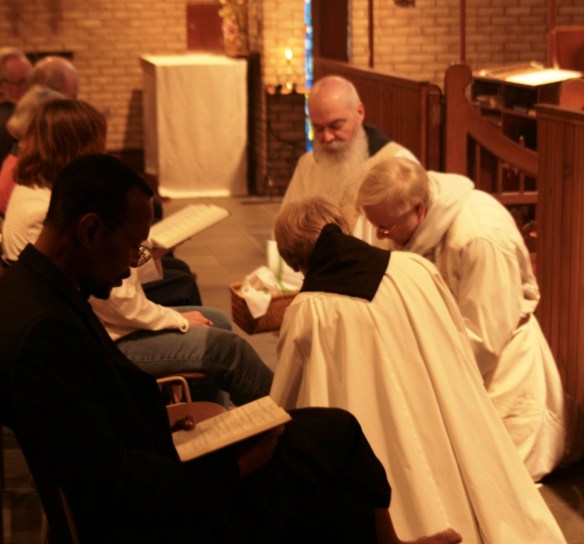 The first verses of today’s Gospel (Lk. 12: 32–34) pick up from where we left off last week. That reading ended with Jesus’ little parable about the rich fool who tore down his barns to build bigger barns (Lk. 12: 12–21) only to find that his life was being demanded of him. This reading begins with Jesus’ soothing admonition to “sell our possessions and give alms” and “make purses for yourselves that do not wear out, an unfailing treasure in heaven, where no thief comes near and no moth destroys.” (Lk. 12: 32-33) This is quite a contrast to two brothers fighting over an inheritance or a rich person gloating over fabulous amounts of wealth. Lest we think Jesus is asking us to make ourselves miserable, Jesus assures us that it is our heavenly Abba’s pleasure to give us a treasure that is the kingdom. If this treasure, the kingdom, is the Abba’s pleasure, then it is our pleasure as well.
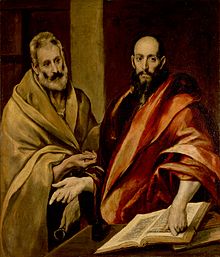 It is interesting and a bit ironic that we celebrate Saints Peter and Paul on the same day. Although there are famous icons of the two embracing one another in Christian love, the two seem not to have had an easy time getting along in real life. Although the two appeared to have been somewhat reconciled at the Council of Jerusalem in Acts 15, in his letter to the Galatians, Paul says that he opposed Peter “to his face” for backing down from what he thought they had agreed on. (Gal. 2: 11) The final chapters of John’s Gospel suggest tensions between the “Beloved Disciple” and Peter, and/or some tension between the two communities derived from them. The Beloved Disciple rests on Jesus’ breast at the Last Supper while Peter stubbornly tries to prevent Jesus from washing his feet. In her book Courting Betrayal,” Helen Orchard argues that Peter was resisting the slavish action of Jesus in washing his feet because he did not want to stoop so low himself. The episode of the Empty Tomb in John shows a rather awkward dance between the two where the Beloved Disciple gets there first but waits at the entrance and allows Peter to go in first. In this little tangle of a narration, both seem to have been first but not in the same way; which suggests some attempt to overcome the tension. In the final chapter of John, after the threefold question to Peter: “Do you love me?,” Peter points to the Beloved Disciple and asks” What about him?” Jesus answer basically tells us it is none of his business.


 Imaginary Visions of True Peace